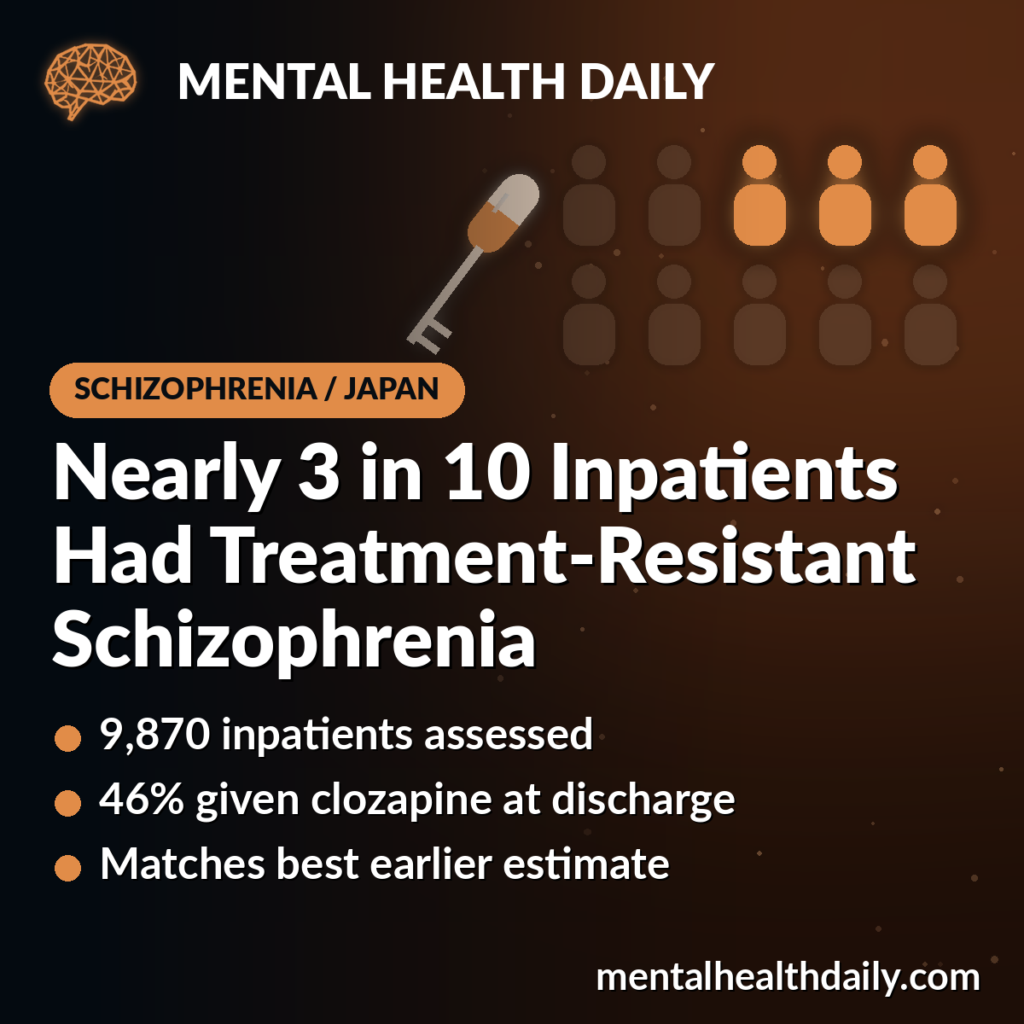
A 2026 nationwide study in Japan found that 28.6% of hospitalized patients with schizophrenia who were checked for treatment resistance met the criteria.1
Nearly half of those patients left the hospital on clozapine, the only antipsychotic with established benefit for this form of the illness.
Research Highlights
- Large real-world sample: records covered 18,914 inpatients discharged from 205 clozapine-licensed hospitals across Japan between 2016 and 2024.1
- Just over half were checked: psychiatrists formally assessed 9,870 patients (52.2%) for treatment resistance.1
- About 3 in 10 were treatment-resistant: 2,819 of the 9,870 assessed patients (28.6%) met Japan’s standardized criteria.1
- Clozapine reached 46.4%: 1,307 of the 2,819 treatment-resistant patients were prescribed clozapine at discharge.1
- Close match with earlier research: a 2023 meta-analysis put the rate at 28.4% when it kept only studies at low risk of bias.2
What Treatment-Resistant Schizophrenia Means
Schizophrenia is a psychiatric disorder that combines positive symptoms (such as hallucinations and delusions), negative symptoms (such as flat emotion and low motivation) and problems with thinking and memory. It affects about 0.4% of people worldwide, and antipsychotic medications are the main treatment.1
Treatment-resistant schizophrenia (TRS) describes patients whose symptoms stay severe despite antipsychotics. Most definitions require a poor response after at least 2 different antipsychotics given at adequate doses for long enough.1
Definitions differ by country. Japan’s official definition, set by the country’s Clozapine Appropriate Use Committee and printed in the clozapine package insert, counts either a poor response to other antipsychotics or poor tolerability of them.1
Clozapine is an older antipsychotic and the only one with established efficacy for TRS. In Japan, only hospitals that meet set accreditation requirements may prescribe it.1
How the Japanese Study Measured Treatment Resistance
Yusuke Arai et al. drew on EGUIDE (Effectiveness of Guidelines for Dissemination and Education in Psychiatric Treatment), a nationwide program that trains psychiatrists in Japan to follow treatment guidelines for schizophrenia and depression.1
- Patients: people with schizophrenia hospitalized for at least 4 days, then discharged between 2016 and 2024
- Hospitals: 205 EGUIDE-participating institutions, all licensed to prescribe clozapine
- Assessment: psychiatrists trained in the Japanese TRS criteria checked each patient’s medications and doses and recorded the result in the discharge summary
- Rate calculation: the TRS rate counted only patients who actually received this check
28.6% of Assessed Inpatients Had Treatment-Resistant Schizophrenia
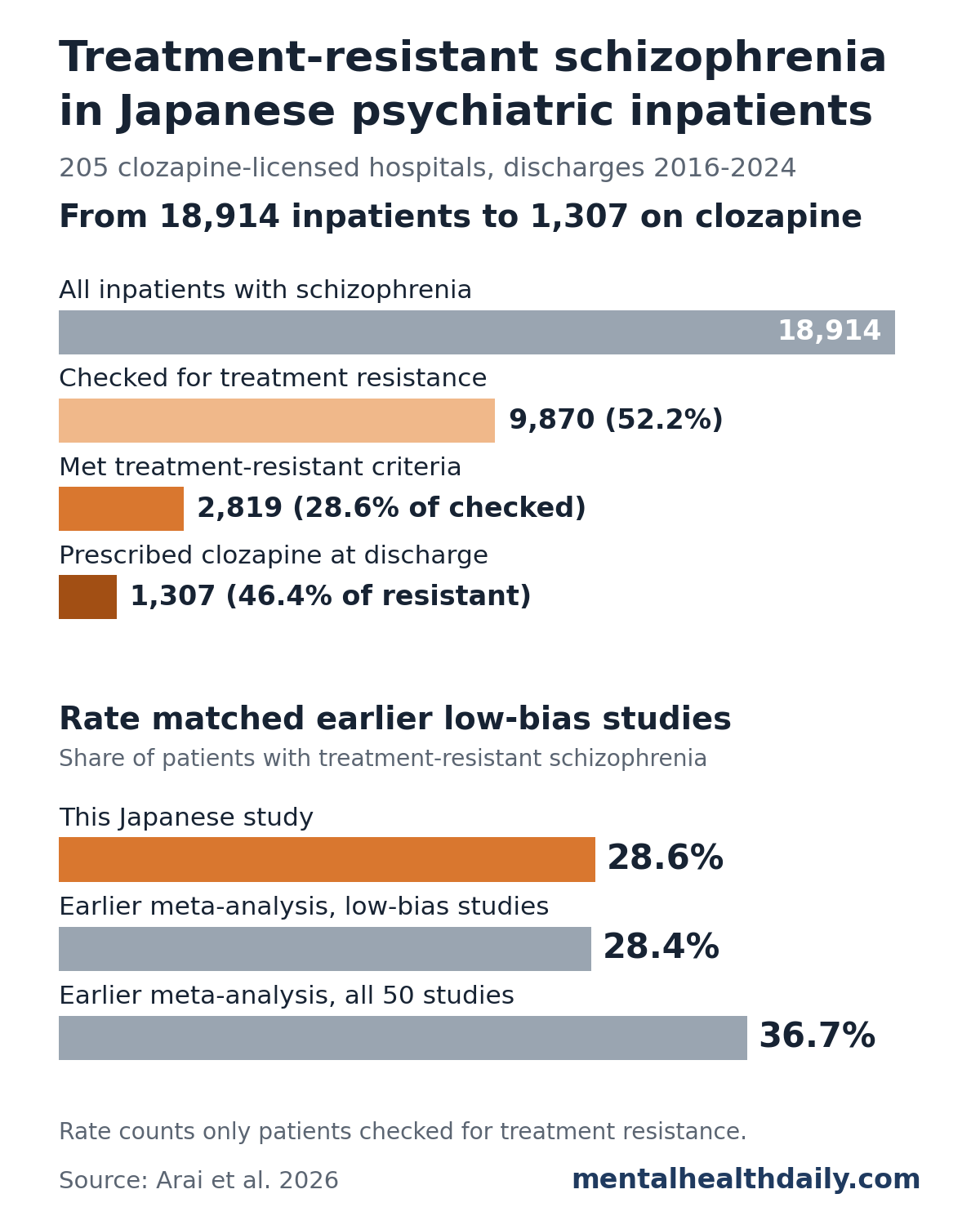
Of 18,914 inpatients with schizophrenia, 9,870 (52.2%) were formally assessed for treatment resistance. Among them, 2,819 (28.6%) met the Japanese criteria for TRS.1
The researchers called it the largest single study of TRS prevalence to date. The previous record holder was a Danish registry study of 8,044 patients, which found that 21% met a treatment-based definition of TRS over a median 9.1 years of follow-up.3
How the 28.6% Rate Compares With Earlier Estimates
A 2023 meta-analysis by Elton Diniz et al. pooled 50 studies covering 29,390 patients and estimated TRS prevalence at 36.7%. Individual studies ranged widely, from 15.4% to 75.6%.21
That spread mostly came down to who was studied. Rates were higher in studies with longer illness and in studies that recruited from long-term hospitals or clozapine clinics. When Diniz et al. kept only studies at lower risk of bias, the rate fell to 28.4%, almost the same as the Japanese result.2
Stage of illness also shifts the rate. A 2022 meta-analysis of 12 first-episode cohorts found that 22.8% of patients met TRS criteria, rising to 24.4% when only first-episode schizophrenia cohorts were counted.4 Inpatients in the Japanese study had a mean age of about 46, an older group than first-episode cohorts.
Clozapine Use Reached 46.4% in Treatment-Resistant Patients
Of the 2,819 patients with TRS, 1,307 (46.4%) were prescribed clozapine when they left the hospital.1
That rate is likely higher than in routine care. Clozapine use among patients with TRS stays below 25% in many clinical settings, the researchers noted, and Japan has reported lower use than other countries.1 A 17-country comparison of 2014 data found clozapine use was lowest in the Japanese cohort, at 0.6 per 100,000 people, compared with 189.2 per 100,000 in Finland.5
The researchers suggested 2 reasons for the higher rate here:
- Active screening. Earlier EGUIDE work found that hospitals that check more patients for TRS also prescribe more clozapine.
- Change over time. TRS checks and clozapine prescribing both rose at EGUIDE hospitals over the study years.1
Even at this level, more than half of patients who met the criteria left the hospital without clozapine. The report did not give reasons why clozapine was not prescribed.
Limits of This Inpatient Study
This was a cross-sectional analysis of discharge records, so it describes how often TRS was identified rather than following patients over time. Several features limit how widely the 28.6% figure applies:
- Inpatients only: everyone was hospitalized at a clozapine-licensed EGUIDE hospital, so the rate may not apply to outpatients or to all of Japan.
- Only half were checked: 47.8% of patients had no TRS assessment. University and private hospital patients were more likely to be checked, and public hospital patients less likely, so the assessed group was not a random sample.
- Trained psychiatrists: EGUIDE participants received guideline training, which likely raised both TRS checks and clozapine use above routine practice.
- Broader definition: Japan’s criteria include intolerance to other antipsychotics, which not every international definition includes.
- Short report: the paper gives no confidence interval for the rate and no breakdown by age, sex, year or reason for not prescribing clozapine.
What the Findings Mean for Schizophrenia Care
About 3 in 10 assessed inpatients with schizophrenia met the criteria for treatment resistance, which fits the best earlier estimates. For hospitals, routine checks for TRS are a practical way to find patients who could be candidates for clozapine.
For patients and families, repeated hospital stays despite trying 2 or more antipsychotics are a reason to ask the treating psychiatrist whether TRS has been assessed and whether clozapine is an option.
References
- Arai Y, Horinouchi T, Muraoka H, et al. Prevalence of treatment-resistant schizophrenia: a nationwide multicenter study. Neuropsychopharmacology Reports. 2026;46:e70163. doi:10.1002/npr2.70163
- Diniz E, Fonseca L, Rocha D, et al. Treatment resistance in schizophrenia: a meta-analysis of prevalence and correlates. Brazilian Journal of Psychiatry. 2023;45(5):448–458. doi:10.47626/1516-4446-2023-3126
- Wimberley T, Støvring H, Sørensen HJ, et al. Predictors of treatment resistance in patients with schizophrenia: a population-based cohort study. Lancet Psychiatry. 2016;3(4):358–366. doi:10.1016/S2215-0366(15)00575-1
- Siskind D, Orr S, Sinha S, et al. Rates of treatment-resistant schizophrenia from first-episode cohorts: systematic review and meta-analysis. British Journal of Psychiatry. 2022;220(3):115–120. doi:10.1192/bjp.2021.61
- Bachmann CJ, Aagaard L, Bernardo M, et al. International trends in clozapine use: a study in 17 countries. Acta Psychiatrica Scandinavica. 2017;136(1):37–51. doi:10.1111/acps.12742