An 8-week virtual reality game program improved teacher ratings of how well children with ADHD were managing school, compared with children on a waiting list.
A randomized trial in Turkey tested the program in 92 children aged 7 to 12.1
Research Highlights
- Scores rose with VR: the teacher-rated school participation total climbed from 136.6 to 150.0 after 16 sessions of a VR job-simulator game.1
- Waiting list slipped: children who got no added therapy went from 134.9 to 132.2, a small drop that was not statistically significant.1
- Large gap after 8 weeks: the VR group scored higher on the total and on all 4 areas teachers rated (Cohen’s d = 0.88 to 1.17, all p < 0.001).1
- Blinded raters, no dropouts: teachers did not know which group a child was in, and all 92 children were analyzed.1
- Key limit: the comparison group got nothing extra, so the trial cannot say whether VR itself, or simply 16 supervised sessions of an engaging activity, drove the gain.
How a VR Job-Simulator Game Was Tested in Kids With ADHD
Attention-deficit/hyperactivity disorder (ADHD) is a neurodevelopmental condition marked by inattention, impulsivity and hyperactivity. At school, it often shows up as trouble following routines, finishing work and getting along with classmates.
Immersive virtual reality (VR) uses a headset to place a child inside a 3-dimensional world they can move around in and interact with. A research team in Turkey and Canada, led by occupational therapist Barkın Köse, used a commercial game called Job Simulator on an Oculus Quest 2 headset.1
In the game, children work 4 jobs in a robot-run “job museum”:
- Office worker: 13 tasks, from eating breakfast to handling phone calls
- Gourmet chef: from frying eggs and bacon up to 17 multistep cooking missions
- Store clerk: 16 tasks serving customers and preparing food
- Auto mechanic: picking the right parts and repairing cars
Tasks get harder as the game goes on. The idea is that steady practice at executive functions (the mental skills used to plan, stay on task and hold back impulses) could carry over into how a child copes with classroom demands. Each session started with a short explanation of the rules, and then the child played without prompting.1
Study Snapshot
- Children: 92 kids aged 7 to 12 with ADHD diagnosed by a child psychiatrist, in mainstream primary schools and seen at a university pediatric occupational therapy unit
- VR group (46 children): 45-minute sessions twice a week for 8 weeks, in a padded, furniture-free therapy room
- Waiting-list group (46 children): no additional therapy during the 8 weeks; 17 who were interested were offered the VR program after the trial
- Medication: about 1 in 3 children in each group were taking medication
- Excluded: children with other neurodevelopmental conditions such as autism, children in other therapies during the study, and children with a VR headset at home
Teacher Ratings of School Participation Rose in the VR Group
The outcome was the School Participation Questionnaire (SPQ), a 44-item form that teachers fill out about a child’s past 2 weeks. Scores run from 44 to 176, and higher is better.
The SPQ does not count how often a child joins in. It rates the things that make joining in possible, in 4 areas:
- Doing: skills, persistence and making choices in school tasks
- Being: the child’s sense of self in the student role
- Symptoms: energy, fatigue, sleep, pain, mood and anxiety as seen at school
- Environment: how well the child uses the school’s spaces, materials, routines and relationships with peers and teachers
Teachers in public primary schools completed the form before and after the 8 weeks, without knowing which group each child was in. The 2 groups had similar scores at the start.1
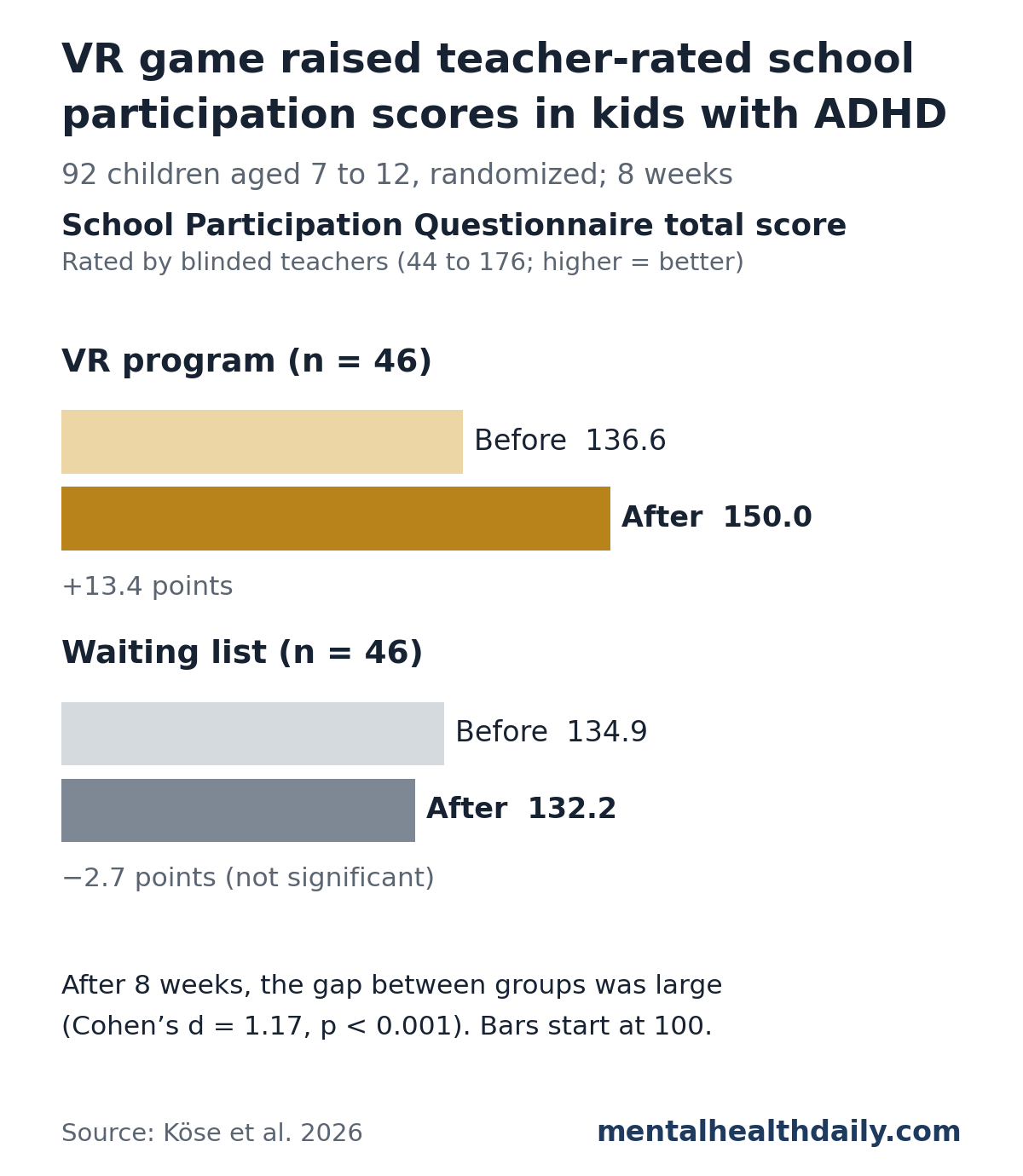
VR group: scores improved in all 4 areas. The total rose from 136.6 to 150.0, a large within-group change (Cohen’s d = 0.98). Cohen’s d expresses a difference in standard-deviation units; about 0.8 or above is usually called large.1
Waiting-list group: the total dipped from 134.9 to 132.2, which was not statistically significant. The environment, being and symptoms scores did fall significantly. The researchers suggested that rising demands and fatigue as the school term went on could explain the drop.1
After 8 weeks, the VR group scored higher than the waiting-list group on every measure:
- Total score: d = 1.17
- Symptoms: d = 1.03
- Being: d = 0.98
- Environment: d = 0.97
- Doing: d = 0.88
Part of that gap comes from the waiting-list group slipping, not only from the VR group improving. The environment score rose even though nothing about the schools changed, which the researchers read as children making better use of what their classrooms already offered.1
Children With ADHD Take Part Less in School Activities
School participation is a real gap for kids with ADHD. A 2025 study involving 365 children in Turkey, 175 of them with ADHD, found that children with ADHD took part less often in 5 kinds of school activities and were less involved when they did, with moderate to large differences.2
Caregiver reports in that study also showed that the school environment itself made participation harder for children with ADHD. Classroom work, socializing with peers outside class, cognitive demands, sensory features and safety were the main trouble spots.2
Earlier VR Research for ADHD Focused on Attention
Most VR studies in ADHD have measured attention and thinking skills outside the classroom, not school life. A 2021 meta-analysis of 4 studies with 125 children found that VR interventions improved sustained attention, with more correct responses and fewer missed targets, but not impulsivity. The evidence was rated low for correct responses and missed targets and moderate for the other outcomes.3
An active comparison matters. A 2024 trial randomized 90 children with ADHD to VR social skills training, traditional social skills training or a waitlist. Both training groups improved on psychologist-rated social skills and parent-rated self-control compared with their starting scores, a reminder that a non-VR version of the same training can produce gains too.4
The 2026 trial adds a school-based outcome to this picture: blinded teachers saw a difference in the classroom after a VR program delivered in a clinic.1
Limits of This VR Trial for ADHD
Random assignment, blinded teacher ratings and no dropouts make this a stronger test than an uncontrolled pilot. Several limits still bear on what it shows:
- No active control. The comparison group got no extra activity, so the gains could reflect adult attention, routine or the fun of any game rather than VR specifically.
- One outcome, one rater. Everything rests on a teacher questionnaire about the building blocks of participation. The trial did not measure attendance, how often children joined activities, grades or executive function tests.
- Short and single-site. Results cover 8 weeks at 1 university clinic, with the program delivered by the lead author. There was no follow-up after the 8 weeks.
- Simple statistics. Groups were compared on their final scores without confidence intervals or adjustment for starting scores, and the paper reports no trial registration or sample-size calculation.
- Practical hiccups. Headsets occasionally overheated, 2 sessions ended in shutdowns, and a few children had brief motion sickness.
What the VR Trial Means for Families of Kids With ADHD
- A promising add-on, not a replacement. The program was a structured, supervised addition to care in a therapy setting. It was not tested against or instead of medication, behavioral therapy or school supports.
- Home gaming is a different thing. Children played set scenarios in a fixed order, with a therapist present and timed sessions. The trial says nothing about unsupervised headset use at home.
- Better comparisons needed. A future trial could compare VR with an equally engaging non-VR activity and measure what children actually do at school over a full year.
References
- Köse B, Güler EC, Güney Yılmaz G, Tanrıverdi M, Anaby D. Exploring immersive virtual reality as an approach to improve school participation–related constructs in children with ADHD. Child: Care, Health and Development. 2026;52:e70328. doi:10.1111/cch.70328
- Kara K, Kaya Kara O, Kose B, et al. School participation, supports and barriers of children with and without attention deficit hyperactivity disorder. BMJ Paediatrics Open. 2025;9(1):e002917. doi:10.1136/bmjpo-2024-002917
- Romero-Ayuso D, Toledano-González A, Rodríguez-Martínez MDC, et al. Effectiveness of virtual reality-based interventions for children and adolescents with ADHD: a systematic review and meta-analysis. Children (Basel). 2021;8(2):70. doi:10.3390/children8020070
- Wong KP, Zhang B, Lai CYY, et al. Empowering social growth through virtual reality–based intervention for children with attention-deficit/hyperactivity disorder: 3-arm randomized controlled trial. JMIR Serious Games. 2024;12:e58963. doi:10.2196/58963