Among people prescribed ADHD medication in 5 health systems, recorded self-harm was most common in the 3 months before their first prescription, not after it.1
Risk fell once treatment began but stayed a little above each person’s unmedicated baseline.
Research Highlights
- Highest risk before the first prescription: in the 90 days before starting ADHD medication, the self-harm rate was 2.58 times each person’s unmedicated rate (95% CI 2.12 to 3.13).1
- Lower after starting: the rate ratio was 1.78 in the first 90 days on medication and 1.27 during later treatment (95% CI 1.01 to 1.60).1
- No clear overall increase: comparing all medicated time with all unmedicated time gave a rate ratio of 1.20 (95% CI 0.96 to 1.49), which was not statistically significant.1
- Same pattern everywhere: Hong Kong, New Zealand, South Korea, Taiwan and the UK each showed the peak before treatment, and stimulants and nonstimulants followed the same shape.1
- Large sample: 461,024 people prescribed ADHD medication from 2001 to 2020, of whom 6,847 had a first recorded self-harm event.1
If you or someone you know is struggling: in the US, call or text 988 to reach the 988 Suicide & Crisis Lifeline, available 24/7. Outside the US, contact local emergency services or a local crisis line.
Why ADHD Medication and Self-Harm Has Been a Worry
Attention-deficit/hyperactivity disorder (ADHD) is a common neurodevelopmental condition marked by ongoing inattention, hyperactivity and impulsivity. People with ADHD have a higher risk of suicidal behavior than people without it, which makes the safety of ADHD treatment an important question.
ADHD medicines fall into 2 main groups:
- Stimulants, such as methylphenidate and amphetamine-type drugs, which increase dopamine and norepinephrine signaling in brain circuits that support attention and self-control.
- Nonstimulants, such as atomoxetine, guanfacine and clonidine, which work mainly through norepinephrine signaling and are not stimulant drugs.
Earlier studies disagreed. Some found more self-harm shortly after people started medication; others found less self-harm during treatment. In the US, atomoxetine carries a Food and Drug Administration (FDA) boxed warning about suicidal thinking in children and teens.1
Randomized trials are too small and too short to measure a rare outcome like self-harm well, so the question has mostly been studied with health records.
How a Self-Controlled Case Series Compares Each Person With Themselves
Adrienne Chan et al. used a self-controlled case series. Instead of comparing people who took ADHD medication with people who did not, this design looks only at people who had the outcome (here, self-harm) and compares different stretches of time in each person’s own life.1
Each person’s follow-up time was sorted into 4 periods:
- Unmedicated time (the baseline), before and after any medication use.
- The 90 days before the first ADHD medication prescription.
- The first 90 days of medication use.
- Later medication use, including restarts after breaks.
The researchers then asked how much more often self-harm happened in each period than in that same person’s unmedicated time. The answer is an incidence rate ratio: 1.0 means no difference, and 2.0 means self-harm happened twice as often.
What this design handles well: anything about a person that stays the same over time cancels out, because they are compared only with themselves. Genes, overall ADHD severity, family income and many other fixed differences cannot explain the results.
What it cannot handle: anything that changes around the time treatment starts. Symptoms getting worse, a new depression or anxiety diagnosis, stressful events, or a family seeking help can all cluster just before a first prescription. The researchers adjusted for age, season and use of other psychiatric medicines, but not for these.1
Self-Harm Peaked in the 90 Days Before ADHD Medication Started
Data came from health records in 5 places: Hong Kong, New Zealand, South Korea, Taiwan and the UK. Each site ran the same analysis code locally, and the results were pooled.1
- Who: people aged 6 and older with at least 1 ADHD medication prescription between 2001 and 2020.
- Outcome: the first self-harm event recorded in medical records, meaning intentional self-poisoning or self-injury whatever the intent. Deaths by suicide were not the outcome.
- Analyzed: 6,847 people who had both an ADHD prescription and a recorded self-harm event.
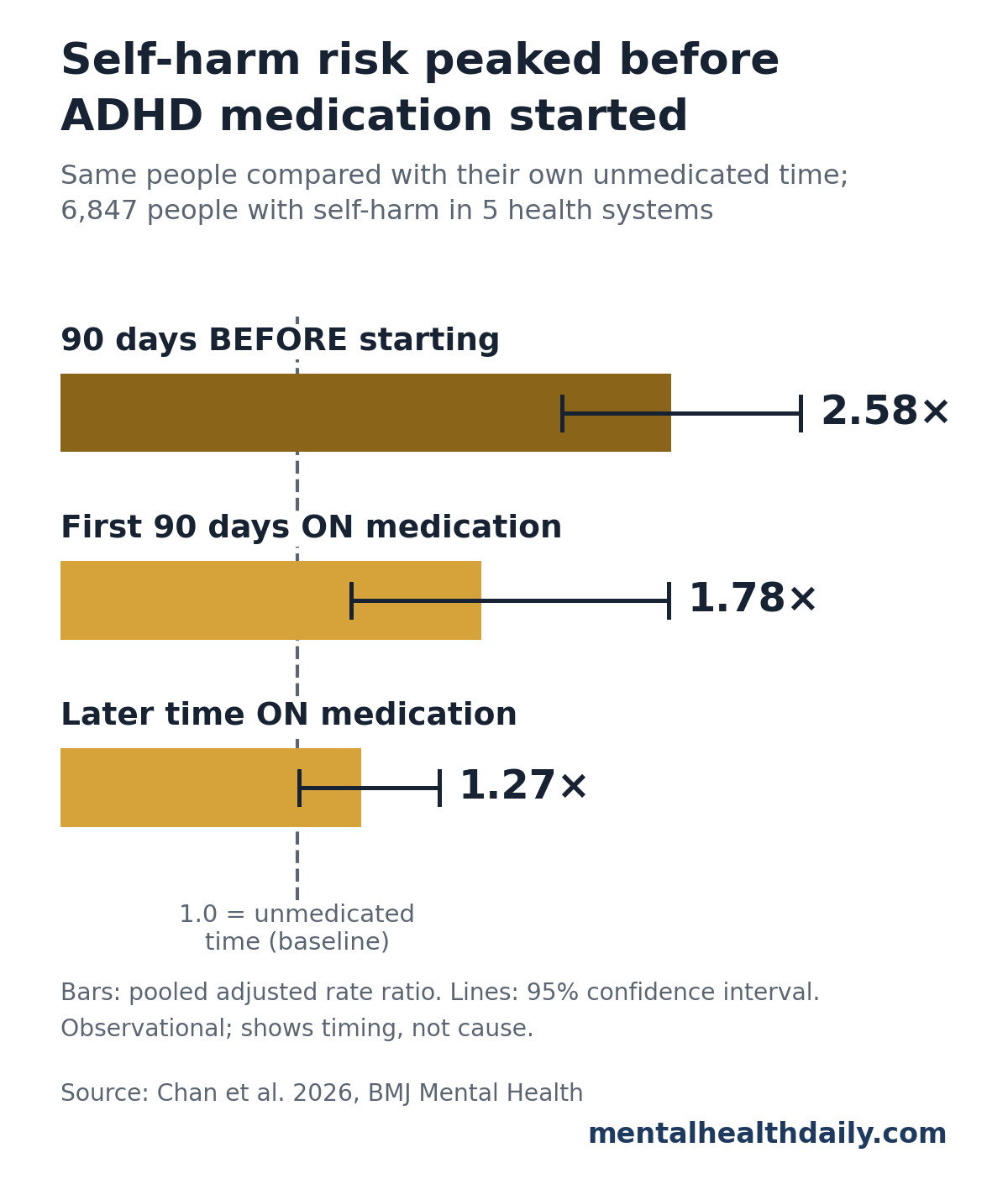
Pooled across all 5 sites, the self-harm rate compared with unmedicated time was:1
- 90 days before starting: 2.58 times higher (95% CI 2.12 to 3.13)
- First 90 days on medication: 1.78 times higher (95% CI 1.23 to 2.57)
- Later medication use: 1.27 times higher (95% CI 1.01 to 1.60)
Unadjusted rates in this group of people who all self-harmed at some point tell the same story: about 11 to 29 recorded events per 100 person-years in the pre-treatment window across sites, compared with 5 to 7 during unmedicated time.1
Every site showed its highest rate ratio in the 90 days before treatment, from 2.07 in the UK to 4.10 in Hong Kong. A follow-up analysis in 3 sites, which let the data draw a smooth curve instead of fixed 90-day blocks, found risk starting to climb at least 100 days before the first prescription and falling afterward.1
Stimulants and Nonstimulants Showed the Same Pattern
Looking at each drug group separately gave similar results:1
- Stimulants: 2.74 before starting, 1.92 in the first 90 days, 1.23 later (95% CI 0.99 to 1.52).
- Nonstimulants: 2.87 before starting, 1.66 in the first 90 days (95% CI 0.79 to 3.49), 1.13 later (95% CI 0.87 to 1.47).
Analyses by sex and 7 sensitivity analyses, including one restricted to people with a formal ADHD diagnosis, also gave consistent patterns.1
What the Timing Suggests About ADHD Medication and Self-Harm
If ADHD medication itself drove self-harm, rates should rise after the first dose. Instead, the peak came before anyone had taken the drug. The researchers concluded that their results do not support ADHD medication as the main driver of self-harm in this group.1
More likely, the months before a first prescription are a hard stretch: symptoms worsening, new mental health problems emerging, stress building, and people seeking help. That crisis is often what leads to an assessment and a prescription.
The study does not show that medication lowered self-harm on its own. Starting treatment usually comes with a clinical assessment, counseling, closer follow-up and care for other conditions, and any of these could account for part of the drop.
Risk did not return fully to baseline. During later treatment, the rate was still 27% above unmedicated time, and the lower end of the confidence interval sat just above 1. The researchers suggest that people on medication are seen by clinicians more often, so more events may get recorded, but this study cannot sort out why.1 Sites also differed: later-treatment rate ratios ranged from 0.87 in Taiwan to 2.22 in South Korea.
Clinical implication: the researchers call for close follow-up around the start of ADHD treatment, with families and patients watching for changes in mood, behavior and self-harm thoughts, rather than delaying treatment over safety fears.1
Earlier Within-Person Studies Found a Similar Pattern
- Hong Kong, methylphenidate: a 2017 self-controlled case series by the same research group, involving 154 young people with a first recorded suicide attempt, found the rate was 6.55 times higher in the 90 days before methylphenidate started. It stayed elevated in the first 90 days, then returned to baseline during ongoing treatment.2
- Sweden, all ADHD drugs: a 2014 national register study of nearly 38,000 people with ADHD compared each person’s medicated and unmedicated periods and found no evidence that ADHD medication raised suicidal behavior. The results pointed toward a possible protective effect, especially for stimulants.3
The new study extends that work across 5 health systems with a shared analysis plan, which reduces the chance that one country’s coding or prescribing habits explain the result.
Limits of This Self-Controlled ADHD Medication Study
- Observational data: the timing argues against medication as the cause of the pre-treatment peak, but changes that happen around treatment start were not fully measured.
- Recorded self-harm only: events that never reached a doctor or were not coded were missed, and some minor events were included. Suicide deaths were not studied.
- Prescriptions, not pills taken: people who did not take their medication, or took breaks, would be counted as exposed.
- Different health systems: people in South Korea and Taiwan had far more recorded depression, anxiety and other psychiatric medication use than those elsewhere, and some subgroups were small.
- Only people who self-harmed: the design cannot give an individual’s absolute risk of self-harm after starting ADHD medication.
Decisions about starting, stopping or changing ADHD medication belong with a prescribing clinician who knows the person’s full history.
References
- Chan AYL, Beyene K, Park S, et al. ADHD medication use and risk of self-harm: a multinational self-controlled case series study. BMJ Mental Health. 2026;29:1–9. doi:10.1136/bmjment-2026-302819
- Man KKC, Coghill D, Chan EW, et al. Association of risk of suicide attempts with methylphenidate treatment. JAMA Psychiatry. 2017;74(10):1048–1055. doi:10.1001/jamapsychiatry.2017.2183
- Chen Q, Sjölander A, Runeson B, et al. Drug treatment for attention-deficit/hyperactivity disorder and suicidal behaviour: register based study. BMJ. 2014;348:g3769. doi:10.1136/bmj.g3769