
Peer support workers and people diagnosed with schizophrenia want a real say in how mental health research is chosen and run, according to a 2026 German interview study. They valued medication and brain research, but no more than research on therapy, relationships and everyday care.1
Research Highlights
- 26 interviews, 21 voices on research: researchers interviewed 13 experts by experience (12 peer support workers and 1 researcher with lived experience) and 13 inpatients with schizophrenia or schizoaffective disorder. Of these, 12 experts and 9 patients talked about research.1
- Biology and psychosocial research valued together: participants wanted better medications, and 5 asked for more research on side effects, but they did not see brain research as more important than therapy or social research.1
- Progress felt real but slow: participants described psychiatry as more humane than decades ago, with lower doses, less sedation and fewer restraints, yet felt change, and the use of research on wards, was too slow.1
- A strong call for involvement: experts wanted people with lived experience involved at every stage, from choosing questions to sharing results, and criticized token gestures such as a small free-text box on a questionnaire.1
- Consistent with earlier research: top psychiatry journals have shifted toward genetic and animal studies, while patients and clinicians tend to prioritize non-drug treatments.2,3
How the German Schizophrenia Research Interviews Worked
Paul Nickel and Moritz Wigand at Ulm University ran 26 one-on-one interviews between October 2021 and February 2022. The study was published in Research Involvement and Engagement.1
They recruited 2 groups:
- Experts by experience (13): 12 peer support workers (people who use their own experience of mental illness and treatment to support others, often on psychiatric wards) and 1 researcher with lived experience. They were recruited across Germany by word of mouth.
- Patients (13): adults with schizophrenia or schizoaffective disorder, recruited one after another from open wards of a psychiatric hospital in southern Germany.
Among the experts, 5 had been diagnosed with schizophrenia and 3 with schizoaffective disorder. The others had diagnoses such as depression or bipolar disorder and worked closely with people with psychosis. Experts averaged about 53 years old and patients about 43.1
Interviews were semistructured: a guide covered fixed topics, but people could answer in their own words and take the conversation where they wanted. Research was 1 of 18 themes covered.
Participants were asked what came to mind when they thought of psychiatric studies, how studies should be run and what they would research with their own institute.1
The researchers sorted the transcripts using qualitative content analysis, a method that codes what people said into categories and subcategories. Expert interviews ran longer (71 minutes on average vs. 43 minutes for patients) and were more detailed, so most of the analysis rests on the experts, with patient views added where they agreed or differed.1
Medication and Psychosocial Research Were Valued Equally
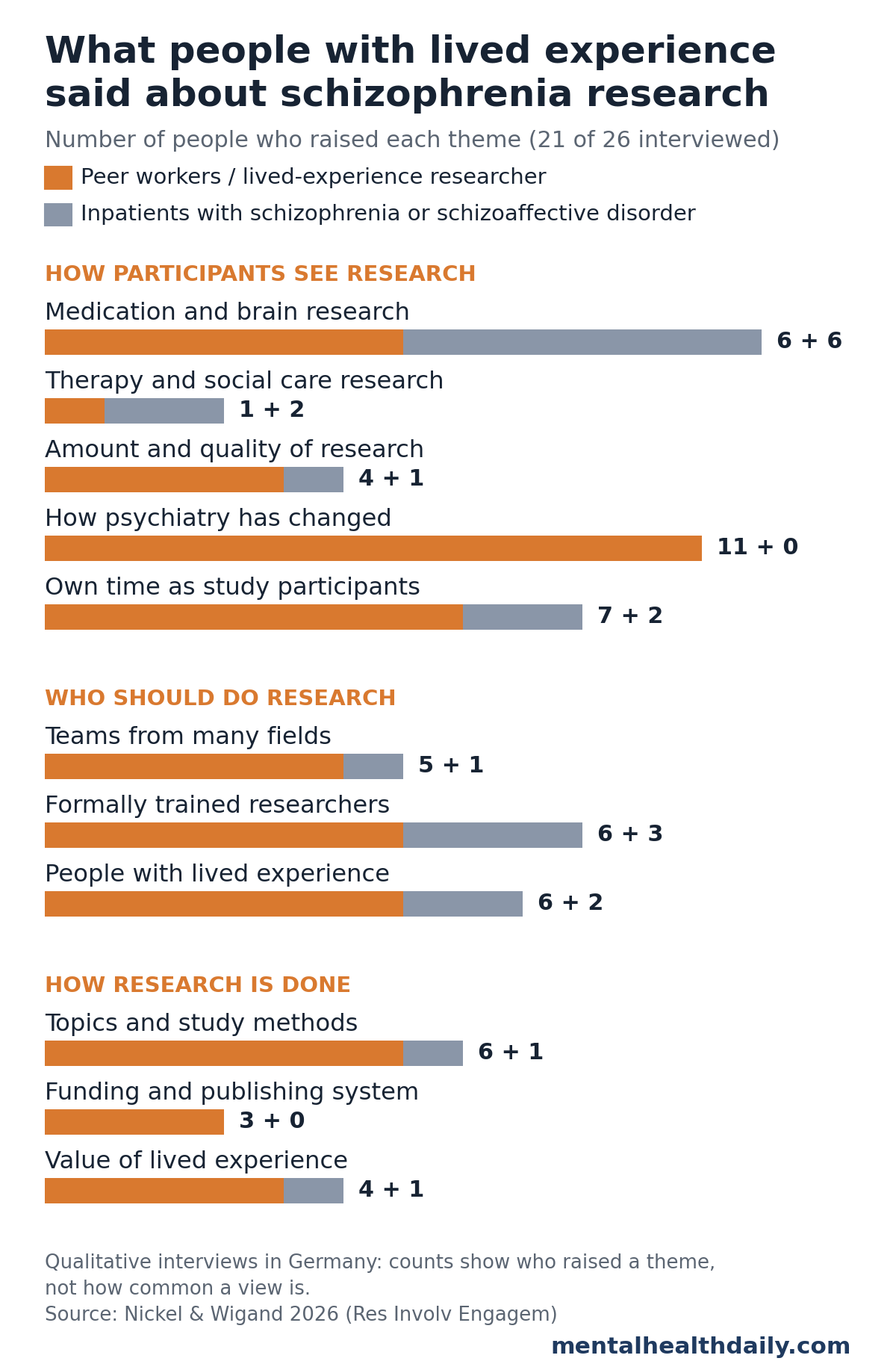
Few participants spontaneously brought up basic brain science. Medication came up far more: almost half the participants talked about it, and most of those asked directly described troublesome side effects.1
Patients were often hopeful about drugs. One said “drug development is incredibly important.” Another hoped “that maybe you can improve something with tablets, or that you can improve the way you interact with people,” a view in which biology and social care work together.1
Some experts pushed back on brain research as the main answer. A peer worker who had briefly done doctoral work in brain research called the idea that biology alone will reveal “the ultimate truth” almost “a bit arrogant.”1
What progress looked like to them: most participants said psychiatry had become more humane. They pointed to lower medication doses, less sedation, fewer restraints, more patient autonomy and better relationships with staff.1
What still frustrated them:
- Slow change: “Things have definitely changed, but everything is moving way too slowly,” one expert said.
- Results not reaching the ward: 2 experts questioned whether the real problem was a lack of research or a failure to use it. “Research is only interesting if it doesn’t exist in isolation, but if it’s applied in practice.”
- Too little money: some felt too little money goes to mental health research.
Who Should Do Schizophrenia Research?
Asked directly who should be involved, participants wanted “multiperspective” teams. One expert argued that philosophy and sociology belong alongside psychiatry and psychology, because questions about ethics and social values always come up.1
Training vs. lived experience. Several participants first said research needs people with formal scientific training. “Nobody can work as a bar manager or kitchen manager who is not a kitchen manager,” one patient put it.1
Some experts then revised that view. One said “it can be anybody, it can be a peer support worker; I’ve been on a [research] trial before.” One participant who first stressed formal training had already done research as a peer worker. The researchers suggest that long-standing hierarchies in psychiatry can lead people to undervalue their own contributions.1
Involving people who have been patients. This was a strong theme. One patient saw “a great opportunity if patients were trained to participate in research.” A peer worker said simply: “Persons being researched should have their say. By all means.”1
Researchers who already have lived experience. The researcher with lived experience made a pointed argument: given how common mental illness is, any large research group already includes people with their own psychiatric history. Few disclose it for fear of harming their careers, so institutions bring in outside peer researchers instead.1
Another expert warned against treating patients as saints: “We’re not better people just because we have experience of psychiatry, but we really do have a different perspective, and I don’t think mental health research is possible without including this view.”1
Complaints About How Studies Treat Participants
Participants generally supported research, but many were unhappy with the topics chosen and how studies were run. Their main criticisms:1
- Being studied without being heard. One peer worker felt researched “an incredible amount,” with questions that were “wrong” and would not improve care. “Sometimes I thought, what right do you have to ask me that? I’m not an alien.”
- Token input. One expert described “pseudo-surveys” that add a small free-text box so clients feel asked, then leave the answers out of the analysis for lack of capacity.
- Outcomes decided in advance. One expert felt studies were set up so “something specific is supposed to come out of it.” The same expert said a report on a project they had taken part in claimed things that did not happen, such as regular group meetings.
- Short-lived projects. One expert described a project that ended when its 3-year funding ran out, even though it filled a gap in care.
- A publishing system that favors certain studies. The lived-experience researcher called the patient-clinician relationship the most important factor in care. It gets little research attention, they argued, because it is hard to test in a randomized controlled trial (RCT; a study that assigns people to treatments by chance) and rarely leads to high-ranking publications.
At the same time, participants did not reject basic science. “Basic research is also very important and is needed,” one expert said, while still wanting people with lived experience to help name what needs studying.1
Other Studies Find the Same Gap Between Research and Patient Priorities
Journal trends. Wigand et al. analyzed the titles and abstracts of papers in 10 top-ranked psychiatry journals in 1999, 2009 and 2019. Neurobiological research, especially genetic and animal studies, grew in importance after 1999, while social and psychological themes stayed underrepresented across all 3 years.2
Priorities vs. registered trials. Crowe et al. compared treatment priorities set jointly by patients and clinicians in James Lind Alliance partnerships with trials registered from 2003 to 2012.
Drugs, vaccines and biologicals made up 18% of the interventions patients and clinicians prioritized but 86% of those in commercial trials. Non-drug approaches such as education, psychological therapy, exercise and service changes made up 59% of priorities but only 3% of commercial trial interventions.3
What people with lived experience want from involvement. An Australian analysis of 3 research agenda-setting studies from 2013 to 2022 found that people with lived experience saw their experience as a critical ingredient of mental health research, one that should help set research agendas rather than only supply study participants.4
Why schizophrenia stands out. German population surveys over 30 years found that stigma toward people with schizophrenia increased, with more fear and desire for social distance, while stigma toward depression eased slightly.5 Nickel and Wigand cite this as one reason research that matches patients’ needs is especially pressing for schizophrenia.1
Limitations of This Schizophrenia Interview Study
Qualitative studies are designed to find out what issues matter to people and why, not how common a view is. The counts in the chart show who raised a theme in an open conversation.
- Small, German sample: 26 people, so the findings may not carry over to other countries or care systems.
- 1 hospital for patients: inpatients came from a single hospital and were likely more severely ill than people treated as outpatients.
- Word-of-mouth recruitment for experts: the experts were reached through 4 initial contacts, which can produce a group with similar views.
- Analysis weighted toward experts: patients gave shorter answers on this abstract topic, so the conclusions mostly reflect peer workers, not all of whom had a schizophrenia diagnosis.
- Limited involvement in the study itself: only 1 lived-experience researcher reviewed the interview guide, which the researchers acknowledge.
What Better Patient Involvement in Research Would Look Like
Nickel and Wigand drew 3 recommendations from the interviews:1
- Shared priority setting: people with lived experience help decide which questions get studied.
- Lived experience on research teams: people with lived experience included as full team members across the research process.
- Openness about researchers’ own experience: a culture where scientists can be open about their own psychiatric history.
They also called for treating study participants with more respect and taking their input seriously, especially in qualitative studies. In Germany, they note, participatory research is still emerging.1
For people living with schizophrenia and their families, the study shows that peers and patients have clear, practical ideas about what research should study and how it should treat participants.
Asking whether a study involved people with lived experience in its design is a fair question when deciding whether to take part.
References
- Nickel P, Wigand M. Views on mental health research in the context of schizophrenia: perspectives of peer support workers and researchers with lived experience – a qualitative study. Research Involvement and Engagement. 2026;12:151. doi:10.1186/s40900-026-00975-5
- Wigand ME, Wiegand HF, Scherp A, Becker T. To whose good? Directions and gaps in psychiatric research. International Journal of Social Psychiatry. 2021;67(8):1061–1067. doi:10.1177/00207640211008480
- Crowe S, Fenton M, Hall M, Cowan K, Chalmers I. Patients’, clinicians’ and the research communities’ priorities for treatment research: there is an important mismatch. Research Involvement and Engagement. 2015;1:2. doi:10.1186/s40900-015-0003-x
- Dray J, Palmer VJ, Banfield M. ‘Keeping it real’: A qualitative exploration of preferences of people with lived experience for participation and active involvement in mental health research in Australia. Health Expectations. 2024;27(1):e13934. doi:10.1111/hex.13934
- Schomerus G, Schindler S, Sander C, Baumann E, Angermeyer MC. Changes in mental illness stigma over 30 years – Improvement, persistence, or deterioration? European Psychiatry. 2022;65(1):e78. doi:10.1192/j.eurpsy.2022.2337