Expectant fathers whose partners were hospitalized for threatened preterm labor reported more distress during pregnancy, and when the baby did arrive early, their anxiety was still higher 6 weeks after birth. The findings come from a 2026 German study that followed 116 fathers.1
Research Highlights
- Anxiety lingered after preterm birth: 6 weeks after birth, fathers whose babies came early still scored higher on state anxiety than fathers of uncomplicated full-term births (difference 1.84 points, one-sided p = 0.041).1
- Postpartum depression evened out: by 6 weeks, average depression scores no longer differed between the 3 groups of fathers.1
- The threat alone was linked to more distress in pregnancy: 28% of fathers whose partners had threatened preterm labor but went on to a full-term birth scored above the depression cutoff, vs. 9% of fathers with uncomplicated pregnancies.1
- Symptoms fell in every group: distress dropped from pregnancy to 6 weeks after birth, and the 3 groups did not follow statistically different paths.1
- Small, exploratory study: groups of 33 to 45 fathers, with 88 of 116 completing the postpartum survey.1
How the Frankfurt Study Followed Fathers Through Threatened Preterm Labor
Preterm birth means a baby born before 37 weeks of pregnancy. Threatened preterm labor means a pregnancy shows warning signs that birth may come early, often serious enough for the mother to be admitted to the hospital. Many of these pregnancies still go to term.
Valia Pernidaki et al. recruited fathers at Frankfurt University Hospital between 2013 and 2017. Mothers in the risk groups had been admitted for complications such as:1
- Cervical insufficiency: the cervix shortening or opening too early
- Premature contractions: uterine contractions well before the due date
- Early rupture of membranes: the waters breaking before labor and before 37 weeks
- Vaginal bleeding
The fathers fell into 3 groups based on the pregnancy and how it ended:
- No threat, full-term birth (45 fathers): partners registered for a routine delivery.
- Threatened preterm labor, then full-term birth (33 fathers): partners hospitalized for preterm risk who still delivered at term (average 38.6 weeks).
- Threatened preterm labor, then preterm birth (38 fathers): babies born at an average of 32.2 weeks, weighing about 1.9 kg (4.3 lb); 74% went to a neonatal intensive care unit (NICU).
Fathers filled out questionnaires in late pregnancy and again 6 weeks after the birth. The Edinburgh Postnatal Depression Scale (EPDS) is a 10-item mood questionnaire widely used around childbirth; it leaves out physical symptoms like poor sleep that are common in new parents anyway. Anxiety was measured with the state anxiety scale of the State-Trait Anxiety-Depression Inventory, which asks how anxious someone feels right now rather than how anxious they usually are.1
Fathers Facing Threatened Preterm Labor Had More Distress Before Birth
During pregnancy, fathers whose babies were later born preterm had the highest average scores for both depression and anxiety. Compared with fathers of uncomplicated pregnancies, they scored 2.09 points higher on depression (one-sided p = 0.016) and 2.97 points higher on anxiety (p = 0.003).1
Fathers in the threatened-but-term group landed in between. Their average depression score was 1.63 points above the uncomplicated group, a difference that fell just short of statistical significance (p = 0.055), and their anxiety score was close to that group’s.1
Elevated depression scores were more common in both threatened groups. Share of fathers at or above the EPDS cutoff of 10 during pregnancy:1
- No threat, full-term birth: 9%
- Threatened labor, full-term birth: 28% (3.91 times the odds of the no-threat group)
- Threatened labor, preterm birth: 36% (5.65 times the odds)
Anxiety above the questionnaire’s cutoff was common in every group during pregnancy, from 34% to 54%, with no significant differences in those rates.1
Timing may explain part of the gap: fathers in the preterm-birth group were surveyed earliest, at about 28.6 weeks of pregnancy, vs. 30.6 weeks for the threatened-but-term group and 35.1 weeks for the uncomplicated group. The researchers suggest a threat that comes earlier in pregnancy is more frightening, and they caution that this timing difference makes the prenatal comparisons harder to interpret.1
Anxiety Stayed Higher 6 Weeks After a Preterm Birth
All 3 groups improved after the birth. The preterm-birth fathers had the steepest drop, but they started highest and still had the highest anxiety at 6 weeks.1
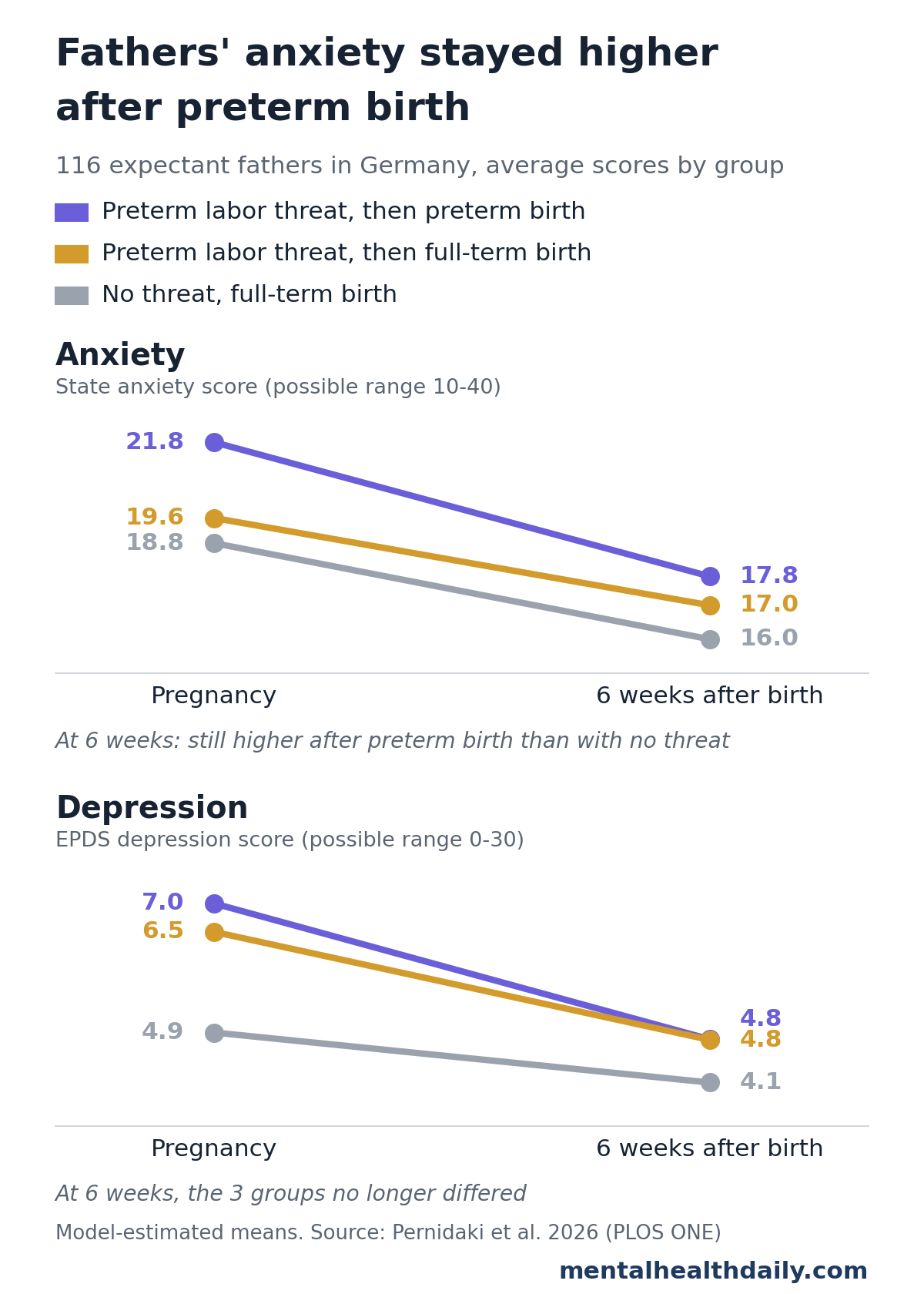
At 6 weeks, the preterm-birth fathers scored 1.84 points higher on anxiety than fathers of uncomplicated term births (one-sided p = 0.041). The threatened-but-term fathers were not significantly different from either group.1
Depression looked different. By 6 weeks, average depression scores were nearly identical across the 3 groups, and none of the comparisons were significant. The share of fathers above the depression cutoff was highest in the threatened-but-term group (17%, vs. 7% and 5% in the other groups), but those rates were not significantly different either.1
An ongoing NICU stay likely weighed on some fathers. In the preterm-birth group, fathers whose baby had been in intensive care reported higher depression scores than those whose baby had not (5.86 vs. 2.25). At 6 weeks, 12 babies were still in the hospital, 11 of them from the preterm-birth group.1
Paths over time: the researchers expected the 3 groups to follow different trajectories from pregnancy to the postpartum weeks. The data did not support that: differences in how steeply scores fell were not statistically significant. Throughout, the threatened-but-term fathers fell between the other 2 groups.1
Other Studies Also Find Persistent Anxiety in Fathers of Preterm Babies
The anxiety result is consistent with earlier research on fathers after preterm birth:
- Pooled prevalence: a 2023 meta-analysis of 79 studies estimated that about 17% of fathers of preterm infants had depression and about 18% had anxiety within the first year after birth.2
- Very preterm babies: among 101 fathers of babies born very early, depression and anxiety symptom rates shortly after birth were 36% and 47%, respectively. Both fell over the first 12 weeks and stayed above expected levels through 6 months compared with fathers of full-term babies.3
- Pregnancy-to-postpartum follow-up: in a study that followed 1,000 fathers, those whose babies were born preterm were more likely to meet the questionnaire threshold for anxiety at 6 weeks after birth (25% vs. 12%).4
That last study found no difference before birth between fathers of preterm and term babies. It did not separate pregnancies with a preterm threat from uncomplicated ones, which the Frankfurt team suggests could have hidden the prenatal effect of the threat itself.1
Limitations of This Study of Fathers and Preterm Birth
- Small groups with dropout: 116 fathers started and 88 completed the 6-week survey, leaving 28 to 41 fathers per group. Real differences in how symptoms changed over time could easily have been missed, and the researchers describe the results as exploratory.
- Only 2 time points: with one survey in pregnancy and one at 6 weeks, the study can only draw a straight line between them and says nothing about later months.
- Different timing of the first survey: the 3 groups were surveyed at different stages of pregnancy, which could account for some of the prenatal differences.
- Questionnaires, not diagnoses: scores show symptoms, not clinical depression or anxiety disorders.
- One hospital, a select group: fathers were recruited at a single German university hospital through partners who had already joined, and most were well educated, first-time fathers in long relationships.
- Missing factors: mothers’ mental health, how premature the babies were, and ongoing NICU stays were not built into the main analysis. The threatened-but-term group also had more past mental illness (31% vs. about 5%), although it did not predict scores within that group.
- One-sided tests: the researchers used one-tailed significance tests based on their predicted direction, which makes borderline results like p = 0.041 easier to reach than with standard 2-sided tests.
What This Means for Fathers Facing Preterm Labor
Check on fathers when the threat appears. A hospital admission for threatened preterm labor is a stressful event for the expectant father too, even when the baby ends up arriving on time. The researchers recommend screening fathers for depression and anxiety at that point, not just after birth.1
Watch anxiety after an early birth. Depression scores in this study settled by 6 weeks, but anxiety in fathers of preterm babies did not fully come down. Follow-up screening after discharge may catch fathers who are still struggling.
Fathers can ask for help. Persistent worry, low mood, or trouble functioning in the weeks around a high-risk pregnancy or NICU stay is worth raising with a doctor, the hospital’s social work or psychology team, or a perinatal mental health service.
References
- Pernidaki V, Schermelleh-Engel K, Sommerlad S, Louwen F, Oddo-Sommerfeld S. Fathers at risk: Effects of threatened and actual preterm birth on the course of paternal peripartum depression and anxiety. PLOS ONE. 2026;21(9):e0356746. doi:10.1371/journal.pone.0356746
- Nguyen CTT, Sandhi A, Lee GT, Nguyen LTK, Kuo SY. Prevalence of and factors associated with postnatal depression and anxiety among parents of preterm infants: A systematic review and meta-analysis. Journal of Affective Disorders. 2023;322:235–248. doi:10.1016/j.jad.2022.11.015
- Pace CC, Spittle AJ, Molesworth CML, Lee KJ, Northam EA, Cheong JLY, et al. Evolution of depression and anxiety symptoms in parents of very preterm infants during the newborn period. JAMA Pediatrics. 2016;170(9):863–870. doi:10.1001/jamapediatrics.2016.0810
- Petersen IB, Quinlivan JA. Fatherhood too soon. Anxiety, depression and quality of life in fathers of preterm and term babies: a longitudinal study. Journal of Psychosomatic Obstetrics and Gynaecology. 2021;42(2):162–167. doi:10.1080/0167482X.2020.1808620