
Stress, low support, loneliness and depression during pregnancy were the factors most strongly linked to postpartum depression in a 2026 survey of 975 mothers from German-speaking countries. Medical factors such as cesarean delivery and gestational diabetes showed no significant link.1
Research Highlights
- Life stress after birth stood out: feeling stressed by one’s general life situation in the first 6 weeks had the strongest link to postpartum depression (Cramer’s V = 0.48), with mothers in the depression group averaging 3.84 on a 5-point agreement scale vs. 2.50 in the comparison group.1
- Depression often started before the birth: 24.2% of mothers in the depression group reported depression during pregnancy (diagnosed or self-identified), compared with 3.2% of the comparison group.1
- Support and loneliness mattered: loneliness in pregnancy and lower satisfaction with help from family, friends, partners and medical staff after birth were all linked to postpartum depression.1
- How the birth felt counted more than how it happened: 41.5% of the depression group described their birth as traumatic vs. 17.7% of the comparison group, while birth mode, induction and preterm birth showed no significant link.1
- Recall-based design: mothers looked back on births up to 5 years earlier in an online survey, so the results show associations that may be inflated by memory, not causes.1
How the German Postpartum Depression Survey Worked
Postpartum depression (PPD) is clinical depression after childbirth, with lasting sadness, loss of pleasure, fatigue and anxiety that can make it hard to function or care for a baby. It affects roughly 10% to 20% of new mothers, and about half of cases are never recognized.1
Ricarda Volz et al. at the University of Freiburg ran an anonymous online survey from May to July 2024. Mothers were recruited through parenting apps, social media groups and newsletters from mother-support organizations.1
- Who took part: 975 women who had given birth in the past 5 years (but not in the last 6 weeks); 96% lived in Germany, 53% had a university degree and 86% were employed
- What they reported: 53 possible risk factors from before pregnancy, during pregnancy, around the birth and in the first 6 weeks afterward
- Comparison: mothers with postpartum depression (the case group) vs. mothers without it (the control group)
Because many cases go undiagnosed, the team did not rely on diagnosis alone. Mothers who said they had experienced PPD (284) went into the case group. Everyone else filled out the Edinburgh Postnatal Depression Scale (EPDS), a standard 10-item depression screening questionnaire, reworded to ask about the weeks after their birth.1
Those scoring 13 or higher (186 women) were added to the case group as probable unrecognized cases, for 470 cases in total. The 505 women scoring below 13 formed the control group.1
Postpartum Stress and Prenatal Depression Had the Strongest Links
For each factor, the researchers measured the strength of its link to postpartum depression with Cramer’s V. It runs from 0 (no link at all) to 1 (a perfect link); in this survey, the strongest links fell between about 0.25 and 0.5. The researchers also used a strict cutoff for statistical significance to account for testing 53 factors.1
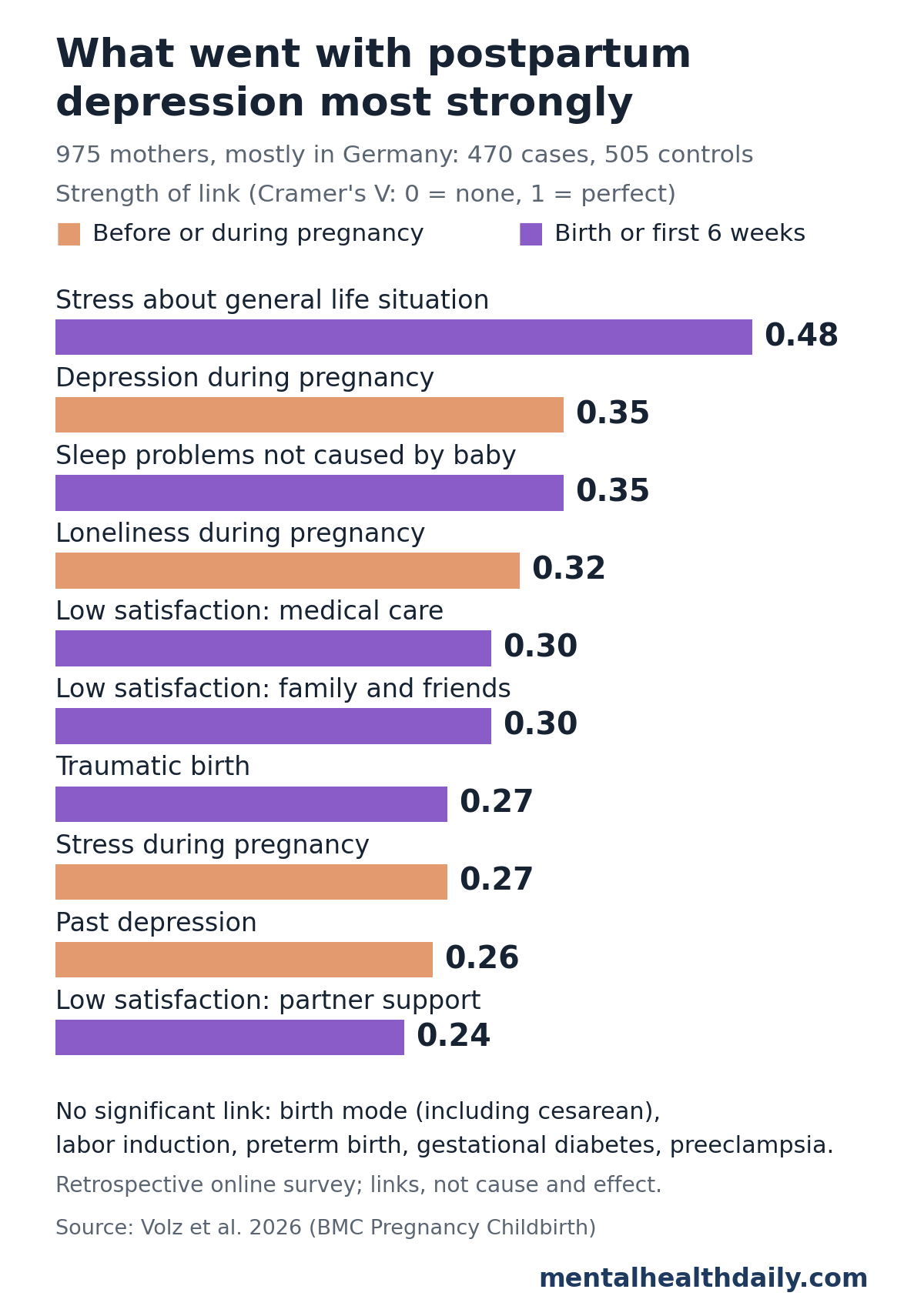
Stress after birth: agreement with “I experienced stress because of my general life situation” in the first 6 weeks had the strongest link of any factor (V = 0.48). Stress from one’s surroundings (V = 0.30), money (V = 0.19) and medical reasons (V = 0.19) were also higher in the case group.1
Depression during pregnancy: in the case group, 7.4% reported a clinical diagnosis of prenatal depression and another 16.8% recognized it in themselves. In the control group, those figures were 0.8% and 2.4% (V = 0.35).1
Earlier depression: 44.3% of the case group reported a past history of depression vs. 21.0% of controls (V = 0.26).1
Sleep after birth: 34.9% of the case group had sleep problems in the first 6 weeks that were unrelated to the baby’s sleep, compared with 6.5% of controls (V = 0.35). Poor sleep can be a symptom of depression as well as a trigger, so this survey cannot say which came first.1
Loneliness and Low Support Were Linked to Postpartum Depression
During pregnancy, mothers in the case group agreed more strongly with “I felt lonely” (V = 0.32) and “I felt generally stressed” (V = 0.27). They were also less likely to believe support was available if they needed it (V = 0.19) and rated themselves less happy during pregnancy (average 3.46 vs. 3.99 on a 5-point scale).1
After the birth, satisfaction with support was lower in the case group across every source (5-point scale, case vs. control):1
- Medical care: 3.26 vs. 3.94 (V = 0.30)
- Family and friends: 3.22 vs. 3.87 (V = 0.30)
- Partner: 3.60 vs. 4.11 (V = 0.24)
These ratings reflect how supported mothers felt, not how much help they objectively received. A mother who is depressed may also judge the same help as less adequate.
Traumatic Birth Was Linked to PPD, but Cesarean Delivery Was Not
In the case group, 41.5% of mothers described their birth as traumatic, compared with 17.7% of controls (V = 0.27). Women with PPD also reported lower satisfaction with how the birth went (V = 0.23) and with how much control they had over decisions (V = 0.24).1
Medical and biological factors showed no significant link in this survey:1
- Birth: birth mode (including cesarean), labor induction, stalled labor, preterm birth
- Pregnancy conditions: gestational diabetes, preeclampsia, thyroid problems, severe pregnancy nausea
- Other conditions: polycystic ovary syndrome (PCOS), migraine, high blood pressure after birth
Family history of PPD, premenstrual syndrome, epidurals and several breastfeeding factors showed only weak links. Hormones, inflammation and other biological markers were not measured at all, so the survey could not test them.1
Larger Studies Also Point to Past Depression and Low Support
Most of these findings are consistent with earlier research, including studies that did not rely on long-term recall:
- Umbrella review: a 2026 analysis of 77 meta-analyses covering 53 risk factors ranked poor social support (relative risk 3.57), history of depression (odds ratio 3.09) and sleep disorders (odds ratio 2.36) among the strongest risk factors for PPD. Most of that evidence was rated low or very low in certainty.2
- Swedish national registers: in all women with live single births in Sweden from 1997 to 2008, those with a history of depression had about 21 times the risk of clinical PPD in the first year after birth.3
- Birth satisfaction: among 584 Slovak women surveyed 2 to 4 days after giving birth, lower birth satisfaction predicted higher PPD risk scores even after adjusting for prenatal stress, psychiatric history and type of delivery.4
The Swedish registry study did find modest increases in risk with gestational diabetes and, among women without past depression, with cesarean and instrument-assisted delivery. A survey of 975 women is not large enough to rule out modest effects like those.3
Limitations of the German Postpartum Depression Survey
- Looking back: mothers recalled pregnancies and births up to 5 years earlier. Women who had PPD may remember those months more negatively, which the researchers say could inflate some links.
- Who answered: an online convenience sample, mostly in Germany, more educated and more often employed than the general population.
- One factor at a time: each factor was tested alone, with no adjustment for the others. Stress, loneliness, low support and past depression often go together, so the list does not show which ones matter independently.
- Symptom or cause: stress, poor sleep and dissatisfaction after birth may partly be signs of depression itself.
- Adapted screening tool: 186 of the 470 cases were classified with an EPDS reworded for long-term recall, which has not been validated in that form.
- Unmeasured traits: personality traits such as neuroticism (a tendency toward worry and negative emotion) could make mothers both feel more stressed and be more prone to depression.
When the team split the cases, most of the main links held up in both mothers with self-reported PPD and those identified by screening score. Links were generally stronger among the self-reported group.1
Screening for Depression During Pregnancy
About 1 in 4 mothers in the case group had depressive symptoms before the baby arrived. The researchers recommend routine depression screening during pregnancy, using a tool such as the EPDS, so that support can start before symptoms deepen after birth.1
Practical signals worth noticing:
- depression before or during pregnancy
- feeling lonely or without reliable help
- heavy stress about life circumstances around the birth
- a birth that felt traumatic or out of control
- trouble sleeping even when the baby is asleep
None of these predicts PPD for an individual mother, but each is a reason to ask about mood and support. Persistent low mood, loss of interest or anxiety in the weeks after birth is worth raising with a doctor or midwife.
References
- Volz R, Coenen VA, Baldermann JC, Döbrössy MD. Identifying risk factors associated with postpartum depression: a retrospective case-control study. BMC Pregnancy and Childbirth. 2026;26:1027. doi:10.1186/s12884-026-09932-2
- Xu M, Luo Y, Huang Y, Liu Y, Ding L. Risk factors for postpartum depression: an umbrella review. Frontiers in Public Health. 2026;13:1714668. doi:10.3389/fpubh.2025.1714668
- Silverman ME, Reichenberg A, Savitz DA, Cnattingius S, Lichtenstein P, Hultman CM, et al. The risk factors for postpartum depression: a population-based study. Depression and Anxiety. 2017;34:178–187. doi:10.1002/da.22597
- Urbanová E, Škodová Z, Bašková M. The association between birth satisfaction and the risk of postpartum depression. International Journal of Environmental Research and Public Health. 2021;18(19):10458. doi:10.3390/ijerph181910458