
People who reported a traumatic event were more credulous — quicker to take others’ word without checking — than people who reported none, according to a 2026 survey of 2,519 people in Germany. That credulity was also linked to more PTSD and complex PTSD symptoms.1
Research Highlights
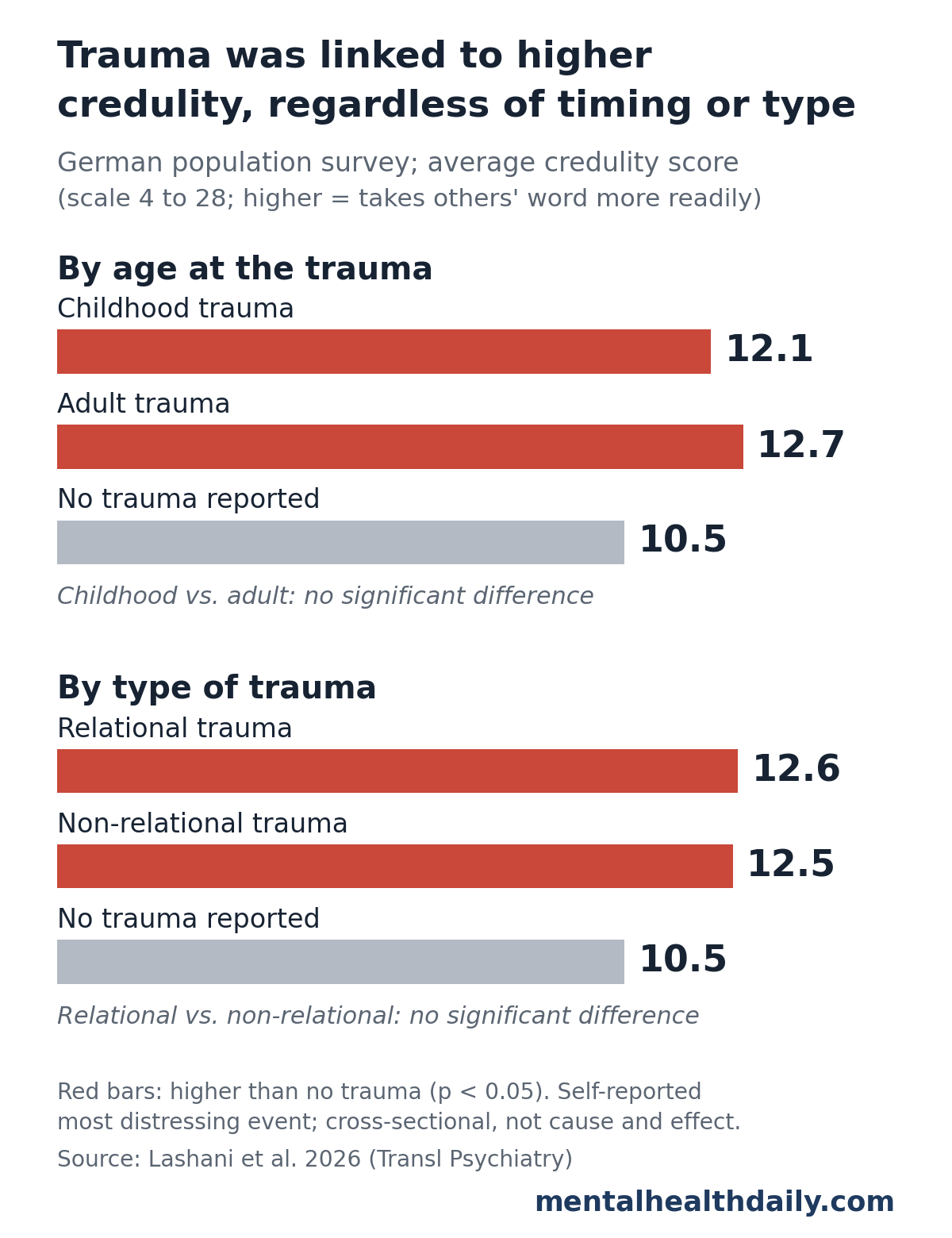
- Trauma went with higher credulity: average credulity scores were 12.1 to 12.7 in trauma groups vs. 10.5 in people reporting no trauma, on a scale of 4 to 28.1
- Timing and type alone made no difference: contrary to the preregistered hypotheses, childhood vs. adult trauma and relational vs. non-relational trauma did not differ in trust, mistrust or credulity.1
- Credulity linked trauma to symptoms: it carried a small, consistent indirect link from trauma to PTSD symptoms and to disturbances in self-organization, the extra symptoms of complex PTSD.1
- Childhood relational trauma stood out in exploratory models: trauma involving close relationships at age 18 or younger was linked to lower trust and higher credulity; the same trauma in adulthood was not.1
- One-time survey: the design shows associations at a single point in time, so it cannot show that trauma changed anyone’s trust.1
What Epistemic Trust, Mistrust and Credulity Mean
Epistemic trust is trust in what other people tell you: the ability to judge whether information from a friend, teacher or therapist is genuine, relevant to you and worth learning from. It is how people pick up knowledge about the world and themselves from others.1,2
Researchers describe 3 overlapping stances toward what others say:1,2
- Trust: open to useful information when openness is warranted.
- Mistrust: treating what others say as unreliable or ill-meant, and rejecting it by default.
- Credulity: taking information on board too readily, with little vigilance about whether the source deserves it. People high in credulity often also feel unsure whom to believe.
The developmental theory behind this work holds that early caregiving teaches children whom to trust. Unreliable or harmful caregiving may push a child toward constant suspicion or toward taking in information indiscriminately, and those habits can make it harder to learn from relationships later.1
PTSD and complex PTSD are the outcomes the researchers tracked. PTSD involves reliving the event, avoiding reminders and feeling under ongoing threat. Complex PTSD, a diagnosis in the World Health Organization’s ICD-11, adds disturbances in self-organization (DSO): trouble managing emotions, a harsh view of oneself and difficulty in relationships.1,5
How the German Trauma and Trust Survey Worked
Eileen Lashani et al. analyzed a representative survey of the German population, randomly sampled and carried out from December 2020 to March 2021. Hypotheses and methods were preregistered, meaning they were posted publicly before analysis.1
- Sample: 2,519 people aged 16 to 96 (average age 50); 52.5% women.
- Trauma: on the International Trauma Questionnaire, people briefly described their single most distressing event. 1,281 (50.9%) named one; 465 (18.5%) reported none; the rest left it unclear.
- Timing: 106 people named an event from age 18 or younger and 987 an event from adulthood.
- Type: 685 events were relational (loss of a loved one, separation, emotional, physical or sexual violence) and 329 non-relational (accidents, illness or surgery, war, natural disaster). Loss was by far the most common, at 512.
- Trust: a 12-item German version of the Epistemic Trust, Mistrust and Credulity Questionnaire (ETMCQ).
- Symptoms: PTSD and DSO scores from the same trauma questionnaire, measured as continuous scores rather than diagnoses.
Credulity Was Higher After Trauma, Whatever Its Timing or Type
The researchers expected childhood trauma, and trauma inside close relationships, to do more damage to trust than adult or non-relational trauma. Neither prediction held.1
Age at trauma: childhood and adult trauma groups did not differ in trust, mistrust or credulity. Both had higher credulity than the no-trauma group (effect sizes d = 0.31 for childhood and d = 0.43 for adulthood, where 0.2 is small and 0.5 is moderate).1
Type of trauma: relational and non-relational trauma were nearly identical, with credulity scores of 12.6 and 12.5 vs. 10.5 with no trauma. Trust and mistrust did not differ across any of these groups.1
Sexual violence stood out: people who named sexual violence as their worst event had the highest credulity score, 15.4, well above the no-trauma group (d = 0.98) and above people who named a loss (d = 0.62). Only 34 people named this kind of event.1
Intentional harm: in a supplementary coding that grouped emotional, physical and sexual violence as harm deliberately done by another person, that trauma was linked to more credulity than other trauma, at any age.1
The researchers were surprised that adult trauma showed the larger credulity gap. How recently the event happened did not explain it, and adjusting for age, gender, education and income left the results unchanged.1
Credulity Carried a Small Link to PTSD and Complex PTSD Symptoms
The third preregistered prediction was that trust, mistrust and credulity would each help connect trauma to symptoms. Only credulity did.1
- PTSD symptoms: credulity carried a small indirect link from reporting trauma to symptom severity (standardized β = 0.04).
- DSO symptoms: the indirect link through credulity was similar (β = 0.05).
- Trust and mistrust: indirect links were essentially zero for both outcomes.
This kind of test is called a mediation analysis: it tests whether a third measure sits on the path between 2 others. In a one-time survey it shows a pattern consistent with that path, and the researchers say plainly that it is not proof of cause.1
Childhood Relational Trauma Stood Out in Exploratory Models
The more striking results come from analyses the team added beyond the preregistered plan. When timing and type were combined, the pattern changed: in childhood, relational trauma went with more disruption of trust than non-relational trauma did, while in adulthood it did not.1
Relational trauma at 18 or younger (compared with non-relational trauma at the same age) was linked to:1
- lower epistemic trust (standardized β = −0.61)
- higher credulity (β = 0.54)
- more PTSD and DSO symptoms indirectly, through higher credulity (and, for DSO, also through lower trust)
Relational trauma in adulthood showed none of these links. These combined models also explained more symptom variation than the simpler ones: 27% vs. 12% for PTSD and 43% vs. 17% for DSO.1
A final exploratory model suggested a chain: childhood relational trauma, then lower trust and higher credulity, then more DSO symptoms, then more PTSD symptoms. The researchers call these findings preliminary and in need of replication, especially since only 106 people named a childhood event.1
Earlier Studies on Epistemic Trust and Trauma
The questionnaire’s origin: Chloe Campbell et al. built the ETMCQ in UK samples in 2021. Mistrust and credulity were both linked to childhood adversity and to more mental health symptoms, and each partly accounted for the link between early adversity and symptoms.2
Same German survey program: Hanna Kampling et al. analyzed 2,004 people from the same 2020–2021 German survey in a study published in 2022. Adverse childhood experiences were linked to more PTSD and complex PTSD symptoms, partly through personality functioning, and adding epistemic trust raised the explained variation in personality functioning from 16% to 41%.3
Treatment settings: in a 2024 pilot study of 50 patients with complex PTSD in 6-week psychodynamic inpatient rehabilitation, symptoms fell substantially, and improvement went along with gains in epistemic trust. The study had no control group.4
The 2026 survey is consistent with this earlier work on credulity. It adds a direct comparison of childhood with adult trauma, which the researchers describe as a first for epistemic trust research.1
Limitations of This Epistemic Trust Survey
- One point in time: the survey cannot show whether trauma lowered trust, whether credulity raised the risk of trauma or symptoms, or both.
- One event per person: people named only their most distressing trauma, so someone with both childhood and adult trauma counted once. This likely blurred the timing comparison.
- Small childhood group: just 106 people named a childhood event, which limits the exploratory childhood results.
- Shaky mistrust scale: the mistrust items had questionable reliability, which may have made credulity look more important by comparison.
- Disclosure bias: people with lower trust were less likely to describe their trauma at all.
- Coarse trauma coding: short free-text descriptions often lacked detail on severity or context.
- Setting: a German community sample surveyed during the COVID-19 pandemic, with no data on race or ethnicity; clinical groups may show stronger patterns.
What Credulity Could Mean for Trauma Recovery
Credulity was the most consistent trust-related signal after trauma in this survey. The researchers suggest that taking others’ word too readily could raise the risk of being manipulated or harmed again, and could make it harder to benefit from supportive relationships, including therapy.1
That idea fits early treatment research in which trust improved alongside complex PTSD symptoms. That work was small and uncontrolled, so whether improving trust or reducing credulity eases symptoms is still an open question.4
If memories of a past trauma still affect sleep, mood, relationships or daily life, a doctor or a therapist trained in trauma-focused treatment is a good place to start.
References
- Lashani E, Fonagy P, Riedl D, Kampling H, Kruse J, Lampe A, Engert V, Montague PR, Brähler E, Fegert JM, Sachser C, Nolte T. Cracks in the foundation: disrupted epistemic trust as a link between trauma, PTSD and disturbances in self-organization. Translational Psychiatry. 2026;16:471. doi:10.1038/s41398-026-04442-3
- Campbell C, Tanzer M, Saunders R, Booker T, Allison E, Li E, et al. Development and validation of a self-report measure of epistemic trust. PLoS ONE. 2021;16(4):e0250264. doi:10.1371/journal.pone.0250264
- Kampling H, Kruse J, Lampe A, Nolte T, Hettich N, Brähler E, et al. Epistemic trust and personality functioning mediate the association between adverse childhood experiences and posttraumatic stress disorder and complex posttraumatic stress disorder in adulthood. Frontiers in Psychiatry. 2022;13:919191. doi:10.3389/fpsyt.2022.919191
- Lampe A, Riedl D, Kampling H, Nolte T, Kirchhoff C, Grote V, et al. Improvements of complex post-traumatic stress disorder symptoms during a multimodal psychodynamic inpatient rehabilitation treatment – results of an observational single-center pilot study. European Journal of Psychotraumatology. 2024;15(1):2333221. doi:10.1080/20008066.2024.2333221
- Cloitre M, Shevlin M, Brewin CR, Bisson JI, Roberts NP, Maercker A, et al. The International Trauma Questionnaire: development of a self-report measure of ICD-11 PTSD and complex PTSD. Acta Psychiatrica Scandinavica. 2018;138(6):536–546. doi:10.1111/acps.12956