
Older adults with rheumatoid arthritis who were more fatigued in the hospital had worse sleep and more trouble with daily activities a month after going home. Fatigue was the only one of 5 tracked symptoms that predicted others over time in this study of 177 patients in Beijing.1
Research Highlights
- Fatigue predicted worse sleep: higher fatigue during the hospital stay predicted worse sleep scores 1 month after discharge (edge weight 0.250, 95% CI 0.038 to 0.621).1
- Fatigue also predicted more functional limitation: patients who were more tired in the hospital had a little more difficulty with everyday tasks a month later (edge weight 0.045, 95% CI 0.016 to 0.068).1
- No other symptom predicted later symptoms: pain, sleep, function and anxiety-depression each tracked mainly with their own earlier levels, and both fatigue findings held after adjusting for age, sex, disease duration and other background factors.1
- Anxiety-depression sat downstream: combined anxiety and depression scores were the symptom most predicted by the others (incoming expected influence 0.819), though no single link into it was statistically significant.1
- Consistent with earlier RA research: fatigue in rheumatoid arthritis is closely linked to disability, pain, poor sleep and low mood, and often persists even when inflammation is treated.2,4
How the Beijing Study Followed Rheumatoid Arthritis Symptoms After Discharge
Rheumatoid arthritis (RA) is an autoimmune disease in which the immune system attacks the lining of the joints, causing swelling, pain, stiffness and, over time, joint damage. Beyond the joints, many people with RA live with exhaustion, poor sleep, low mood and difficulty with daily tasks.
Yuan Ren et al. enrolled patients aged 55 and older from the rheumatology department of Beijing Hospital between August 2025 and February 2026. Of 195 people enrolled, 177 completed both assessments.1
- Patients: average age 67.5 (range 55 to 88), 79% women, with RA for 77 months (about 6.4 years) on average
- First assessment: face to face during the hospital stay
- Second assessment: by phone, 1 month after discharge
The researchers chose this window on purpose. The first month home brings medication changes, the start of rehabilitation and the loss of the hospital’s fixed routine, which could change how symptoms affect each other.1
At each time point, patients rated 5 symptoms:
- Joint pain on a 0 to 10 scale
- Fatigue on a 0 to 10 scale
- Anxiety-depression, the total score on the Hospital Anxiety and Depression Scale (HADS), treated as a single measure of emotional distress
- Sleep disturbance on the Pittsburgh Sleep Quality Index (PSQI), a 0 to 21 questionnaire about the past month of sleep
- Functional limitation on the Health Assessment Questionnaire-Disability Index (HAQ-DI), which rates difficulty with dressing, walking, eating, reaching and other daily tasks from 0 to 3
Fatigue and Poor Sleep Were the Most Common Symptoms
Fatigue was the most common symptom in the hospital, and sleep disturbance was the most common a month later.1
- Fatigue: 70.1% in the hospital, 63.3% after 1 month
- Sleep disturbance: 66.1%, then 68.9%
- Pain: 61.0%, then 52.5%
- Functional limitation: 35.0%, then 38.4%
- Anxiety-depression above the screening cutoff: 20.3%, then 14.7%
Pain and fatigue eased slightly after discharge, while sleep got a little worse on average (PSQI 7.31 in the hospital vs. 7.84 a month later).1
What a Cross-Lagged Symptom Network Measures
A symptom network treats each symptom as a point and the statistical links between symptoms as lines. Instead of adding everything into one total score, it shows which symptoms travel together and which sit at the center.
A cross-lagged panel network adds time. For each symptom at 1 month, it asks how well each symptom measured in the hospital predicts it, while accounting for all the others, including that symptom’s own earlier level. A link from fatigue to sleep therefore means fatigue predicted later sleep beyond what earlier sleep already predicted.
Expected influence sums a symptom’s links. Outgoing expected influence shows how strongly a symptom predicts the others; incoming expected influence shows how strongly it is predicted by them.1
Fatigue Was the Only Symptom That Predicted Later Symptoms
Every symptom predicted its own later level, most strongly for sleep (0.477), functional limitation (0.463) and fatigue (0.462). Among the links between different symptoms, only fatigue’s held up statistically.1
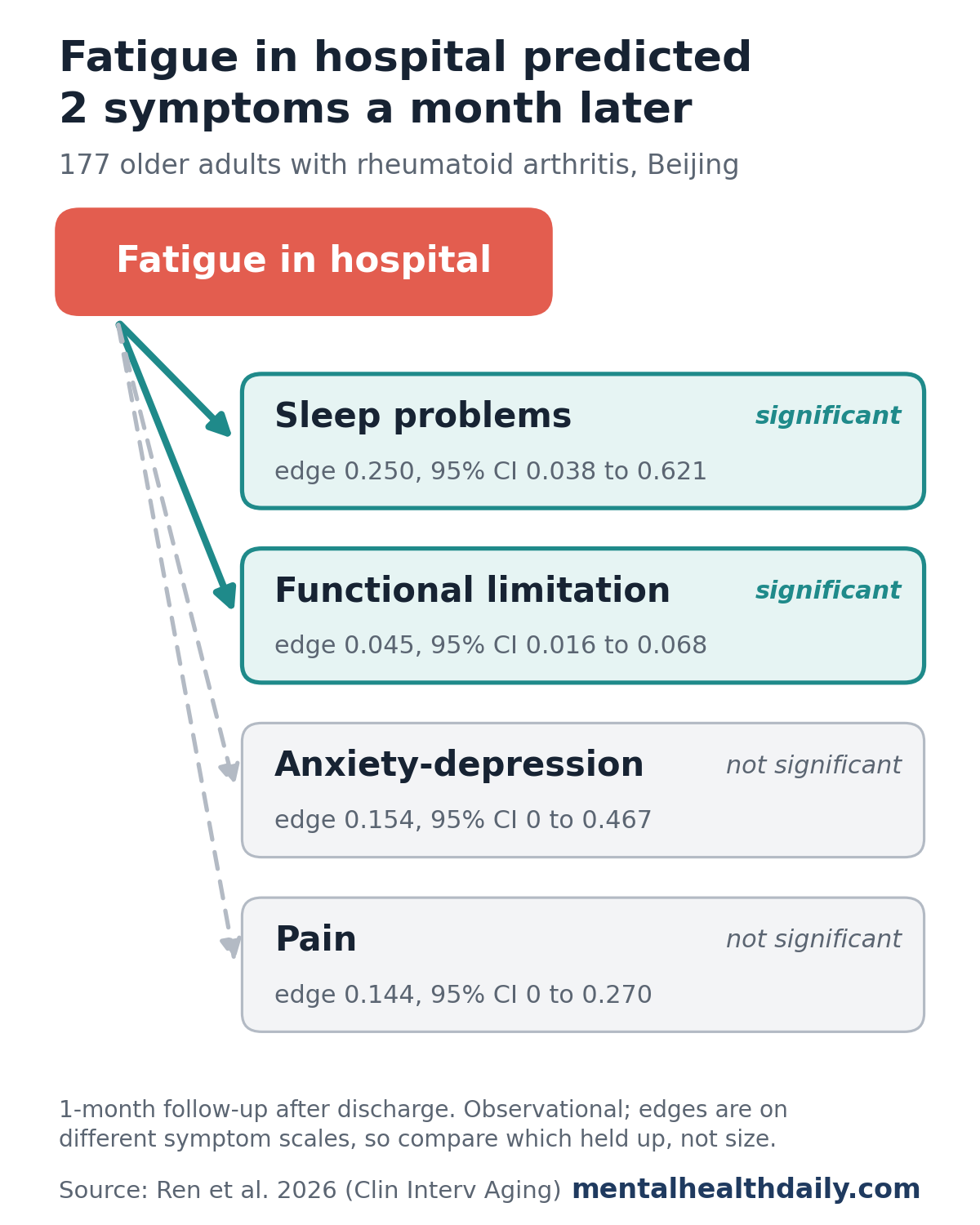
- Sleep: edge weight 0.250 (95% CI 0.038 to 0.621)
- Functional limitation: edge weight 0.045 (95% CI 0.016 to 0.068)
- Anxiety-depression: 0.154, not significant (CI reached 0)
- Pain: 0.144, not significant (CI reached 0)
The two significant numbers are not directly comparable, because sleep is scored from 0 to 21 and functional limitation from 0 to 3. Both links survived a correction for testing many links at once.1
Adjusted analysis: after the researchers removed the influence of age, sex, marital status, disease duration, family history and joint function, fatigue still predicted later sleep (0.209) and functional limitation (0.044), and it still had the highest outgoing expected influence.1
Fatigue and sleep moved closer after discharge. In the snapshot networks at each time point, pain and fatigue were the most tightly linked pair in the hospital. A month later, fatigue’s links with sleep and with daily function had grown stronger. The researchers suggest that losing the hospital’s regular routine may let tiredness and poor sleep feed each other more at home.1
Anxiety and Depression Were Most Predicted by Physical Symptoms
Combined anxiety-depression had the highest incoming expected influence (0.819; 0.865 in the adjusted analysis), and it had no significant link to any later symptom. The largest single link into it came from functional limitation (0.634), followed by fatigue (0.154), but the researchers did not report any of these single links as significant.1
The researchers read this as distress building on top of physical symptoms in older RA patients, rather than driving them. That interpretation goes a little beyond their own results in one place: the discussion says fatigue predicted later anxiety-depression, while the results section reports that link as not significant.1
A 1-month follow-up is also short for mood, which tends to change slowly, a point the researchers raise themselves.
Earlier Studies Link RA Fatigue to Sleep, Pain and Mood
Fatigue has many sources. A 2019 systematic review found that fatigue in RA correlated at 0.50 or higher with physical disability, poor mental well-being, pain, sleep disturbance, depression and anxiety. Most of those links stayed significant when analyzed together, and the authors proposed a network model in which these factors keep each other going.2
Pain may come first early on. In a 12-month study of 100 people with RA, 83% reported fatigue, 60% still had it a year later, and baseline pain was the only independent predictor of that persistent fatigue.3 The Beijing team suggests that pain may help start fatigue, while fatigue, once established, spreads to other symptoms.
Fatigue often outlasts inflammation control. Among 184 patients with established RA starting biologic drugs, only 18% fell into an improving-fatigue pattern over a year. Continued fatigue was predicted by patient-reported measures, not by inflammatory disease activity or joint ultrasound.4
Can Treating Fatigue Improve Sleep in Rheumatoid Arthritis?
This study cannot answer that, because nobody received a fatigue treatment. It identifies fatigue as a reasonable target to test. The researchers suggest checking fatigue routinely during a hospital stay and trying non-drug approaches such as energy conservation and graded activity, plus combined fatigue and sleep guidance in discharge planning.1
Existing fatigue treatments help, but modestly. A Cochrane review of 24 studies with 2,882 people with RA found that physical activity programs lowered fatigue by about 9 points on a 0 to 100 scale compared with control, and psychosocial programs by about 6 points.5 Whether those benefits carry over to sleep and daily function is the question a trial would need to test.
Limitations of This Rheumatoid Arthritis Symptom Network Study
- Observational, 2 time points: fatigue predicted later sleep and function, but the design cannot show that fatigue caused those changes.
- Short follow-up: 1 month may miss slower changes, especially in mood.
- No disease activity or treatment data: inflammation levels and medication changes were not in the model, so they could explain part of the pattern.
- Anxiety and depression combined: a single distress score cannot show whether anxiety or depression behaves differently.
- One hospital, self-report: all patients came from 1 Beijing hospital, and every symptom was self-rated, with the second round collected by phone.
What This Means for Older Adults With Rheumatoid Arthritis
Fatigue is worth raising. It was the most common symptom during the hospital stay, and in this group it was the one that pointed toward worse sleep and more difficulty with daily tasks a month later.
The weeks after discharge are a vulnerable stretch. Sleep problems became the most common symptom after going home, and fatigue and sleep became more closely linked. Asking about both before discharge is a simple step.
Low mood may reflect physical strain. When an older person with RA feels anxious or down, the researchers suggest also checking how well fatigue, pain, sleep and function are controlled, alongside emotional support.1
References
- Ren Y, Zhao Y, Fu X, Wu J, Hu HX, Sun C. Longitudinal dynamics of pain, fatigue, anxiety-depression, sleep, and functional limitation in older adults with rheumatoid arthritis: a cross-lagged panel network analysis. Clinical Interventions in Aging. 2026;21:632582. doi:10.2147/CIA.S632582
- Geenen R, Dures E. A biopsychosocial network model of fatigue in rheumatoid arthritis: a systematic review. Rheumatology. 2019;58(Suppl 5):v10–v21. doi:10.1093/rheumatology/kez403
- Fazaa A, Boussaa H, Ouenniche K, et al. Baseline predictors of fatigue and persistent fatigue in rheumatoid arthritis: a longitudinal observational study. Musculoskeletal Care. 2023;21(4):1068–1074. doi:10.1002/msc.1787
- Provan SA, Michelsen B, Sexton J, Uhlig T, Hammer HB. Trajectories of fatigue in actively treated patients with established rheumatoid arthritis starting biologic DMARD therapy. RMD Open. 2020;6(3):e001372. doi:10.1136/rmdopen-2020-001372
- Cramp F, Hewlett S, Almeida C, et al. Non-pharmacological interventions for fatigue in rheumatoid arthritis. Cochrane Database of Systematic Reviews. 2013;(8):CD008322. doi:10.1002/14651858.CD008322.pub2