Being suddenly paralyzed by Guillain-Barré syndrome and treated with plasma exchange in intensive care brought helplessness, fear and isolation, followed by a slow rebuilding of body, mood, relationships and faith. That is the picture from in-depth interviews with 7 survivors in Indonesia, published in 2026.1
Research Highlights
- A small interview study: 7 adults aged 21 to 60, all treated with plasma exchange in the intensive care unit (ICU) of one Indonesian referral hospital, described their illness up to 3 years later.1
- 4 themes: bodily disruption and recovery, emotional distress and self-acceptance, communication barriers and rebuilt relationships, and spiritual distress and resilience.1
- The treatment itself was hard: participants described violent shivering, fever, dizziness, a painful neck catheter and sessions lasting hours, yet accepted it as they felt stronger.1
- Not being able to speak was distressing: on a ventilator, patients tapped bed rails or raised their eyebrows to signal needs that staff often missed.1
- Recovery was real but incomplete: walking and self-care returned, while fatigue, stiffness, numbness and tremor lingered, in line with larger studies showing common long-term fatigue and a sharp rise in depression in the first 2 years.1,5,6
What Guillain-Barré Syndrome and Plasma Exchange Are
Guillain-Barré syndrome (GBS) is a rare illness in which the immune system attacks the peripheral nerves, the nerves running from the spinal cord to the muscles and skin. It often follows a chest or gut infection. Tingling and weakness can spread within days to near-total paralysis.1,2
It affects roughly 1 to 2 people per 100,000 each year. About 20% to 30% of patients lose enough breathing strength to need a ventilator, and recovery can take months to years.1
Plasma exchange (also called therapeutic plasma exchange or plasmapheresis) is one of the 2 first-line treatments for severe cases, alongside intravenous immunoglobulin.1 A machine draws blood through a large catheter, separates out the plasma (the liquid part that carries the harmful antibodies), and returns the blood cells with a replacement fluid, usually an albumin solution.2
It works. A Cochrane review of 6 trials with 649 participants found that plasma exchange sped recovery compared with supportive care alone:2
- Walking sooner: in 1 trial of 220 severely affected patients, median time to walk with an aid fell from 44 days to 30 days.
- Less ventilator use: the need for a breathing machine was about half as likely (risk ratio 0.53).
- Better long-term strength: full muscle strength at 1 year was more likely (risk ratio 1.24).
How the Indonesian Study Was Done
Vera Susanti et al. interviewed patients at Dr. Hasan Sadikin General Hospital in Bandung, a national referral center in West Java. Everyone had a first diagnosis of GBS, had received plasma exchange in intensive care, and was in recovery within 3 years of discharge.1
- Who: 5 women and 2 men, aged 21 to 60; 6 were Muslim and 1 Christian.
- How: open-ended interviews of 45 to 60 minutes in Bahasa Indonesia, held between September and December 2025.
- Analysis: a structured phenomenological method (Colaizzi’s method) that sorts meaningful statements into themes; participants then reviewed the results to confirm they matched their experience.
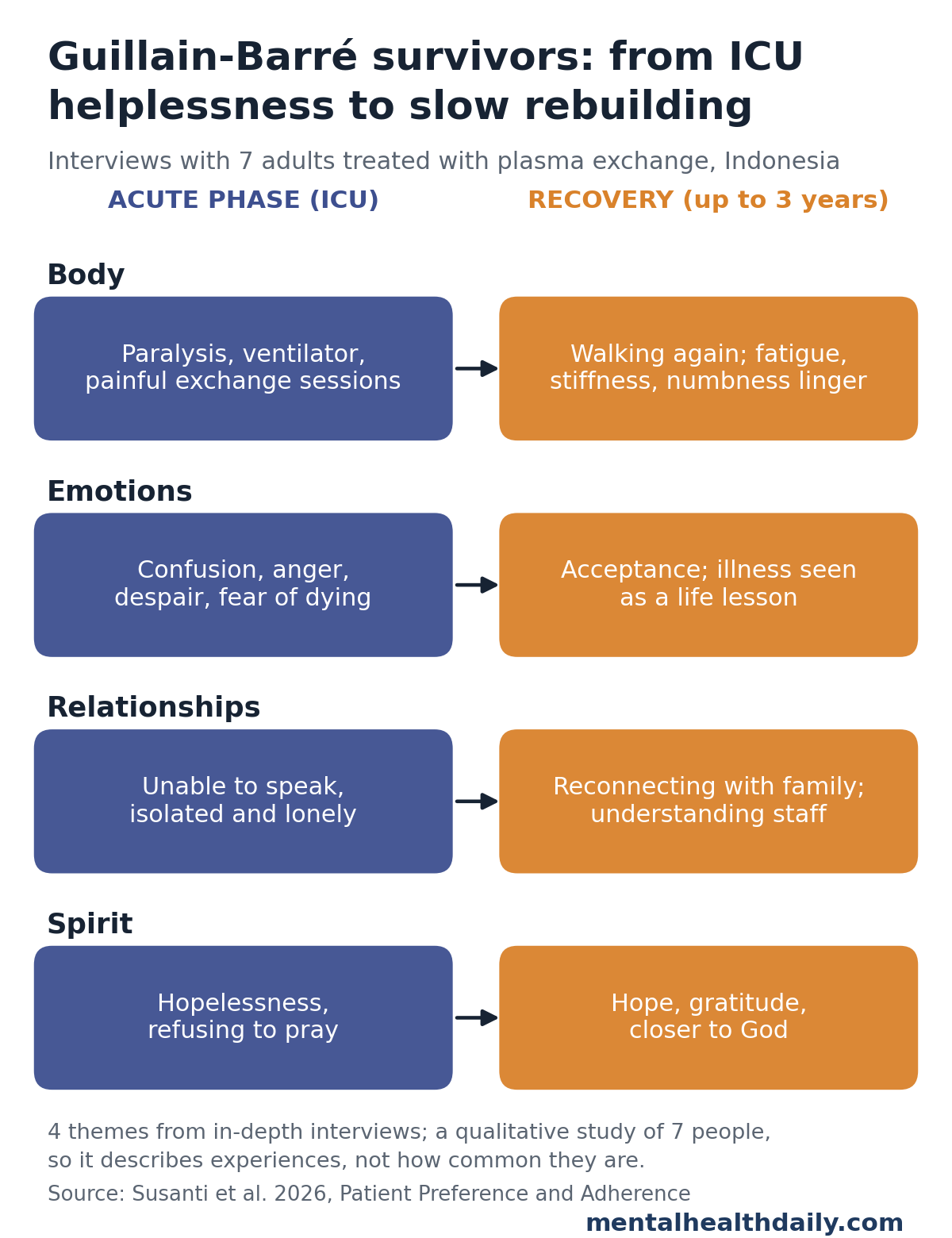
No new themes appeared by the 6th interview, and a 7th confirmed it. The researchers grouped what people said into 4 themes and 14 subthemes, each tracing a path from the acute crisis to recovery.1
The Body: Sudden Paralysis and a Hard Treatment
Symptoms started small. One woman described tingling in her palms for 2 days, then waking to find her hands completely weak. Within days, several participants could not sit up, swallow or breathe on their own, and needed a feeding tube or a ventilator.1
Plasma exchange brought its own suffering. Participants described:1
- Shivering and fever: one felt freezing no matter how many blankets were piled on, along with a floating, dizzy sensation.
- Catheter pain: placing the large line in the neck was, for one man, the most painful part.
- Long sessions: several hours lying still with the head turned to one side; one session stretched to 12 hours because the line kept clotting.
Acceptance grew once patients understood why the treatment mattered and began to feel it working. One woman said her body felt noticeably lighter after 3 sessions. Recovery was gradual and incomplete: at the time of the interviews, participants still reported daily fatigue, muscle soreness, stiff joints, numb fingers and hand tremors.1
Emotions: From Confusion and Despair to Acceptance
Before diagnosis came confusion. One participant drank coconut water after a doctor friend suggested an electrolyte problem; another was first told she had a stroke, until stroke treatment did nothing. One family waited a full day in the emergency department for a ward bed.1
Then came disappointment, anger and what one woman called “complete, utter despair.” During his 2nd plasma exchange session, one man felt his body being crushed from all sides and was sure he was dying. Racing thoughts and drooling made sleep almost impossible for one patient, whom a psychiatrist visited regularly.1
Over time, most moved toward acceptance. Several reframed the illness as a test or a reminder from God rather than a punishment, and that shift went along with following treatment and trusting the medical team.1
Relationships: Unable to Speak in the ICU
A breathing tube plus paralysis meant no voice and almost no gestures. Patients tapped the bed rail to ask for help such as suctioning.1
One woman tried to signal a nurse with her eyebrows, only to hear “I’m so sorry, I do not understand” as the nurse walked out. She wept in the interview recalling a signal that was ignored.1
Isolation added to it. Children under 18 were not allowed into the ICU, so one father saw his youngest child only by video call. Some patients refused all visitors because they felt insecure about their changed bodies and could not speak.1
As strength returned, so did connection. Resentment toward busy nurses softened into understanding, often with a family member’s encouragement, and participants spoke warmly of individual staff who had been kind.1
Spirit: Hopelessness, Then Gratitude
The spiritual theme was the most dramatic. In the acute phase, participants described fear of death and complete loss of hope. One woman refused to pray or listen to Quran recitation because her “heart felt closed off.”1
The same woman told a psychiatrist, by nodding, that she had thoughts of ending her life. The researchers note that such thoughts had not been explicitly reported in earlier GBS research, and they link them to the extreme helplessness of being paralyzed and unable to speak.1
As participants stabilized, they reflected on their lives, found motivation in their children and families, and later described gratitude, more care for their own health and a closer relationship with God. “Please, learn to love and take care of your own self,” one young woman said of what the illness taught her.1
Larger Studies Show the Same Pattern
The Indonesian accounts are consistent with earlier qualitative research elsewhere:
- A 2021 meta-synthesis of 5 qualitative studies traced the same journey: suspecting something is wrong, hospitalization, ongoing difficulties, slow recovery, adjusting and re-evaluating life, with lasting changes in social roles and identity.3
- A 2025 interview study of 11 people diagnosed in the previous 4 years identified “loss, determination, and adjustment” and “the unknown” as the core psychological processes, eased by support, information and hope.4
Numbers from large cohorts show how common the distress is. In a Danish nationwide registry study, 21.3% of people with GBS had depression recorded through an antidepressant prescription or a hospital depression diagnosis within 2 years, compared with 3.3% of the general population (hazard ratio 7.6).5
That risk was highest in the first 3 months (hazard ratio 20.5) and was no longer elevated after 2 years. It matches the arc the Indonesian participants described: the worst distress came early, then eased.5
Fatigue is the other lasting problem. In a European study of 113 people with GBS or related immune nerve diseases, about 80% had severe fatigue, and it was not significantly related to their current muscle strength. Fatigue and pain can persist for years after apparent recovery.6
Limitations of This Study
- Only 7 people: qualitative studies describe experiences in depth; they cannot say how common each experience is.
- One hospital and culture: a mostly Muslim group in a resource-limited Indonesian ICU, which shapes both the care and the spiritual themes.
- Looking back: some interviews took place up to 3 years after the ICU stay, so memories may have been reshaped over time.
- No measured outcomes: depression, anxiety and fatigue were described, not scored, and the study did not test any care change.
What This Means for Patients and Families
Expect emotional distress, especially early. Fear, anger, despair and sleeplessness came up repeatedly in these accounts, and depression risk in larger studies peaked in the first months. It is worth asking the care team for psychological support early.5
Communication tools matter on a ventilator. The researchers recommend simple non-verbal code systems for intubated patients, such as agreed taps or eye signals for common needs. Families can ask the ICU team about setting up such a system.1
Plan for a long recovery. Fatigue, stiffness and numbness can outlast the return of walking. The researchers call for routine psychological and spiritual screening during follow-up and for peer support among survivors.1
If you or someone you care about is having thoughts of ending their life, contact a crisis line right away. In the US, call or text 988 (Suicide & Crisis Lifeline); elsewhere, contact local emergency services or a national crisis line.
References
- Susanti V, Trisyani Y, Nuraeni A. Living through acute helplessness and ongoing recovery: a phenomenological study of patients with Guillain-Barré syndrome undergoing therapeutic plasma exchange. Patient Preference and Adherence. 2026;20:628967. doi:10.2147/PPA.S628967
- Chevret S, Hughes RAC, Annane D. Plasma exchange for Guillain-Barré syndrome. Cochrane Database of Systematic Reviews. 2017;2:CD001798. doi:10.1002/14651858.CD001798.pub3
- Laparidou D, Curtis F, Akanuwe J, Jackson J, Hodgson TL, Siriwardena AN. Patients’ experiences and perceptions of Guillain-Barré syndrome: a systematic review and meta-synthesis of qualitative research. PLoS One. 2021;16(2):e0245826. doi:10.1371/journal.pone.0245826
- Bell K, Summers SJ, Moffitt J, Hill G. The psychological effects of Guillain-Barré syndrome: a grounded theory study. Qualitative Health Research. 2025;35(12):1354–1364. doi:10.1177/10497323241304641
- Levison LS, Thomsen RW, Andersen H. Increased risk of depression after Guillain-Barré syndrome. Muscle & Nerve. 2023;67(6):497–505. doi:10.1002/mus.27816
- Merkies ISJ, Kieseier BC. Fatigue, pain, anxiety and depression in Guillain-Barré syndrome and chronic inflammatory demyelinating polyradiculoneuropathy. European Neurology. 2016;75(3–4):199–206. doi:10.1159/000445347