Children whose mothers screened positive for ADHD symptoms had lower parent-rated quality of life at follow-up, in a Spanish school cohort of 456 children with and without ADHD. Fathers’ ADHD symptoms showed no such link, and children’s conduct problems tracked their own ADHD instead.1
Research Highlights
- Lower quality of life with a positive maternal screen: children of mothers who screened positive for ADHD symptoms scored 7.7 points lower on a parent-rated quality-of-life questionnaire (95% CI −14.5 to −0.9), after accounting for the child’s own ADHD and both parents’ psychological distress.1
- No link for fathers: fathers’ ADHD screens were not linked to children’s quality of life, emotional problems or conduct problems in any model.1
- Mothers’ distress mattered most for emotional problems: once maternal psychological difficulties were added, they became the strongest factor linked to children’s emotional problems and to those problems lasting across both assessments.1
- Conduct problems followed the child’s ADHD: a child’s own ADHD diagnosis was linked to conduct problems at follow-up (odds ratio 2.62) and to conduct problems that persisted (odds ratio 6.84).1
- Positive screens were common: 18.2% of mothers and 15.9% of fathers screened positive, rising to 24.8% among mothers of children with ADHD.1
How the EPINED Study Followed Spanish Families
Fátima El-Bouhali-Abdellaoui et al. used data from EPINED, a school-based study of ADHD and autism in Tarragona province, Catalonia. Children were first assessed between 2014 and 2019, at ages 4–5 or 10–11, and reassessed between 2020 and 2023.1
Clinicians diagnosed ADHD and autism with standard DSM-5 interviews and observation. The 456 children fell into 4 groups:
- ADHD: 127 children
- Subthreshold ADHD symptoms: 59 children with real symptoms and daily-life problems who fell just short of a diagnosis
- ADHD plus autism: 13 children
- Comparison group: 257 children without ADHD or autism
Parents filled out questionnaires about themselves and their children. 448 mothers and 375 fathers took part.1
Parent ADHD symptoms: the Adult ADHD Self-Report Scale (ASRS) is an 18-question checklist of adult ADHD symptoms developed with the World Health Organization. Its first 6 questions form a quick screener; a parent who reported frequent symptoms on at least 4 of them counted as “at risk” for ADHD.1
In its original validation against clinicians’ ratings, the 6-question screener caught about 69% of adults with ADHD and wrongly flagged fewer than 1% of adults without it.2
A positive ASRS screen is a flag for further evaluation. It is not an ADHD diagnosis, and the study did not clinically assess parents for ADHD.
Parent distress: the General Health Questionnaire-12 (GHQ-12) is a 12-question screen for psychological difficulties such as anxiety, low mood and strain.1
Child quality of life: the KIDSCREEN-27 is a 27-question survey covering 5 areas of a child’s well-being:
- Physical well-being
- Psychological well-being
- Independence and relationship with parents
- Friends and social support
- School environment
Each question is rated 1 to 5, and the researchers summed them into a total from 27 to 135, with higher meaning better quality of life. Parents, not children, completed it at follow-up.1
Child emotional and conduct problems: parents rated these with standard checklists at both assessments. Problems counted as persistent when they reached the clinical range both times.1
Mothers’ ADHD Screen Was Linked to Lower Child Quality of Life
Children of mothers who screened positive for ADHD symptoms had lower quality-of-life scores in every model the researchers ran:1
- Unadjusted: 9.2 points lower
- Adjusted for child age, sex, IQ, family socioeconomic status and the child’s ADHD status: 9.5 points lower (95% CI −15.9 to −3.0)
- Also adjusted for both parents’ distress: 7.7 points lower (95% CI −14.5 to −0.9)
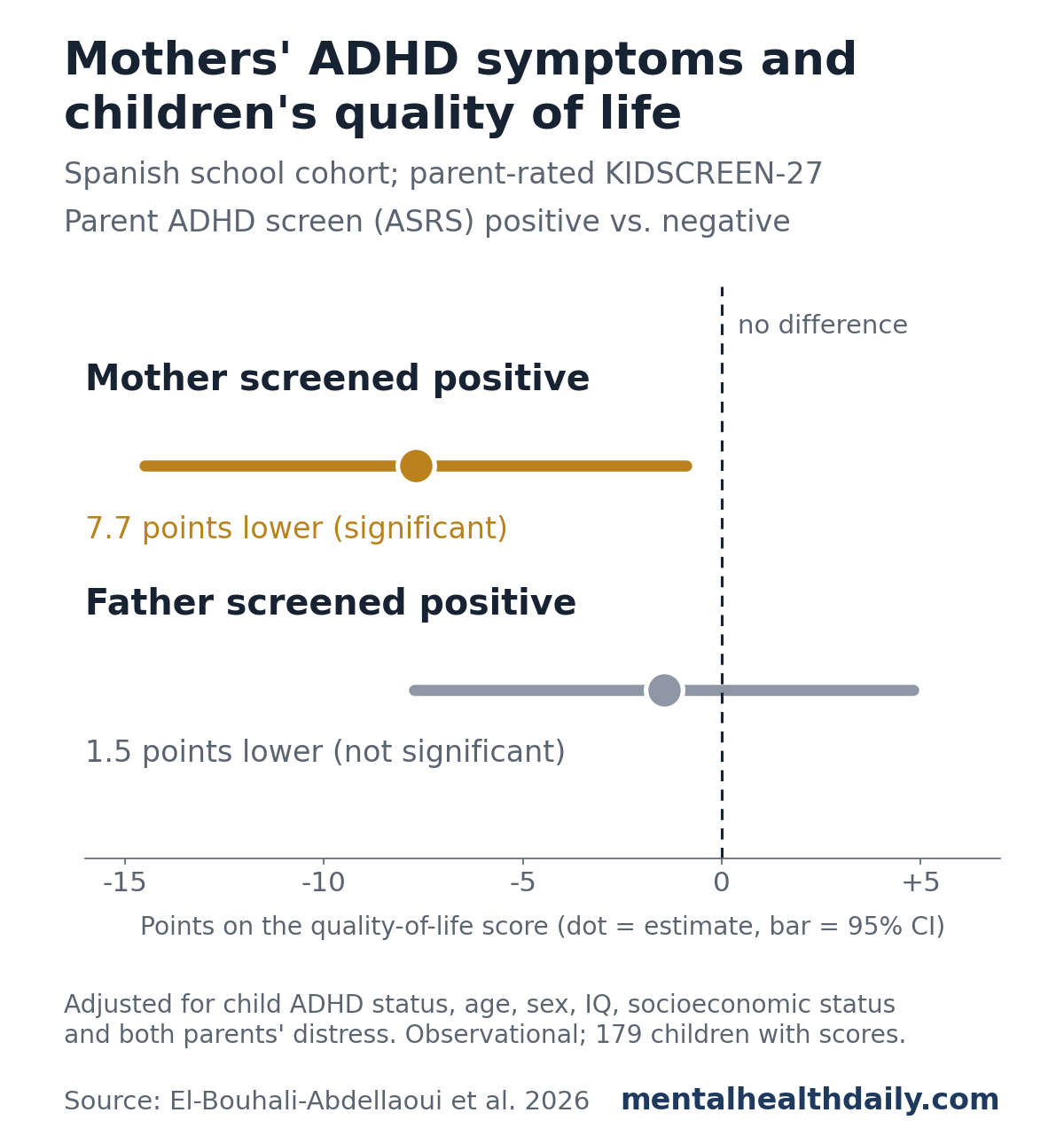
Effect size: in the comparison group, quality-of-life scores averaged 107.4 with a standard deviation of 14.5. A gap of 7.7 points is about half a standard deviation, a moderate difference. The confidence interval was wide, though, running from about 1 point to about 15 points.1
Fathers’ screens showed no such link. Children of fathers who screened positive scored only 1.5 points lower in the fully adjusted model, an estimate consistent with no difference (95% CI −7.7 to +4.8).1
Child diagnosis did not separate the groups on quality of life. Average scores were similar for children with ADHD (106.4), subthreshold symptoms (109.8) and the comparison group (107.4). Children with both ADHD and autism had the lowest average (98.9), but that group had only 10 scores.1
Mothers’ Distress Was Most Closely Linked to Children’s Emotional Problems
Before parents’ distress was considered, a positive maternal ADHD screen was linked to emotional problems such as anxiety and low mood in children. Unadjusted odds were 2.9 times higher at follow-up and 4.3 times higher for problems that persisted across both assessments, and both links held after adjusting for child factors.1
That picture changed when the researchers added parents’ psychological difficulties to the analysis. Maternal distress then became the factor most closely linked to children’s emotional problems:1
- Emotional problems at follow-up: odds ratio 4.09 (95% CI 1.98 to 8.43) for maternal distress; the maternal ADHD screen was no longer significant
- Persistent emotional problems: odds ratio 6.51 (95% CI 2.44 to 17.40) for maternal distress; again, the ADHD screen was no longer significant
In a final model that let ADHD symptoms and distress interact, both a positive maternal ADHD screen (odds ratio 8.15) and maternal distress (odds ratio 12.15) were independently linked to persistent emotional problems. Those intervals were very wide (1.74 to 38.24 for the ADHD screen) because only 38 children had persistent emotional problems.1
The consistent result is the maternal distress link. The ADHD-screen link for emotional problems depended on how the model was built.
Mothers of children with ADHD were also more often distressed: 37.6% met the GHQ-12 cutoff, compared with 20.6% of mothers in the comparison group. Fathers’ distress was not linked to children’s emotional problems.1
Children’s Own ADHD Was Linked to Conduct Problems
Conduct problems include frequent temper outbursts, fighting, lying and disobedience. For these, parents’ ADHD screens dropped out of the picture. A positive maternal screen was linked to persistent conduct problems only before adjustment (odds ratio 2.52), and the link disappeared once child factors were included.1
The child’s own ADHD diagnosis carried the association in the fully adjusted model:1
- Conduct problems at follow-up: odds ratio 2.62 (95% CI 1.26 to 5.43)
- Persistent conduct problems: odds ratio 6.84 (95% CI 2.56 to 18.28)
Persistent conduct problems affected 26.1% of children with ADHD, compared with 6.1% of the comparison group. Children with subthreshold symptoms looked like the comparison group (7.1%).1
ADHD Screens Were More Common in Mothers of Children With ADHD
Overall, 18.2% of mothers and 15.9% of fathers screened positive for ADHD symptoms. 28.2% of children had at least one parent above the cutoff, and 4.8% had both parents above it.1
Rates for mothers varied by the child’s diagnosis:
- Comparison group: 14.7%
- Subthreshold ADHD symptoms: 15.3%
- ADHD: 24.8%
- ADHD plus autism: 46.2% (6 of 13 mothers)
Fathers’ rates were nearly flat, from 15.7% to 20.0% across all 4 groups. ADHD is highly heritable, so higher rates in parents of children with ADHD are expected. The flat rate among fathers may partly reflect who actually filled out the forms.1
Other Research on Parents’ ADHD and Children’s Well-Being
The Spanish findings are consistent with a growing body of family research:
- Parenting: a 2017 meta-analysis of 32 studies found that more ADHD symptoms in parents were linked to harsher and more lax (permissive) parenting, and slightly less positive parenting. The links were small, accounting for about 3% of the variation in harsh or lax parenting.3
- Early childhood: a Canadian cohort of about 3,200 mothers and 3,200 fathers found that parents’ ASRS symptoms shortly after birth were linked to more social and emotional problems in children by age 2. Children of 2 parents with symptoms had the highest odds (odds ratio 4.43).4
- Treatment: a 2017 review estimated that one-fourth to one-half of parents of children with ADHD have ADHD themselves, which can make it harder to deliver behavioral and medication treatment for the child.5
The Canadian study found links for both mothers and fathers, with differences by child sex. The Spanish result for fathers is one null finding in one cohort, so it is weak evidence that fathers’ symptoms are unimportant.1,4
EPINED did not measure parenting, so it cannot show whether parenting style explains the maternal link. The researchers suggest that mothers’ larger share of daily caregiving may explain why maternal symptoms showed up and paternal ones did not.1
Limitations of the EPINED Parent ADHD Analysis
This was an observational study, so it shows links, not cause and effect. Several specific limits also apply:
- Same reporter: the parent who reported their own ADHD symptoms and distress also rated the child’s quality of life. A parent’s own symptoms or mood could shape how they see their child; the researchers note that maternal ADHD may influence parents’ perceptions of their child’s quality of life.
- Unknown respondent: forms went to each family as a unit, and the study did not record which parent completed them. That weakens any firm mother-versus-father comparison.
- Small quality-of-life sample: only 179 children had KIDSCREEN-27 scores, and the fully adjusted model as a whole did not reach statistical significance (p = 0.075), even though the maternal-screen coefficient did.
- Screen, not diagnosis: parents’ ADHD was a 6-question self-report screen. For 81 mothers and 63 fathers, missing baseline answers were filled in with their later scores.
- Two-way effects: a child’s emotional problems can raise a parent’s stress, and the researchers describe these links as likely running both ways.
- Sample attrition and small groups: not all children without risk were reassessed at follow-up, the comparison group was partly selected for emotional symptoms, and the ADHD-plus-autism group had only 13 children.
What This Means for Families Affected by ADHD
A family view of ADHD care: ADHD symptoms are common in parents, especially mothers of children with ADHD. The researchers recommend asking about parents’ ADHD symptoms and psychological well-being during a child’s ADHD evaluation.1
Parent well-being is part of the picture: maternal distress had the most consistent link to children’s emotional problems in this study. Support for a stressed or struggling parent can be worth pursuing on its own merits.
Not a matter of blame: ADHD runs in families through shared genes and shared environments, and this study cannot separate those paths. A parent who recognizes ADHD symptoms in themselves can talk with a doctor about a full evaluation; a positive screen alone does not establish a diagnosis.1,2,5
References
- El-Bouhali-Abdellaoui F, Voltas N, Morales-Hidalgo P, Hernández-Martínez C, Canals-Sans J. ADHD symptoms in parents of children with or without ADHD: prospective association with children’s quality of life and emotional and conduct problems (EPINED cohort). Research on Child and Adolescent Psychopathology. 2026;54:113. doi:10.1007/s10802-026-01510-6
- Kessler RC, Adler L, Ames M, et al. The World Health Organization Adult ADHD Self-Report Scale (ASRS): a short screening scale for use in the general population. Psychological Medicine. 2005;35(2):245–256. doi:10.1017/S0033291704002892
- Park JL, Hudec KL, Johnston C. Parental ADHD symptoms and parenting behaviors: a meta-analytic review. Clinical Psychology Review. 2017;56:25–39. doi:10.1016/j.cpr.2017.05.003
- Finegold KE, Wade M, Marini F, Brown HK, Vigod SN, Shiri R, Dennis CL. Associations between paternal and maternal attention deficit hyperactivity disorder and children’s socioemotional development during early childhood. Development and Psychopathology. 2026;38(1):271–281. doi:10.1017/S0954579425000276
- Chronis-Tuscano A, Wang CH, Woods KE, Strickland J, Stein MA. Parent ADHD and evidence-based treatment for their children: review and directions for future research. Journal of Abnormal Child Psychology. 2017;45:501–517. doi:10.1007/s10802-016-0238-5