Adults with opposite beliefs about sex and gender each lined up with a different form of authoritarian thinking, according to 2 preregistered surveys in the US and UK. A binary, fixed view was linked to right-wing conventionalism, and a nonbinary, changeable view to left-wing anti-conventionalism.1
Research Highlights
- 2 large samples: 1,431 US adults and 1,390 UK adults completed online surveys, published in Archives of Sexual Behavior in 2026.1
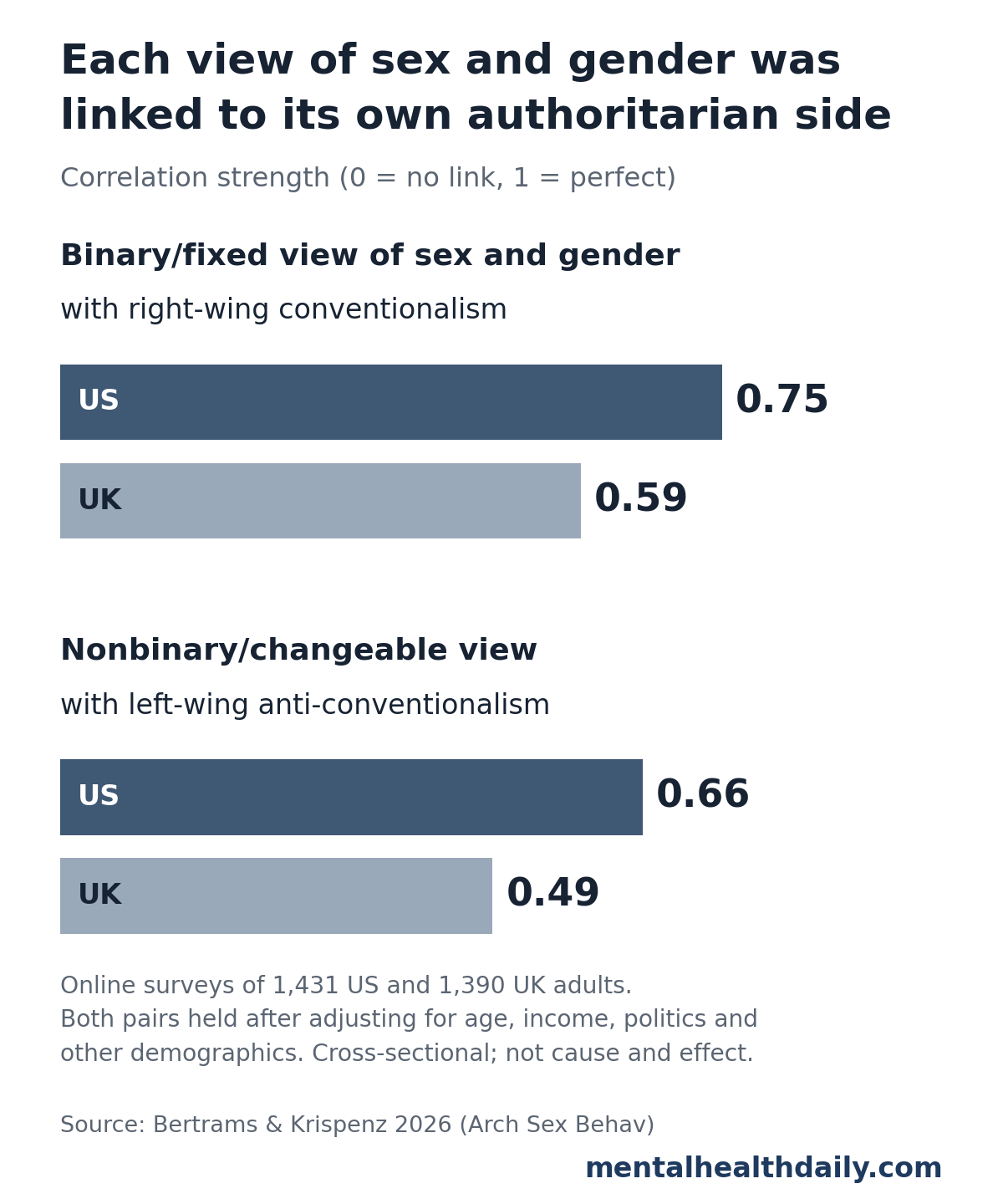
- Binary/fixed view and the right: a stronger belief that sex and gender are binary and fixed was linked to higher right-wing authoritarian conventionalism (correlation r = 0.75 in the US and 0.59 in the UK).1
- Nonbinary/changeable view and the left: a stronger belief that sex and gender are nonbinary or changeable was linked to higher left-wing authoritarian anti-conventionalism (r = 0.66 in the US and 0.49 in the UK).1
- Held after adjustment: both links remained after accounting for age, income, political orientation and other demographics.1
- Neither belief is authoritarian in itself: the researchers stress that many people holding either view scored relatively low on authoritarianism, and they attribute the links to people on each side who scored higher.1
How Researchers Measured Sex and Gender Beliefs and Authoritarianism
Alex Bertrams and Ann Krispenz of the University of Bern recruited participants through Prolific, an online research platform, using its option for samples that roughly match national demographics. Study 1 drew from the US; Study 2 repeated the design in the UK. Both studies and their predictions were registered in advance.1
Sex and gender beliefs were measured 2 ways:
- A 10-item scale: the sex/gender beliefs section of the Transgender Attitudes and Beliefs Scale (TABS), with statements such as “Although most of humanity is male or female, there are also identities in between” and “If you are born male, nothing you do will change that.” Scores run from a binary, fixed view at one end to a nonbinary, changeable view at the other.1,4
- A single question: whether, in general, there are only 2 genders or not only 2 genders.
On that single question, 57% of US participants and 68% of UK participants chose “only 2 genders.”1
What Right-Wing and Left-Wing Authoritarianism Mean Here
In psychology, authoritarianism describes a desire for everyone in a group to conform to the group’s values, along with deference to its authorities and a wish to punish people who break its norms. Researchers measure it on both sides of politics with separate questionnaires.1
- Right-wing authoritarian (RWA) conventionalism: the view that traditional values and moral standards should be followed by everyone in society. It comes from a scale that splits RWA into 3 related parts: conventionalism (traditionalism), submission to established authorities and aggression toward rule breakers.2
- Left-wing authoritarian (LWA) anti-conventionalism: the view that progressive moral values are absolutely right and that one’s social environment should share them, with conservative values and people seen as immoral. It is 1 of 3 parts of a left-wing authoritarianism index, alongside anti-hierarchical aggression and top-down censorship.3
Example items show the parallel. The conventionalism scale includes “The radical and sinful new ways of living and behaving of many young people may one day destroy our society.” The anti-conventionalism scale includes “Radical and progressive moral values can save our society.”1
A high score on either scale reflects how strongly a person wants their own moral views applied to everyone, not which side of the sex and gender debate they are on. Both scales run from 1 to 7, and average scores in both countries sat between about 3.2 and 3.6.1
Each Sex and Gender Belief Was Linked to One Side’s Authoritarianism
Results mirrored each other in both countries, as the researchers had predicted:1
- Binary/fixed view: higher right-wing conventionalism, r = 0.75 in the US and 0.59 in the UK.
- Nonbinary/changeable view: higher left-wing anti-conventionalism, r = 0.66 in the US and 0.49 in the UK.
Correlation strength (the absolute value of r) runs from 0 (no link) to 1 (a perfect match); signed r ranges from −1 to 1 and also records direction. By recent effect-size guidelines for research on individual differences, values of 0.30 and above count as strong, so all 4 qualify. The single-question measure showed the same pattern, a little more weakly (r = 0.40 to 0.57).1
Demographics did not explain it. Younger people might be expected to hold the nonbinary view and older people the binary view, and earlier research linked older age to right-wing and younger age to left-wing authoritarianism. The researchers checked this by adding all collected demographics, including age, income and political orientation, to their models. Both links stayed significant in both countries.1
In the UK, for example, each 1-point rise in left-wing anti-conventionalism went with about twice the odds of answering “not only 2 genders” (odds ratio 2.22). Each 1-point rise in right-wing conventionalism went with about one-third the odds of that answer (odds ratio 0.34), meaning higher odds of answering “only 2 genders.”1
Conventionalism Mattered More Than Other Authoritarian Traits
The UK study also measured the other parts of authoritarianism on each side, plus social dominance orientation (a preference for group-based hierarchy). This tested whether beliefs about sex and gender track conventionalism specifically or authoritarianism in general.1
With all right-wing measures in one model, they explained 41% of the variation in sex and gender beliefs; the left-wing measures together explained 29%. Within each model, the conventionalism scale carried the most weight. The numbers below are standardized weights (β), where a larger value means a stronger link after accounting for the other measures:1
- Right-wing model: conventionalism had the largest link to the binary/fixed view (β = 0.42), followed by authoritarian aggression (β = 0.33, same direction). Submission and social dominance added little (β of 0.07 or less).
- Left-wing model: anti-conventionalism had the largest link to the nonbinary/changeable view (β = 0.67). Top-down censorship added nothing significant (β = 0.03).
One unexpected result: on its own, left-wing anti-hierarchical aggression (support for overthrowing current power structures) went slightly with the nonbinary view (r = 0.14). Once anti-conventionalism was accounted for, it switched direction and was linked to the binary view (β = 0.30). The researchers flag this as a side finding that needs follow-up rather than a settled result.1
Earlier Research Looked Mostly at Right-Wing Authoritarianism
Before this study, research on sex and gender beliefs and authoritarianism focused almost entirely on the right. Those studies typically linked right-wing authoritarianism to the binary view and to less favorable attitudes toward transgender and nonbinary people:
- US survey of 808 adults: higher right-wing authoritarianism, traditional masculinity and anti-egalitarian attitudes predicted less favorable attitudes toward transgender and nonbinary people, with right-wing authoritarianism generally the strongest predictor.5
- 2022 meta-analysis: across 82 studies and 36,285 participants, authoritarianism was among the significant predictors of prejudice toward transgender people, alongside political orientation and gender-related beliefs.6
Left-wing authoritarianism had long been debated as a concept. A 2022 project by Costello et al. built and tested a measure across 6 samples totaling 7,258 people and found 3 related dimensions on the left. It also found that left-wing authoritarianism, right-wing authoritarianism and social dominance share a common core of personality traits and beliefs.3
The 2026 study is the first to apply that left-wing measure to beliefs about sex and gender. Its right-wing results replicate the earlier pattern, and its left-wing results add the matching half.1
What These Correlations Do and Do Not Show
Neither belief is authoritarian in itself. Bertrams and Krispenz call that interpretation “obviously absurd”: since both opposing beliefs correlated with authoritarianism, it would imply everyone is authoritarian. The researchers attribute the links to people who hold each view and also score relatively high in that side’s authoritarianism, while many people on both sides score low.1
The 2 sides may not be exact mirror images. The right-wing and left-wing questionnaires were built separately. The left-wing items use harsher language toward opponents (one reads “All political conservatives are fools”), so the 2 sets of correlations cannot be compared as if they were measured on one scale. The researchers also note that their results do not test “horseshoe theory,” the idea that political extremes converge.1
Limitations of the US and UK Gender Belief Surveys
- Cross-sectional design: beliefs and authoritarianism were measured at the same time, so the surveys show links, not which comes first. The researchers did not test whether authoritarian attitudes shape sex and gender beliefs or the reverse.
- Some analyses were added later: the demographic adjustments, the single-question models and the facet comparisons beyond conventionalism were not preregistered and need replication.
- Broad belief measure: the scale mixes beliefs about biological sex with beliefs about social gender, so it cannot say which part drives the links.
- 2 countries: results apply to online US and UK samples; other cultures have not been studied with this design.
- No explanations tested: the study did not examine what might account for the links, such as personality traits.
What This Means for Debates About Sex and Gender
Rigid moral certainty shows up on both sides. In these samples, the people most insistent that everyone should share their moral values were found among both those who see sex and gender as binary and fixed and those who see them as nonbinary or changeable. The researchers conclude that one-sided arguments linking only one belief to authoritarianism are shortsighted.1
The belief and the attitude are separate. Someone can hold either view about sex and gender without wanting to impose it on others. What the surveys tracked is that wish to impose: on the right it went with the binary view, and on the left with the nonbinary view.1
References
- Bertrams A, Krispenz A. Sex/gender beliefs are strongly related to either right-wing authoritarian conventionalism or left-wing authoritarian anti-conventionalism. Archives of Sexual Behavior. 2026;55:809–822. doi:10.1007/s10508-025-03371-4
- Duckitt J, Bizumic B, Krauss SW, Heled E. A tripartite approach to right-wing authoritarianism: the Authoritarianism-Conservatism-Traditionalism model. Political Psychology. 2010;31(5):685–715. doi:10.1111/j.1467-9221.2010.00781.x
- Costello TH, Bowes SM, Stevens ST, Waldman ID, Tasimi A, Lilienfeld SO. Clarifying the structure and nature of left-wing authoritarianism. Journal of Personality and Social Psychology. 2022;122(1):135–170. doi:10.1037/pspp0000341
- Kanamori Y, Cornelius-White JHD, Pegors TK, Daniel T, Hulgus J. Development and validation of the Transgender Attitudes and Beliefs Scale. Archives of Sexual Behavior. 2017;46(5):1503–1515. doi:10.1007/s10508-016-0840-1
- Perez-Arche H, Miller DJ. What predicts attitudes toward transgender and nonbinary people? An exploration of gender, authoritarianism, social dominance, and gender ideology. Sex Roles. 2021;85(3–4):172–189. doi:10.1007/s11199-020-01212-3
- Hatch HA, Warner RH, Broussard KA, Harton HC. Predictors of transgender prejudice: a meta-analysis. Sex Roles. 2022;87(11–12):583–602. doi:10.1007/s11199-022-01338-6