Adults in Hong Kong who developed diabetes by age 40 reported less diabetes distress after a year of personalized care that included genetic and biomarker testing. Over 3 years, though, the extra care did not lower their rate of diabetes complications.1
Research Highlights
- A large randomized trial: the PRISM trial assigned 884 Chinese adults with young-onset diabetes to personalized JADE-PRISM care (441) or a JADE risk report plus usual clinic care (443). Results were published in Diabetes Care in 2026.1
- No drop in complications: 26.3% of the JADE-PRISM group and 28.2% of the JADE-only group developed a new or worsening diabetes complication or died within 3 years (odds ratio 0.908, 95% CI 0.675–1.221).1
- Less distress at year 1: the JADE-PRISM group had larger improvements in 3 areas of diabetes stress (treatment routine, social support and doctors), plus empowerment and several self-care habits.1
- One gain lasted: by year 3, most of those differences had faded, but distress related to doctors was still lower in the JADE-PRISM group.1
- Better risk factors: 23.8% of the JADE-PRISM group reached 3 or more strict treatment targets at year 3, compared with 12.2% of the JADE-only group.1
- Open-label: patients and clinicians knew which care they were getting, which matters for self-reported outcomes like distress.1
Why Young-Onset Diabetes and Diabetes Distress Matter
Young-onset diabetes here means non-type 1 diabetes diagnosed at age 40 or younger. It tends to progress faster than diabetes that starts later, and younger patients are often left out of the big outcome trials that shape treatment guidelines.1
It is also harder to sort out. A small share of young patients actually have an autoimmune form (marked by GAD antibodies) or a single-gene form called monogenic diabetes, sometimes known as MODY. These types call for different treatment than typical type 2 diabetes.1
Diabetes distress is the emotional burden of living with and managing diabetes: worry about blood sugar, frustration with the daily routine, and strain in dealing with family or doctors. It is different from clinical depression, and it is common. A meta-analysis of 55 studies (36,998 people) estimated that 36% of adults with type 2 diabetes have it.2
What JADE-PRISM Added to Standard Care
Both groups started with a JADE assessment, a structured checkup built on the web-based Joint Asia Diabetes Evaluation platform that produces a personalized risk report. The 2 arms then split:1
- JADE only (443 people): received the JADE report, then went back to their usual clinics for care under local guidelines, with access to the same medications. They got their genetic and biomarker results only when the study ended.
- JADE-PRISM (441 people): moved to a specialist diabetes center for 1 year of intensified team care, then returned to their usual clinics with a yearly review by the diabetes team in years 2 and 3.
During that first year, the JADE-PRISM group received several extras:1
- A biogenetic report: testing for GAD antibodies, fasting C-peptide (a marker of how much insulin the body still makes), gene sequencing for 34 monogenic diabetes genes, and 3 polygenic risk scores. A nurse explained the JADE report within 4 weeks, and an endocrinologist went over the biogenetic results within 12 weeks.
- Attention to questionnaires: clinicians reviewed patients’ answers about well-being, distress and self-care to spot problems that could get in the way of managing diabetes.
- Visits every 3 months: treatment followed algorithms guided by the test results, aiming for strict targets such as HbA1c below 6.2% and blood pressure below 120/75 mmHg.
- Ongoing support: nurses and care assistants gave psychosocial support and reminders about taking medications and checking blood sugar, blood pressure and weight.
Diabetes Distress Eased in Year 1, and Doctor-Related Distress Stayed Lower
At 1 year, the JADE-PRISM group improved more than the JADE-only group on 3 parts of the Chinese Diabetes Stress Scale:1
- Regimen distress: stress about the daily treatment routine
- Social support distress: stress about help from family and friends
- Physician distress: stress about the relationship with doctors
They also scored higher on the Diabetes Empowerment Scale and on several self-care habits, including overcoming barriers, eating to plan and checking blood sugar. Self-reported medication adherence did not differ between groups.1
Most of these differences faded over time. At year 3, physician-related distress was still significantly lower in the JADE-PRISM group, and that group also reported better perceived control over their diabetes.1
The authors suggest that explaining what was causing each person’s diabetes helped patients and clinicians make decisions together. The trial did not test that idea directly, and the paper reports the questionnaire results by significance rather than giving effect sizes in the main text.1
Complications Did Not Fall, but Risk Factors Improved
The trial’s primary outcome was a composite of any new or worsening diabetes complication, including heart disease, stroke, kidney disease, eye disease and nerve damage, or death. Over 3 years it occurred in 116 of 441 JADE-PRISM patients (26.3%) and 125 of 443 JADE-only patients (28.2%), a difference that could easily be due to chance.1
The trial was designed to detect a 40% reduction in that composite. The result stayed nonsignificant after adjusting for baseline differences (odds ratio 0.921), in a per-protocol analysis (0.897) and after excluding 68 people with autoimmune or monogenic diabetes (0.874).1
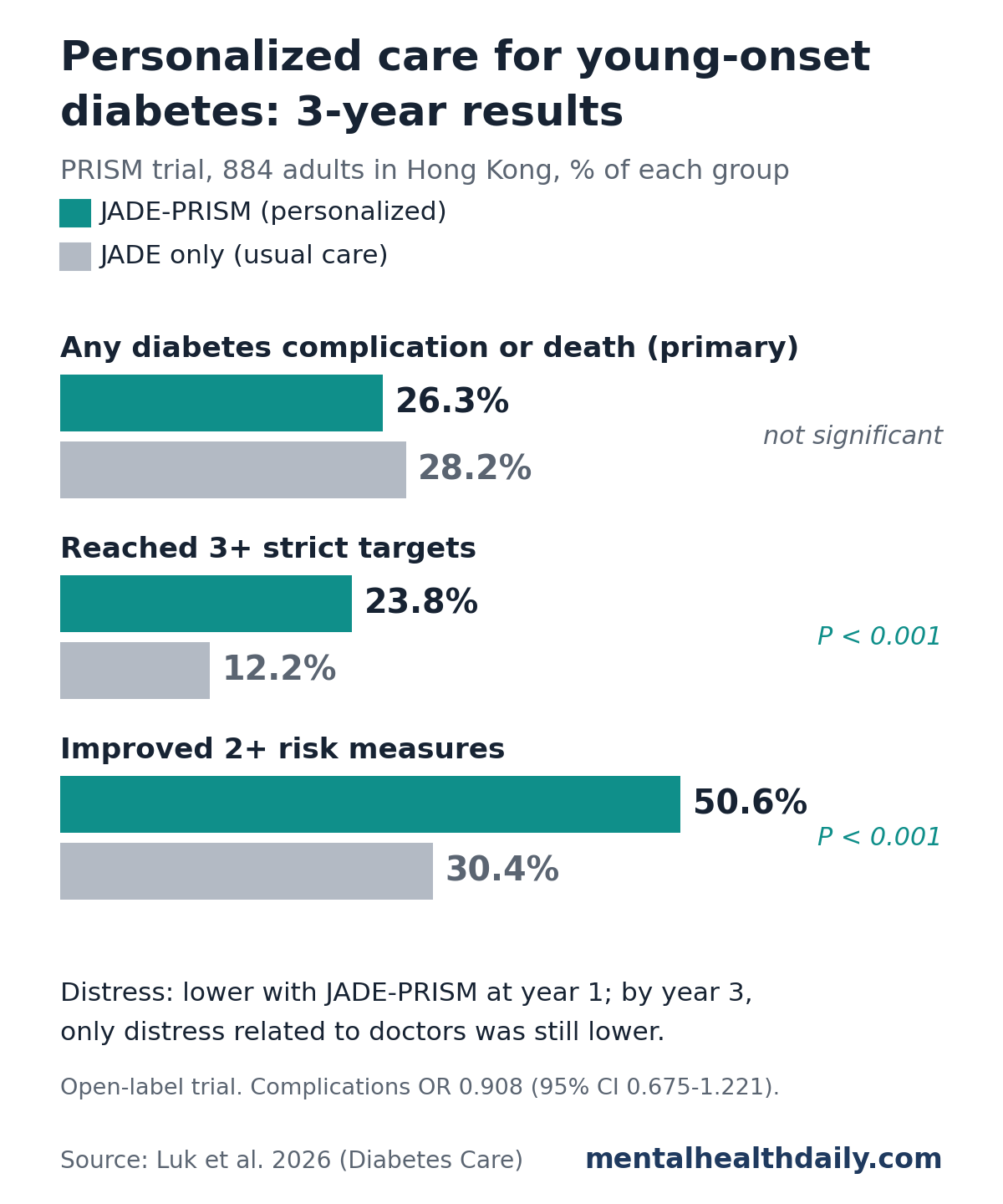
Risk factors told a different story. At year 3, the JADE-PRISM group had better average changes in:1
- HbA1c: −0.2% vs. +0.1% (P = 0.015)
- Systolic blood pressure: −6.6 vs. −1.7 mmHg (P < 0.001)
- Body weight: −1.8 vs. −0.6 kg (P = 0.004)
More JADE-PRISM patients started newer drugs. GLP-1 receptor agonist use rose from 4.8% to 30.9%, compared with 5.6% to 14.9% in the JADE-only group, and SGLT2 inhibitor use rose from 28.6% to 62.2%, compared with 29.9% to 49%. Severe low blood sugar requiring a hospital stay occurred once in the JADE-PRISM group and 5 times in the JADE-only group.1
Testing turned up 46 people (5.2%) with GAD antibodies, 23 (2.6%) with monogenic diabetes and 82 (9.3%) with low C-peptide. Within these subgroups, blood sugar measures did not differ by group.1
How PRISM Fits With Earlier Trials
The pattern of better risk factors without a clear drop in hard outcomes has shown up before. In the Japanese J-DOIT3 trial of 2,542 adults with type 2 diabetes, intensive treatment to strict targets did not significantly reduce the main cardiovascular outcome (hazard ratio 0.81, 95% CI 0.63–1.04), although strokes and related events were less common. PRISM borrowed its strict treatment targets from J-DOIT3, which followed patients for more than 8 years.3
The distress results line up with other work:
- Genetic risk counseling: in an earlier Hong Kong trial from the same group (GEM), 435 adults with type 2 diabetes all had genetic testing. Adding personalized counseling on genetic risk did not improve target attainment, but in a per-protocol analysis the counseled group had higher empowerment and less diabetes distress.4
- Distress is changeable: in the US REDEEM trial of 392 adults with type 2 diabetes and distress, all 3 programs reduced distress, with no difference between them. Patients with high regimen distress did better with a program that targeted distress directly.5
Together, these trials suggest that more attention, clearer explanations and stronger support can ease diabetes distress. PRISM adds that the effect may fade once the intensive phase ends, except for patients’ sense of their relationship with their doctors.
Limitations of the PRISM Trial
- Open-label design: patients and clinicians knew who received JADE-PRISM, which can push self-reported measures such as distress and empowerment in its favor. Data analysts were blinded to participant identity.
- Null primary outcome: the trial was built to test complications and did not find a reduction. The distress findings come from secondary outcomes.
- Many parts at once: genetic testing came bundled with a specialist team, more frequent visits, strict targets and nurse support, so the trial cannot show which part helped.
- A strong comparison group: the JADE-only group also received a personalized risk report with an explanation and had access to the same drugs, which may have narrowed the differences.
- Short follow-up for complications: 3 years is a short time for complications to show up. The authors note that benefits from better risk-factor control could emerge with longer follow-up.
- One setting: a single endocrinologist-led center in Hong Kong, where care is highly subsidized, with Chinese participants only.
- Conflicts of interest: 2 senior authors are coinventors on patents for biomarker-based diabetes prediction, and 3 authors cofounded a precision diabetes care company. The JADE platform was developed by a foundation the corresponding author leads without pay.
What This Means for People With Young-Onset Diabetes
Distress deserves attention. A year of care that explained the causes of each person’s diabetes, reviewed how they were coping and offered regular support eased several kinds of diabetes stress. Anyone feeling worn down by their diabetes can raise it with their care team, since distress responds to support.
Testing helps a minority. About 1 in 13 participants had an autoimmune or monogenic form of diabetes. For them, an accurate diagnosis can change treatment, and finding monogenic diabetes can lead to screening of relatives.1
Complications need longer follow-up. Better blood pressure, weight and target attainment could still pay off over time, but this trial did not show fewer complications within 3 years.
References
- Luk AOY, O CK, Fan B, Lau ESH, Fan Y, Lim C, et al. Precision Medicine to Redefine Insulin Secretion and Monogenic Diabetes (PRISM): a randomized controlled trial in Chinese patients with young-onset diabetes. Diabetes Care. 2026;49(7):1202–1212. doi:10.2337/dc26-0114
- Perrin N, Davies MJ, Robertson N, Snoek FJ, Khunti K. The prevalence of diabetes-specific emotional distress in people with Type 2 diabetes: a systematic review and meta-analysis. Diabetic Medicine. 2017;34(11):1508–1520. doi:10.1111/dme.13448
- Ueki K, Sasako T, Okazaki Y, et al. Effect of an intensified multifactorial intervention on cardiovascular outcomes and mortality in type 2 diabetes (J-DOIT3): an open-label, randomized controlled trial. The Lancet Diabetes & Endocrinology. 2017;5(12):951–964. doi:10.1016/S2213-8587(17)30327-3
- Ma RCW, Xie F, Lim CKP, et al. A randomized clinical trial of genetic testing and personalized risk counseling in patients with type 2 diabetes receiving integrated care: the genetic testing and patient empowerment (GEM) trial. Diabetes Research and Clinical Practice. 2022;189:109969. doi:10.1016/j.diabres.2022.109969
- Fisher L, Hessler D, Glasgow RE, et al. REDEEM: a pragmatic trial to reduce diabetes distress. Diabetes Care. 2013;36(9):2551–2558. doi:10.2337/dc12-2493