
A virtual reality (VR) headset and a simple hand massage from a companion both eased pain and anxiety during emergency room stitches, compared with usual care alone, in a 2026 randomized trial involving 87 adults in Iran.1
Research Highlights
- 3 arms: 90 adults with cuts needing sutures were randomized to usual care, usual care plus a companion’s hand massage, or usual care plus a VR headset showing calming nature videos; 87 were analyzed.1
- Less pain with both add-ons: average pain after suturing was 1.3 out of 10 with VR and 1.7 with companion touch, vs. 3.6 with usual care. Both differences held after adjusting for age and starting pain.1
- Less anxiety with both add-ons: anxiety scores fell by 27 points with VR and 25 with touch, vs. 7.5 with usual care, on a 20-80 scale.1
- VR vs. touch: pain was similar between the 2 add-ons. VR had lower anxiety than touch, though that comparison came with a statistical warning.1
- Open-label, single hospital: patients knew which option they got, and the researcher who delivered it also asked the pain and anxiety questions.1
Why Stitches Cause Both Pain and Anxiety
Cuts are one of the most common reasons people end up in the emergency department. Even with numbing medicine, suturing involves needle sticks, tugging and a bright, busy room, and many patients are tense before the first stitch.1
Pain and anxiety feed each other: fear can make pain feel sharper, and pain raises fear. That is why researchers have been testing low-cost, drug-free add-ons that target the experience of the procedure rather than the wound itself.1
How the Iranian ER Trial Compared VR, Companion Touch and Usual Care
Tooba Khajehhasani-Rabori et al. ran the trial in the minor procedure room of the emergency department at Shahid Bahonar Hospital in Kerman, Iran. Adults with a cut of at least 2 cm needing stitches were eligible; people with head or face wounds, recent pain or anxiety medicine, or serious psychiatric illness were excluded.1
Everyone got the same standard care: wound cleaning, lidocaine (a local anesthetic injected to numb the skin), and stitches by the same emergency physician. Every patient also had one companion with them. On top of that, patients were randomly assigned to 1 of 3 groups:1
- Usual care (30 analyzed): standard care only.
- Companion-delivered touch (27 analyzed): the patient closed their eyes and breathed deeply while the companion massaged the hand opposite the injury throughout the procedure.
- VR (30 analyzed): a smartphone-based headset with noise-canceling headphones played 360-degree videos of forests, ocean shores, skies and polar landscapes, starting 5 minutes before the first stitch.
What “therapeutic touch” meant here: the paper uses that name, which in nursing can also refer to an energy-healing practice. In this trial it was a plain, structured hand massage by the companion who came in with the patient.1
Companions watched a 3-minute video, practiced while a researcher watched, and then worked through 3 stages:1
- Gentle pressure: light, rhythmic fingertip pressure on the palm, the pads at the base of the thumb and little finger, and the webs between the fingers.
- Finger squeeze: gently squeezing and rotating each finger from base to tip.
- Circular massage: slow circles over the back of the hand and fingers.
Distraction is the idea behind VR: a full field of sight and sound pulls attention away from the procedure, leaving less room to focus on the needle. Touch is thought to work partly through the nervous system, since gentle pressure signals from the skin can dampen pain signals in the spinal cord, and partly through the comfort of a familiar person.1
Measures: pain on a 0-10 visual analog scale (VAS) and state anxiety (how anxious someone feels right now) on the State-Trait Anxiety Inventory, scored 20-80. Both were asked 5 minutes before the numbing shot and within 2 minutes after the last stitch. Pain change was the main outcome.1
VR and Companion Touch Both Beat Usual Care for Pain and Anxiety
Pain and anxiety fell in all 3 groups, but they fell further with either add-on:1
- Pain after suturing (0-10): usual care 3.60, companion touch 1.70, VR 1.27.
- Pain drop: 2.50 points with usual care, 3.63 with touch, 4.17 with VR.
- Anxiety after suturing (20-80): usual care 54.87, touch 41.56, VR 38.13.
- Anxiety drop: 7.50 points with usual care, 25.04 with touch, 27.40 with VR.
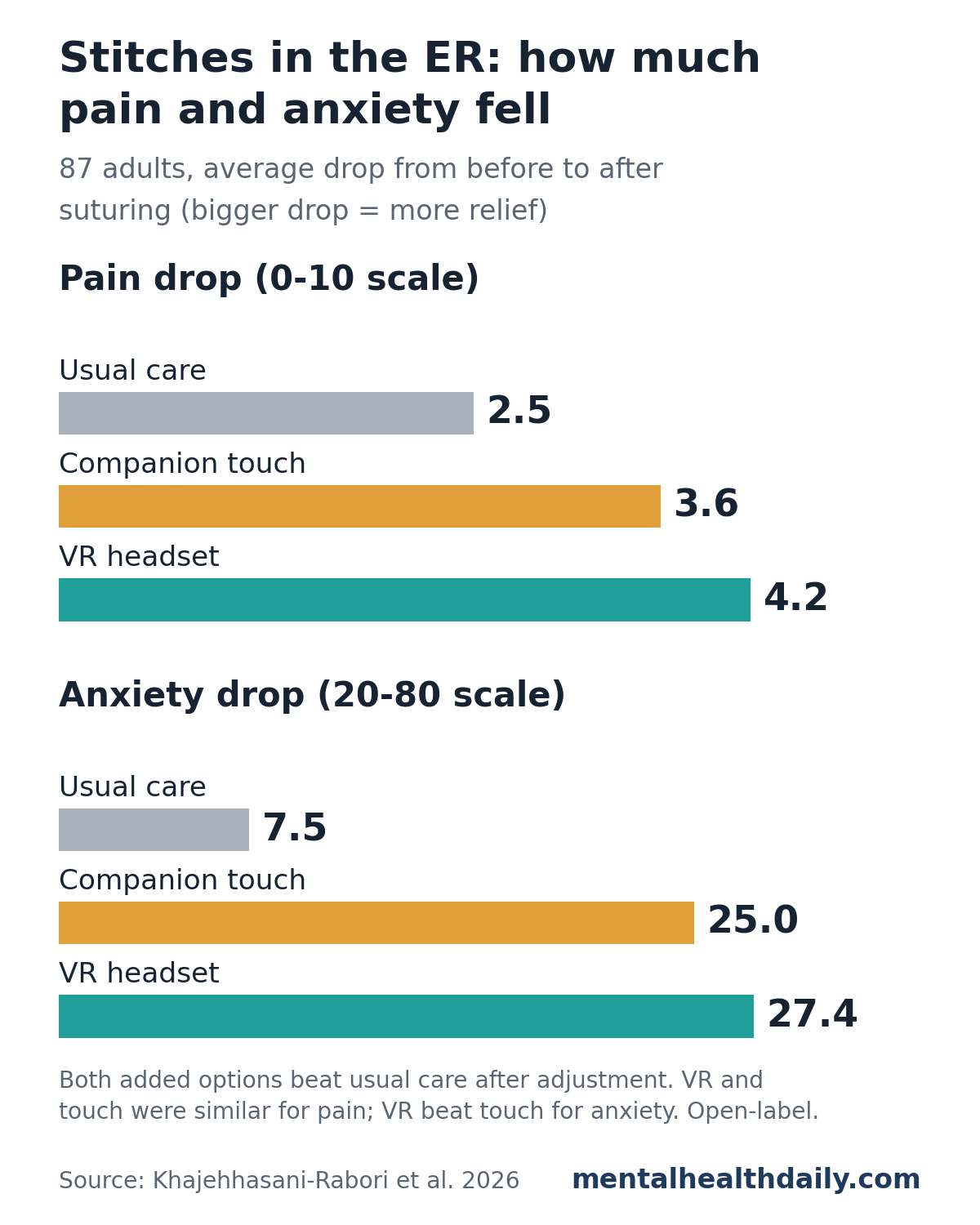
Adjusting for uneven groups: the usual-care group was older (average age 36 vs. 28-30) and started out somewhat less anxious. To account for this, the researchers used a rank-based adjusted analysis (Quade’s nonparametric ANCOVA) that controlled for starting scores and age. Both add-ons still had clearly lower pain and anxiety than usual care (P < 0.001).1
VR Matched Companion Touch for Pain and Edged It for Anxiety
Pain: VR came out slightly lower than touch, but the gap was not statistically significant in either the simple comparison (P = 0.317) or the adjusted one (P = 0.096). On this evidence, the 2 options eased stitch pain about equally.1
Anxiety: VR had lower post-procedure anxiety than touch, 38.1 vs. 41.6 (P = 0.031 unadjusted; P < 0.001 adjusted). The researchers flagged that the adjusted anxiety result depended on how anxious patients were at the start (a significant interaction), so they advised caution with it.1
No side effects were reported in any group, including dizziness or nausea from the headset. Three companions in the touch group declined to do the massage before it started, and those patients were dropped from the analysis.1
Other Trials of VR for Stitches and Touch During Procedures
The VR result is consistent with earlier emergency department research:
- Hong Kong pilot trial: in 80 adults having wounds stitched, adding VR to standard care led to larger reductions in anxiety and pain than standard care alone.2
- Meta-analysis of laceration repair: pooling 6 randomized trials with 607 patients, VR reduced pain and fear during emergency laceration repair. The pooled anxiety reduction was not statistically significant, and all included trials had some risk-of-bias concerns.3
Head-to-head comparisons of VR and touch are rare. A 3-arm trial in Turkey compared VR glasses, therapeutic touch and standard care in 96 women having intrauterine insemination. VR lowered procedure pain more than both touch and standard care, both add-ons lowered anxiety compared with standard care, and women were most satisfied with touch.4
Across these studies, VR shows a fairly steady pain benefit, while the anxiety results are less consistent. The Iranian trial adds the first direct test of VR against a companion’s touch during emergency suturing.
Limitations of This Emergency Suturing Trial
- No blinding: patients knew their group, and the researcher who delivered the VR or coached the massage also collected the pain and anxiety ratings by interview. That setup can push self-reported scores toward the expected result, especially for anxiety, where the drops with either add-on were unusually large.
- Uneven starting groups: age and baseline anxiety differed by group. Adjustment helps, but cannot fully fix imbalance in a small trial.
- Small, single site: 87 adults at 1 hospital, recruited by convenience during certain shifts.
- Touch group losses: 3 patients whose companions declined were not analyzed, so that arm reflects companions willing to take part.
- Short-term only: ratings were taken minutes after the last stitch. Extra anesthetic use and patient satisfaction were not reported.
- Unclear timeline: the paper says the trial was registered before enrollment on July 3, 2026, but the journal received the manuscript on July 11, 2026. The paper does not explain how enrollment fit into that window.
What This Means for Patients Getting Stitches
Both options added to numbing, not replaced it. Every patient still got lidocaine. VR and touch made the experience less painful and less stressful on top of standard care.1
A companion’s hand can help when no headset is available. The massage cost nothing, needed only a short video for training, and eased pain about as well as VR in this trial. VR may have an edge for anxiety, but that comparison needs confirmation in larger, better-blinded trials.
It is reasonable to ask. Some emergency departments already offer VR distraction. If you or someone you are with needs stitches, asking whether a companion can stay and hold or massage the patient’s free hand is a low-risk request.
References
- Khajehhasani-Rabori T, Haji-Maghsoudi S, Mehdipour-Rabori R. Virtual reality versus companion-delivered therapeutic touch for reducing pain and anxiety during suturing: a randomized controlled trial. International Journal of Emergency Medicine. 2026;19:225. doi:10.1186/s12245-026-01360-5
- Ko SY, Wong EML, Ngan TL, Leung HK, Kwok KTY, Tam HF, Chan CC. Effects of virtual reality on anxiety and pain in adult patients undergoing wound-closure procedures: a pilot randomized controlled trial. Digital Health. 2024;10:20552076241250157. doi:10.1177/20552076241250157
- Liang JS, et al. Effects of virtual reality on procedural emotional distress during laceration repair in emergency departments: a systematic review with meta-analysis. International Emergency Nursing. 2026. PubMed 41856001
- Bal S, Karakaya N, Koç E, Güven D. The effect of virtual reality (VR) glasses and therapeutic touch (TT) on pain, anxiety, and patient satisfaction during intrauterine insemination (IUI) compared to standard care: a single-blind, randomized controlled trial. BMC Pregnancy and Childbirth. 2025;25(1):361. doi:10.1186/s12884-025-07435-0