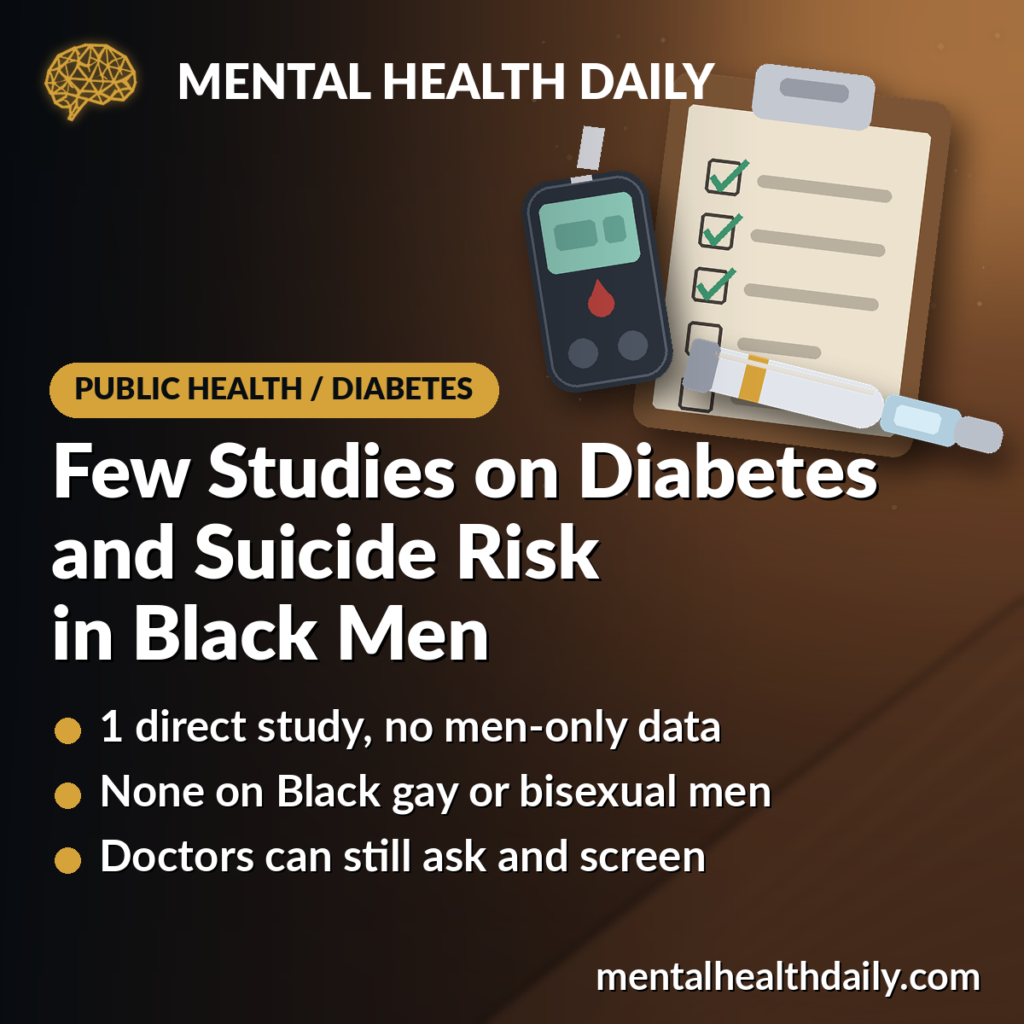
Almost no research has measured suicide risk in Black men with diabetes, and none has looked at Black gay, bisexual and other sexual minority men with diabetes, according to a 2026 review. The review argues that primary care can still check for distress and suicide risk now.1
Research Highlights
- 1 directly relevant study: it compared 412 African American adults with type 1 diabetes and 404 without. Lifetime suicide attempts were 13.3% vs. 3.5%, but results were not reported separately for men.1
- No data on Black sexual minority men with diabetes: the review found no study estimating suicidal thoughts, attempts or deaths in this group, so there is no risk figure to report.1
- Known risk factors converge: depression, diabetes distress, treatment burden, complications, discrimination in health care and money pressures all show up among Black men with diabetes.1
- Screening tools are untested in this group: common depression, diabetes-distress and suicide-risk questionnaires have broad support, but their accuracy in Black men with diabetes has not been established.1
- Diabetes is linked to suicide risk overall: a 2017 meta-analysis of 54 studies found a 56% higher suicide risk in people with diabetes (relative risk 1.56).2
How the Review Searched for Evidence on Diabetes and Suicide in Black Men
Donte Boyd et al., researchers at Ohio State University and the University of Michigan, searched 5 research databases for studies published from January 2000 through August 2026. They asked what is known about diabetes-related suicide risk in Black men and what primary care clinicians can reasonably do with that evidence.1
Because they expected few studies to cover all of these topics at once, they sorted the literature into 5 streams:1
- Direct studies of diabetes and suicide outcomes in Black participants
- General diabetes and suicide research that explains clinical pathways
- Research on diabetes disparities and suicide in Black men
- Studies of minority stress, heart and metabolic health, and health care among Black sexual minority men
- Primary care screening and intervention research
Black sexual minority men here means Black men who identify as gay, bisexual, queer or another nonheterosexual identity, or who were counted as sexual minority men in a study based on attraction or behavior.
The review treats them as a subgroup of Black men, not a separate population, and does not treat sexual orientation as interchangeable with gender identity.1
This is a narrative review: the authors read and summarized the studies rather than pooling them into a single statistical estimate.
Diabetes Is Linked to Higher Suicide Risk Overall, but Estimates Vary
Research on diabetes and suicide is uneven. A 2017 meta-analysis of 54 studies found that diabetes was linked to a 56% higher risk of suicide overall (relative risk 1.56, 95% CI 1.29–1.89), and to more than double the risk in type 1 diabetes (relative risk 2.25).2
Other work is less clear-cut. A 2024 meta-analysis of 31 studies in adolescents and young adults with type 1 diabetes found suicidal thoughts in 15.4% and suicide attempts in 3.5%. Those rates were not clearly higher than in peers without diabetes, because the estimates were imprecise and varied widely between studies.3
Pathways the review identified across diabetes types:1
- Depression: consistently linked to poorer diabetes outcomes and higher suicide risk
- Diabetes distress: feeling overwhelmed, discouraged, unsupported or burdened by the daily work of managing diabetes
- Treatment fatigue: wearing down under constant self-care demands
- Complications: pain, disability and fear of future illness
- Role loss: disruption of work, family or social life
Diabetes distress is related to depression but is a separate problem, which is why the review recommends asking about each one.1
The review also cautions clinicians not to read missed insulin doses, uneven medication use or unstable blood sugar as self-harm without asking the person directly.1
One Direct Study Found More Suicide Attempts in Black Adults With Type 1 Diabetes
The most directly relevant study, published in 2010 by Roy et al., compared 412 African American adults with type 1 diabetes with 404 African American adults without diabetes.1,4
- Lifetime suicide attempts: 13.3% with type 1 diabetes vs. 3.5% without
- Factors linked to attempts in the diabetes group: being female, depression, childhood trauma, hostility, smoking, and alcohol or drug misuse
- What it did not report: separate figures for men
Beyond that study, the review found no population-based study and no long-term follow-up study reporting suicidal thoughts, attempts or deaths specifically in Black men with diabetes. That 2010 study also covered only type 1 diabetes.1
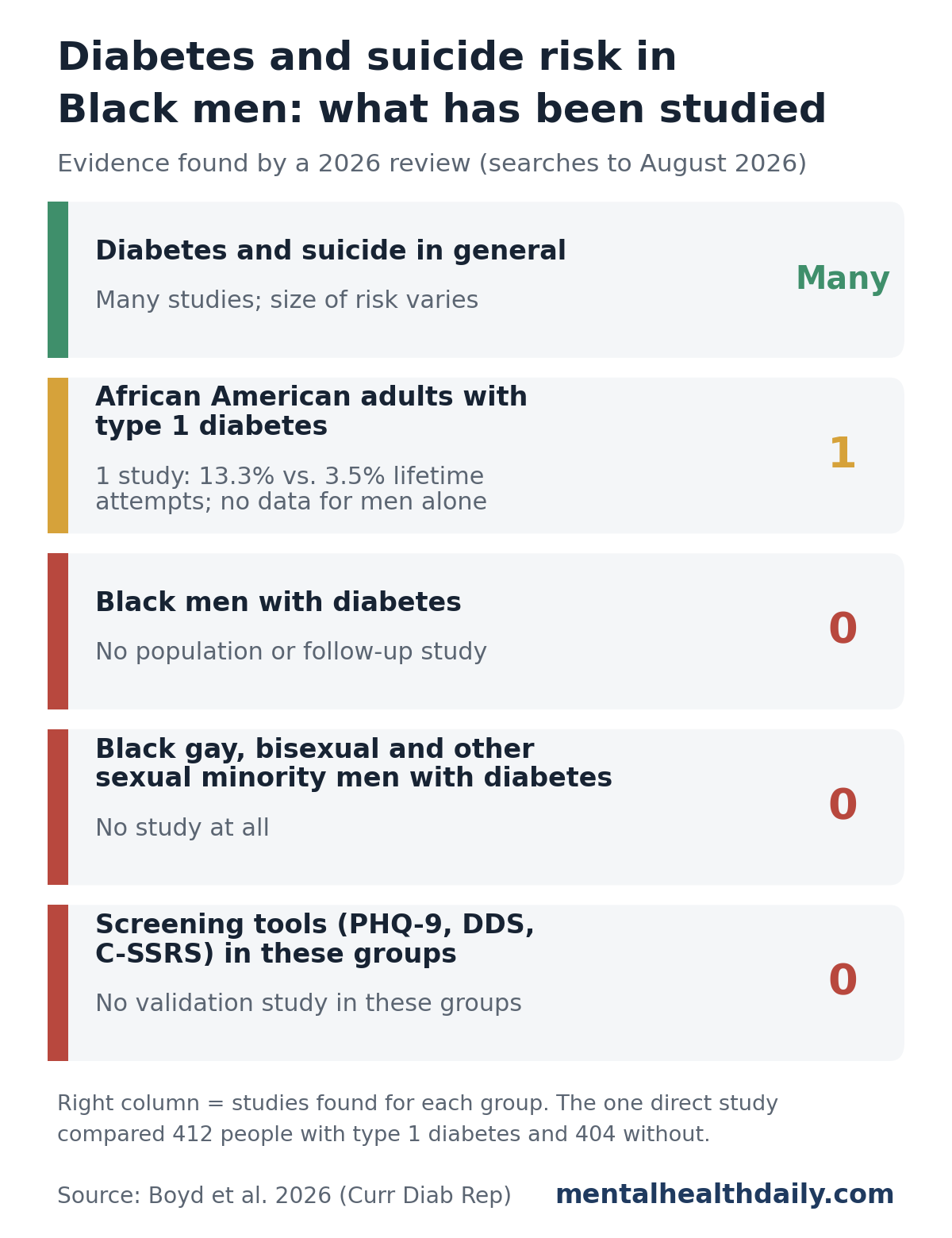
Current evidence therefore cannot show whether diabetes raises suicide risk more for Black men than for White men, and it cannot support a prevalence estimate for Black men with diabetes. What it does show is that several known risk processes converge in this group.1
Racism, Cost Barriers and Health Care Discrimination Add to the Diabetes Burden for Black Men
Black men carry a disproportionate share of type 2 diabetes and of complications such as kidney disease and lower-limb problems. The review attributes these gaps to structural racism and its consequences, not to inherent biology.1
Structural and daily barriers the review named:1
- Unequal opportunity: residential segregation, unequal education and jobs, environmental exposures and underinsurance
- Cost and logistics: medication and food prices, transportation, inflexible work schedules, unstable housing and family demands
- Chronic stress: long-term exposure to discrimination, which may affect stress hormones, inflammation, sleep and coping
When clinicians read these barriers as personal nonadherence, they can miss how treatment burden builds into shame, frustration and hopelessness. The review describes this as a plausible, changeable pathway that has not yet been tested in Black men.1
Discrimination in diabetes care: in a study involving 163 Black adults with type 2 diabetes (85 men and 78 women), men reported more racial discrimination in health care than women. Discrimination was linked to higher hemoglobin A1c (a measure of average blood sugar) in men but not in women.1
Experiences like these can produce well-founded mistrust and make people less willing to mention depression or suicidal thoughts. Separate studies of Black men link racial discrimination to depression and to thoughts of suicide or death.1
Suicide rates: suicide is less common among Black men than White men overall, but the age-adjusted rate among non-Hispanic Black men rose to 13.1 per 100,000 in 2020, and more recent national data show significant increases across several age groups of Black Americans.1
Masculine norms: expectations of self-reliance and stoicism can make it harder for some Black men to talk about emotional pain. The review stresses that faith, family commitment, racial pride and community responsibility are also strengths, and that peer-led, culturally tailored diabetes programs for Black men have proven workable in early studies.1
No Research Yet on Black Gay and Bisexual Men With Diabetes and Suicide Risk
Black sexual minority men can face racism and heterosexism together, along with pressure to hide their identity, family rejection, housing or money instability and isolation. The review describes these stressors as reinforcing one another rather than simply adding up.1
What adjacent research shows:1
- Suicidal thoughts and behaviors: national data show gay and bisexual adults generally report more than heterosexual adults across many racial and ethnic groups, though subgroup estimates vary.
- Discrimination: in Black sexual minority men, discrimination based on both race and sexual orientation is linked to psychological distress and depression.
- Young Black sexual minority men: studies of young Black sexual minority men link anticipated discrimination to suicidal behaviors and point to positive identity and other personal strengths as possible buffers.
- Health care stigma: in a study of HIV prevention care, expecting stigma from health care was linked to much lower use of preventive medication. The review suggests the same dynamic could affect diabetes care and disclosure of distress, an idea that still needs testing.
Diabetes itself: evidence on sexual orientation and diabetes is mixed and rarely broken down by race. In one national study, bisexual behavior was linked to diabetes, while sexual minority identity and attraction were not.1
The review found no study estimating suicidal thoughts, attempts or deaths among Black sexual minority men with diabetes. It calls them a high-priority group because several established risk processes may converge, and states that a multiplied “triple jeopardy” effect has not been demonstrated.1
How Primary Care Can Screen for Suicide Risk in Black Men With Diabetes
Diabetes is often managed in primary care over years, and many people who die by suicide had recent contact with health services. Short visits, competing demands and weak referral pathways make that contact harder to use well.1
Common screening tools:1
- PHQ-9 (Patient Health Questionnaire-9): a 9-question depression screen whose last item asks about thoughts of death or self-harm. It is broadly validated, and a large study found only clinically negligible differences in how its items performed across broad racial and ethnic groups.
- DDS (Diabetes Distress Scale): measures the emotional burden of living with diabetes. It is reliable across diverse clinics, but cutoffs for this group have not been checked.
- C-SSRS (Columbia-Suicide Severity Rating Scale): a structured interview about suicidal thoughts and behavior, with support in mixed clinical samples but no validation study in Black men with diabetes.
No one has shown that these tools work worse in Black men with diabetes; the evidence simply has not been gathered. The review recommends using them to open a conversation, not to replace it.1
A positive answer on the last PHQ-9 item calls for direct follow-up, and a negative answer should not end the conversation when other warning signs are present.1
The review’s primary care framework has 5 linked steps:1
- Identify: check emotional well-being and diabetes distress periodically, and ask directly about suicide when symptoms, health changes, losses or patient statements raise concern.
- Assess: use the C-SSRS or a similar protocol alongside a clinical interview about intent, past behavior, protective factors and access to lethal means.
- Ask about context: racism, mistrust, masculine expectations, sexual minority stress, family responses and money strain, without assuming heterosexuality and using the patient’s own words for identity and relationships.
- Respond: build a safety plan together, make a warm handoff to behavioral health care and arrange timely follow-up.
- Support: partner with Black community organizations and groups serving Black sexual minority men, and back clinicians with training and protected time.
Insulin and safety planning: safety planning should include safe access to medications, including insulin, and other lethal means such as firearms. Any change to diabetes treatment should be made jointly with the patient and diabetes team, because abrupt or punitive insulin restriction can damage trust and is medically dangerous.1
Limitations of This Diabetes and Suicide Review
- Narrative, not systematic: study selection followed relevance to a narrow question, and no results were pooled.
- Very little direct evidence: most conclusions rest on adjacent, often cross-sectional studies (single-time-point snapshots) that can suggest pathways but cannot show cause or a combined effect.
- Mixed study types: diabetes type, treatment, age, suicide outcome and follow-up varied widely.
- Blurred categories: race, sex, gender, sexual identity, attraction and behavior are inconsistently recorded and often lumped together, which can hide differences within groups.
The review calls for long-term studies that link clinical and death records, include enough Black men and Black sexual minority men, separate type 1 from type 2 diabetes, and test how well screening tools work in these groups.1
What This Means for Patients and Primary Care
Diabetes stress is worth raising. Feeling worn down by blood sugar checks, costs, complications or unfair treatment in health care is a real burden, and the review treats it as something clinicians should ask about directly.1
Clinicians can ask directly. The review urges plain, specific questions about distress and suicide, read alongside the patient’s situation rather than a single screening score.1
Trust shapes care. Respectful communication, shared decisions, affordable treatment and continuity with clinicians who earn trust are the changeable targets the review highlights.1
If you or someone you know is struggling, help is available. In the United States, call or text 988 to reach the 988 Suicide & Crisis Lifeline. Elsewhere, contact local emergency services or a local crisis line.
References
- Boyd DT, Hawkins J, Mitchell J. Diabetes and suicide risk among Black males, including sexual minority males: a narrative review with primary care implications. Current Diabetes Reports. 2026;26:32. doi:10.1007/s11892-026-01647-0
- Wang B, An X, Shi X, Zhang JA. Management of endocrine disease: suicide risk in patients with diabetes: a systematic review and meta-analysis. European Journal of Endocrinology. 2017;177(4):R169–R181. doi:10.1530/EJE-16-0952
- Renaud-Charest O, Stoljar Gold A, Mok E, et al. Suicidal ideation, suicide attempts, and suicide deaths in adolescents and young adults with type 1 diabetes: a systematic review and meta-analysis. Diabetes Care. 2024;47(7):1227–1237. doi:10.2337/dc24-0411
- Roy A, Roy M, Janal M. Suicide attempts and ideation in African-American type 1 diabetic patients. Psychiatry Research. 2010;179(1):53–56. doi:10.1016/j.psychres.2010.06.004