Heart surgery patients who slept poorly around their operation had lower heart rate variability before surgery and on each of the next 3 days, according to a 2026 study of 95 adults in China.1
Research Highlights
- Poor sleep was common: 33 of 95 cardiac surgery patients scored above 7 on the Pittsburgh Sleep Quality Index (PSQI), the cutoff the researchers used for a sleep disorder.1
- Lower variability at every time point: compared with the 62 better sleepers, poor sleepers had lower values on 5 of 8 heart rate variability measures (HF, SDNN, SDANN, pNN50 and RMSSD) the day before surgery and on postoperative days 1, 2 and 3.1
- Strongest link on day 1: pNN50 measured the day after surgery had the closest correlation with poor sleep (r = −0.78). Poor sleepers averaged 6.3% vs. 10.3% in better sleepers.1
- Surgery lowered everyone’s readings: heart rate variability fell in both groups on day 1 and recovered only partly by day 3.1
- Observational evidence: the study shows a link, not which came first, and it did not track recovery or complications. Earlier research on insomnia and heart rate variability has been mixed.4,5
What Heart Rate Variability Measures
Heart rate variability (HRV) is the small, constant change in time between one heartbeat and the next. A healthy heart does not tick like a metronome: the gap between beats stretches and shrinks with breathing, posture and stress.
Much of that beat-to-beat flexibility comes from the vagus nerve, the main nerve of the parasympathetic or “rest-and-digest” system, which slows the heart. When the body is under stress, the sympathetic “fight-or-flight” system becomes more active and the rhythm becomes steadier and less variable.
Higher HRV at rest usually means more flexible control of the heart and more rest-and-digest activity. Lower HRV usually points to stress, illness, fatigue or weaker vagal control.2
The study used 8 standard HRV measures. The ones that separated the 2 sleep groups were:
- RMSSD: the typical size of the change from one beat to the next, in milliseconds. It is the main time-based marker of vagal activity.2
- pNN50: the percentage of consecutive beats whose spacing differs by more than 50 milliseconds. It tracks closely with RMSSD.
- HF power: variation that rises and falls with breathing, another vagal marker.
- SDNN and SDANN: broader measures of overall variability, reflecting both branches of the nervous system.
Three measures did not differ between groups: LF power, the LF/HF ratio and SDNNI. LF and the LF/HF ratio mix sympathetic and parasympathetic influences and are harder to interpret.
How the Nanjing Heart Surgery Study Worked
Tingting Lu and Jiudong Chen followed adults having heart surgery with cardiopulmonary bypass (a heart-lung machine) at Nanjing First Hospital between January 2023 and December 2024. Of 116 patients screened, 21 were excluded for reasons such as cancer, active infection, severe liver or kidney disease, or incomplete data.1
- Patients: 95 adults, average age about 70, roughly half men
- Sleep: the PSQI, a widely used 18-item questionnaire scored 0 to 21, completed on day 3 after surgery; a score above 7 placed patients in the poor-sleep group
- Heart rhythm: a 5-minute resting ECG after 15 minutes lying down, recorded the day before surgery and on days 1, 2 and 3 after
- Blinding: staff who scored sleep did not see the HRV data
The 2 groups were similar going in. Age, sex, body mass index, diabetes, high blood pressure, smoking and drinking did not differ significantly between poor and better sleepers.1
Poor Sleepers Had Lower HRV Before and After Heart Surgery
The gap was already there the day before surgery and persisted through day 3. pNN50 showed it most clearly:1
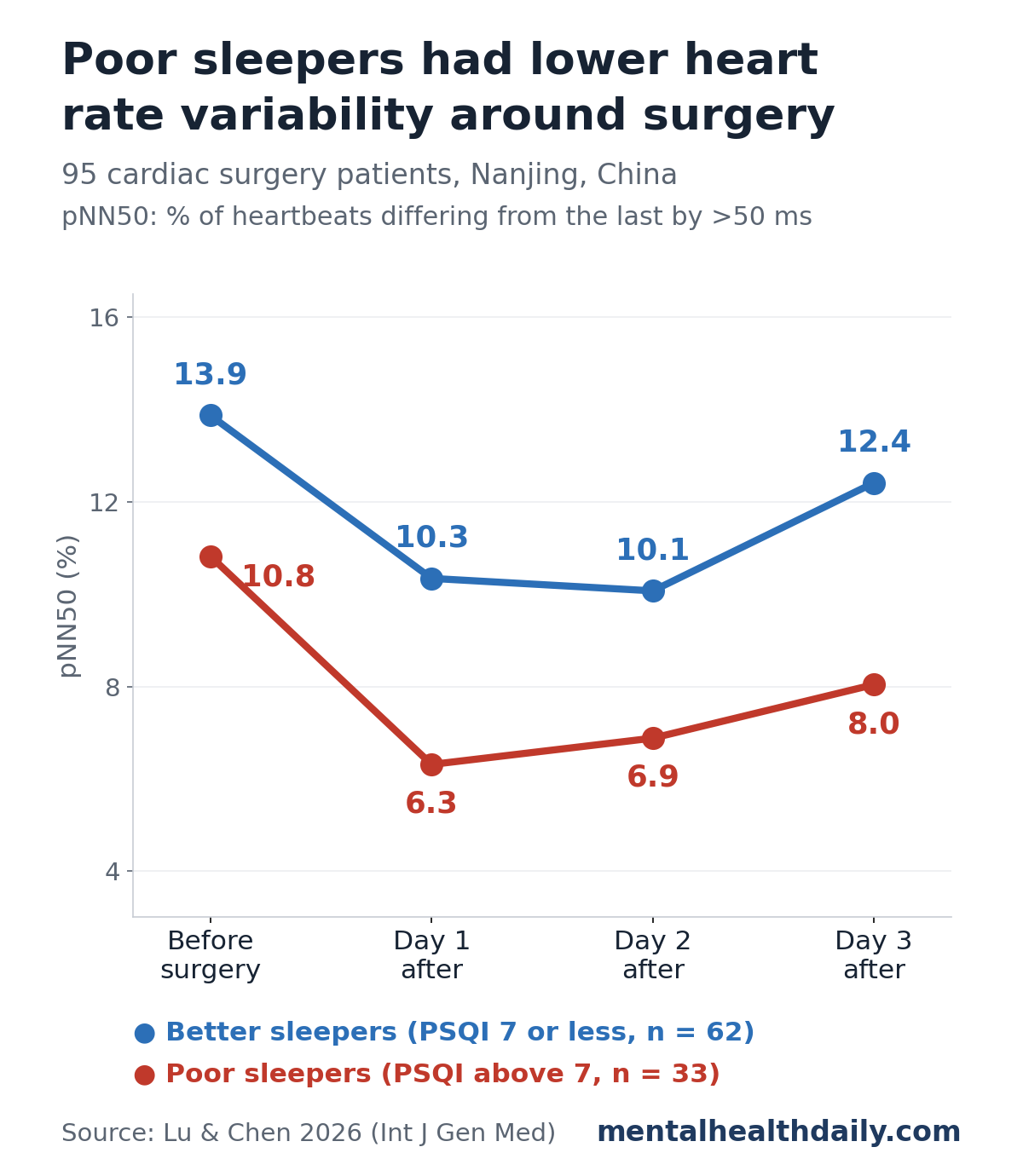
RMSSD followed the same pattern. Poor sleepers averaged 27.4 ms before surgery vs. 33.5 ms in better sleepers, and 16.9 vs. 24.7 ms on day 1. By day 3 the gap had narrowed to 20.8 vs. 24.6 ms, but it was still significant.1
HF power, SDNN and SDANN were also lower in poor sleepers at all 4 time points. SDNN, for example, was 121.7 vs. 132.8 ms the day before surgery.1
Surgery itself pulled HRV down: every measure changed significantly over time. In both groups, HRV dropped sharply on day 1 and climbed back only part of the way by day 3, while the LF/HF ratio rose on day 1, a pattern consistent with stress-driven sympathetic activity after a major operation.1
pNN50 Had the Strongest Link to Poor Sleep
The researchers then narrowed the 32 readings (8 measures at 4 time points) to the ones most strongly linked to poor sleep, using a statistical screening method called Lasso regression followed by logistic regression. Nine readings remained, all from HF, SDANN, pNN50 or RMSSD.1
Each had an odds ratio below 1, meaning higher HRV went with lower odds of being in the poor-sleep group. pNN50 on day 1 stood out: in the regression model, each 1-point higher pNN50 went with about 84% lower odds of poor sleep (odds ratio 0.157).1
A separate correlation analysis found that all selected readings were negatively correlated with poor sleep, with coefficients from −0.40 to −0.78. Day-1 pNN50 again had the strongest link (r = −0.78), which is large for a clinical study.1
Effect sizes in context: correlations this strong in a 95-person, single-hospital sample can shrink in larger studies, especially when a model picks the best performers from 32 candidate readings and is tested on the same patients.
Earlier Studies on Sleep and Heart Rate Variability Are Mixed
The idea that poor sleep goes with weaker vagal control is not new, but the evidence outside surgery is less tidy than this study suggests.
- Before an operation: in a 2020 study of 61 women having gynecologic surgery, poor sleepers had lower RMSSD, pNN50 and HF power before anesthesia. Those differences disappeared once general anesthesia began.3
- Insomnia review: a 2017 critical review found that studies differed widely in patients, protocols and HRV processing, most had a high risk of bias, and the authors could not confirm that HRV is reliably lower in insomnia.4
- Insomnia meta-analysis: a 2022 meta-analysis pooled 17 studies with 921 participants and found a small effect (R = 0.19) that did not clearly confirm blunted HRV in insomnia disorder.5
The Nanjing results are consistent with the presurgery finding in the gynecologic study and extend it to the days after heart surgery. They are much larger than the effects seen in general insomnia research, which may reflect the specific stress of cardiac surgery, the way groups were defined, or the small sample.
Limitations of This Heart Surgery Sleep Study
- Association only: poor sleep could lower HRV, low HRV could reflect a stress state that also disrupts sleep, or both could stem from pain, illness severity or the ICU environment. The researchers state that cause and effect cannot be established.
- One sleep questionnaire, given after the fact: the PSQI was filled out once, on day 3 after surgery, and was used to label all 4 HRV readings, including the one taken before surgery.
- Medications not accounted for: beta-blockers, sedatives and opioids, all common around heart surgery, can change HRV and sleep, and the paper does not report adjusting for them.
- Mixed equipment: recordings came from 3 types of ECG devices. The methods describe 5-minute recordings, while broader measures such as SDANN are normally based on 24-hour recordings.
- Small, single-center sample: 95 patients from 1 hospital, with only 33 poor sleepers.
- No clinical outcomes: the study did not measure complications, length of stay or recovery, so it cannot say whether lower HRV in poor sleepers made any difference to how patients did.
- Some reporting inconsistencies: the paper calls the design both a cohort and a case-control study, and the abstract lists an SDNN group effect that the results table does not support.
What This Means for Sleep Around Heart Surgery
Poor sleep and low HRV went together. In this study, patients who reported bad sleep also showed less flexible heart rhythm control, starting the day before surgery and continuing through the first 3 days after.
HRV is a possible early warning sign that still needs testing. The researchers suggest bedside HRV monitoring could help flag patients whose sleep and stress responses need attention. That idea needs larger, multicenter studies that also follow patient outcomes.
Sleep is worth raising with the care team. Sleep around heart surgery is often disrupted by pain, noise and overnight checks.1 Patients who have trouble sleeping before or after an operation can tell their nurses or surgeons, who can look for causes such as pain or noise that may be fixable.
References
- Lu T, Chen J. Correlation analysis of sleep quality and heart rate variability in patients undergoing cardiac surgery: a prospective observational cohort study. International Journal of General Medicine. 2026;19:619140. doi:10.2147/IJGM.S619140
- Shaffer F, Ginsberg JP. An overview of heart rate variability metrics and norms. Frontiers in Public Health. 2017;5:258. doi:10.3389/fpubh.2017.00258
- Ho CN, Fu PH, Chen JY, et al. Heart rate variability and surgical pleth index under anesthesia in poor and normal sleepers. Journal of Clinical Monitoring and Computing. 2020;34(6):1311–1319. doi:10.1007/s10877-019-00450-5
- Dodds KL, Miller CB, Kyle SD, Marshall NS, Gordon CJ. Heart rate variability in insomnia patients: a critical review of the literature. Sleep Medicine Reviews. 2017;33:88–100. doi:10.1016/j.smrv.2016.06.004
- Zhao W, Jiang B. Heart rate variability in patients with insomnia disorder: a systematic review and meta-analysis. Sleep and Breathing. 2023;27(4):1309–1313. doi:10.1007/s11325-022-02720-0