When teens with depression were hospitalized after a suicide attempt, they and their parents described stress moving in both directions, from child to parent and back again. That pattern came from separate interviews with 12 teens and 12 of their parents at a psychiatric hospital in China.1
Research Highlights
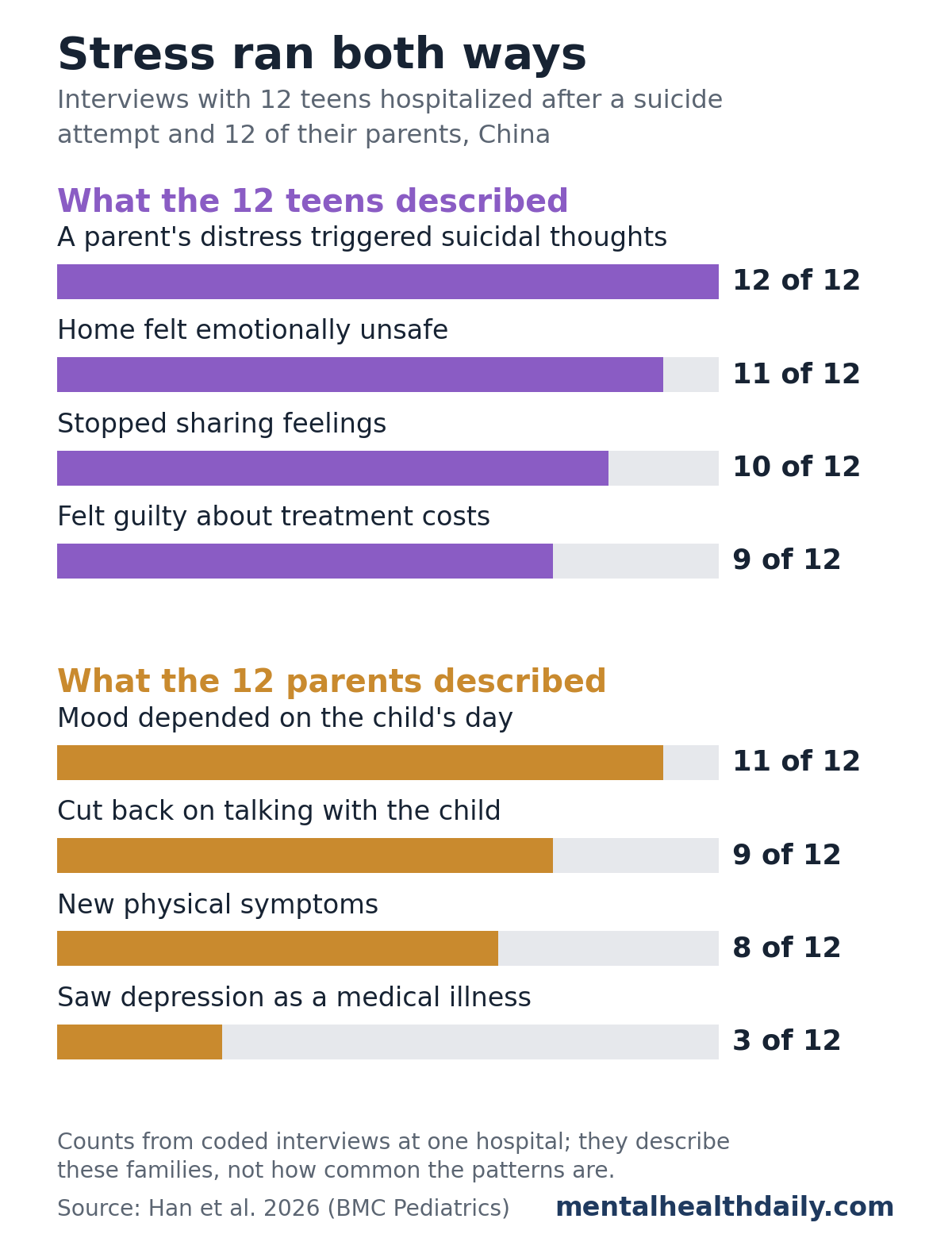
- Parents’ moods reached their teens: all 12 teens described a parent’s anxiety or distress as a trigger for their own suicidal thoughts, and 11 of 12 parents said their mood rose and fell with how their child was doing that day.1
- Both sides went quiet: 10 of 12 teens had stopped sharing their feelings with their parents, and 9 of 12 parents had cut back on talking, mostly out of fear of setting off a relapse.1
- Depression was often misread: only 3 of 12 parents understood depression as a medical condition; the rest tended to see it as weakness or a choice, and every teen named feeling misunderstood as a main source of their suicidal thoughts.1
- Money, stigma and delays added pressure: families spent an average of 42,500 yuan a year on treatment, about a third of the local median household income, and waited an average of 5.3 months for proper psychiatric care.1
- Small qualitative study: the counts describe 24 people at one hospital. They show shared experiences, not how common these patterns are in all families.1
Who Took Part in the Chinese Teen Suicide-Attempt Interviews
Yan Han et al. recruited families at the Third People’s Hospital of Huai’an City, a mental health hospital in Jiangsu province, between August and October 2024. The study was published in BMC Pediatrics in 2026.1
- Teens: 12 inpatients aged 12 to 17 (average 14.9), 7 girls and 5 boys, all with a severe depressive episode and a suicide attempt in the month before admission
- History: depressive symptoms had lasted an average of 8.7 months before hospitalization, and 9 of the 12 teens had made more than one previous attempt
- Parents: each teen’s main caregiver, 7 mothers and 5 fathers aged 34 to 44
This was a qualitative study, meaning researchers interviewed people in depth and looked for shared themes rather than measuring outcomes with scales. Teens and parents were interviewed separately on the same day, for about 30 to 40 minutes each, so neither would shape the other’s answers.1
Interviews covered how each person’s illness experience affected the other, willingness to share feelings, changes in family life and what support they needed. Two researchers coded the transcripts independently and agreed closely (Cohen’s kappa 0.87, a standard measure of rater agreement).1
Stress Passed From Parents to Teens and Back Again
The researchers grouped what families said into 4 connected themes. The first, stress running both ways, showed up in both bodies and moods.1
Physical toll on teens: 11 of 12 reported constant fatigue, 10 had sleep problems and 9 described aches and pains with no clear medical cause. Teens also described parents who did not treat these symptoms as real and kept up the pressure about schoolwork.1
Physical toll on parents: 8 of 12 parents had developed new physical symptoms since their child’s diagnosis, most often headaches (7) and digestive problems (6).1
Emotional feedback loop: teens described parental anxiety and worry as something that deepened their own distress. Parents, in turn, said their own mood rose and fell with their child’s. One parent called their son “my mood barometer.”1
Teens Stopped Talking While Parents Avoided Hard Topics
The second theme was a breakdown in communication. Both sides pulled back, for different reasons.1
- Teens withdrew to protect themselves: 10 of 12 had stopped sharing their feelings with their parents, often after being scolded for “overreacting,” and 11 of 12 described home as emotionally unsafe.
- Parents went quiet out of fear: 9 of 12 had reduced how often they talked with their child, and 8 avoided mental health topics completely, even though they could see their child was still struggling.
Researchers also found the same events described in opposite ways. Parents often saw their behavior as support, while teens experienced it as control: 8 of 12 teens read their parents’ caregiving as an attempt at control, and 7 reported more suicidal thoughts in response to what they saw as their parents’ sacrifices.1
Understanding depression: only 3 of 12 parents described depression as a medical illness. The other 9 tended to blame personal weakness or bad choices, and one parent suspected their son was faking. All 12 teens said feeling misunderstood by their parents was a main source of their suicidal thoughts.1
The researchers describe parents’ actions as coming from a wish to protect their child, and much of the harm as unintentional. Many parents were exhausted, frightened and unsure what to say.1
Family Strain and Treatment Costs Fed the Cycle
The third theme covered how the illness reshaped family life. Among the 12 families:1
- Routines: 10 described a complete breakdown of normal family routines
- Roles: 9 described confusion about who was responsible for what
- Marriages: 7 reported marital strain or separation
- Parent-child bond: 11 said the relationship had gotten much worse
Treatment costs: families spent an average of 42,500 yuan a year on treatment, which the researchers put at 34.2% of the median household income in the region. 4 families spent more than 50,000 yuan. Medical insurance in China covers only part of psychiatric care.1
Work: 5 parents had their jobs disrupted by caregiving, 3 took extended leave and 7 families lost more than 30% of their income.1
The money worries reached the teens. 9 of 12 felt guilty about what their treatment cost, and 7 named the financial burden as one of the things feeding their suicidal thoughts.1
Stigma, Late Diagnosis and School Barriers Left Families Without Support
The fourth theme was a lack of outside help. Families described several gaps:1
- Stigma: 11 of 12 families had faced discrimination or social rejection over their child’s mental health. One parent described hiding their son’s condition from friends and contacts.
- Delayed care: on average, 5.3 months passed between the first symptoms and proper psychiatric care. 8 of 12 families first went to non-specialist providers, and one rural family described not recognizing depression at all at first.
- Returning to school: 10 of 12 teens ran into obstacles going back to school after hospitalization, and 7 had to provide extensive medical paperwork and signed liability waivers.
The researchers argue that these outside pressures fed back into the family: shame made it harder to ask for help, and school barriers added stress for teens trying to return to normal life.1
Larger Chinese Studies Also Link Parenting and Family Conflict to Teen Suicidal Thoughts
The interview themes are consistent with survey research in China:
- Parenting style in teens with depression: a study of 1,604 Chinese adolescent patients with depression found that the 609 with suicidal thoughts reported less emotional warmth from both parents and more interference from their mothers than those without suicidal thoughts.2
- Parental conflict and attachment: a survey of 1,028 middle school students aged 10 to 19 in Liaoning province linked strong perceived conflict between parents to higher risk of suicidal intent, and strong attachment to a mother or father to lower risk. Attachment explained part of the conflict link.3
- Parents after an attempt: interviews with 15 Chinese family caregivers of teens who had attempted suicide described intense negative emotions, many practical dilemmas, little outside support and an urgent need for information on how to help.4
The 2026 interviews add the parents’ side of the same relationship, showing how a parent’s own stress, health and fears can shape the conversations a struggling teen has at home.
Limitations of This Qualitative Study of Teens and Parents
- Small sample: 12 families from one hospital. Each person counts for about 8% of a group, so the percentages describe these families only, not how common these experiences are.
- Severe cases: every teen was hospitalized with severe depression, and most had made more than one attempt. Families in community care may look different.
- One point in time: each person was interviewed once during a hospital stay, so the study cannot show how these relationships change over recovery.
- Perceptions, not causes: teens’ accounts of what triggered their distress are their own experiences. The study cannot show that parents’ behavior caused suicide attempts.
- Interviewer role: all interviews were done by the department’s head nurse, which may have influenced what people chose to share.
- Chinese context: academic pressure, family expectations, stigma and out-of-pocket costs may differ in other countries.
What This Means for Families of Teens With Depression
Support the whole family, not only the teen. Parents in this study were often physically unwell, anxious and short on information. The researchers call for family-centered care: treatment that includes caregivers, helps them manage their own stress and teaches families to communicate about depression. This study did not test any specific program.1
Learning about depression can change conversations. Most parents here saw depression as weakness, while teens felt deeply misunderstood. Understanding depression as a treatable illness, not a character flaw, is a practical starting point for parents.1
Keep talking, gently. Teens in this study wanted to be understood even when they had stopped talking, and parents’ silence came from fear rather than indifference. Listening without judgment and asking directly about how a teen is feeling are ways to keep that door open.1
Outside barriers need fixing too. The researchers point to stigma, slow access to psychiatric care, treatment costs and school re-entry rules as problems families cannot solve alone.1
If you or someone you know is struggling, help is available. In the United States, call or text 988 to reach the 988 Suicide & Crisis Lifeline. Elsewhere, contact local emergency services or a local crisis line.
References
- Han Y, Sun R, Tang Y, Wei C. Bidirectional pathways to suicide: how parent-child interactions shape adolescent depression and suicidality in China. BMC Pediatrics. 2026;26:869. doi:10.1186/s12887-026-07402-4
- Liu J, Cheng C, Edeleva K, Zhao Z, Yang L, Kang C, Wang X, Zhao N, Hu J. Association of parental rearing styles with suicidal ideation in Chinese adolescent patients with depression: a large-scale cross-sectional study. Frontiers in Psychiatry. 2024;15:1414887. doi:10.3389/fpsyt.2024.1414887
- Wang J, Chen K, Huang X, Jin Z, He J, Han B, Feng L, Meng N, Yang C, Yao P, Li Z. Parent-child attachment mediates the association between parental conflict perceptions and suicide intention: a cross-sectional survey among middle school students in China. Frontiers in Public Health. 2024;12:1332095. doi:10.3389/fpubh.2024.1332095
- Wang X, Miu Q, Wang J, Huang X, Xie W. Caregiving information needs of family caregivers of adolescent patients with suicide attempts: a qualitative study in China. BMC Nursing. 2024;23(1):445. doi:10.1186/s12912-024-02120-7