Research on how emergency departments break bad news mostly measures how confident staff feel, not how patients and grieving families fare afterward, according to a 2026 scoping review of 156 publications.1
Research Highlights
- Training was judged by staff confidence: of 36 evaluations of bad-news training, 23 measured confidence or comfort, mostly by self-report. None measured outcomes for patients or relatives.1
- Few studies watched real conversations: no training evaluation observed actual emergency department conversations, and only a handful of studies of any kind examined real encounters.1
- Most publications reported no new data: only 60 of 156 were empirical studies; the rest were mainly training program reports and educational articles.1
- Borrowed scripts dominated: SPIKES, a protocol built for cancer care, was the most cited of 25 frameworks. Only 3 were designed for emergency departments.1
- Families asked for honesty and presence: patients and relatives most often wanted honesty, clarity, a clinician who stays with them, and emotional support.1
- Delivery can change grief outcomes elsewhere: in a French intensive care trial, relatives offered longer end-of-life meetings with more time to talk had fewer PTSD-related symptoms 90 days after the death (45% vs. 69% with the usual meeting).5
Why Bad News in the Emergency Department Is Different
Emergency clinicians often meet patients and families for the first time, in the middle of a crisis. The news might be a sudden death, a cancer found on a scan, or a decision that further treatment will not help.
That news often arrives in a crowded, noisy department with little privacy. In some health systems, as many as 50% of cancer diagnoses are first identified in the emergency department.1
How the news is delivered can affect the people who hear it. Graham Johnson et al., a UK team led by an emergency physician, note that insensitive delivery has been associated with more intense grief, complicated bereavement and psychological distress in patients and relatives.1
Staff feel the strain too. In an Irish survey cited by the researchers, only 39% of less experienced emergency clinicians felt comfortable discussing end-of-life care, and 79% of all respondents wanted more training.1
How the Review Mapped 156 Publications on ER Bad News
A scoping review maps everything written on a topic, whatever the study design or quality, to show what kinds of evidence exist and where the gaps are. It does not grade studies or pool results, so it cannot say which approach works best.
The team searched 4 medical databases in July 2025, plus gray literature such as reports and guidelines. From 7,985 database records and 285 other records, 156 publications met the criteria. Children’s emergency care was excluded.1
3 kinds of bad news: the review defined bad news broadly and counted publications in each group:1
- Serious or life-limiting diagnosis (71 publications): news that needs admission, tests or treatment, including miscarriage
- Terminal diagnosis (43): death is imminent or highly likely, often in end-of-life or palliative care talks
- Death of a patient (42): telling relatives or friends that someone has died
What the literature consisted of:
- Empirical studies: 60 publications (38%), mostly surveys (25) and interviews (15)
- Training program reports: 51 (33%)
- Educational and review articles: 31 (20%)
- Other: editorials, letters, guidelines, a book chapter, a blog and a personal reflection
The United States contributed 85 publications and the United Kingdom 18, out of 26 countries in total. Output grew from 2010 onward and peaked in 2023, with 17 publications.1
ER Bad-News Training Was Mostly Judged by Staff Confidence
Of the 51 training program reports, 36 included some evaluation. Most used before-and-after questionnaires, and 30 of the 36 relied on Likert-type rating scales (agree-to-disagree scales).1
- Confidence or comfort: the most common outcome, measured in 23 of 36 evaluations
- Improvement in at least one outcome: reported in 14 of 36
- Skills rated by an observer: only 5 of 36, all in simulation or role-play, usually with locally made checklists
- Patient or relative outcomes: 0 of 36
Simulation was the most common format, used in 23 evaluations. Of those, 19 reported positive results, 2 were neutral and 2 gave no outcome data.1
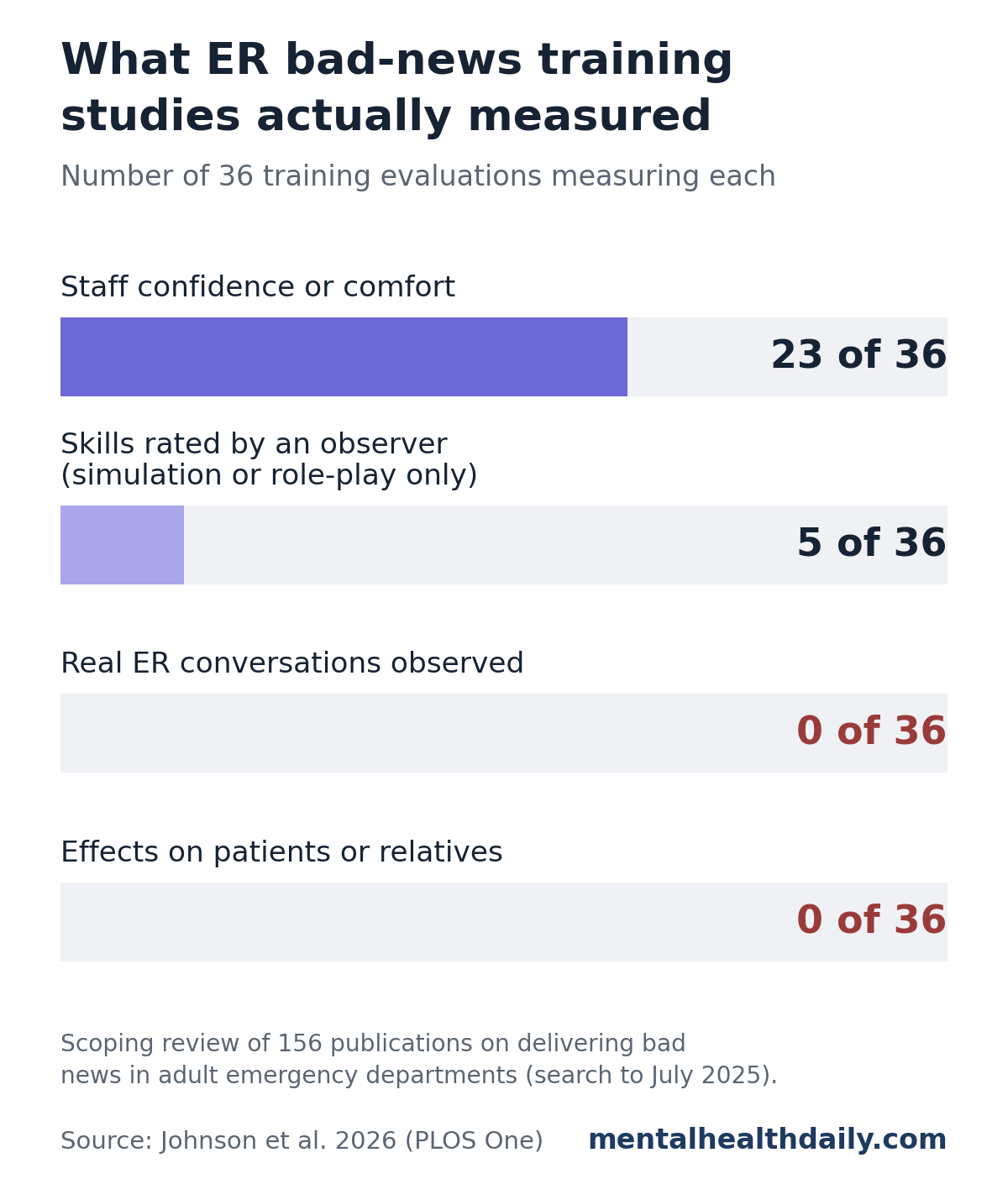
Confidence is not the same as skill. The researchers point out that feeling more comfortable says little about whether patients and relatives felt informed and supported. Positive results may also be inflated because trainings that did not work are less likely to be published.1
Training improves observed skills elsewhere in medicine. A 2018 meta-analysis of 17 studies across medicine found that bad-news training improved observer-rated skills (standardized mean difference, or SMD, 0.74, a large effect) and physician confidence (SMD 0.60). Only 1 of those studies reported effects on patients’ depression or anxiety.4
SPIKES and Other Cancer-Care Scripts Dominate ER Training
The review found 25 communication frameworks across 80 publications. SPIKES, the most cited with 37 mentions, was developed in 2000 for telling people they have cancer. It walks clinicians through 6 steps:1,2
- Setting: arrange a private, uninterrupted space
- Perception: find out what the person already understands
- Invitation: ask how much they want to know
- Knowledge: give the information clearly
- Emotions: respond to feelings with empathy
- Strategy and summary: agree on next steps
That sequence assumes time, a private room and some knowledge of the patient. Emergency staff often have none of those. The review found no study showing whether SPIKES is actually used in routine emergency care or whether it helps patients or relatives there.1
Only 3 frameworks were built for emergency departments:
- GRIEV_ING (12 mentions): a step-by-step mnemonic for telling families about a death. In its 2005 evaluation, a 2-hour session of small-group teaching and role-play improved residents’ confidence and competency, with testing right after training and 3 months later; communication scores did not significantly change.3
- 8S: developed for breaking bad news by telephone during COVID-19
- EMTalk: a training program for emergency clinicians
Terms were inconsistent as well. “Breaking bad news” was used in 61 publications, but it often covered very different events, from a sudden death to a goals-of-care talk or an early pregnancy loss.1
What Patients and Families Say They Need From ER Staff
Studies of staff views (20) outnumbered studies of relatives (10) and patients (8). Across those groups, patients and relatives most often emphasized:1
- Honesty about what happened and what comes next
- Clarity, without jargon or vague wording
- Presence: a clinician who stays rather than rushing off
- Emotional support during and after the conversation
Clinicians, by contrast, more often talked about limits on time, training, confidence and space.1
Barriers: time pressure, too little training, interruptions, noise, no private room, and sudden or uncertain clinical situations such as unexpected deterioration.1
Helpful conditions: even brief preparation, an extra staff member in the room, a private space, chances for families to ask questions, and in some studies letting families be present during resuscitation.1
The researchers conclude that training alone cannot make up for a department without the time, privacy or staff for these conversations.1
How Bad News Is Delivered Can Shape Families’ Grief and PTSD Symptoms
The emergency department evidence on family outcomes is missing, but trials in nearby settings show these conversations can affect relatives for months:
- Intensive care, 2007: in a randomized trial across 22 French intensive care units, relatives of 126 dying patients had either a longer end-of-life conference with more time to talk plus a bereavement brochure, or the usual conference. At 90 days, PTSD-related symptoms affected 45% of the intervention group vs. 69% of the usual-care group, with less anxiety (45% vs. 67%) and depression (29% vs. 56%).5
- Cardiac arrest at home, 2013: in a trial involving 570 relatives across 15 French emergency medical service units, families routinely offered the chance to watch resuscitation had fewer PTSD-related symptoms 90 days later than families not routinely offered it (adjusted odds ratio 1.7 for the usual-practice group). Their presence did not change resuscitation, survival or staff stress.6
- Sudden workplace deaths, 2019: in a survey of 148 bereaved relatives, those who were satisfied with the information they got about the death were less likely to have probable prolonged grief disorder, an intense grief that persists and disrupts daily life.7
None of these studies tested how emergency staff deliver news. Together, they show that how families are informed and included can affect later grief and trauma symptoms. Emergency department research has not yet measured those outcomes.
Limitations of This Scoping Review
- Mapping, not testing: the review did not rate study quality or combine results, so it describes what has been studied rather than what works.
- Mixed source quality: many sources were conference abstracts, training reports or opinion pieces with limited methods detail.
- English only: relevant work in other languages may have been missed.
- Mostly US and UK: findings may not transfer to emergency systems organized differently.
- Adults only: children’s emergency care was deliberately excluded.
What Better Research on ER Bad News Would Look Like
The researchers set out 3 priorities:1
- Study real conversations: observe and analyze how bad news is actually delivered and received in emergency departments.
- Build emergency-specific frameworks: base them on real encounters and on what clinicians, patients and relatives say, rather than adapting cancer-care models.
- Measure what happens to families: evaluate training with observed practice, patient and relative outcomes, and longer-term psychological effects, not only staff confidence.
They also call for attention to staffing, private space and senior support, arguing that better bad-news conversations depend on the department as well as on individual skill.1
For families: it is reasonable to ask for a private room, for someone to stay while you take in the news, and for time to ask questions.
Grief after a sudden death can be overwhelming. If intense grief, intrusive memories or low mood persist for months and get in the way of daily life, a doctor or bereavement service can help.
References
- Johnson G, Edwards S, Jarman H, Peel E, Pino M. Understanding delivery of bad news in the emergency department: a scoping review. PLOS One. 2026;21(9):e0358343. doi:10.1371/journal.pone.0358343
- Baile WF, Buckman R, Lenzi R, Glober G, Beale EA, Kudelka AP. SPIKES—a six-step protocol for delivering bad news: application to the patient with cancer. The Oncologist. 2000;5(4):302–311. doi:10.1634/theoncologist.5-4-302
- Hobgood C, Harward D, Newton K, Davis W. The educational intervention “GRIEV_ING” improves the death notification skills of residents. Academic Emergency Medicine. 2005;12(4):296–301. doi:10.1197/j.aem.2004.12.008
- Johnson J, Panagioti M. Interventions to improve the breaking of bad or difficult news by physicians, medical students, and interns/residents: a systematic review and meta-analysis. Academic Medicine. 2018;93(9):1400–1412. doi:10.1097/ACM.0000000000002308
- Lautrette A, Darmon M, Megarbane B, et al. A communication strategy and brochure for relatives of patients dying in the ICU. New England Journal of Medicine. 2007;356(5):469–478. doi:10.1056/NEJMoa063446
- Jabre P, Belpomme V, Azoulay E, et al. Family presence during cardiopulmonary resuscitation. New England Journal of Medicine. 2013;368(11):1008–1018. doi:10.1056/NEJMoa1203366
- Matthews LR, Quinlan MG, Bohle P. Posttraumatic stress disorder, depression, and prolonged grief disorder in families bereaved by a traumatic workplace death: the need for satisfactory information and support. Frontiers in Psychiatry. 2019;10:609. doi:10.3389/fpsyt.2019.00609