A 2026 meta-analysis of 7 small Chinese trials found that adding herbal patches on acupuncture points to usual stroke care improved self-rated sleep in 608 stroke survivors with sleep problems.1 The researchers rated that evidence as very low certainty, and safety was barely reported.
Research Highlights
- Better sleep scores: across 6 trials (536 people), Pittsburgh Sleep Quality Index (PSQI) scores ended 2.69 points lower with the herbal patches than with background care alone (95% CI −3.84 to −1.55).1
- More responders: in 5 trials (466 people), the odds of meeting each trial’s own improvement criteria were 3.5 times higher with the patches (odds ratio 3.50, 95% CI 2.05–5.97).1
- Results varied widely: trial-to-trial inconsistency in the sleep result was extreme (I² = 95%), and the gain looked larger when the patches were added to conventional care alone than when added to another active therapy.1
- Anxiety and depression rest on 2 trials: scores fell sharply in 182 people, but the evidence was rated very low certainty.1
- Safety is unknown: only 2 of 7 trials reported side effects, and no trial followed patients after treatment ended.1
What Herbal Acupoint Application Is and Who Was Studied
Chinese herbal acupoint application is a traditional Chinese medicine treatment in which a powdered herbal preparation is mixed into a paste or patch and taped onto specific acupuncture points on the skin. There are no needles. The idea is that the herbs stimulate the point locally and some of their compounds pass through the skin.
The most common version in these trials was powdered Evodia rutaecarpa fruit (a traditional Chinese herb) placed on Yongquan (KI1), a point on the sole of the foot. Other trials used cinnamon powder or herbal blends on points at the wrist, navel, back, or leg.1
Xu et al. searched 4 Chinese and 4 English-language databases through April 1, 2026 for randomized trials in stroke survivors with a diagnosed sleep disorder, mostly insomnia or poor sleep quality.1 Seven trials qualified, all from China and all published in Chinese between 2013 and 2025.
- Size: 608 participants, 304 per group; individual trials enrolled 60 to 150 people.
- Design: every trial added the patches to a background treatment and compared that with the same background treatment alone.
- Background treatments: conventional medical care alone, or care plus acupuncture, rehabilitation, structured psychological nursing, or an oral herbal formula.
- Dose: patches stayed on anywhere from 30 minutes to 24 hours a day, for 10 days to 4 weeks.
Post-Stroke Sleep Scores Fell 2.69 Points, but Trials Disagreed
The PSQI is a self-rated questionnaire covering sleep quality, time to fall asleep, sleep duration and efficiency, night waking, sleep medication use, and daytime problems. Scores run from 0 to 21, and lower is better. Where reported, people in these trials started around 12 to 17 points.1
Pooled across 6 trials, PSQI scores at the end of treatment were 2.69 points lower in the patch groups (95% CI −3.84 to −1.55).1 Removing any single trial did not change the direction or significance of that result.
Trials disagreed sharply. An I² of 95% means almost all of the spread between trials reflected real differences between them rather than chance. Herbs, acupoints, daily wear time, treatment length, stroke stage, and background care all differed.1
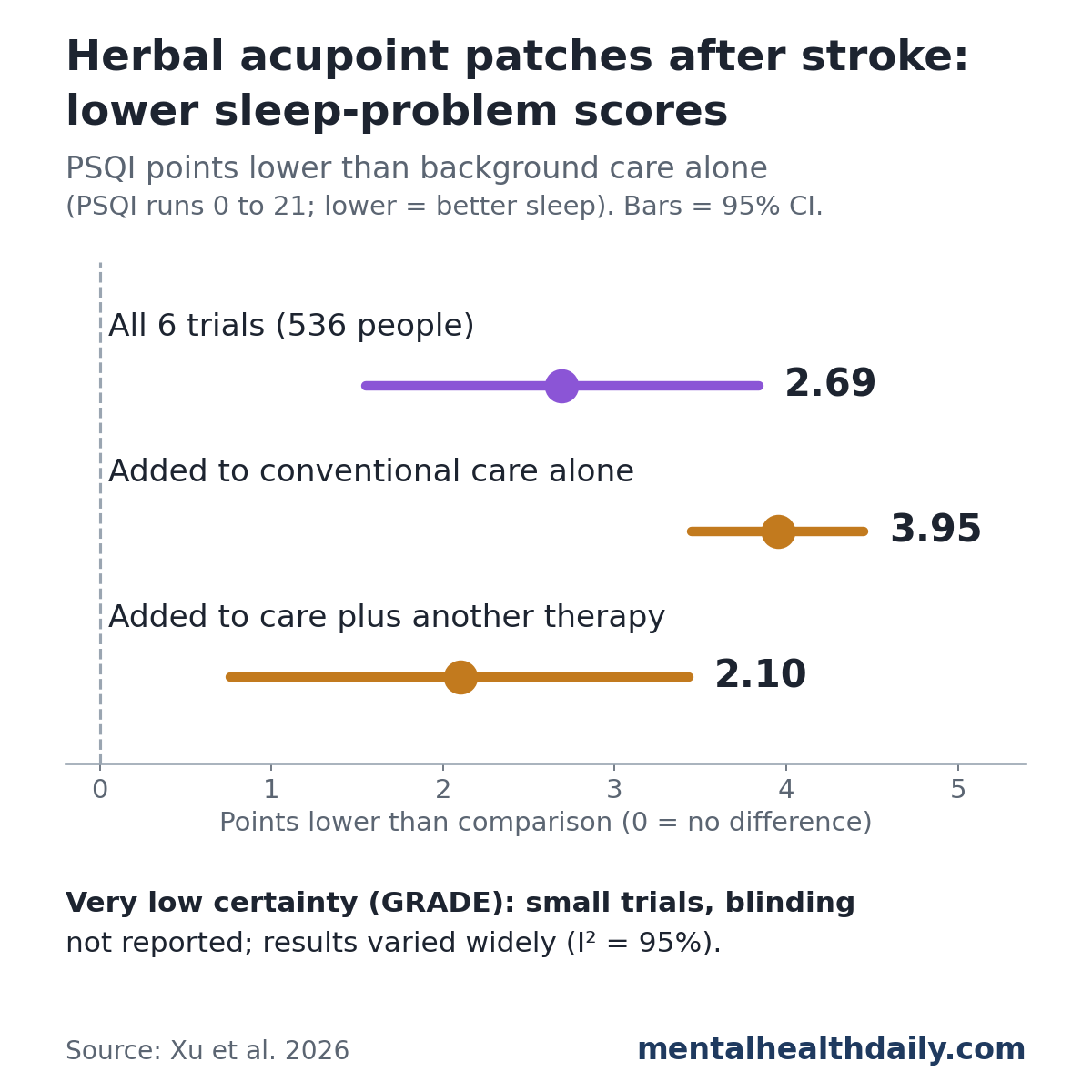
Background care changed the size of the gain. When the patches were added to conventional medical care alone, PSQI scores were 3.95 points lower (95% CI −4.45 to −3.45). When added to care that already included another active therapy, such as acupuncture or rehabilitation, the difference shrank to 2.10 points (95% CI −3.43 to −0.76).1
That pattern makes sense: an add-on has less room to help when patients already get another active treatment. Each subgroup held only a few trials, though, so the researchers treated the split as exploratory.
Response rates: 5 trials reported how many people met the trial’s own definition of clinical improvement. The patch groups had 3.5 times the odds of responding (odds ratio 3.50, 95% CI 2.05–5.97), with no measurable inconsistency. Each trial defined response differently, so this is a combined tally of different yardsticks.1
Anxiety and Depression Scores Fell in 2 Small Trials
Two trials (182 people) also measured mood with clinician-rated scales: the Hamilton Anxiety Rating Scale (HAMA) and the Hamilton Depression Rating Scale (HAMD).1
- Anxiety: HAMA scores ended 9.38 points lower with the patches (95% CI −10.09 to −8.68). The 2 trials gave nearly identical results, −9.20 and −9.49.
- Depression: HAMD scores ended 7.58 points lower (95% CI −9.08 to −6.08), with high inconsistency between the 2 trials (I² = 81%).
Those are very large differences for a skin patch, and the tight interval comes from small spreads within 2 trials rather than strong evidence. Neither trial described blinding the people who rated anxiety and depression, and neither reported which Chinese version of the HAMA was used or how raters were trained. The researchers warned the mood effects may be overestimated.1
Side Effects of Herbal Acupoint Patches Were Barely Tracked
Only 2 trials reported adverse events.1
- Gao et al.: dry mouth, dizziness or fatigue, and skin allergy in the patch group; the same plus facial swelling and memory problems in the control group.
- Zhao et al.: 1 case of nausea in the patch group and 1 case of constipation in the control group.
The other 5 trials did not say whether side effects were monitored at all. Silence is not the same as safety, and skin reactions are the obvious risk with any herbal paste worn for hours. No trial followed patients after treatment stopped, so delayed reactions, relapse, and lasting benefit are all unknown.1
Why the Evidence Is Rated Low to Very Low Certainty
GRADE is the standard system for rating how much confidence a pooled result deserves. Xu et al. rated the response result low certainty and every other outcome very low, meaning the true effect could be substantially different from the estimate.1 Five problems drove that rating:
- No blinding or concealment reported. None of the 7 trials described hiding the group assignment from staff, patients, or outcome raters. Self-rated sleep and clinician-rated mood are both easily nudged by expectations.
- No registered protocols. No trial had a protocol or registry record, so selective reporting of favorable outcomes cannot be ruled out.
- Likely publication bias. All trials were Chinese-language, most were small and single-center, and results generally favored the patches. The search skipped trial registries, gray literature, and theses, where negative results often end up.
- Too much variation. Different herbs, acupoints, wear times, durations, and background care make the pooled number an average of quite different treatments.
- Short and subjective. Treatment lasted 4 weeks at most, with no follow-up and no objective sleep measures such as wrist actigraphy or overnight sleep studies.
Publication bias is a long-documented issue in this literature. A 1998 review of Medline-indexed trials found that every acupuncture trial from China, Japan, Hong Kong, and Taiwan reported a positive result, and 99% of Chinese trials of other treatments favored the test treatment, vs 75% of trials published in England.2 A small set of generally positive Chinese trials fits that pattern.
How Herbal Patches Compare With Acupuncture for Post-Stroke Insomnia
Needle acupuncture for post-stroke insomnia has a much larger trial base. A 2023 meta-analysis of 41 studies with 3,233 participants found that acupuncture improved PSQI scores more than control treatments (standardized mean difference −1.03, 95% CI −1.32 to −0.74).3
The quality picture was similar: GRADE ratings were mostly low or very low, and too little safety information was reported to draw firm conclusions.3 Herbal acupoint patches now sit in the same place as acupuncture, with consistently favorable trials and weak evidence, but with 7 trials instead of 41.
What This Means for Stroke Survivors With Poor Sleep
- An add-on at most. Every trial tested the patches on top of other care. The researchers say they should not replace standard post-stroke treatment or be considered an established sleep treatment yet.1
- The real benefit may be smaller. Small unblinded trials with no registered protocols tend to overstate effects, and the 2.69-point average blends quite different treatments.
- Watch the skin. Anyone trying herbal patches through a traditional Chinese medicine clinic should tell their stroke team and stop if irritation or allergy appears, since side effects were not systematically tracked.
- Check for other sleep problems. Stroke can also bring sleep apnea and other sleep disorders that patches would not address; these trials mostly studied insomnia and poor sleep quality.
The researchers call for larger multicenter trials with registered protocols, blinded outcome raters, standardized herbs and acupoints, objective sleep measures, and real follow-up.1
References
- Xu Y, Xia Y, Wang X, Qian X, Xiang Y, Wei T, Fu Z. Efficacy and safety of Chinese herbal acupoint application for post-stroke sleep disorders: a systematic review and meta-analysis. Frontiers in Neurology. 2026;17:1881026. doi:10.3389/fneur.2026.1881026
- Vickers A, Goyal N, Harland R, Rees R. Do certain countries produce only positive results? A systematic review of controlled trials. Controlled Clinical Trials. 1998;19(2):159–166. doi:10.1016/S0197-2456(97)00150-5
- Shi M, Ji Z, Sun T, et al. Efficacy and safety of acupuncture on sleep quality for post-stroke insomnia: a systematic review and meta-analysis. Frontiers in Neurology. 2023;14:1164604. doi:10.3389/fneur.2023.1164604