Children as young as 2 told preschool staff “I’m full” at well-timed moments during lunch, and staff usually took them at their word, according to a 2026 video study of 97 lunches at 4 Swedish preschools.1
Research Highlights
- 77 “I’m full” moments: 44 children aged 2 to 6 said they were full at least once, and 41 of the 97 lunches (42%) included at least 1 such statement.1
- Children picked their moment: 58% of the statements came unprompted. Children often looked straight at an adult or waited for a pause in the conversation, and the median statement came 25 minutes into the meal.1
- Staff mostly accepted it: the most common reply was simply repeating it back (“Are you full?”), in 30 of 77 cases. Only 8 statements went unanswered, when the child was hard to hear, spoke over someone or the adult was talking to someone else.1
- A few cases met pushback: some adults pointed to food left on the plate or kept offering food, but none claimed to know better than the child whether the child was full.1
- Pressure tends to backfire: in an earlier lab experiment, preschoolers ate more and made far fewer negative comments about the food when they were not pressured to finish it.4
What Responsive Feeding Means for Young Children
Responsive feeding is a nurturing, back-and-forth style of feeding in which the adult pays attention to a child’s hunger and fullness cues and responds to them warmly instead of overriding them. International and Swedish guidelines recommend it.1,2
The idea rests on a long line of research showing that young children are good at regulating how much they eat. In a classic study of 15 children aged 2 to 5, intake swung widely from one meal to the next, but total daily calories stayed fairly steady because children ate less after a big meal and more after a small one.3
What happens when a child actually says “I’m full” at the table has barely been studied. Most research on children’s fullness relies on parent reports or picture scales, such as a teddy bear rating scale.1
How Researchers Recorded 97 Preschool Lunches in Sweden
Sandra Nyberg-Akremi et al. at Linköping University filmed ordinary lunches between October 2021 and November 2022, visiting each preschool once a week during 3 recording periods of about 5 to 7 weeks.1
- Setting: 4 preschools, 3 in suburbs near one city and 1 in the center of another city
- People: 92 children aged 1 to 6 and 22 adults, including preschool teachers, child carers and trainees
- Recording: 3 cameras and 2 microphones per table, with researchers out of the room during the meal
- What counted: a child saying the Swedish word for “full” (mätt) or a variation such as “full tummy” about their own current state; stopping eating or rubbing the stomach did not count
Swedish preschools serve a free hot lunch, and staff follow a practice called pedagogic meals: adults sit at the table with the children and often eat the same food, aiming to give children a positive experience around food, meals and health.1
The team counted when and how the statements occurred, then studied selected exchanges line by line using discursive psychology. This method looks at what people accomplish with their words in a conversation, including timing, pauses, gaze and gestures, rather than treating speech as a simple readout of an inner state.1
Children Said “I’m Full” When an Adult Was Likely to Hear
None of the 1-year-olds said anything about being full that an adult could make out. Statements came from children aged 2 years 3 months to 6 years 2 months, and 4-year-olds produced the most, with 27 of the 77 (35%).1
Timing: children said they were full a median of 25 minutes after they started serving themselves (range 12 to 41 minutes), and 62 of the 77 came between 20 and 39 minutes in, as lunch was winding down.1
Who started it: 45 statements (58%) were the child’s own opening. The other 32 (42%) answered something an adult or another child had said, such as “How’s it going?”1
The video excerpts show children working to be heard (all names are pseudonyms):1
- Sophia, 4: put her cutlery together, looked directly at the adult and announced she was full, using a Swedish word that roughly means “as you know.” The adult asked “Are you full?” and she confirmed. Nobody mentioned the food still on her plate.
- Daniel, 4: his first, unclear attempt overlapped with other talk. Soon after, he said it again during a pause. The adult asked “Is your tummy full?” and added “that’s good.”
- Simon, 3: said “I can’t manage” 3 times while the adult was busy serving another child, then switched to “I’m full” and got an answer on the fourth try. She told him to put his cutlery together.
The researchers read these exchanges as evidence that young children treat their fullness as something an adult needs to hear and respond to, not just a private feeling.1
Staff Usually Repeated, Acknowledged or Praised “I’m Full”
Adults answered in a narrow range of ways, and most of them accepted the statement at face value:1
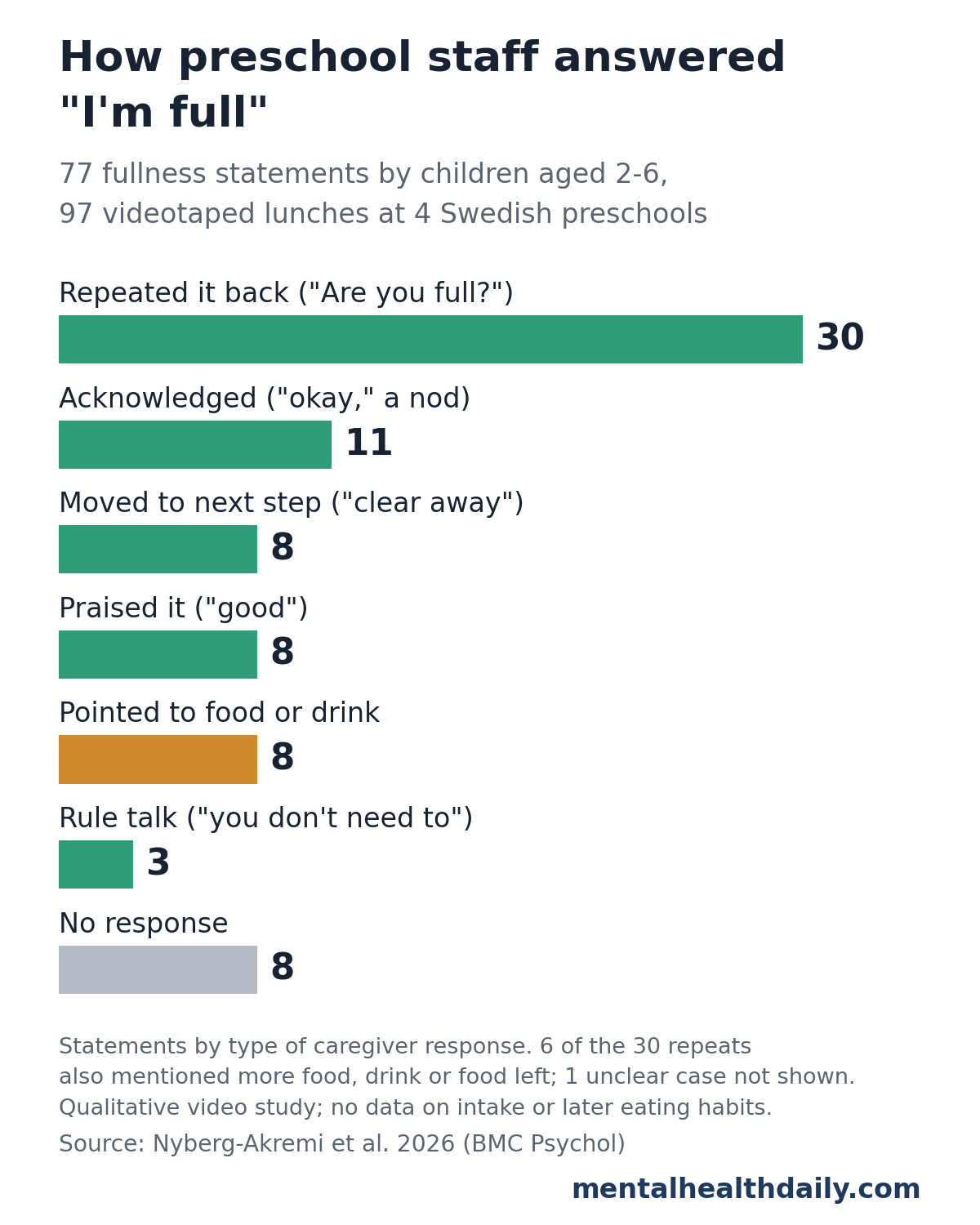
- Repeated it back: 30 times, usually as a check like “Are you full?” In 6 of these the adult also mentioned more food, a drink or food left on the plate.
- Acknowledged it: 11 times, with an “okay,” a “yes” or a nod.
- Moved to the next step: 8 times, such as “You’re welcome to clear away.”
- Praised it: 8 times, such as “Good.”
- Pointed to food or drink: 8 times, such as “Do you want to drink some water?” or scraping the food on the child’s plate.
- Rule talk: 3 times, such as “If you can’t manage more, you don’t need to.”
No adult ever described being full as a bad thing. The 8 unanswered statements were unclear, spoken over someone else, or made while the adult was in another conversation.1
When “I’m Full” Met Pushback at the Lunch Table
A handful of exchanges show how fullness gets tangled up with other mealtime concerns:1
- More food on offer: Mona, 4, said she was “super full.” The adult said “good” and then asked what she wanted now. At this preschool, children who finish the main meal can have crispbread, so “full” partly meant “done with the main course.” The researchers note that offering more food right after a fullness statement could count as non-responsive feeding.
- Food left on the plate: as Lucas, 4, started to leave the table, the adult pointed at his plate and said “but you are not done with the food.” He quietly said he was full. She kept the focus on the potatoes he had wanted, even though she had scraped the last of the dish onto his plate without asking how many he wanted. After a pouty look from Lucas, she smiled and moved on, and he cleared his plate.
- Repeated urging: Nina, 3, said she was full after putting a lot of ketchup on her pasta. The adult made 4 attempts to get her to eat the ham or pasta or drink her milk, including an “either-or” choice. Nina grew upset and asked for her mother. The researchers describe this as a rare case.
Even in these cases, no adult told a child that they could not really be full. The disagreement was about whether being full meant the child could skip a specific food or leave food behind.1
Earlier Research on Pressure to Eat and Children’s Appetite
Why do these small exchanges matter? Earlier studies show how pressure and portion size can override a child’s own appetite:
- Pressure to finish: in a repeated-measures lab experiment, preschoolers ate significantly more when they were not told to finish their food and made far fewer negative comments about it.4
- Big portions: in a study involving 30 preschool children, doubling the entrée portion increased entrée intake by 25% and total meal calories by 15% compared with an age-appropriate portion.5 Children ate more simply because more was served, so the amount left on a plate is not a reliable sign of whether a child is still hungry.
Child care talk has not always looked like the Swedish lunches. A 2010 video study of 29 Head Start staff members in 3 US states found that mealtime talk mostly pointed children to outside cues, such as how much to take, whether they were “done” and praise for eating, rather than asking how their bodies felt.6
That study used a different setting and method, so the 2 are not a direct comparison. The Swedish findings fit an older observation from family dinners: finishing a meal and saying you are full is something families work out together in conversation, not just a signal from the stomach.7
Limitations of This Swedish Preschool Lunch Study
- No measure of real fullness: the study captured what children said, not whether they were physically full or how much they ate.
- No eating-habit outcomes: there were no data on later eating, weight or appetite regulation, so the study cannot say whether these responses help children long term.
- Words only: nonverbal signs of fullness, which younger children may rely on, were left out.
- Camera effect: staff knew they were being filmed and may have been on their best behavior, although recording over many weeks gave them time to get used to it.
- One country, few details: the study covered 4 Swedish preschools with a strong pedagogic-meal tradition and recorded no background information on children or staff, such as diet or home language.
What This Means for Parents and Preschool Staff
Young children can tell you they are full. Children as young as 2 in this study said so clearly and chose a good moment to say it. Those who repeated or rephrased it were trying to get an answer.1
A simple acknowledgment counts. The responses the Swedish staff used most were short: repeating “Are you full?”, a nod or “You’re welcome to clear away.” Busy adults managing a whole table could still do this.1
Watch for pressure that slips in. Comments about food left on the plate or quick offers of something else are easy to make without noticing. Serving smaller portions and letting children ask for more fits the wider evidence on portion size and pressure to eat, though this study did not test those strategies.4,5
References
- Nyberg-Akremi S, Willemsen A, Cromdal J, Wiggins S. Children’s verbal satiety expressions and caregivers’ responses during preschool mealtimes in Sweden. BMC Psychology. 2026;14:1369. doi:10.1186/s40359-026-05650-8
- Pérez-Escamilla R, Jimenez EY, Dewey KG. Responsive feeding recommendations: harmonizing integration into dietary guidelines for infants and young children. Current Developments in Nutrition. 2021;5(6):nzab076. doi:10.1093/cdn/nzab076
- Birch LL, Johnson SL, Andresen G, Peters JC, Schulte MC. The variability of young children’s energy intake. New England Journal of Medicine. 1991;324(4):232–235. doi:10.1056/NEJM199101243240405
- Galloway AT, Fiorito LM, Francis LA, Birch LL. ‘Finish your soup’: counterproductive effects of pressuring children to eat on intake and affect. Appetite. 2006;46(3):318–323. doi:10.1016/j.appet.2006.01.019
- Fisher JO, Rolls BJ, Birch LL. Children’s bite size and intake of an entrée are greater with large portions than with age-appropriate or self-selected portions. American Journal of Clinical Nutrition. 2003;77(5):1164–1170. doi:10.1093/ajcn/77.5.1164
- Ramsay SA, Branen LJ, Fletcher J, Price E, Johnson SL, Sigman-Grant M. “Are you done?” Child care providers’ verbal communication at mealtimes that reinforce or hinder children’s internal cues of hunger and satiation. Journal of Nutrition Education and Behavior. 2010;42(4):265–270. doi:10.1016/j.jneb.2009.07.002
- Laurier E, Wiggins S. Finishing the family meal. The interactional organisation of satiety. Appetite. 2011;56(1):53–64. doi:10.1016/j.appet.2010.11.138