
In a 2026 survey of 420 middle school students in eastern China, more physically active teens reported more cognitive reappraisal (reframing stressful situations), better stress-management habits and better health-related quality of life.1
Research Highlights
- Activity linked to quality of life through coping scores: the researchers’ model combined proposed links through reframing stressful situations and stress-management habits. The combined estimate was 0.30 (95% CI 0.23 to 0.37), a standardized association, not a 30% improvement in quality of life. The model accounted for gender, grade, academic stress, sleep and sports-club participation.1
- Strongest activity link was to reframing stress: more active students reported more cognitive reappraisal, the habit of changing how they interpret a stressful situation. Activity was more strongly linked to reappraisal than to stress-management habits.1
- Rest, relaxation and pacing were linked to wellbeing: more active students reported better stress-management habits. Students who reported better stress habits or more reappraisal also rated their quality of life more highly.1
- One survey, one moment: all data came from a single questionnaire in 2 schools, so the study cannot show that exercise caused better coping or better quality of life.1
- Trials show small benefits: exercise programs in children and teens improved quality of life by a small amount in a 17-study meta-analysis.3
What the Jiangsu School Survey Measured
Li et al. handed out 500 paper questionnaires to grade 7 to 9 students at 2 secondary schools in Jiangsu Province in April 2026 and kept 420 complete responses (84.0%).1 Classes were recruited by convenience, then teachers referred other classes in the same schools.
Academic pressure was common: 43.6% of students rated their academic stress relatively high and 20.2% very high. Just under half (46.7%) took part in a school sports club, team or extra training.1
Students answered 4 sets of questions:
- Physical activity: a 3-item rating scale (PARS-3) that multiplies how hard, how long and how often a student usually exercises into one score
- Cognitive reappraisal: 6 items such as “When I want to feel more positive emotion, I change the way I’m thinking about the situation”
- Stress self-management: 6 items on how often a student uses stress-control methods, gets enough sleep, relaxes or meditates, has calming thoughts at bedtime and paces themselves to avoid exhaustion
- Quality of life: the KIDSCREEN-10, a 10-item questionnaire about the past week
Health-related quality of life (HRQoL) is a person’s own rating of how well they are doing physically, emotionally and socially. In the KIDSCREEN-10, that includes feeling fit and well, mood, having time and freedom for oneself, getting along with parents and friends, and coping at school.
Cognitive reappraisal means changing how you interpret a situation so it hits less hard emotionally. A teen who reframes a bad test as “feedback on what to study” instead of “proof I’m stupid” is reappraising. Emotion researchers count it among the most helpful regulation strategies because it works early, before the emotional reaction fully builds.
Stress self-management, as used here, is a set of practical habits rather than a feeling: rest, relaxation, sleep and pacing. It is different from perceived stress, which is how stressed a person feels.
Physical Activity Linked to Reappraisal, Stress Habits and Quality of Life
Researchers used structural equation modeling, a statistical method that tests a proposed chain of relationships all at once. Their model ran from physical activity to the 2 coping measures and from there to quality of life.1
Each link is a standardized path coefficient. In plain terms, a value of 0.48 means a student one standard step (1 standard deviation) above average on physical activity scored about half a standard step higher on reappraisal, with the other factors in the model held steady. All 5 links were statistically significant (p < 0.001):
- Activity to reappraisal: 0.48, the strongest link in the model
- Activity to stress self-management: 0.27
- Reappraisal to stress self-management: 0.31
- Reappraisal to quality of life: 0.32
- Stress self-management to quality of life: 0.36
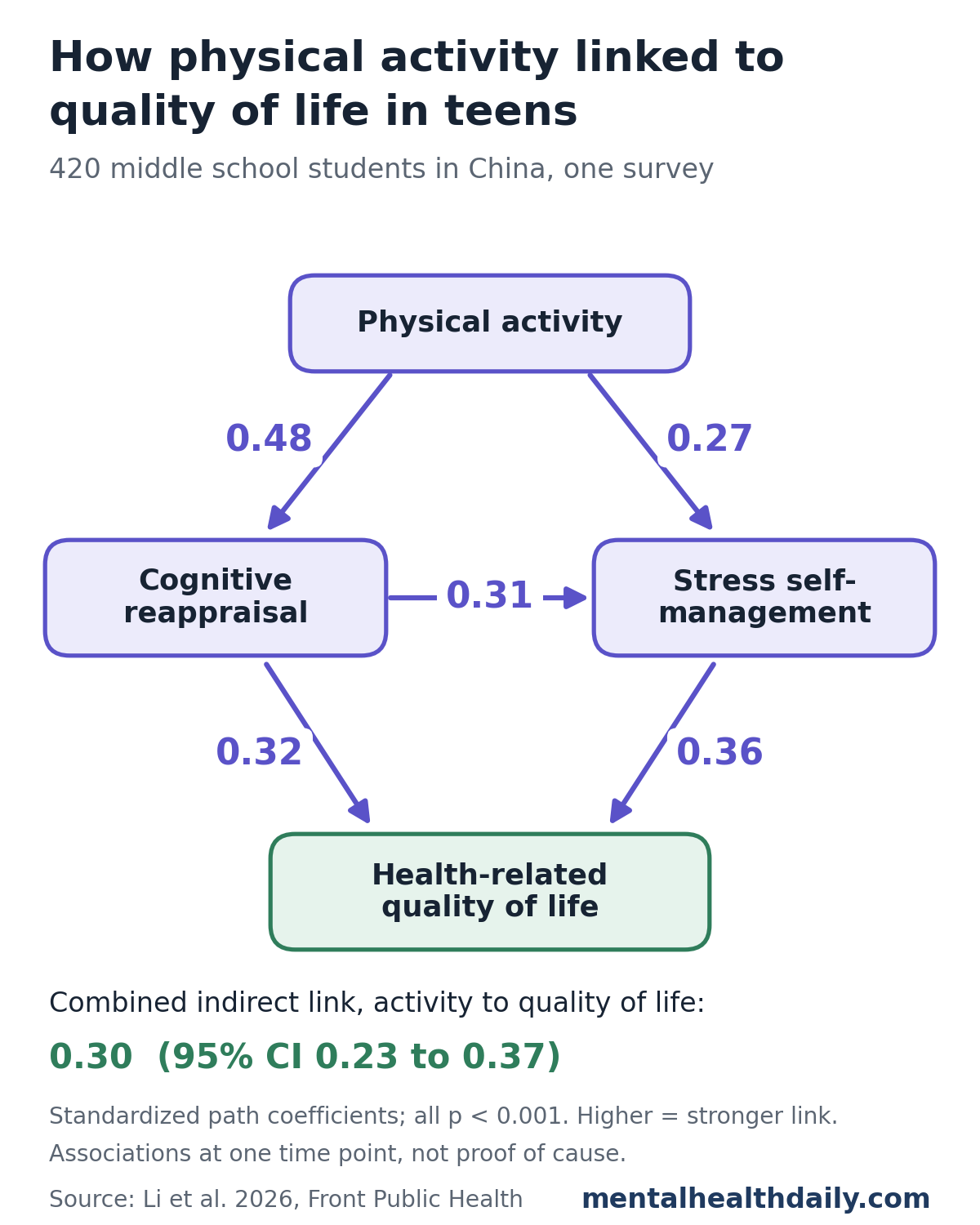
3 routes from activity to quality of life. Multiplying the published links gives 3 routes, which add up to the reported combined indirect link of 0.30:
- Through reappraisal: about 0.15, the largest share
- Through stress self-management: about 0.10
- Through reappraisal, then stress self-management: about 0.05
The split is our arithmetic from the reported coefficients; the researchers reported only the combined value (bootstrap 95% CI 0.23 to 0.37, p < 0.001).1
How much was explained. The model accounted for 33% of the variation in quality of life between students, 28% for stress self-management and 26% for reappraisal. Most of what separates a teen with high quality of life from one with low quality of life lies outside this model.
Background factors. Students with higher academic stress reported slightly less reappraisal (−0.09). Unexpectedly, students in sports clubs or teams reported slightly worse stress self-management (−0.09), even though overall activity was linked to better stress habits. Both effects were small and only just below the p = 0.05 cutoff.1
Why a One-Time Survey Cannot Show Mediation
The paper describes reappraisal and stress self-management as mediators, the steps through which activity is linked to quality of life. Mediation is a claim about order: activity first, coping skills next, quality of life last. A survey taken at one moment cannot show that order. The researchers acknowledge that the direction of these relationships cannot be confirmed.1
Specific limits of this study:
- The direction could run the other way. Teens who already feel well and cope well may have more energy and motivation to exercise.
- Shared causes were not measured. Family income, fitness, screen time, existing depression or anxiety and personality could raise all 4 scores together. No socioeconomic data were collected.
- No direct activity-to-quality-of-life estimate. The published model draws no direct arrow from activity to quality of life and reports none, so the 0.30 indirect link is the only activity–quality-of-life figure given. The paper’s statement that coping skills explain the link only “partly” cannot be checked from the reported numbers.
- Everything was self-reported. The same students rated their own activity, coping and wellbeing on one form, which tends to inflate correlations. A standard check suggested this was not severe (one factor explained 38.4% of answers, under a 40% cutoff), but that test is a weak safeguard.
- Narrow sample. 2 schools in one province, recruited by convenience and teacher referral.
- Adapted measures. The reappraisal and stress items were adapted from existing scales, and a planned check of the activity scale against sports participation was described but its result was not reported.
Exercise Trials in Teens Show Small Quality-of-Life Gains
The broader evidence fits the survey’s pattern, with the caveat that most of it is also observational. A 2017 systematic review found 31 studies on physical activity and HRQoL in children and teens: 21 were cross-sectional, 6 longitudinal and 3 school-based intervention studies. Higher activity generally went with better quality of life.2
Intervention evidence. Trials that actually increase activity give a cleaner test of cause:
- Quality of life: a 2024 meta-analysis of 17 experimental studies in people under 18 found that exercise programs improved overall HRQoL with a small pooled effect size of 0.18, and psychological wellbeing by 0.16.3
- Depressive symptoms: a 2023 meta-analysis of 21 studies with 2,441 children and teens found that physical activity programs reduced depressive symptoms compared with control conditions (Hedges’ g = −0.29, 95% CI −0.47 to −0.10, a small standardized effect where a negative value means fewer symptoms). Benefits were larger in participants older than 13 and in those with a diagnosed mental illness or depression.4
Those trial effects are modest, a useful reality check on links drawn from a single survey.
Reappraisal and youth mental health. The coping half of the model also has support. A meta-analysis of 35 studies in adolescents found that habitual use of reappraisal, problem solving and acceptance went with fewer depressive and anxiety symptoms, while rumination and avoidance went with more.5 Whether exercise itself builds reappraisal skill is far less tested, and this survey cannot settle it.
What This Means for Teens, Parents and Schools
- Exercise is a reasonable bet for teen wellbeing. Exercise trials in children and teens show small improvements in quality of life and mood.34
- Pair activity with coping skills. The researchers suggest schools build brief lessons on reframing setbacks and on rest, sleep and pacing into physical or health education. This survey did not test that combination.1
- Choice may help activity stick. The researchers suggest offering a range of activities, from team sports and running to dance, yoga and tai chi.
- Not a substitute for care. For a teen with persistent low mood, anxiety or trouble functioning, exercise and stress habits work alongside professional treatment, as the researchers also note.
References
- Li C, Zhang S, Wang H, Xu Z. Physical activity and HRQoL among adolescents: the mediating roles of cognitive reappraisal and stress self-management. Frontiers in Public Health. 2026;14:1914300. doi:10.3389/fpubh.2026.1914300
- Wu XY, Han LH, Zhang JH, Luo S, Hu JW, Sun K. The influence of physical activity, sedentary behavior on health-related quality of life among the general population of children and adolescents: a systematic review. PLoS One. 2017;12(11):e0187668. doi:10.1371/journal.pone.0187668
- Bermejo-Cantarero A, Sánchez-López M, Álvarez-Bueno C, Redondo-Tébar A, García-Hermoso A, Martínez-Vizcaino V. Are physical activity interventions effective in improving health-related quality of life in children and adolescents? A systematic review and meta-analysis. Sports Health. 2024;16(6):877–885. doi:10.1177/19417381231190885
- Recchia F, Bernal JDK, Fong DY, et al. Physical activity interventions to alleviate depressive symptoms in children and adolescents: a systematic review and meta-analysis. JAMA Pediatrics. 2023;177(2):132–140. doi:10.1001/jamapediatrics.2022.5090
- Schäfer JÖ, Naumann E, Holmes EA, Tuschen-Caffier B, Samson AC. Emotion regulation strategies in depressive and anxiety symptoms in youth: a meta-analytic review. Journal of Youth and Adolescence. 2017;46(2):261–276. doi:10.1007/s10964-016-0585-0