hit counter

Turkish UCLA PTSD Questionnaire Screens Teens Well at a Higher Cutoff

MHD card with a glowing crimson score dial whose needle points past a marked threshold, and 4 lit circles holding icons of a house, a school, 2 friends and a sprout, illustrating a Turkish PTSD questionnaire for teens and its link to daily functioning.

A Turkish version of the UCLA PTSD Reaction Index, a widely used child and teen PTSD questionnaire, separated trauma-exposed adolescents with and without PTSD well in a 157-person clinic study.1 Higher scores were linked to more problems at home, at school, with friends, and in development.1 Research Highlights Strong screening accuracy: total scores told apart …
Read more

Physical Activity Linked to Better Quality of Life in Teens

MHD card showing a glowing teen runner on a curved school running track at night with a thought bubble that turns a jagged stress scribble into calm arcs, illustrating a survey linking physical activity to better quality of life in teens.

In a 2026 survey of 420 middle school students in eastern China, more physically active teens reported more cognitive reappraisal (reframing stressful situations), better stress-management habits and better health-related quality of life.1 Research Highlights Activity linked to quality of life through coping scores: the researchers’ model combined proposed links through reframing stressful situations and stress-management …

Read more

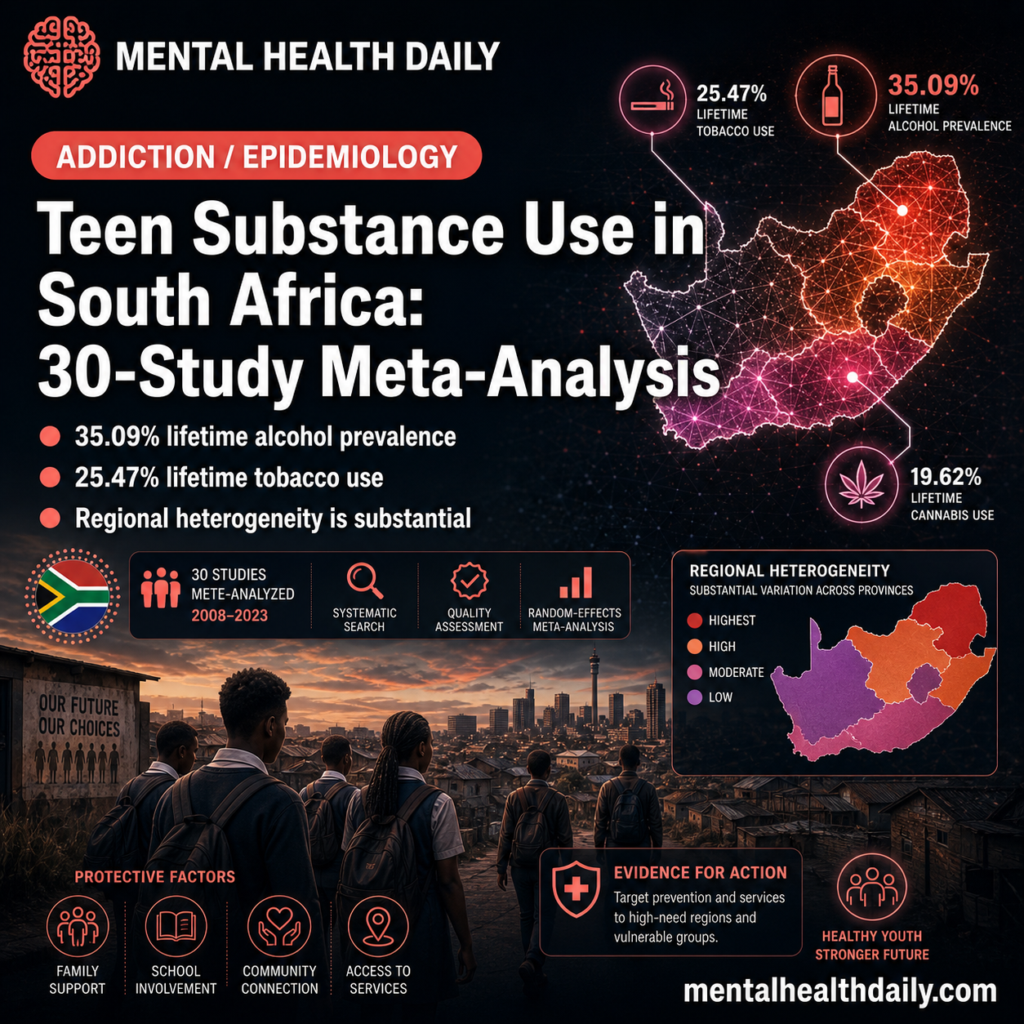
Teen Substance Use in South Africa: 30-Study Meta-Analysis

A 2026 PRISMA-compliant systematic review and meta-analysis in Drug and Alcohol Review consolidated 30 publications covering 202 prevalence estimates from 120,041 South African adolescents: pooled lifetime prevalence was 35.09% for alcohol use, 25.47% for tobacco use, and 10.47% for cannabis use.1 Research Highlights 30 publications, 202 estimates: pooled data covered 120,041 South African adolescents. Alcohol …

Read more

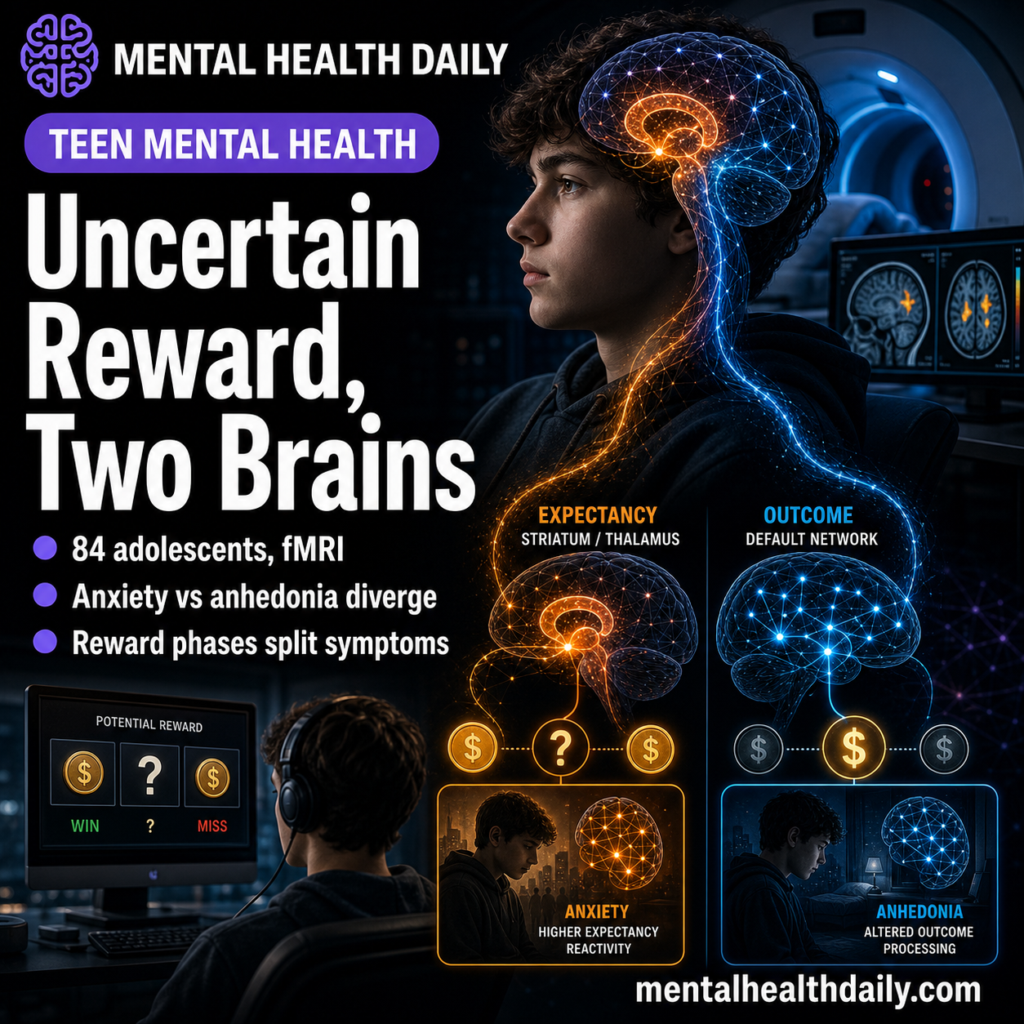
Teen Anxiety and Anhedonia Split Reward-Uncertainty fMRI

Photoreal illustration of adolescent brain regions with overlapping reward and default-mode network glow, conveying uncertainty processing.

A 2026 fMRI study of 84 medication-free adolescents found that reward uncertainty had its own phase-specific brain pattern: anxiety, depression, and anhedonia separated across different task phases and brain systems.1 The clearest clinical split was narrow but useful: anxiety tracked blunted striatum/thalamus activation during uncertain non-reward expectancy, while depression and anhedonia tracked higher visual/default-network activation …

Read more

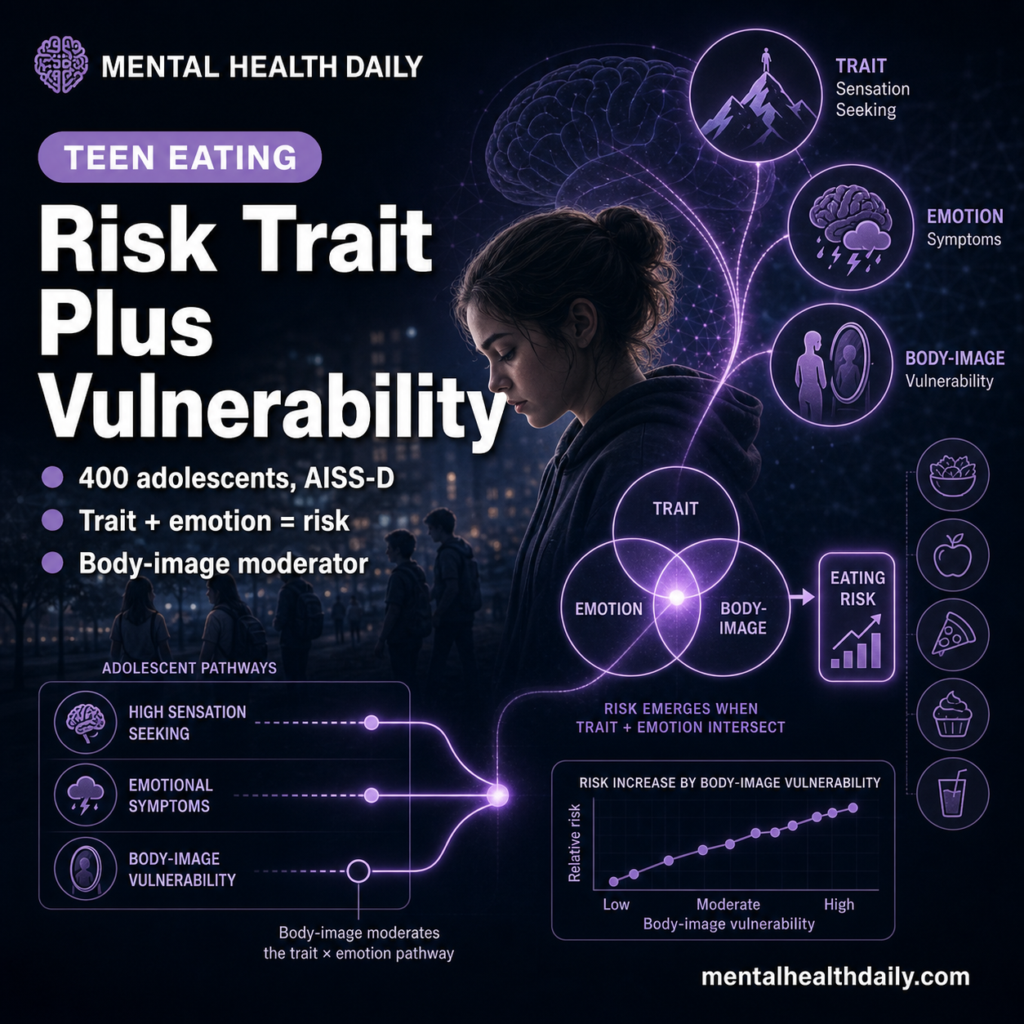
Sensation Seeking Predicts Disordered Eating in Teens

Photoreal illustration of a teenager with overlapping symbols of food and personality traits, conveying sensation-seeking eating-disorder risk.

Sensation seeking has long been linked to risky behaviors in teens, but its role in eating-disorder psychopathology has been mixed. A 2026 study by Bogner and colleagues clarifies the picture in 400 German adolescents: sensation seeking matters for disordered eating, but the effects are moderated by weight status and emotional symptoms.1 Research Highlights Sensation seeking …

Read more

Effects of Stress & Negative Life Events on Brain Structure Connectivity in Adolescents (2024 Study)

Adolescence marks a pivotal era of transformation, where the brain undergoes significant development, shaping the trajectory of an individual’s emotional and psychological maturity. Recent studies, including one leveraging data from the IMAGEN Consortium, have evaluated how negative life events during these formative years can subtly yet significantly alter the structural connectivity of the adolescent brain. …

Read more