A 2026 meta-analysis of 11 reports from small randomized trials found that virtual reality (VR) training modestly improved thinking-test scores in people with Alzheimer’s dementia (standardized effect 0.44), but it did not produce a clear benefit for everyday functioning, quality of life, or mood.1 The studies were small, several had design problems, and the researchers themselves called the evidence weak.
Research Highlights
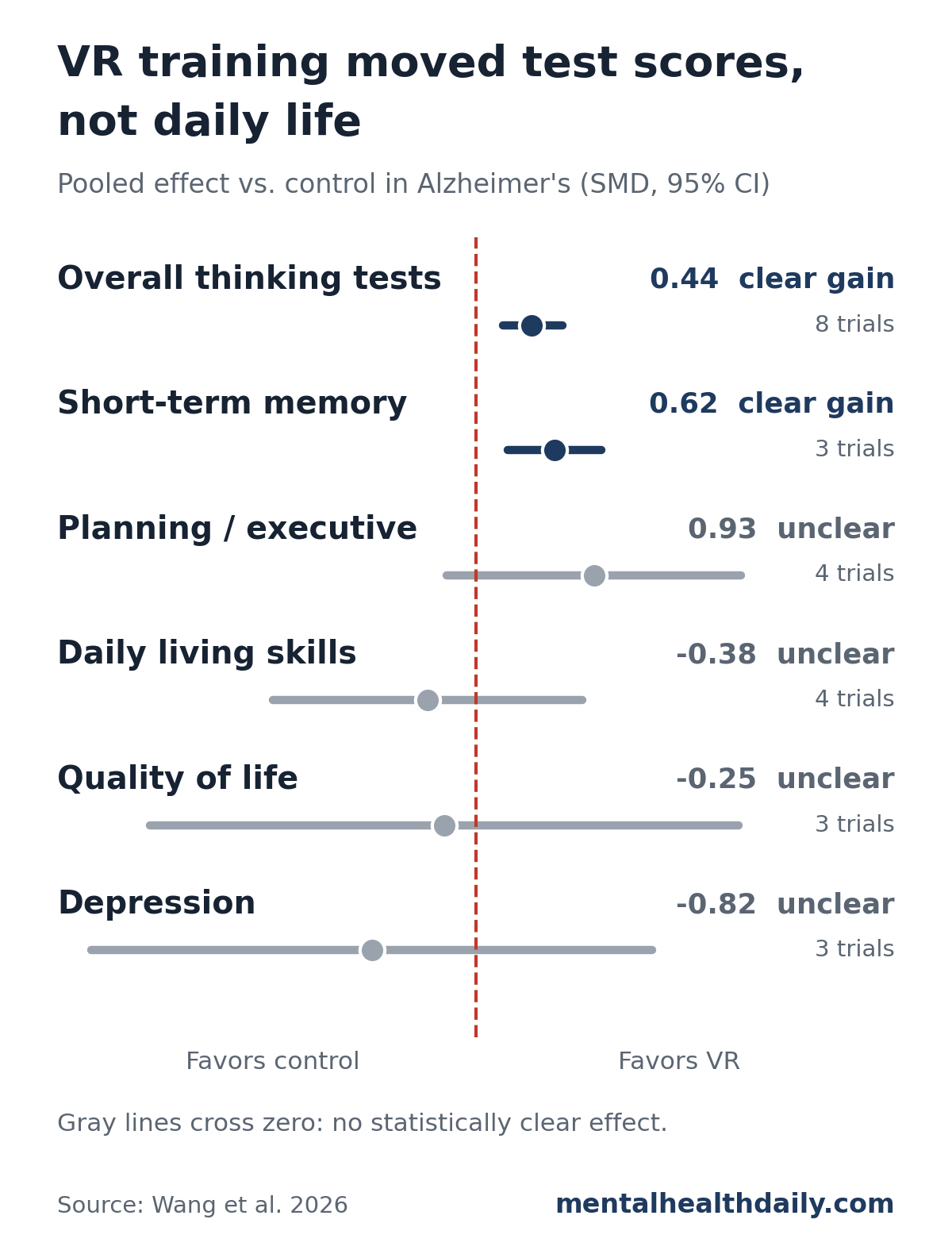
- Cognitive test scores rose modestly: across 8 trials, people who did VR-based training scored better on overall cognition tests than controls, a small-to-moderate difference (SMD 0.44, 95% CI 0.21 to 0.68).1
- Short-term memory improved too: 3 trials pooled to an SMD of 0.62, the largest statistically clear effect in the analysis.1
- No clear gain in daily life: activities of daily living, quality of life, depression, balance, and falls all showed no significant difference, with confidence intervals wide enough to include benefit, no effect, or harm.1
- Same size as ordinary brain training: a 2019 Cochrane review of 33 non-VR cognitive-training trials in dementia found almost the same cognition effect (SMD 0.42) and also no improvement in daily living.2
- Thin evidence base: the review counted 361 participants across 11 reports, though 2 reports followed the same Italian cohort; just 2 reports were rated low risk of bias overall.1
Virtual reality has become one of the more hopeful non-drug ideas in Alzheimer’s care. Anti-amyloid antibodies such as lecanemab help only in early disease and carry brain-swelling and bleeding risks, so families and care homes are looking for anything that might support thinking and independence without those tradeoffs.
Wang et al., a team from Wuhan, set out to test VR specifically in Alzheimer’s disease. Earlier reviews had mostly pooled people with mild cognitive impairment (MCI) from any cause — vascular, frontotemporal, and others — which blurs what VR might do for Alzheimer’s itself.1
What Counted as “Virtual Reality” Training in These Alzheimer’s Trials
VR-based training uses a computer-generated environment to deliver exercise or mental practice. The idea is that a game-like, multisensory setting holds attention better than paper drills or plain walking, so people with dementia practice longer and engage more of the brain at once — moving, planning, and remembering in the same task.
In practice, the 11 reports used a broad definition. The search terms included Wii, Kinect, Xbox, video games, and computerized cognitive training, and the included studies fell into 2 groups:1
- VR exercise (exergaming): balance and movement games such as Wii Fit, where the body steers an on-screen activity. Controls walked, or received routine medical care.
- VR cognitive training: screen-based or immersive tasks targeting memory, attention, and orientation. Controls usually did traditional pen-and-paper cognitive exercises or received routine care.
Only a few programs used a headset that fully surrounds the person, such as a nature-scene program in a U.S. care facility.8 The largest included trial tested structured computerized cognitive training on a regular screen.6 So “VR” here mostly means interactive digital training, not necessarily goggles.
Trial snapshot:
- Participants counted by the review: 361 (182 VR, 179 control) with clinically diagnosed Alzheimer’s dementia, mean age 73 to 87; the unique-person count may be lower because 2 Italian reports followed the same cohort.
- Severity: 6 trials in mild dementia, 5 in moderate dementia; no trials of Alzheimer’s-related MCI qualified.
- Dose: 4 to 12 weeks, 10 to 40 sessions of 20 to 45 minutes, 2 to 5 times a week.
- Settings: the United States, Italy, Turkey, Portugal, Brazil, and South Korea; published 2012 to 2025.
VR Improved Cognitive Test Scores and Short-Term Memory in Alzheimer’s
Results were reported as a standardized mean difference (SMD), which converts different test scales into one common unit: how far apart the VR and control groups ended up, measured in standard deviations. By convention, 0.2 is small, 0.5 moderate, and 0.8 large.
For overall cognition — usually measured with the Mini-Mental State Examination (MMSE) or the Alzheimer’s Disease Assessment Scale–Cognitive Subscale (ADAS-Cog) — 8 trials pooled to an SMD of 0.44 (95% CI 0.21 to 0.68). The trials disagreed only moderately (I² = 43%, meaning some but not most of the spread in results reflected real differences between studies), and dropping any single trial did not change the conclusion.1
Short-term memory, measured with tasks such as digit span, improved more: SMD 0.62 (0.25 to 0.99) across 3 trials whose results agreed closely.1
Subgroups did not separate. Exercise-based VR (SMD 0.33) and cognitive VR (SMD 0.63) each fell short of statistical significance on their own, and the difference between them was not significant either. The point estimate was larger in moderate dementia (0.70) than in mild dementia (0.35), but that gap was also not statistically confirmed, and the moderate group rested on 3 trials.1
Session count may matter for executive function. Executive function — planning, switching between tasks, and controlling impulses — did not improve overall (SMD 0.93, 95% CI −0.23 to 2.09). In the 2 trials with 24 or more sessions, the effect was large and significant (SMD 1.6), while the 2 trials with fewer sessions showed none.1 Two trials per subgroup is a hypothesis, not a dosing rule.
No Clear Benefit for Daily Living, Quality of Life, Mood, or Falls
The outcomes families usually care about most showed no statistically clear change:1
- Activities of daily living: SMD −0.38 (−1.60 to 0.84), 4 trials.
- Quality of life: SMD −0.25 (−2.57 to 2.07), 3 trials.
- Depression: SMD −0.82 (−3.03 to 1.39), 3 trials.
- Balance and coordination: SMD 1.08 (−1.25 to 3.4), 5 trials.
- Fall risk and fear of falling: no significant effect, each from only 2 trials.
- Spatial memory: SMD 0.92 (−1.28 to 3.12), 3 trials.
Scores were aligned so that higher always meant better, which means the negative point estimates lean toward the control group. But these intervals are so wide that they cannot distinguish a meaningful benefit from a meaningful harm. The accurate reading is “unknown,” not “VR made daily life worse.”
Wang et al. argued that these nonsignificant results probably reflect too little statistical power rather than proof that VR does nothing.1 That is plausible for balance and falls, where the estimates lean positive. For daily living and quality of life, though, the best guesses sit on the wrong side of zero, so the data give no directional hint of benefit to lean on yet.
Ordinary Cognitive Training Shows the Same Pattern in Dementia
The VR results closely echo what 2 decades of non-VR brain training have found in dementia. Different reviews, using different technologies and populations, converge on a modest test-score effect with little transfer to daily function:
- Cognitive training in dementia: a 2019 Cochrane review by Bahar-Fuchs et al. pooled 33 trials and 1,924 people with mild to moderate dementia. Training improved global cognition by SMD 0.42 (95% CI 0.23 to 0.62) — nearly identical to the VR estimate — but did not improve activities of daily living, mood, or behavioral symptoms.2
- Computerized training, MCI vs. dementia: Hill et al. found computerized cognitive training helped global cognition and several specific abilities in MCI, but called the evidence in dementia weak and limited to trials of immersive technologies.3
- Exergaming: a 2024 Cochrane review by Voinescu et al. found exergaming may improve global cognition in dementia at the end of treatment (SMD 1.47; 2 studies, 113 people), but rated the evidence very uncertain and found little support for better walking, balance, or daily tasks.4
- Earlier VR meta-analysis: Kim et al. reported a cognition effect of 0.42 across MCI and dementia. Across all measured outcomes, semi-immersive studies had a larger pooled effect than fully immersive studies (0.37 vs. 0.03), but only 2 studies used full immersion; these were not head-to-head hardware trials.5
Two conclusions follow from that convergence:
- The size is believable. An SMD near 0.4 keeps turning up for structured mental practice in dementia, whatever the delivery format.
- The added value of VR is unproven. In Wang et al.’s 3 trials that compared VR with traditional cognitive exercises, VR came out ahead (SMD 0.46, 95% CI 0.16 to 0.76).1 But most of those programs were screen-based computerized training, and no trial has isolated immersion as the active ingredient.
Test-score gains also tend to stay close to the trained tasks. Doing better on the MMSE or a digit-span test after weeks of practicing memory-heavy games is not the same as remembering to take medications or managing money again.
How Strong Is the Evidence for VR in Alzheimer’s?
Evidence strength: this is a meta-analysis of randomized trials, which is normally a strong design, but the trials underneath it are small pilots. The pooled result can support a claim that short VR programs modestly raise cognitive test scores in mild-to-moderate Alzheimer’s dementia at the end of training. It cannot support claims that VR slows Alzheimer’s progression, preserves independence, or improves mood.
Specific weaknesses:
- Tiny evidence base: the review counted 361 participants across reports that may share people, and most non-cognitive outcomes pooled just 2 to 4 reports. A single new trial could move these estimates substantially.
- Risk of bias: 3 reports were rated high risk and 6 had some concerns; only 2 were rated low risk overall. Participants always knew whether they were playing a game, so expectation effects are hard to rule out.1
- Reports may share participants: the 2016 and 2019 Italian papers describe follow-up of the same 80-person randomized training study, yet the review lists them as separate study rows. Two Turkish reports (2020 and 2025) also list the same 16-per-group size, mean age, sex mix, and 6-week schedule.6, 7, 9, 10 Whether any participants were counted twice in a pooled outcome remains unclear.
- Mixed interventions: Wii balance games, tablet memory drills, and headset nature scenes were pooled as one “VR” treatment, and comparators ranged from routine care to active cognitive training.
- No long-term follow-up: results were measured at the end of 4 to 12 weeks of training. Whether any gain lasts was not analyzed.
- Safety by omission: the included trials reported no adverse events, but none was large enough to detect uncommon problems such as falls during exergaming or motion sickness with headsets.
One claim in the discussion also runs ahead of the data: Wang et al. wrote that VR outperformed conventional exercise, yet that subgroup rested on 2 trials with a confidence interval of −6.3 to 6.82.1
Using VR Programs for Someone With Alzheimer’s
For a person with mild or moderate Alzheimer’s who enjoys games or finds ordinary exercises boring, a supervised VR or exergaming program is a reasonable activity. The likely upside is a modest bump in thinking-test performance while the program runs. The realistic expectation is that it will not, on current evidence, make daily tasks easier or slow the disease.
- Pick engagement over hardware: no head-to-head evidence shows that full headsets work better than screens. Ordinary cognitive training also produces a similar test-score effect.2, 5
- Supervise balance games: exergaming involves standing and shifting weight, so a spotter and a clear space matter for someone at risk of falling.
- Keep the proven basics: VR is an add-on activity, not a replacement for medical care, physical activity, social contact, or support with daily routines.
Questions About VR Training for Alzheimer’s
Does virtual reality slow Alzheimer’s disease?
There is no evidence that it does. The trials lasted 4 to 12 weeks and measured test scores at the end of training; none tracked disease progression.1
Is a VR headset better than a tablet or Wii game?
No head-to-head evidence establishes that. An earlier meta-analysis found a larger pooled effect across mixed outcomes in semi-immersive studies, but only 2 studies used full immersion. Most trials in the 2026 analysis used screens or game consoles rather than headsets.5
How many sessions would someone need?
Trials used 10 to 40 sessions over 4 to 12 weeks, typically 2 to 3 times a week for 20 to 45 minutes.1
Overall cognition did not differ significantly between shorter and longer programs; only executive function hinted that 24 or more sessions might help, based on 2 trials.
Did VR make daily living or mood worse?
No clear harm was shown. The point estimates leaned slightly toward controls, but the confidence intervals were very wide and crossed zero, so the honest answer is that the effect on these outcomes is still unknown.1
Does this apply to mild cognitive impairment?
Not directly. Every participant had diagnosed Alzheimer’s dementia. Computerized training has stronger evidence in MCI, but those trials usually mixed causes of impairment.3
References
- Virtual reality-based training in patients with Alzheimer’s disease: A systematic review and meta-analysis. Wang J, et al. J Prev Alzheimers Dis. 2026;13:100590. doi:10.1016/j.tjpad.2026.100590
- Cognitive training for people with mild to moderate dementia. Bahar-Fuchs A, et al. Cochrane Database Syst Rev. 2019;3:CD013069. doi:10.1002/14651858.CD013069.pub2
- Computerized Cognitive Training in Older Adults With Mild Cognitive Impairment or Dementia: A Systematic Review and Meta-Analysis. Hill NT, et al. Am J Psychiatry. 2017;174(4):329-340. doi:10.1176/appi.ajp.2016.16030360
- Exergaming for dementia and mild cognitive impairment. Voinescu A, et al. Cochrane Database Syst Rev. 2024;9:CD013853. doi:10.1002/14651858.CD013853.pub2
- The effectiveness of virtual reality for people with mild cognitive impairment or dementia: a meta-analysis. Kim O, et al. BMC Psychiatry. 2019;19(1):219. doi:10.1186/s12888-019-2180-x
- Computerized structured cognitive training in patients affected by early-stage Alzheimer’s disease is feasible and effective: a randomized controlled study. Cavallo M, et al. Arch Clin Neuropsychol. 2016;31(8):868-876. doi:10.1093/arclin/acw072
- Long-lasting neuropsychological effects of a computerized cognitive training in patients affected by early stage Alzheimer’s disease: are they stable over time? Cavallo M, Angilletta C. J Appl Gerontol. 2019;38(7):1035-1044. doi:10.1177/0733464817750276
- Efficacy of an immersive nature-based virtual reality program on depression, emotional health, and quality-of-life among care facility residents with Alzheimer’s disease and its related dementias. Kim J, et al. Am J Health Behav. 2023;47(5):1052-1061. doi:10.5993/AJHB.47.5.18
- The effect of virtual reality applications on balance and gait speed in individuals with Alzheimer dementia. Uğur F, Sertel M. Top Geriatr Rehabil. 2020;36(4):221-229. doi:10.1097/TGR.0000000000000285
- Wii Fit exercise’s effects on muscle strength and fear of falling in older adults with Alzheimer disease: a randomized controlled trial. Uğur F, Sertel M. J Aging Phys Act. 2025;33(2):181-191. doi:10.1123/japa.2023-0428