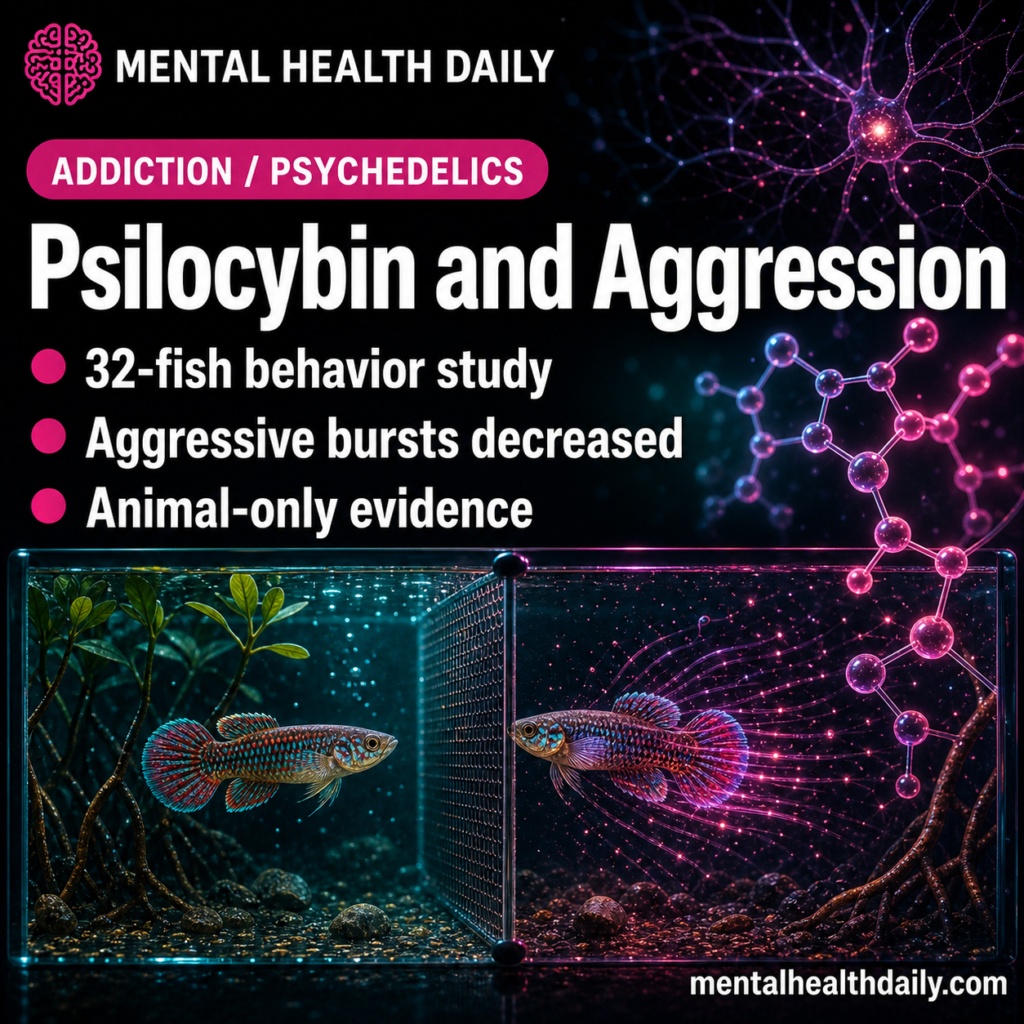
A 2026 study involving 32 adult mangrove rivulus fish pairs found that 3,000 µg/L waterborne psilocybin reduced movement and aggressive swimming bursts, but the result belongs in animal behavioral pharmacology, not in human aggression treatment claims.1
Research Highlights
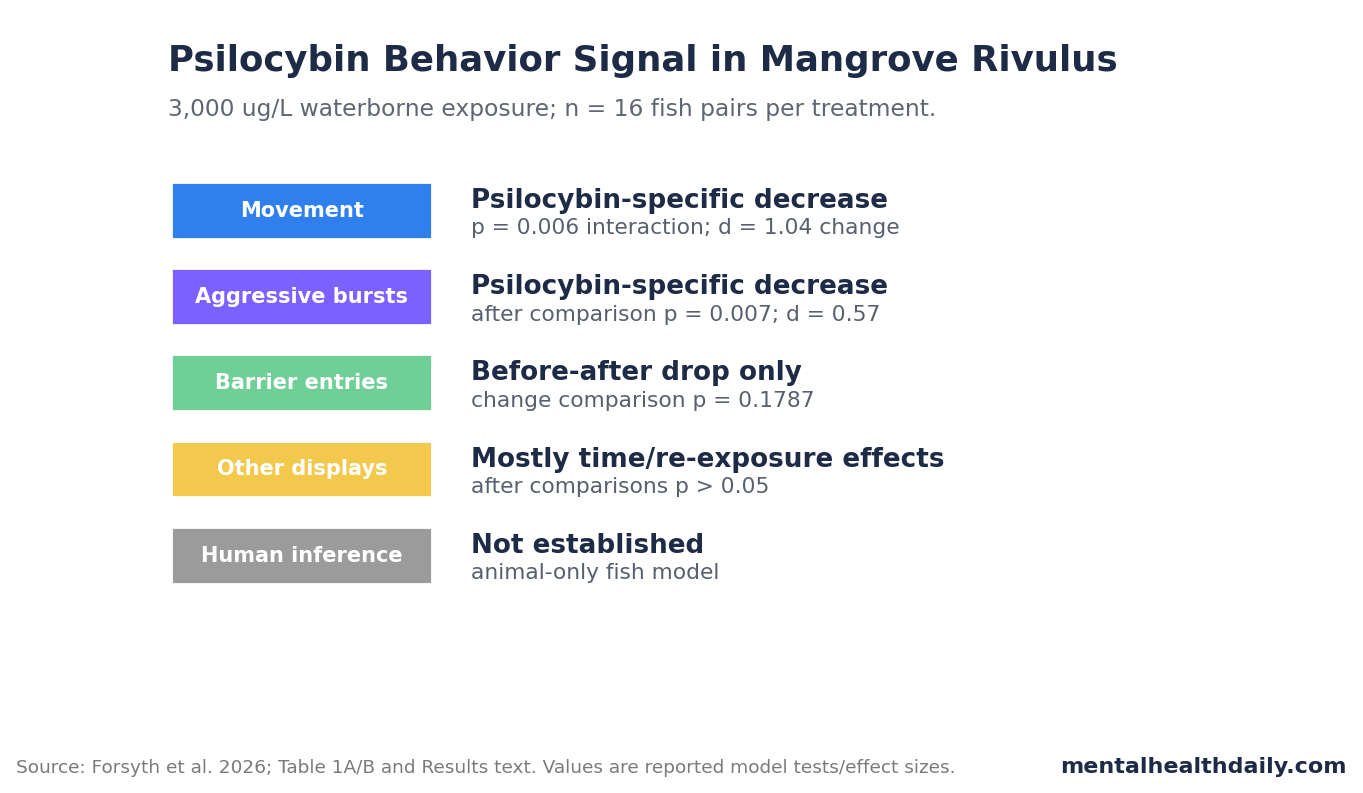
- Fish movement decreased: psilocybin produced a treatment-by-time interaction for time spent moving (p = 0.006), with a large change-effect estimate (d = 1.04).
- Aggressive bursts decreased: swimming bursts toward another fish fell after 3,000 µg/L psilocybin, with the after-treatment comparison favoring psilocybin over control (p = 0.007; d = 0.57).
- Other displays were less decisive: head-on displays, lateral displays, mesh-zone time, and interaction time often changed across the 2 test days, but after-treatment group differences were not consistently significant.
- Exposure was biologically plausible: whole-body psilocin after water exposure was around 7 ng/mL, near the 11 ng/mL human peak cited for a low-to-moderate 15 mg dose, though aquatic dosing cannot be translated directly.
- Clinical inference stays narrow: n = 16 fish pairs per treatment supports a preclinical behavior signal, not a claim that psilocybin treats human aggression, irritability, or social conflict.
Mangrove rivulus are small amphibious fish used in behavioral neuroscience because laboratory lineages can be highly inbred and behaviorally variable at the same time. Forsyth et al. used that model to ask whether a single psilocybin exposure would quiet activity and attack-like behavior during a controlled social encounter.
Psilocybin is a psychedelic prodrug that the body converts into psilocin, a serotonin-like compound with activity at serotonin receptors including 5-HT2A. Human psychedelic therapy research usually focuses on depression, anxiety, addiction, and distress; this fish experiment asked a narrower mechanistic question about acute behavior.
3,000 µg/L Psilocybin Reduced Movement in a 32-Pair Fish Test
Researchers first tested 500, 1,000, and 3,000 µg/L waterborne psilocybin and selected 3,000 µg/L because it produced the strongest behavioral response. Focal fish sat in the psilocybin bath for 20 minutes, then were tested 15 minutes later against a size-matched stimulus fish behind a mesh barrier.
Design: 16 focal-stimulus pairs were assigned to control and 16 to psilocybin. The study used a before-and-after design, so each focal fish contributed baseline behavior before the treatment comparison.
Main movement result: psilocybin changed time spent moving across the 2 test days. The treatment-by-time interaction was significant (p = 0.006), the psilocybin group moved less after exposure (p < 0.001), and the after-treatment comparison separated psilocybin from control (p = 0.011).
When the researchers analyzed individual change scores, psilocybin reduced movement with t(24.4) = 3.0, p = 0.007, and d = 1.04. In plain terms, the fish were less active after psilocybin than control fish tested under the same social-exposure setup.
Aggressive Swimming Bursts Fell, but Not Every Aggression Measure Changed
Swimming bursts were rapid darts toward the stimulus fish at the mesh barrier. The researchers treated them as an aggressive attack-like behavior because mangrove rivulus use quick directed movements during social confrontation.
The headline aggression signal came from that endpoint. Psilocybin-treated fish showed a before-to-after decrease in swimming bursts (p < 0.001), and after treatment they had fewer swimming bursts than control fish (p = 0.007). The change-score comparison was smaller than the movement effect but still statistically significant (W = 182.5, p = 0.039, d = 0.57).
Mesh barrier entries were more complicated. Psilocybin fish entered the barrier zone less often after exposure (p < 0.001), while the control before-after comparison was not significant (p = 0.139). But the change-score comparison between groups did not reach significance (p = 0.1787), so this result is weaker than the movement and burst findings.
Other display behaviors looked even less psilocybin-specific:
- Head-on displays: frequency and time decreased over time in both groups, but after-treatment group differences were not significant.
- Lateral displays: frequency decreased over time, with a larger-looking decline in psilocybin fish, but after-treatment group differences were not significant.
- Interaction time: both groups spent less time interacting after repeated exposure, which makes familiarity or day effects hard to separate from drug effects.
The calibrated read is not “psilocybin turned off aggression.” It is narrower: in this fish setup, psilocybin reduced general activity and one directed burst behavior more clearly than it changed the full menu of social displays.
Fish and Zebrafish Psilocybin Studies Do Not All Point the Same Way
The adjacent literature is small and uneven. Abramson et al. tested psilocybin and LSD in Siamese fighting fish in 1963, reporting surface-floating behavior after psilocybin and compound-specific differences between waterborne and injected exposure.2 That older result already warned that fish behavior depends heavily on route and compound kinetics.
Braun et al. later used high-resolution tracking in larval zebrafish and reported that 2.5 µM psilocybin for 4 hours enhanced spontaneous exploration and reversed stress-induced behavioral changes.3 That study fits the idea that psilocybin can alter fish stress or exploration behavior, but it does not match the mangrove rivulus endpoint exactly.
Tombari et al. found a different pattern in a larval zebrafish developmental neurotoxicity screen: psilocybin showed low potency and no observed behavioral or teratological effect in that assay.4 Different life stage, exposure window, dose, and outcome definitions can easily move a fish study from “clear behavior signal” to “no detectable effect.”
Donovan et al. added a mammalian bridge by studying pigs after a single psilocybin dose, measuring behavior, brain 5-HT2A receptor occupancy, and gene-expression effects.5 That work is closer to human translational pharmacology than a fish bath, but it still supports the same basic rule: acute psilocybin can alter behavior through serotonin-linked biology, while clinical meaning depends on model, dose, and endpoint.
LC-MS Confirmed Uptake but Dose Translation Is Hard
LC-MS, or liquid chromatography-mass spectrometry, is a laboratory method that separates chemicals and measures their concentration by mass. Forsyth et al. used it to check whether psilocybin and psilocin entered the fish after water exposure.
Whole-body psilocybin and psilocin increased with higher waterborne doses of 3,000, 6,000, and 12,000 µg/L. Fasting did not produce a clear difference in uptake. The discussion reports a low tissue concentration around 7 ng/mL after waterborne exposure, compared with a cited human peak plasma psilocin concentration of 11 ng/mL after a low-to-moderate 15 mg dose.
That comparison is useful only as a plausibility check. A water bath concentration in a small amphibious fish is not a human oral dose. Mangrove rivulus can absorb chemicals through gills and vascularized skin, but brackish-water osmoregulation, compound charge, lineage differences, and whole-body measurement all complicate translation.
Exposure limit: the LC-MS work used a different lineage than the behavior experiment because appropriately sized fish were available from that lineage. The researchers expected major uptake differences to be negligible, but lineage-specific absorption remains an uncertainty.
Animal-Only Psychedelic Aggression Evidence Needs a Narrow Claim
Serotonin has a known role in aggression and stress responses across animal models. Psilocin’s serotonin-like structure gives a plausible route for changing social behavior, especially when the endpoint is a rapid attack-like movement during a controlled confrontation. That mechanism makes the result biologically interesting without making it clinically actionable.
The evidence-strength note is still load-bearing. This was not a trial in people with aggression, irritability, trauma, personality disorder, substance use, or any psychiatric diagnosis. It was an acute experiment in a small fish species selected because it is active, socially reactive, and useful for genetic-control questions.
Useful conclusions stay at the preclinical level:
- Behavioral pharmacology: psilocybin can reduce selected activity and burst behaviors in adult mangrove rivulus under acute exposure.
- Model development: this species may be useful for studying psychedelic effects on social behavior, especially when genotype and individual variability are part of the question.
- Clinical restraint: the result does not establish that psilocybin calms human aggression or should be used outside controlled research or regulated medical settings.
The study is most useful as a model-building result. It adds one adult fish system to a literature that already includes older Betta work, larval zebrafish screens, pig neuropharmacology, and scattered rodent aggression findings.
A stronger next experiment would separate sedation from social calming more directly. If a compound lowers all movement, an apparent reduction in attack-like movement could partly reflect general hypoactivity. A sharper design would pair aggression endpoints with independent locomotion, anxiety-like behavior, serotonergic markers, and dose-response data across multiple lineages.
Questions About Psilocybin and Aggression in Fish
Did this study show that psilocybin treats aggression in people?
No. It showed reduced movement and aggressive swimming bursts in a fish model after acute waterborne exposure. Human aggression treatment would require human studies with psychiatric endpoints, safety monitoring, and clear dosing.
Why use mangrove rivulus instead of zebrafish?
Mangrove rivulus are naturally active and socially reactive, and laboratory lineages can be genetically controlled. That gives researchers a social-confrontation readout alongside standard swimming behavior.
Could the fish have been sedated rather than less aggressive?
Possibly in part. Movement decreased strongly, and aggressive bursts decreased too. Because not all display endpoints changed in the same way, the safest interpretation is that psilocybin produced a calming or hypoactive behavioral pattern with a clearer signal for swimming bursts than for the whole aggression repertoire.
References
- The Magic of Mushrooms: Psilocybin Influences Behavior in the Mangrove Rivulus Fish, Kryptolebias marmoratus. Forsyth D et al. Frontiers in Behavioral Neuroscience. 2026;20:1767175. doi:10.3389/fnbeh.2026.1767175
- Lysergic Acid Diethylamide (LSD-25): XXXIV. Comparison With Effect of Psilocybin on the Siamese Fighting Fish. Abramson HA et al. Journal of Psychology. 1963;56:363-374. doi:10.1080/00223980.1963.9916652
- High-Resolution Tracking of Unconfined Zebrafish Behavior Reveals Stimulatory and Anxiolytic Effects of Psilocybin. Braun D et al. Molecular Psychiatry. 2024;29:1046-1062. doi:10.1038/s41380-023-02391-7
- Developmental Neurotoxicity Screen of Psychedelics and Other Drugs of Abuse in Larval Zebrafish (Danio rerio). Tombari RJ et al. ACS Chemical Neuroscience. 2023;14:875-884. doi:10.1021/acschemneuro.2c00642
- Effects of a Single Dose of Psilocybin on Behaviour, Brain 5-HT2A Receptor Occupancy and Gene Expression in the Pig. Donovan LL et al. European Neuropsychopharmacology. 2021;42:1-11. doi:10.1016/j.euroneuro.2020.11.013