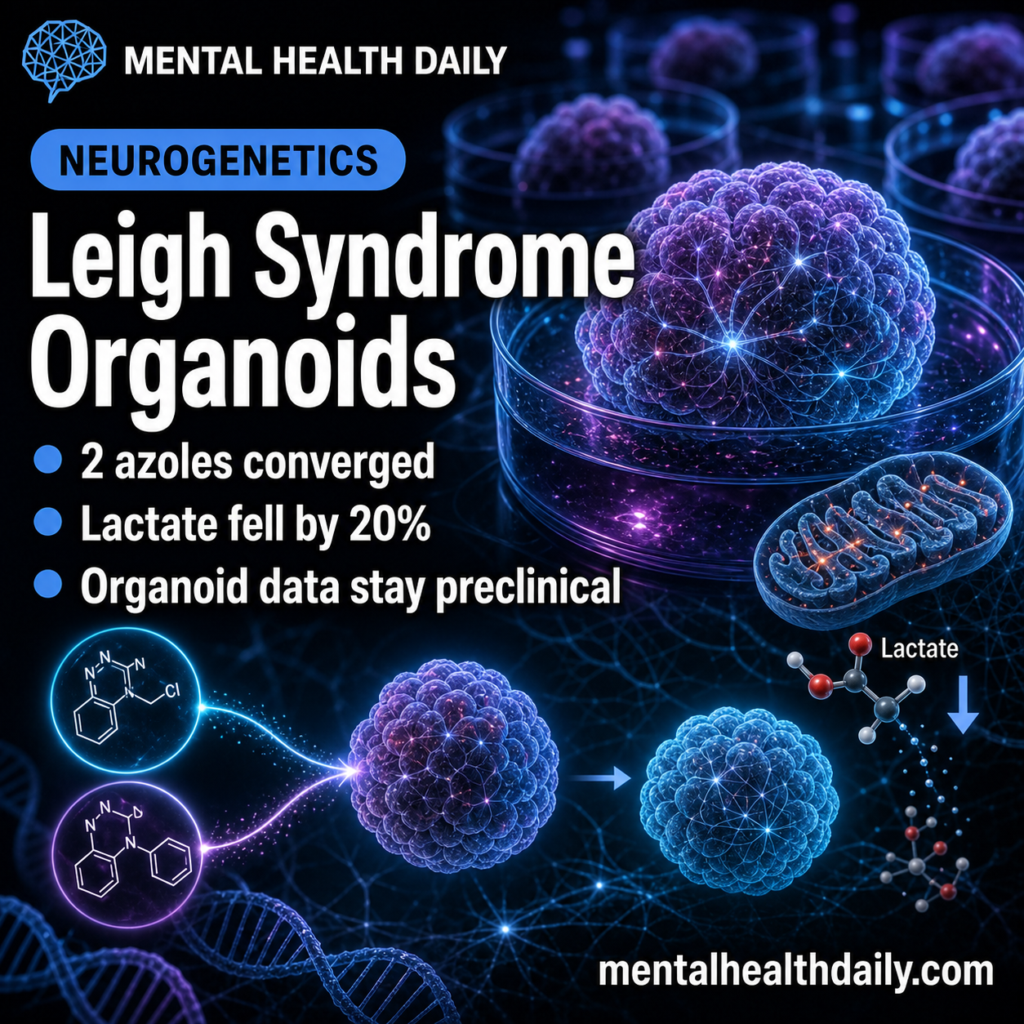
A 2026 Leigh syndrome study combined a cell-type-specific deep-learning screen with a 2,250-drug yeast survival screen and found the same drug family from both directions: azoles, with talarozole and sertaconazole lowering lactate release by 20% in SURF1-mutant midbrain organoids.1 The finding is preclinical, but it is stronger than a single in silico hit because the compounds were carried into human neural cells and brain-organoid assays.
Research Highlights
- 2 screening routes converged: deep learning and a 2,250-drug yeast screen both prioritized azole compounds for SURF1-related Leigh syndrome.1
- Organoid lactate fell: 0.1 μM sertaconazole and 1 μM talarozole decreased lactate in Leigh midbrain organoid media by 20%.1
- Talarozole looked stronger: the retinoic-acid-pathway modulator improved more Leigh phenotypes than sertaconazole, including calcium-response measures in organoids.1
- The model has history: a 2021 organoid study had already shown that SURF1 Leigh cells failed early neuronal morphogenesis because metabolic programming stayed abnormal.2
- Clinical use remains distant: 0 patients were treated, and pediatric mitochondrial-disease safety cannot be inferred from organoid rescue.1
Leigh syndrome is a severe mitochondrial disease in which impaired oxidative phosphorylation damages high-energy brain regions such as the basal ganglia and brainstem. SURF1 is one of the nuclear genes that can cause Leigh syndrome by disrupting assembly of cytochrome c oxidase, also called complex IV, in the mitochondrial respiratory chain.
Brain organoids are small three-dimensional neural cultures grown from stem cells. They cannot reproduce a child with Leigh syndrome, but they can expose human-specific developmental failures that mouse models may miss.
Deep Learning and a 2,250-Drug Yeast Screen Pointed to Azoles
Menacho et al. started from a prior disease model: SURF1-mutant cerebral organoids had fewer committed neural progenitors and neurons, suggesting stalled neuronal development. Their new screen asked whether existing drugs could push Leigh neural cells toward a more mature neuronal state.1
The computational arm used single-cell RNA sequencing to model a desired transition from radial-glia-like precursors toward intermediate progenitors and neurons. The parallel wet-lab arm screened 2,250 FDA-approved drugs in yeast lacking SHY1, the yeast homolog of SURF1.
Convergence is the main signal: the two pipelines were built differently, yet both elevated azole compounds. That reduces the chance that the result is a one-off artifact of a single model.
Talarozole and Sertaconazole Lowered Lactate by 20% in Leigh Organoids
The study then moved into human neural validation. Sertaconazole and talarozole rescued neuronal morphogenesis in induced neurons and improved growth-rate abnormalities in Leigh midbrain organoids. At 0.1 μM sertaconazole and 1 μM talarozole, both compounds reduced lactate release by 20%.1
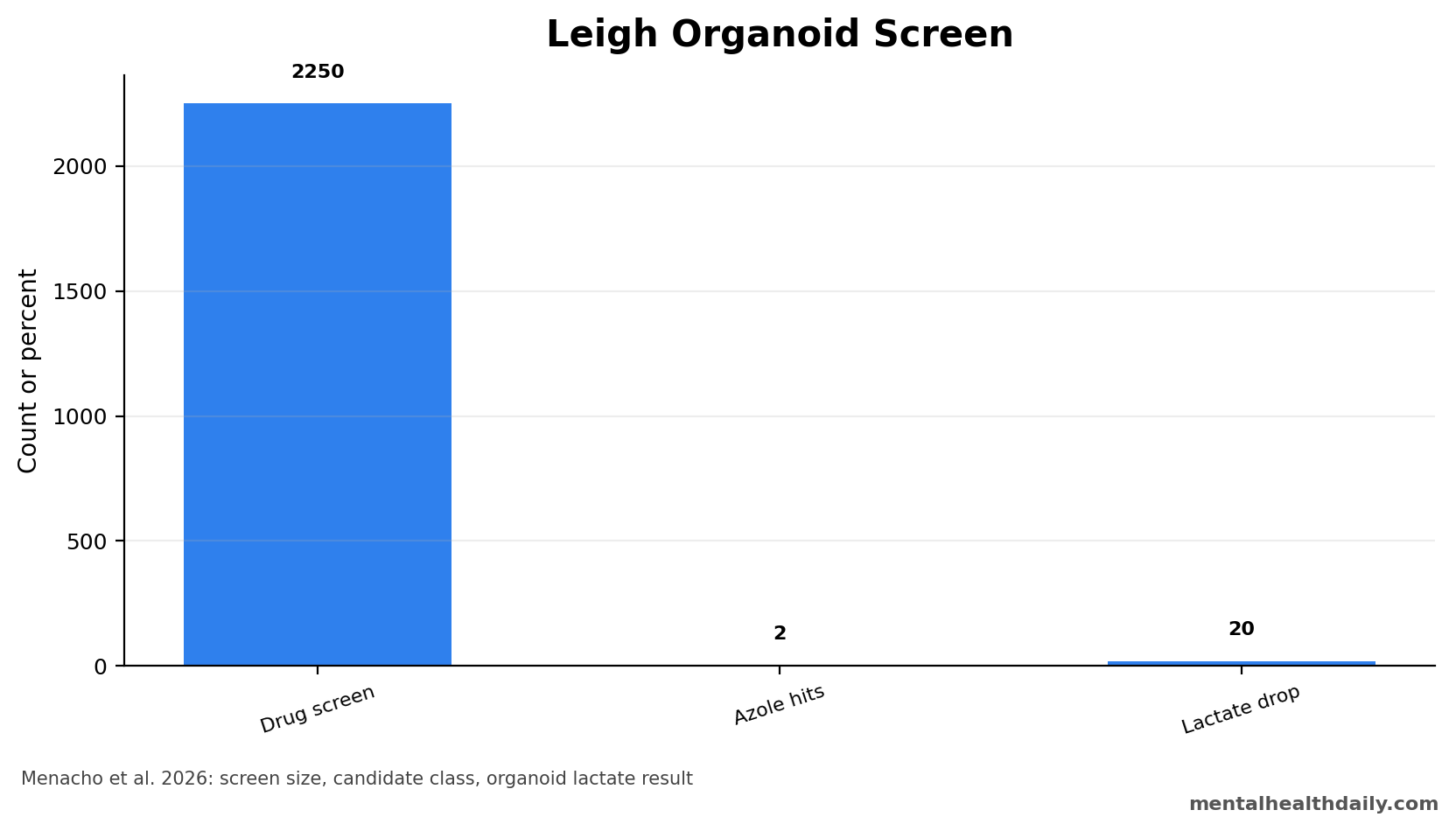
Why lactate matters: Leigh syndrome is tied to failed energy metabolism, and lactic acidosis is part of the clinical syndrome. A 20% lactate reduction in organoids is not a clinical endpoint, but it is directionally aligned with the disease biology.
Talarozole appeared more potent across several follow-up assays. It increased tyrosine-hydroxylase-positive neurons, improved calcium activity, and showed stronger engagement with the retinoic acid pathway, which helps govern neuronal differentiation.
The Result Extends the 2021 SURF1 Organoid Finding
A 2021 Nature Communications study had shown that SURF1 Leigh syndrome neural progenitor cells retained a glycolytic, proliferative state and failed to establish normal neuronal morphogenesis.2 Menacho et al. treated that defect as a screenable phenotype.
Model logic: if a disease model captures a reproducible human-cell defect, drug discovery can target that defect directly. The 2026 study therefore did more than rank compounds; it tested whether the organoid phenotype could act as a therapeutic readout.
That logic fits the broader push toward new approach methodologies (NAMs), a term for human-cell, organoid, computational, and other non-animal methods used to improve translational prediction.3
SURF1 Biology Explains Why Human Models Were Needed
SURF1-related Leigh syndrome is a specific complex-IV assembly disorder. SURF1 helps assemble cytochrome c oxidase, also called mitochondrial complex IV, the respiratory-chain enzyme that transfers electrons to oxygen. When that assembly fails, high-energy neural tissue can become vulnerable during development and after birth.1
The modeling problem is unusually important here because species differ. Menacho et al. noted that SURF1 knockout mice do not reproduce the classic human Leigh phenotype and can even show prolonged lifespan, while a SURF1 knockout piglet model developed severe lethal neurodevelopmental disease.1 That mismatch is the reason a human-cell organoid result deserves attention without being treated as clinical proof.
What the organoid adds: it lets researchers test whether a candidate compound changes the human neural-cell phenotype that looks broken in SURF1 disease. The useful signal is layered: 2 unrelated discovery systems pointed to the same compound family, and the follow-up assays moved neuronal morphology, organoid growth, and lactate in the expected direction.
Retinoic Acid Signaling Makes Talarozole More Than an Antifungal Hit
Sertaconazole and talarozole both belong to the broad azole scaffold, but they do not imply the same translational story. Sertaconazole is best known as an antifungal. Talarozole inhibits CYP26 enzymes, which break down retinoic acid, a signaling molecule that helps regulate cell differentiation and neural development.1
That mechanism fits the paper’s developmental frame. If SURF1 Leigh organoids remain stuck in a less mature neural state, a compound that nudges retinoic-acid signaling could plausibly improve differentiation markers. Menacho et al. reported that talarozole engaged the retinoic acid pathway and produced broader rescue across follow-up assays than sertaconazole, including calcium-response measures in midbrain organoids.1
The calibrated read: talarozole is the more interesting mechanistic candidate inside this preclinical paper, while sertaconazole strengthens the class-level convergence signal. Neither result means that children with Leigh syndrome should receive either drug outside a research path.
The safety question is not cosmetic. Retinoic acid signaling is powerful because it influences development, but that same developmental reach can create dose-sensitive toxicity. A repurposing path would therefore need to separate the disease-rescue signal from broad retinoid-like developmental effects, especially if treatment were aimed at infants or young children with mitochondrial disease.
Why azole convergence is still useful: rare-disease drug discovery often fails when a candidate is chosen from one attractive assay and then collapses in the next model. Here, the yeast SHY1 survival screen, single-cell-informed deep learning, induced-neuron assays, and midbrain organoid readouts did not all measure the same thing. Agreement across those layers makes the finding more credible than a single top-ranked computational hit.
The paper also gives a practical reason to care about drug repurposing in a rare mitochondrial disorder. Building a new molecule for a tiny pediatric population is slow, expensive, and uncertain. Starting from already-characterized compounds can shorten the early toxicology and formulation questions, although it never removes them. In this case, the repurposing claim is strongest as a prioritization argument: azoles deserve deeper testing before less-supported candidates.
That prioritization still has to stay genotype-specific. SURF1 disease affects complex IV assembly, while other Leigh syndrome variants can disrupt different respiratory-chain components or mitochondrial DNA maintenance. A compound that improves SURF1 neural maturation may fail in a Leigh subtype where the dominant problem is a different molecular bottleneck.
Azole Repurposing Is Plausible but Clinically Unproven
Azoles are familiar drug scaffolds, but that familiarity should not be confused with Leigh syndrome readiness. Sertaconazole is an antifungal, while talarozole affects retinoic acid metabolism through CYP26 inhibition. Pediatric mitochondrial disease creates a different safety problem than ordinary antifungal use.
Evidence-strength note: this was a preclinical drug-discovery study. It can prioritize compounds, sharpen mechanism, and justify animal or carefully staged translational work. It cannot show symptom improvement, survival benefit, dosing range, or safety in children.
The strongest clinical translation is therefore a sequence: confirm rescue in additional Leigh genotypes, test pharmacokinetics and toxicity in relevant models, then design a narrow early-phase trial around biomarkers such as lactate, neurodevelopmental function, and safety.
What would count as a stronger next signal? A useful next experiment would extend beyond the same lactate readout. It would test whether talarozole or a better-tuned retinoic-acid-pathway compound improves survival-relevant neural function across additional SURF1 models, whether the dose range avoids retinoid toxicity, and whether the effect survives in a model with whole-organism drug metabolism.
Questions About Leigh Syndrome Organoid Drug Screening
Did the study prove that talarozole treats Leigh syndrome?
No. It showed partial rescue of cellular and organoid phenotypes, including a 20% lactate reduction, but no child or adult patient received the drug.
Why use brain organoids instead of only mice?
Human organoids can reveal developmental problems in human neural cells that mouse models may compensate for. That is especially relevant for SURF1 Leigh syndrome, where animal models do not always reproduce the human disease.
Which compound looked more interesting?
Talarozole had the broader rescue pattern in this paper, especially around retinoic acid signaling and calcium-response measures. Sertaconazole still mattered because it emerged from the same convergent azole signal.
Why does a 20% lactate reduction not settle the treatment question?
Lactate is biologically relevant because Leigh syndrome often involves lactic acidosis, but an organoid lactate result is a mechanistic marker. A treatment claim would need animal safety, human dosing logic, and eventually clinical outcomes such as neurologic function, development, seizures, hospitalization, or survival.
Does this result apply to all Leigh syndrome genotypes?
No. The strongest inference is for SURF1-related models. Leigh syndrome can come from many nuclear or mitochondrial DNA variants, so the same compound would need genotype-by-genotype testing before anyone could treat the result as a general Leigh syndrome strategy.
References
- Menacho C, Okawa S, Alvarez-Merz I, et al. Accelerating Leigh syndrome drug discovery through deep learning screening in brain organoids. Nature Communications. 2026;17:3570. https://doi.org/10.1038/s41467-026-71391-2
- Inak G, Rybak-Wolf A, Lisowski P, et al. Defective metabolic programming impairs early neuronal morphogenesis in neural cultures and an organoid model of Leigh syndrome. Nature Communications. 2021;12:1929. https://doi.org/10.1038/s41467-021-22117-z
- New approach methodologies for drug discovery. Cell. 2026. https://doi.org/10.1016/j.cell.2026.02.012
- Tiranti V, Hoertnagel K, Carrozzo R, et al. Mutations of SURF-1 in Leigh disease associated with cytochrome c oxidase deficiency. American Journal of Human Genetics. 1998;63(6):1609–1621. https://doi.org/10.1086/302150