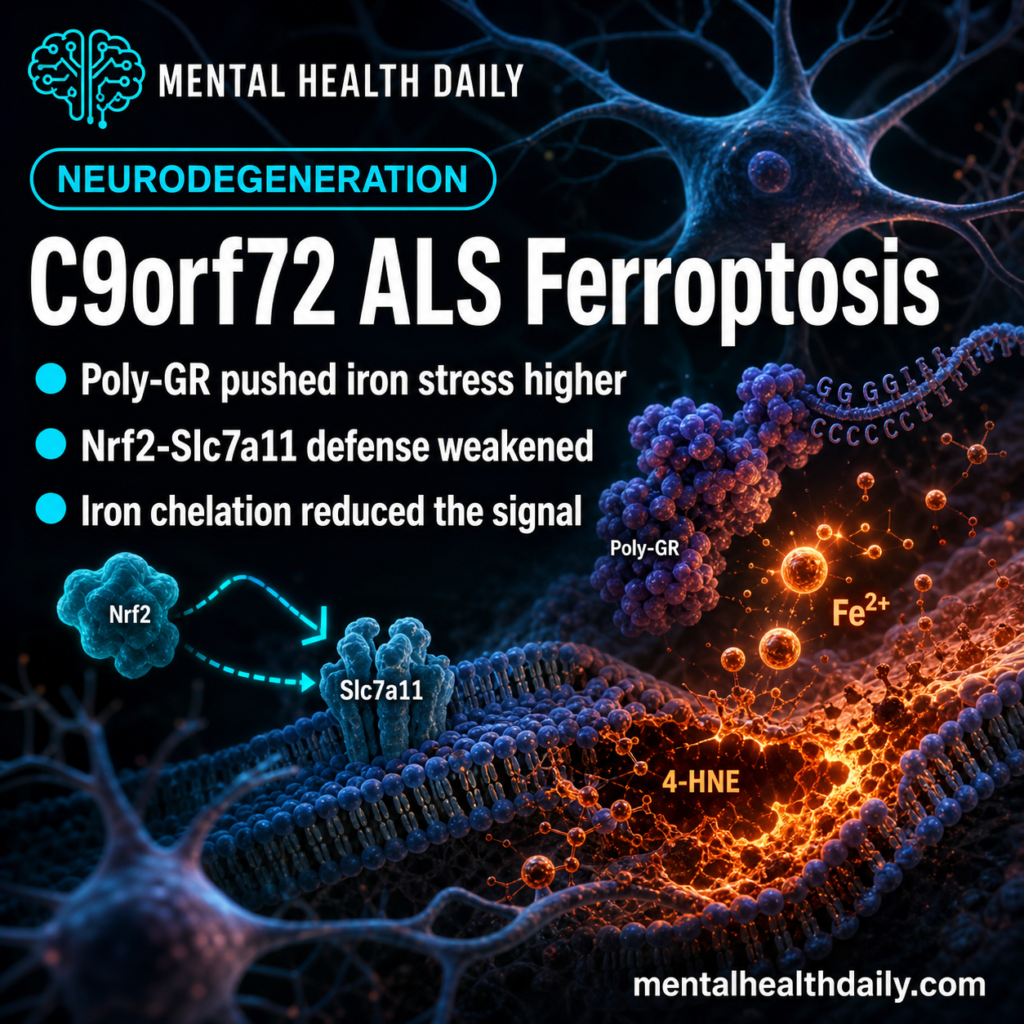
A 2026 Cell & Bioscience study found that poly-GR, one of the toxic dipeptide-repeat proteins produced in C9orf72-linked amyotrophic lateral sclerosis (ALS), pushed motor neuron-like cells toward ferroptosis: 4-HNE lipid peroxidation rose at p < 0.0001, labile Fe²+ rose at p < 0.001, and erastin caused more cell death in poly-GR-expressing cells than in control cells.1
Research Highlights
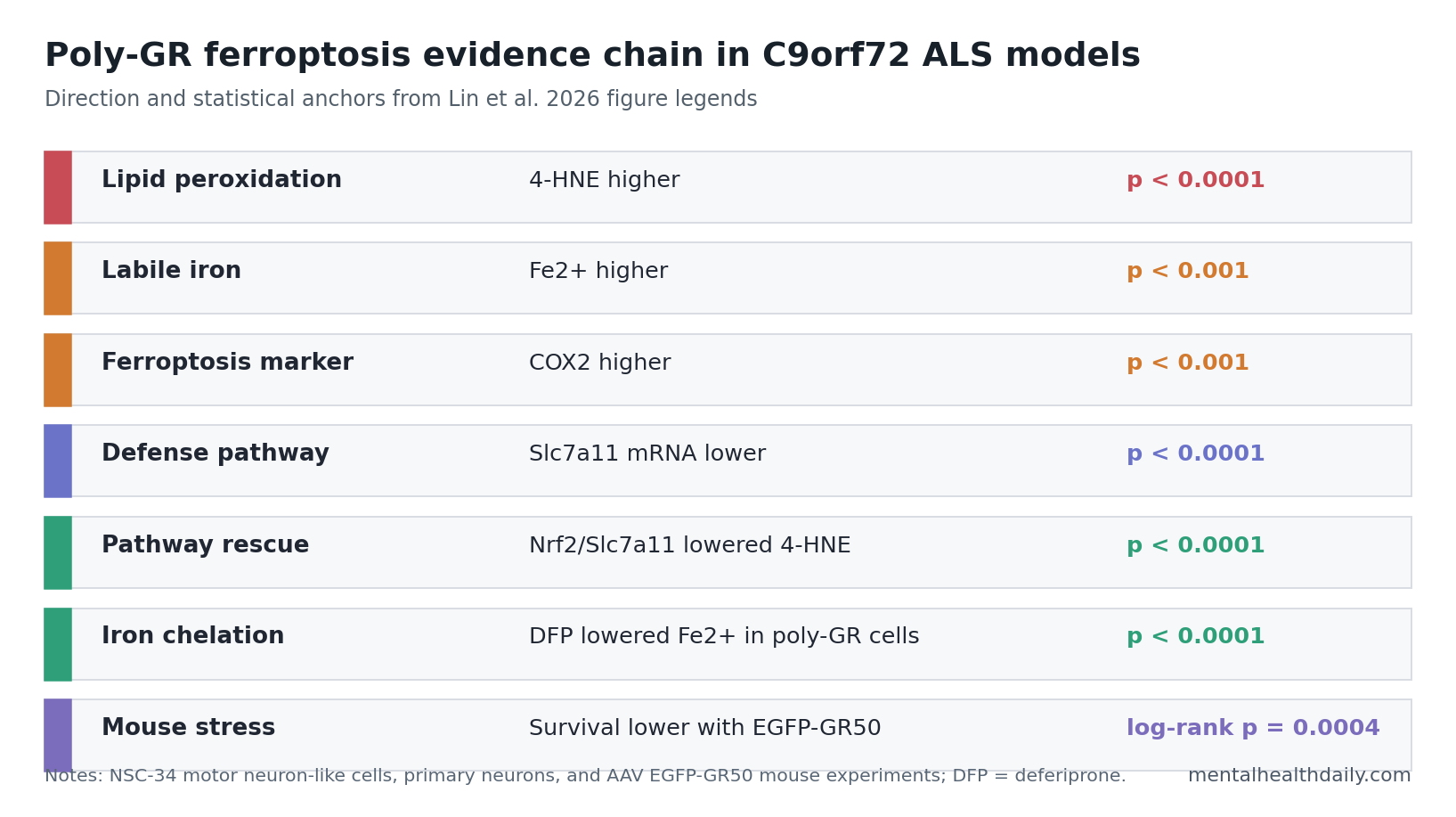
- Poly-GR raised ferroptosis markers: EGFP-GR50 expression increased 4-HNE lipid peroxidation in 20 vs. 20 quantified cells (p < 0.0001) and labile Fe²+ in 24 vs. 24 cells (p < 0.001).
- The antioxidant gate weakened: Slc7a11 protein and mRNA fell under poly-GR stress, with Slc7a11 mRNA reduced at p < 0.0001 while Gpx4 mRNA stayed unchanged.
- Nrf2 rescue pointed to mechanism: Nrf2 overexpression restored Slc7a11 protein and promoter activity, then reduced poly-GR-linked 4-HNE and reactive oxygen species across 3 biological experiments.
- Iron chelation reduced the signal: 50 μM deferiprone lowered labile Fe²+ in poly-GR cells (45 vs. 45 cells, p < 0.0001) and reduced 4-HNE lipid peroxidation (20 vs. 20 cells, p < 0.01).
- Mouse evidence stayed preclinical: EGFP-GR50 mice had reduced survival vs. controls (n = 7 per group; log-rank p = 0.0004), but this model does not prove a human ALS treatment.
C9orf72-linked ALS is the most common inherited form of ALS and is caused by a large GGGGCC repeat expansion in the C9orf72 gene. That expansion can produce abnormal dipeptide-repeat proteins, short repetitive proteins translated from the repeat RNA; poly-GR is an arginine-rich version that has been tied to motor-neuron toxicity.
Ferroptosis is an iron-dependent form of regulated cell death driven by runaway lipid peroxidation, meaning oxidative damage to membrane fats. Lin et al. tested whether poly-GR makes neurons vulnerable to that pathway by measuring 4-HNE, labile Fe²+, COX2, Slc7a11, Gpx4, Nrf2, erastin sensitivity, and mouse-neuron injury.
Poly-GR Increased 4-HNE, Labile Iron, and COX2 in Motor Neuron-Like Cells
Lin et al. expressed EGFP-GR50 in NSC-34 cells, a mouse motor neuron-like cell line commonly used in ALS lab work. EGFP is a fluorescent tag that lets researchers see which cells carry the construct, and GR50 means the experimental protein contains 50 glycine-arginine repeats.
The first result was not subtle. Poly-GR expression markedly increased 4-HNE, a toxic lipid-peroxidation product used as a readout of membrane oxidative damage. Quantification included 20 EGFP control cells and 20 EGFP-GR50 cells across 3 biological experiments, with p < 0.0001.
Labile Fe²+ also rose. The researchers used FerroOrange staining, a probe for ferrous iron, and quantified 24 control cells vs. 24 EGFP-GR50 cells across 3 biological experiments (p < 0.001). COX2, a common ferroptosis-associated surrogate marker, increased as well in 22 control cells vs. 33 EGFP-GR50 cells (p < 0.001).
Evidence-strength note: these are cellular readouts of a ferroptosis-permissive state. They show that poly-GR pushes motor neuron-like cells toward iron-linked lipid damage; they do not by themselves prove that ferroptosis is the only way C9orf72 ALS neurons die.
Slc7a11 and Gpx4 Defenses Fell, But Not in the Same Way
Slc7a11 is a cystine/glutamate transporter that helps cells import cystine, a building block for glutathione. Gpx4 is an enzyme that uses glutathione to neutralize lipid peroxides. Together, the Slc7a11/Gpx4 pathway is one of the cell’s main brakes on ferroptosis.
Poly-GR lowered both Slc7a11 and Gpx4 protein levels. The mRNA pattern split the mechanism: Slc7a11 mRNA fell at p < 0.0001, while Gpx4 mRNA did not significantly change. That points to transcriptional suppression for Slc7a11 and a different post-transcriptional or protein-level problem for Gpx4.
Nrf2 is a transcription factor that moves into the nucleus and activates antioxidant genes during oxidative stress. In the Lin study, poly-GR reduced nuclear Nrf2 localization and reduced Nrf2 occupancy at the Slc7a11 promoter, the DNA regulatory region that controls Slc7a11 transcription. Nrf2 mRNA did not significantly change, but a cycloheximide chase suggested lower Nrf2 protein stability.
Mechanistically, poly-GR appeared to destabilize or mislocalize Nrf2, then reduce Nrf2-driven Slc7a11 transcription, while Gpx4 protein loss likely came through a separate translation or degradation route.
Nrf2 or Slc7a11 Restoration Reduced the Lipid-Damage Signal
The rescue experiments make the pathway more convincing than a marker-only story. Nrf2 overexpression increased Slc7a11 mRNA and restored Slc7a11 protein in poly-GR-expressing cells. Luciferase reporter assays using Slc7a11 promoter fragments also showed that Nrf2 increased promoter activity, while poly-GR suppressed it; Nrf2 overexpression rescued that suppression.
Functionally, adding Nrf2 reduced 4-HNE accumulation in poly-GR cells (p < 0.0001 across 3 biological experiments). Slc7a11 overexpression also reduced 4-HNE fluorescence in poly-GR cells, with 27 mCherry plus EGFP controls, 27 mCherry plus EGFP-GR50 cells, and 37 mCherry-Slc7a11 plus EGFP-GR50 cells counted across 3 biological experiments.
Reactive oxygen species followed the same direction. Poly-GR increased CellROX signal, a fluorescent oxidative-stress readout, while Nrf2 overexpression reduced that signal in 116 EGFP plus HA cells, 115 EGFP-GR50 plus HA cells, and 128 EGFP-GR50 plus Nrf2-HA cells across 3 biological experiments (p < 0.0001).
Interpretation: Nrf2 and Slc7a11 were not decorative pathway labels. Restoring them changed the oxidative and lipid-peroxidation phenotype, which supports the claim that weakened Nrf2/Slc7a11 defense contributes to poly-GR ferroptosis vulnerability.
Deferiprone Reduced Ferrous Iron and 4-HNE Without Proving ALS Efficacy
Deferiprone is an iron chelator, meaning it binds excess iron and is used clinically for transfusional iron overload. Lin et al. used 50 μM deferiprone in cells to test whether labile iron was only a bystander or a contributor to the poly-GR phenotype.
Deferiprone reduced FerroOrange Fe²+ signal in ordinary NSC-34 cells and in EGFP-GR50 cells. In the poly-GR condition, 45 EGFP-GR50 cells and 45 EGFP-GR50 plus deferiprone cells were quantified across 3 biological experiments, with p < 0.0001. Deferiprone also reduced 4-HNE fluorescence in poly-GR cells, with 20 cells per group and p < 0.01.
The survival-stress experiment used erastin, a ferroptosis inducer that blocks system xc-, the cystine-import system that includes Slc7a11. Poly-GR sensitized NSC-34 cells to 25 μM erastin. Deferiprone increased viability in poly-GR cells exposed to erastin, while Nrf2 and Slc7a11 overexpression reduced death or restored viability in related erastin conditions.
This is where calibration is necessary. The deferiprone result says iron chelation can reduce a poly-GR-linked ferroptosis signal in a cell model. It does not say deferiprone slows C9orf72 ALS in patients, and it does not settle dosing, brain penetration, long-term safety, or whether iron chelation would help without disrupting iron biology that neurons need.
Mouse EGFP-GR50 Expression Added In Vivo Stress, Not a Human Disease Model
Lin et al. also delivered an adeno-associated virus (AAV) encoding EGFP-GR50 into mice. AAV delivery is a gene-transfer method used to make cells express a selected construct; here it created neuronal poly-GR expression rather than reproducing the full human C9orf72 repeat expansion.
EGFP-GR50 mice had smaller body and brain measures, altered neuronal integrity, higher cortical 4-HNE staining, and reduced survival compared with EGFP controls. The survival analysis used 7 mice per group and reported log-rank p = 0.0004 and Wilcoxon p = 0.0023.
Model limit: the in vivo result strengthens biological plausibility because the 4-HNE signal was not limited to a dish of NSC-34 cells.
The model is still acute and construct-driven. It cannot tell readers whether human C9orf72 ALS progression is mainly ferroptotic, whether motor neurons in patients show the same pathway timing, or whether a ferroptosis-targeting drug would preserve function.
Adjacent C9orf72 and ALS Papers Point to the Same Vulnerability Lane
Saberi et al. gave the poly-GR target biological weight before this ferroptosis paper: sense-encoded poly-GR dipeptide-repeat protein burden correlated with neurodegeneration in repeat-expanded C9orf72 ALS and co-localized with TDP-43 in dendrites.2 Zhang et al. then showed that poly(GR) impaired protein translation and stress granule dynamics in C9orf72 ALS/FTD models.3
More recent poly-GR work sharpened the translation-stress side. Dong et al. reported that C9orf72 poly-GR repeats impaired translation elongation and induced a ribotoxic stress response in neurons.4 That matters for Lin et al. because Gpx4 protein fell without a matching Gpx4 mRNA decrease, and Gpx4 is a selenoprotein especially vulnerable to translation problems.5
ALS ferroptosis evidence also predates the Lin paper. Wang et al. reported that ferroptosis mediated selective motor neuron death in ALS, with GPX4-linked findings across ALS-relevant material.6 Ryan et al. reviewed therapeutic ferroptosis inhibition across neurodegenerative diseases and framed the pathway as plausible but still translationally early.7
Together, the adjacent evidence makes the 2026 result more than an isolated cell-stress finding. C9orf72 poly-GR has already been tied to affected tissue, translation disruption, and ribotoxic stress; ALS motor neurons have already been linked to GPX4/ferroptosis vulnerability. Lin et al. connect those threads through Nrf2/Slc7a11 failure and labile iron.
What This Mechanism Changes for C9orf72 ALS Research
The practical research implication is target ranking. If poly-GR increases lipid peroxidation and Fe²+ while weakening Slc7a11/Gpx4 defenses, then C9orf72 ALS experiments should measure more than generic oxidative stress. They should separate:
- Labile iron: whether Fe²+ accumulation appears before irreversible neuron injury.
- Lipid peroxidation: whether 4-HNE or related membrane-damage markers track with poly-GR burden.
- Nrf2 movement: whether Nrf2 fails to enter the nucleus or bind antioxidant-response targets.
- Slc7a11/Gpx4 defense: whether cystine import and lipid-peroxide detoxification fail together or split by model.
- Translation stress: whether Gpx4 protein loss follows ribosome stalling, selenium biology, or quality-control degradation.
Human translation requires patient-derived induced pluripotent stem cell motor neurons, postmortem C9orf72 ALS tissue, and animal studies that test whether ferroptosis-targeting interventions preserve motor function rather than only changing fluorescence markers. Lin et al. did not run those clinical-proximity tests.
Questions About C9orf72 ALS Ferroptosis
Does this mean ferroptosis causes C9orf72 ALS?
No. The study supports a mechanism in which poly-GR increases ferroptosis-associated vulnerability. C9orf72 ALS also involves RNA foci, loss of C9orf72 function, nuclear transport disruption, stress granules, mitochondrial dysfunction, neuroinflammation, and other dipeptide-repeat proteins.
Is deferiprone now a C9orf72 ALS treatment?
No. Deferiprone reduced Fe²+ and 4-HNE signals in poly-GR cell experiments. That is a useful mechanistic probe, not evidence that deferiprone improves survival, strength, breathing, or function in people with ALS.
Why does Slc7a11 matter?
Slc7a11 helps import cystine for glutathione synthesis. Glutathione lets Gpx4 detoxify lipid peroxides. When Slc7a11 falls, cells have less capacity to stop the membrane lipid damage that drives ferroptosis.
What should a future study test first?
The most useful next step is patient-derived C9orf72 ALS motor-neuron work that measures poly-GR burden, Nrf2 nuclear localization, Slc7a11/Gpx4 status, Fe²+ accumulation, and ferroptosis-rescue effects in the same system. Without that bridge, the mechanism remains promising but preclinical.
Bottom line: poly-GR appears to weaken a specific anti-ferroptosis defense system in C9orf72 ALS models: Nrf2 fails to sustain Slc7a11, Gpx4 protein falls, Fe²+ rises, and lipid peroxidation increases. The result is a sharper mechanistic target, not a ready clinical treatment.
References
- Lin C-Y, Hsieh W-C, Wang S-M. Poly-GR promotes ferroptosis-associated vulnerability in C9orf72-ALS. Cell & Bioscience. 2026. https://doi.org/10.1186/s13578-026-01574-3
- Saberi S, Stauffer JE, Jiang J, et al. Sense-encoded poly-GR dipeptide repeat proteins correlate to neurodegeneration and uniquely co-localize with TDP-43 in dendrites of repeat-expanded C9orf72 amyotrophic lateral sclerosis. Acta Neuropathologica. 2018;135(3):459-474. https://doi.org/10.1007/s00401-017-1793-8
- Zhang YJ, Gendron TF, Ebbert MTW, et al. Poly(GR) impairs protein translation and stress granule dynamics in C9orf72-associated frontotemporal dementia and amyotrophic lateral sclerosis. Nature Medicine. 2018;24(8):1136-1142. https://doi.org/10.1038/s41591-018-0071-1
- Dong D, Zhang Z, Li Y, et al. Poly-GR repeats associated with ALS/FTD gene C9ORF72 impair translation elongation and induce a ribotoxic stress response in neurons. Science Signaling. 2024;17(848):eadl1030. https://doi.org/10.1126/scisignal.adl1030
- Li Z, Ferguson L, Deol KK, et al. Ribosome stalling during selenoprotein translation exposes a ferroptosis vulnerability. Nature Chemical Biology. 2022;18(7):751-761. https://doi.org/10.1038/s41589-022-01033-3
- Wang T, Tomas D, Perera ND, et al. Ferroptosis mediates selective motor neuron death in amyotrophic lateral sclerosis. Cell Death & Differentiation. 2022;29(6):1187-1198. https://doi.org/10.1038/s41418-021-00910-z
- Ryan SK, Ugalde CL, Rolland AS, Skidmore J, Devos D, Hammond TR. Therapeutic inhibition of ferroptosis in neurodegenerative disease. Trends in Pharmacological Sciences. 2023;44(10):674-688. https://doi.org/10.1016/j.tips.2023.07.007