
A 2026 polysomnography study involving 685 children found that neck-to-height ratio identified moderate/severe pediatric obstructive sleep apnea better than BMI Z-score, waist-to-height ratio, or hip-to-height ratio. The signal was useful but not diagnostic: neck-to-height ratio reached AUC 0.781 overall, which is strong enough for triage but not strong enough to replace a sleep study.1
Research Highlights
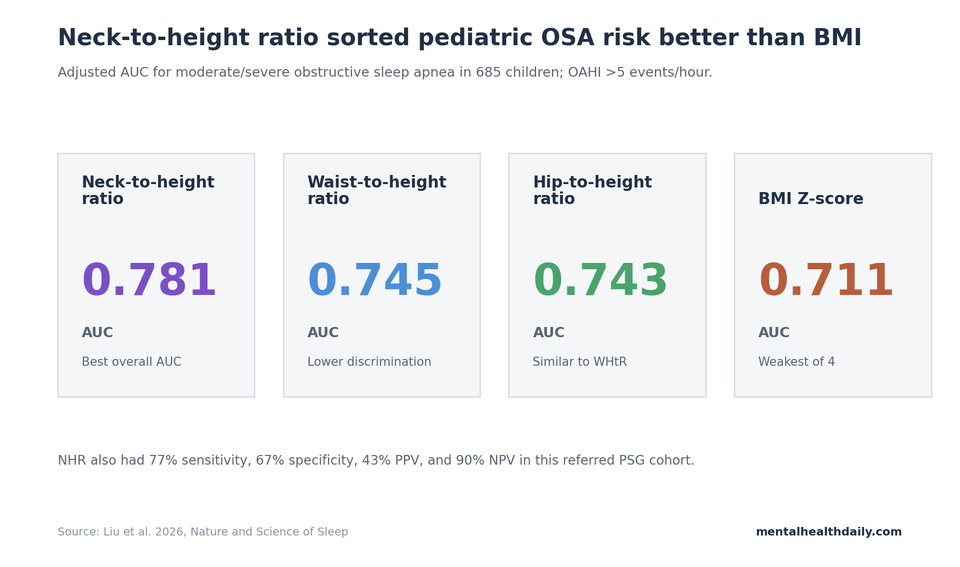
- Neck-to-height ratio had the strongest overall screen: in 685 children aged 3–16 years, NHR reached AUC 0.781 (95% CI 0.742–0.820) for moderate/severe obstructive sleep apnea, compared with 0.745 for waist-to-height ratio, 0.743 for hip-to-height ratio, and 0.711 for BMI Z-score.1
- The practical value was ruling risk down, not confirming disease: NHR had 77% sensitivity, 67% specificity, 43% positive predictive value, and 90% negative predictive value. A low-risk NHR result was more reassuring than a high-risk result was confirmatory.1
- Age changed the signal: NHR performed especially well in children aged 10+ years, with AUC 0.913 in girls aged 10+ (n = 24) and AUC 0.777 in boys aged 10+ (n = 51), though the small older-girl subgroup makes the 0.913 estimate unstable.1
- BMI was weaker than NHR: BMI Z-score reached AUC 0.711 overall, suggesting that generalized body size missed airway-relevant information captured by neck size normalized to height.1
- PSG remains the diagnostic standard: this was a single-center retrospective study, and the researchers framed NHR as an adjunctive screening marker for referral decisions, not as a replacement for polysomnography.1
Obstructive sleep apnea (OSA) in children means repeated partial or complete upper-airway blockage during sleep, producing disrupted ventilation, sleep fragmentation, and intermittent oxygen drops. Moderate/severe pediatric OSA can extend beyond noisy breathing into learning problems, behavior symptoms, growth restriction, cardiometabolic risk, and measurable brain injury in some cohorts.2,3
Polysomnography (PSG) is the overnight sleep-laboratory test that measures airflow, oxygen saturation, respiratory effort, sleep stage, and apnea/hypopnea events. It is the diagnostic gold standard, but it is expensive, slow, and hard to scale. A cheap body-measurement screen is valuable only if it helps clinicians decide which children should move up the PSG queue.
Neck-to-Height Ratio Beat BMI Z-Score in 685 Children
Liu et al. retrospectively analyzed 685 children aged 3–16 years who underwent PSG at a Beijing pediatric sleep/ENT center from February 2022 to March 2023. Moderate/severe OSA was defined as obstructive apnea-hypopnea index (OAHI) > 5 events/hour, using Chinese pediatric OSA criteria. The no/mild group included 518 children; the moderate/severe group included 167 children.1
The researchers compared 4 simple anthropometric markers after adjusting for age, sex, tonsil size, and adenoid size:
- Neck-to-height ratio (NHR): neck circumference divided by height, a size-normalized proxy for soft tissue around the upper airway.
- Waist-to-height ratio (WHtR): waist circumference divided by height, a marker of central adiposity.
- Hip-to-height ratio (HHR): hip circumference divided by height, another body-shape measure.
- BMI Z-score: body mass index standardized for a child’s age and sex.
NHR produced the best overall receiver-operating-characteristic curve. Area under the curve (AUC) ranges from 0.50 for chance-level sorting to 1.00 for perfect separation; NHR reached 0.781, which is a moderate-to-good screening signal. BMI Z-score, by contrast, reached 0.711, meaning it sorted moderate/severe OSA risk less cleanly.
90% Negative Predictive Value Makes NHR a Triage Tool
NHR’s most useful number was the 90% negative predictive value. In plain language, children below the NHR risk cutoff were unlikely to have moderate/severe OSA in this clinic sample. Positive predictive value was much weaker at 43%, so a high-risk NHR result did not prove disease; it identified a child who deserved PSG attention.
This pattern is exactly what a primary-care or ENT screening marker should do. A triage tool should be cheap, objective, fast, and sensitive enough to reduce missed moderate/severe cases. It does not need to make the final diagnosis, because PSG still defines apnea severity.
Questionnaires have not solved that problem. A 2021 systematic review and meta-analysis of pediatric OSA screening questionnaires found variable diagnostic accuracy, with performance too inconsistent for stand-alone diagnosis.4 A body-measurement marker will not replace symptom history, airway examination, or PSG, but it can add objective information when questionnaire answers are noisy or parental report is uncertain.
Why Neck Size Can Outperform General Obesity Measures
BMI is a blunt measure. It tells clinicians about total body mass relative to height, but it does not say where tissue is distributed. For sleep apnea, location is central: soft tissue around the neck and upper airway can increase collapsibility during sleep.
Prior studies already pointed in this direction. Katz et al. found that neck circumference percentile had screening value for pediatric OSA, and Ho et al. reported that neck circumference-height ratio predicted sleep-related breathing disorder in both children and adults.5,6 Liu et al. extended that line of work by comparing NHR head-to-head against WHtR, HHR, and BMI Z-score in the same PSG-confirmed pediatric cohort.
The moderate/severe OSA group had a higher BMI, higher neck circumference, higher NHR, higher WHtR, and higher HHR than the no/mild group. The stronger NHR AUC suggests that neck-region size carried airway-specific information beyond generalized obesity.
Age 10 Separated Anatomy-Driven From Body-Habitus Risk
Younger children often develop OSA because enlarged adenoids and tonsils narrow the upper airway. Older children and adolescents increasingly resemble the adult pattern, where obesity and neck-region soft tissue contribute more to airway collapse.
Liu et al. used age 10 as the subgroup cutoff because adenoid and tonsil tissue can regress with age while puberty changes fat distribution. After adjustment for tonsil and adenoid size, NHR still performed best across age/sex subgroups, but the older-child results were the most striking:
- Girls aged 10+ years: NHR AUC 0.913, sensitivity 100%, specificity 75%, and negative predictive value 100% in a small n = 24 subgroup.
- Boys aged 10+ years: NHR AUC 0.777, sensitivity 82%, specificity 68%, and negative predictive value 89% in n = 51.
- Children under 10 years: NHR still outperformed BMI Z-score but with lower AUCs: 0.757 in girls and 0.731 in boys.
The older-girl estimate needs restraint. AUC 0.913 looks impressive, but n = 24 and a 95% CI reaching 1.000 mean the estimate could drift substantially in another cohort. The direction is useful; the exact magnitude is not locked in.
Missed Pediatric OSA Can Affect Learning and Brain Health
Halbower et al. linked childhood OSA to neuropsychological deficits and neuronal brain injury, including evidence of altered hippocampal and frontal-region metabolites.3 The Childhood Adenotonsillectomy Trial later found that early surgery improved symptoms, behavior, quality of life, and PSG indices, even though formal attention/executive-function testing did not show a significant between-group improvement at 7 months.7
Together, those findings explain the screening problem without overstating it. Moderate/severe pediatric OSA is worth catching early because sleep disruption and hypoxemia can affect daytime functioning and development. At the same time, a single body-ratio screen cannot tell clinicians which child has cognitive injury, which child needs surgery, or which child will improve after treatment.
Limitations of This Pediatric Sleep Apnea Screen
Single-center retrospective design: the data came from children who were already referred for PSG, not from a general community sample. Screening performance in primary care could differ.
Subgroup instability: older-child subgroup estimates, especially girls aged 10+ years, were based on small samples. Wide confidence intervals mean the high AUC should be treated as a signal for validation, not a final benchmark.
No external threshold validation: NHR needs prospective testing before clinicians use a universal cutoff across countries, growth patterns, and ethnic groups.
Excluded high-risk conditions: children with neuromuscular disorders, severe craniofacial deformities, chronic pulmonary disease, sickle-cell disease, and metabolic disorders were excluded. Those groups may need different screening logic.
PSG still decides: NHR can support referral decisions, but apnea severity, oxygen burden, arousals, and sleep architecture require PSG or validated sleep testing.
Questions About Neck-to-Height Ratio and Pediatric Sleep Apnea
Can parents use neck-to-height ratio at home to diagnose sleep apnea?
No. NHR is a screening clue, not a diagnosis. Snoring, witnessed pauses, restless sleep, daytime behavior problems, learning concerns, tonsil/adenoid size, and PSG results still matter.
A high NHR result should prompt a clinical conversation about sleep testing, not a home diagnosis.
Why is BMI weaker than neck-to-height ratio?
BMI reflects overall body mass. Pediatric OSA depends heavily on airway anatomy, adenotonsillar tissue, and tissue around the neck. Liu et al. found BMI Z-score AUC 0.711 vs. NHR AUC 0.781, which means BMI sorted risk less accurately in this PSG cohort.1
BMI still belongs in the assessment, but it is not the most airway-specific body measure.
Does a low NHR rule out sleep apnea?
Not completely. The 90% negative predictive value was encouraging in this referred Chinese cohort, but predictive values change with disease prevalence. A child with loud snoring, witnessed apneas, behavioral deterioration, or growth concerns may still need PSG despite a lower NHR.
The safer interpretation is risk reduction, not exclusion.
What should clinicians do with this finding now?
NHR can be added to routine physical examination as a low-cost triage marker, especially in children aged 10+ years where adenotonsillar anatomy may no longer explain as much risk. It should sit beside symptom history, airway examination, and PSG access decisions.
Prospective validation is the next required step before NHR becomes a formal referral threshold.
References
- Predictive value of neck-to-height ratio in children with moderate/severe obstructive sleep apnea: a retrospective cross-sectional study. Liu T et al. Nature and Science of Sleep. 2026;18:588036. doi:10.2147/NSS.S588036
- Diagnosis and management of childhood obstructive sleep apnea syndrome. Marcus CL et al. Pediatrics. 2012;130(3):576-584. doi:10.1542/peds.2012-1671
- Childhood obstructive sleep apnea associates with neuropsychological deficits and neuronal brain injury. Halbower AC et al. PLoS Medicine. 2006;3(8):e301. doi:10.1371/journal.pmed.0030301
- Diagnostic accuracy of screening questionnaires for obstructive sleep apnea in children: a systematic review and meta-analysis. Parenti SI et al. Sleep Medicine Reviews. 2021;57:101464. doi:10.1016/j.smrv.2021.101464
- Neck circumference percentile: a screening tool for pediatric obstructive sleep apnea. Katz S et al. Pediatric Pulmonology. 2015;50(2):196-201. doi:10.1002/ppul.23003
- Neck circumference-height ratio as a predictor of sleep related breathing disorder in children and adults. Ho AW et al. Journal of Clinical Sleep Medicine. 2016;12(3):311-317. doi:10.5664/jcsm.5572
- A randomized trial of adenotonsillectomy for childhood sleep apnea. Marcus CL et al. New England Journal of Medicine. 2013;368(25):2366-2376. doi:10.1056/NEJMoa1215881
- Age-related hypertrophy of adenoid and tonsil with its relationship with craniofacial morphology. Huang X et al. BMC Pediatrics. 2023;23(1):163. doi:10.1186/s12887-023-03979-2