hit counter

Eco-Anxiety in Children: Art and Philosophy Trial

MHD featured image for eco-anxiety in children and a classroom art and philosophy trial.

A 2026 pilot trial tested a classroom program for children's climate anxiety: art projects plus guided discussion were supposed to help students express climate emotions and build coping skills. The intervention did not work better than waitlist control, but it also did not make children more anxious. Research Highlights The intervention failed to separate: 46 …

Read more

Neck-to-Height Ratio Screens Pediatric Sleep Apnea Better Than BMI

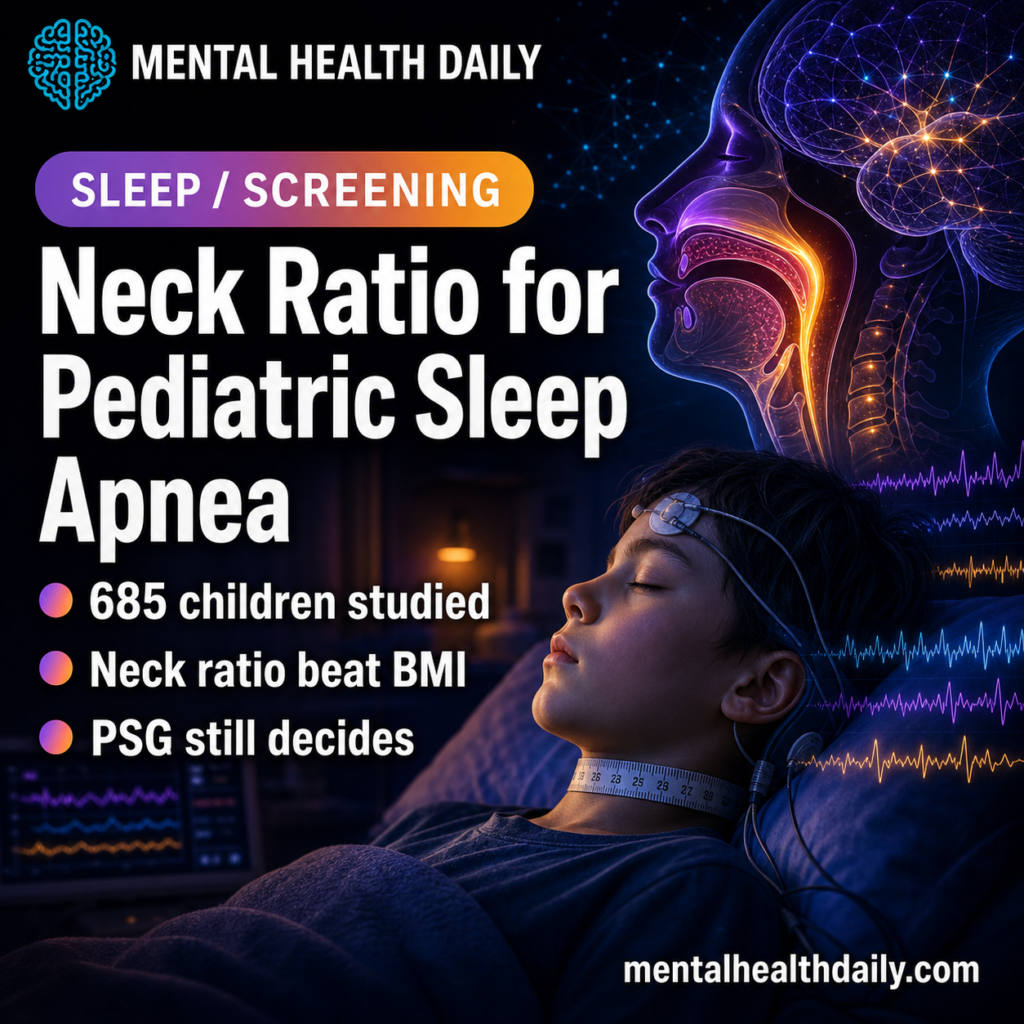
Editorial medical card showing pediatric sleep apnea screening with neck measurement, PSG waveforms, and airway anatomy.

A 2026 polysomnography study involving 685 children found that neck-to-height ratio identified moderate/severe pediatric obstructive sleep apnea better than BMI Z-score, waist-to-height ratio, or hip-to-height ratio. The signal was useful but not diagnostic: neck-to-height ratio reached AUC 0.781 overall, which is strong enough for triage but not strong enough to replace a sleep study.1 Research …

Read more

Abnormal Glutamate Biomarkers in ADHD: CDK5, MAP2, GKAP, PSD95 (2023 Study)

Attention-Deficit Hyperactivity Disorder (ADHD) is a complex neurodevelopmental condition that has puzzled researchers and clinicians for decades. Recent studies have begun to unravel the intricate relationship between ADHD and the glutamatergic system, a major neurotransmitter pathway in the brain. A newer study evaluated the roles of cyclin-dependent kinase 5 (CDK5), microtubule-associated protein-2 (MAP2), guanylate kinase-associated …

Read more

MicroRNAs as Blood-Based Biomarkers for Early ADHD Diagnosis in Children

Attention-deficit/hyperactivity disorder (ADHD) is a common childhood-onset neurodevelopmental disorder characterized by developmentally inappropriate levels of inattention, hyperactivity, and impulsivity. While highly heritable, the heterogeneity of clinical presentation suggests complex interactions between genetic and environmental risk factors. A new study suggests that it may be possible to diagnose ADHD or detect ADHD susceptibility risk in children …

Read more