
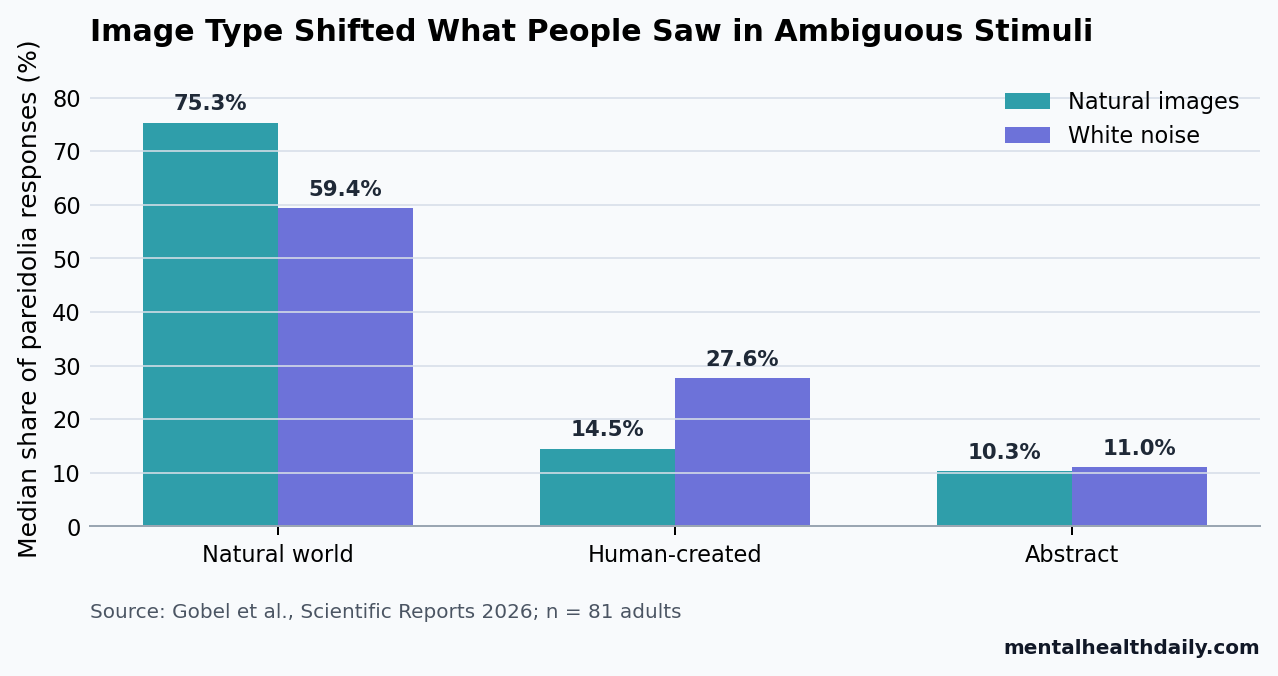
A 2026 experiment involving 81 healthy adults found similar pareidolia counts across natural and white-noise images, but different content: natural images favored natural-world categories (75.3% vs. 59.37%), while white noise favored human-created categories (27.59% vs. 14.53%). Pareidolia means seeing meaningful objects or patterns in ambiguous input.1
Research Highlights
- Image type changed the content, not the count: participants produced a median of 9 pareidolia per image, and counts did not differ significantly across the 16 images (H(15) = 20.642; p = 0.149).1
- Natural scenes pulled perception toward nature: natural-world pareidolia made up 75.3% of responses to natural images vs. 59.37% of responses to white noise (p = 0.0109).1
- White noise pulled perception toward artifacts: human-created categories were more common in white noise than natural images (27.59% vs. 14.53%; p = 0.0076).1
- Animals dominated the open-ended task: animal perceptions accounted for nearly 40% of all pareidolia across 19 semantic categories.1
- Clinical translation needs restraint: pareidolia has been studied in schizophrenia, bipolar disorder, dementia with Lewy bodies, and creativity research, but this 81-person healthy-adult task cannot diagnose hallucination risk by itself.2,3
When ambiguous input contains real scene structure, people tend to complete it into animals, faces, bodies, geography, weather, and other natural categories. When the input is white noise, people still find meaning, but the meaning shifts toward tools, vehicles, architecture, food, and other human-made concepts.
That distinction fits a broader visual-perception literature in which bottom-up processing means information flowing from the stimulus itself, while top-down processing means expectations, memories, categories, and imagination shaping what ambiguous input becomes. The Gobel et al. task did not prove a single neural mechanism, but it separated 2 parts of false perception that often get blurred together: how much meaning people see and what kind of meaning they impose.
Natural Images Raised Natural-World Pareidolia to 75.3%
Gobel et al. used a within-person design: each participant viewed 3 natural images and 1 white-noise image, with each image presented for 5 minutes. Participants used a digital pen to draw whatever they perceived and verbally named each perception. The instruction was deliberately open-ended: let imagination run free, except for naming the actual objects in the natural images.
Sample: 81 healthy adults, mean age 49.94 years, age range 20-78 years, 47 females, and mean education of 16.46 years.
Task output: a median of 9 pareidolia per image, with an interquartile range of 5 and an individual range from 2 to 42. This wide range means some people generated many more perceived forms than others, but image type did not meaningfully change the total number.
Category result: natural images increased natural-world responses: 75.3% of responses to natural images vs. 59.37% of responses to white noise. White noise moved in the opposite direction for human-created categories: 27.59% vs. 14.53% in natural images.
The design matters because many pareidolia tasks tell participants to search for faces. A face-search task can answer whether face-like patterns capture attention, but it cannot tell whether faces, animals, tools, or abstract forms appear spontaneously when the observer is not told what to look for. Here, the open-ended instruction let the semantic categories compete.
Animals Were Nearly 40% of All False Patterns
Across all images, animals were the most frequent category, accounting for nearly 40% of reported pareidolia. Fantasy figures, humans, tools, human faces, and body parts followed, while the remaining 12 categories each stayed below 5%.
Animal detection is a plausible bias because living things, especially potentially dangerous animals, have been unusually important targets for rapid visual attention. The study’s animal-heavy result leaves room for learned and cultural influences, but it suggests that free-form visual ambiguity is category-weighted rather than category-neutral.
This aligns with adjacent work on animal-shaped visual processing. Bracci et al. reported that the ventral visual pathway represents animal appearance strongly enough that objects with animal-like shape features can cluster closer to animals than their real object category. Chen et al. described rapid feedforward animal-appearance processing around 80-100 milliseconds, which is the time range where the visual system is still making fast coarse guesses before slower identification catches up.
Those studies make the Gobel result more coherent: participants were applying recognizable category biases to ambiguous structure. Their first-pass visual system may be especially ready to treat curved, limb-like, eye-like, or body-like structure as biologically relevant. A false animal in bark, rock, shadow, or noise is an error, but it is an error with a recognizable direction.
White Noise Favored Human-Made Objects
White-noise images lack the coherent layout of a natural scene. In the Gobel study, that absence did not reduce the overall number of pareidolia. Instead, it shifted the semantic result. Human-created categories rose from 14.53% in natural images to 27.59% in white noise.
Semantic memory is long-term knowledge about objects, categories, meanings, and relationships. When visual input is weak or structure-poor, stored concepts can supply more of the answer. A noisy patch can become a tool, vehicle, building, symbol, or constructed object because the stimulus leaves more interpretive room.
The temporal pattern inside the task points in the same direction. Human pareidolia appeared earlier in the sequence (r = -0.760; p = 0.002), while tool pareidolia became more common later (r = 0.610; p = 0.021). Animal, fantasy, human-face, and body-part categories did not show significant timing trends. One reasonable interpretation is that some biologically salient forms arrive early, while artifact-like interpretations can accumulate as people search longer and apply more conceptual imagination.
The participants were healthy adults, the task invited imagination, and the design measured reports during a perception task. This is an ordinary false-perception task rather than a clinical hallucination model.
The result is still relevant to hallucination research because hallucinations also involve the balance between incoming sensory evidence and prior expectations. Ordinary pareidolia under instruction is controlled evidence about false perception, not proof that a person is psychotic, cognitively impaired, or neurologically ill.
Face Pareidolia Is Only One Part of the Problem
Face pareidolia has dominated the literature because faces are socially important and experimentally convenient. Liu et al. used the famous “Jesus in toast” framing to study neural and behavioral correlates of face pareidolia. Wardle et al. later showed rapid dynamic processing of face pareidolia, with early brain responses that resembled face processing before later signals diverged from real faces.
A face-only lens can make the broader phenomenon look too narrow. Abo Hamza et al. studied pareidolia in schizophrenia and bipolar disorder, tying visual ambiguity to clinical questions about false perception and meaning attribution.2
Pepin et al. studied fractal-pattern pareidolia as a sign of creativity and visual ambiguity processing.3 Balas et al. showed that contrast negation can increase face pareidolia rates in natural scenes, reinforcing that stimulus context changes the false-perception rate.4
Gobel et al. add a missing category-level piece. If a study only asks “did you see a face?”, the animal dominance and artifact shift can disappear from view. Open-ended tasks expose whether a visual stimulus invites living things, human-made objects, fantasy forms, abstract symbols, or some mixture of all of them.
The GPT-4 Category Step Is Useful but Not Neutral
The researchers first coded responses into 19 semantic categories, then used GPT-4 to group those categories into 3 superordinate clusters: Natural World, Human-Created Categories, and Abstract Concepts. That step made the statistical comparison easier, but it also introduces a methodological caveat.
- The 19 original categories were human-readable: animals, fantasy, humans, tools, human faces, body parts, nature, architecture, geography, vehicles, food, accessories, technics, symbols, art, alphabet, geometry, sports, and weather.
- The 3 clusters are interpretive: GPT-4 grouped categories by semantic relationship, which is reasonable for dimensionality reduction but not the same as a biological taxonomy.
- The statistics depend on the grouping: natural-world and human-created effects were significant after clustering, while abstract-concept responses were similar across image types (10.35% vs. 11.02%; p = 0.6708).
The cluster result is still informative because the direction is plausible and the grouped categories are transparent. The caution is that the headline should stay at the level the data support: image type shifted semantic categories of pareidolia. It did not prove that GPT-defined clusters map cleanly onto separate brain systems.
What This Means for Hallucination and Bias Research
Pareidolia sits between perception, memory, and belief. The observer is not passively reading the world; the brain is proposing candidate objects and then checking them against sensory evidence. That checking process is usually useful, but it can produce false positives when the input is ambiguous.
In dementia with Lewy bodies, schizophrenia, bipolar disorder, and other clinical contexts, pareidolia tasks have been used because they offer a safer and more measurable way to probe false perception than waiting for spontaneous hallucinations. The Gobel study clarifies why the stimulus set matters in those paradigms: a task made from white noise, natural scenes, fractals, degraded photographs, or face-like objects may be measuring partly different mixtures of bottom-up structure and top-down expectation.
Wisher et al. made a related point in cave-art research, arguing that ambiguous natural surfaces can invite meaningful perception and image-making.5 The modern lab task and the Paleolithic-art hypothesis are separate claims, but both point to the same constraint: false perception is shaped by the environment as well as the observer.
Limitations of the 81-Person Open-Instruction Task
Healthy-adult sample: the study involved 81 healthy participants. It can inform ordinary visual ambiguity, but it cannot estimate hallucination risk in psychosis, dementia, Parkinson’s disease, or neurological injury.
Stimulus confounding: natural images and white noise differ in spatial structure, color, contrast, and real-world familiarity. The design shows that the 2 image classes behave differently, not which exact image feature caused the difference.
Open-ended instruction: the 5-minute drawing task created a naturalistic search space, but participants may have formed their own internal strategies. One person might keep scanning for animals; another might start naming constructed objects after the obvious natural forms are exhausted.
Category reduction: GPT-4 clustering helped simplify 19 categories into 3 broad clusters. A different clustering rule might move borderline labels such as body parts, fantasy, or art into different conceptual bins.
The next stronger experiment would use natural images, phase-scrambled versions of the same images, white noise, and fractal noise under the same open-ended instructions. That design could separate coherent scene structure from color, spatial frequency, and pure semantic imagination more cleanly.
Questions About Pareidolia and Image Type
Does this mean pareidolia is a hallucination?
No. Pareidolia is a false perception of meaning in ambiguous input, usually with preserved awareness that the pattern may not be real. Hallucinations are perceptions without an external stimulus and can carry much stronger conviction, distress, or clinical significance.
Why did animals dominate the responses?
Animals may be visually privileged because rapid detection of living things had survival value. The study’s nearly 40% animal share supports an animal-detection bias, but it does not prove that every animal-like response came from a dedicated evolutionary module.
Why did white noise produce more human-created categories?
White noise gives the visual system less coherent scene structure. With weaker bottom-up cues, people may lean more on semantic memory and imagination, which can turn ambiguity into tools, vehicles, architecture, symbols, or other constructed objects.
Can pareidolia tasks help study psychosis or dementia?
They can help, but only as controlled probes. Clinical studies need patient samples, validated tasks, and careful comparison groups. A healthy-adult pareidolia task should not be treated as a screening test for psychosis, dementia with Lewy bodies, or another disorder.
References
- Göbel N, Camenzind M, Nef T, Mosimann UP, Müri RM, Eberhard-Moscicka AK. Image Type Reveals Evolutionarily Shaped Perceptual and Conceptual Mechanisms of Pareidolia. Scientific Reports. 2026. https://doi.org/10.1038/s41598-026-47242-x
- Abo Hamza EG, Kéri S, Csigó K, Bedewy D, Moustafa AA. Pareidolia in Schizophrenia and Bipolar Disorder. Frontiers in Psychiatry. 2021;12:746734. https://doi.org/10.3389/fpsyt.2021.746734
- Pepin AB, et al. Processing visual ambiguity in fractal patterns: Pareidolia as a sign of creativity. iScience. 2022;25:105103. https://doi.org/10.1016/j.isci.2022.105103
- Balas B, Morton M, Setchfield M, Roshau L, Westrick E. Contrast negation increases face pareidolia rates in natural scenes. Journal of Vision. 2025;25(13):5. https://doi.org/10.1167/jov.25.13.5
- Wisher I, Pettitt P, Kentridge R. The deep past in the virtual present: developing an interdisciplinary approach towards understanding the psychological foundations of palaeolithic cave art. Scientific Reports. 2023;13:19009. https://doi.org/10.1038/s41598-023-46320-8