
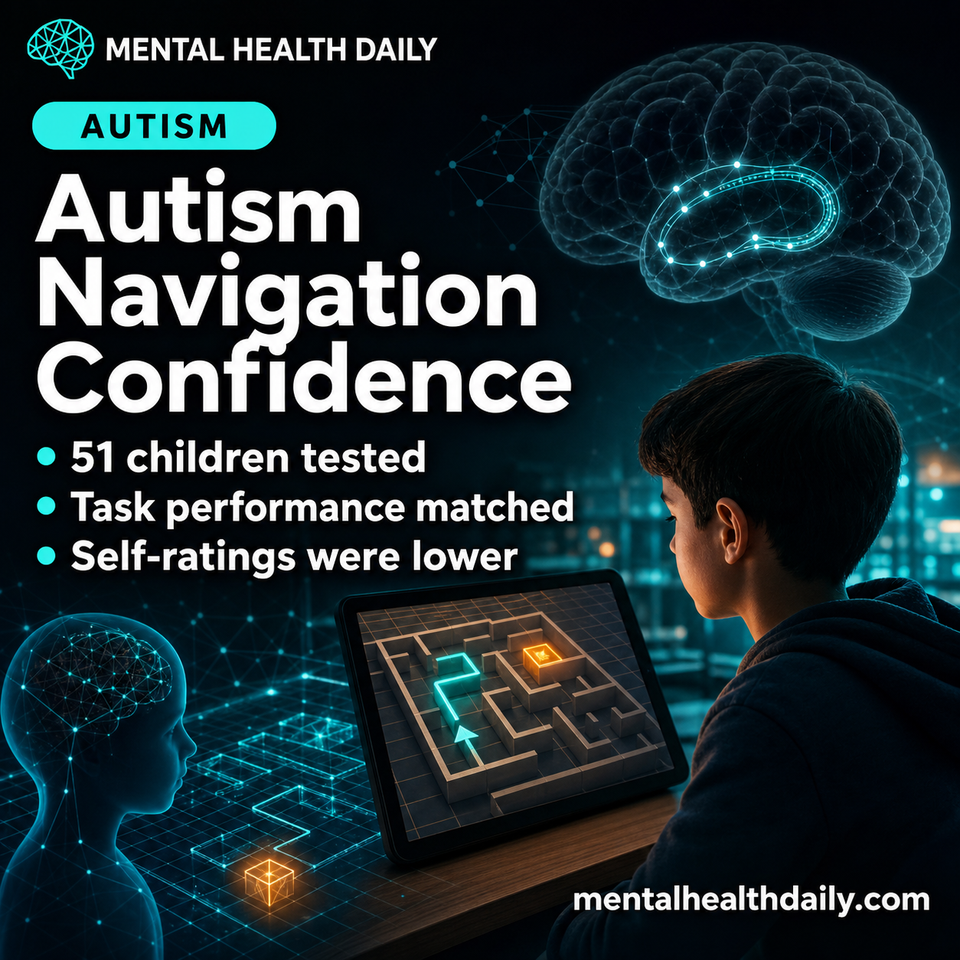
A 2026 medRxiv preprint found that 26 autistic children performed similarly to 25 typically developing children on objective SPACE navigation tasks, contrary to the prediction, while autistic children rated their own navigation ability lower on the Santa Barbara Sense of Direction scale.1
Research Highlights
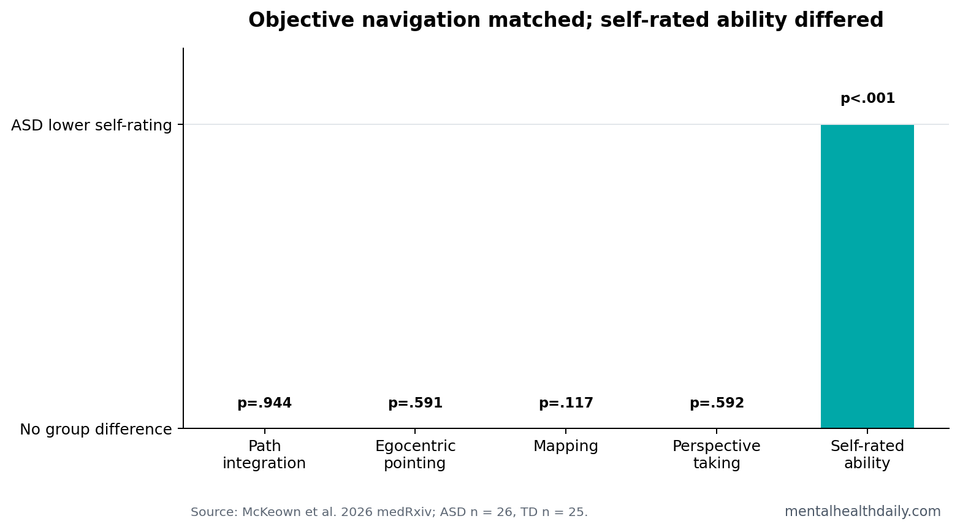
- Objective performance did not separate groups: 26 autistic children and 25 controls completed SPACE tasks, and condition effects were nonsignificant for path integration (p = .944), egocentric pointing (p = .591), mapping (p = .117), and perspective taking (p = .592).1
- Self-rated navigation did separate groups: autistic children reported lower perceived ability on the SBSOD scale (condition β = −0.71, p < .001; R² = .253).1
- Age still mattered: older children made smaller path-integration errors than younger children (β = −8.8, p = .047) and smaller perspective-taking errors than younger children (β = −4.39, p = .023).1
- The hypothesis was directionally reversed: researchers predicted worse allocentric navigation in autistic children than in controls, but task performance was comparable across all 4 SPACE domains.1
- Survey scores need caution: a self-report navigation scale may capture confidence, anxiety, or strategy preference more than actual controlled-task ability in autistic children.2
Spatial navigation is the ability to learn routes, update one’s position, remember landmarks, and shift perspective in an environment. It depends on multiple systems, including the hippocampus for map-like spatial memory, parietal regions for body-centered direction updating, and prefrontal systems for flexible strategy use.
Autism spectrum disorder is associated with differences in sensory processing, attention, anxiety, and cognitive style. Those differences could plausibly affect real-world navigation. The 2026 study is useful because it separated actual task performance from perceived ability instead of treating them as the same thing.
SPACE Tasks Found Comparable Navigation Performance
The researchers used SPACE, a tablet-based navigation battery with path integration, egocentric pointing, mapping, associative memory, and perspective-taking tasks. Path integration means updating position from self-motion cues; egocentric pointing means judging where unseen landmarks are relative to one’s own viewpoint; mapping means reconstructing landmark positions from above.
Across objective tasks, autism diagnosis did not significantly predict performance. Path integration had condition β = 0.96, p = .944; egocentric pointing had β = −2.98, p = .591; mapping had β = 0.134, p = .117; and perspective taking had β = 3.23, p = .592.1
Self-Rated Navigation Was Lower in Autistic Children
The subjective result went the other way. On the Santa Barbara Sense of Direction scale, the overall model was significant (F(2,47) = 9.32, p < .001, R² = .253), and autism diagnosis predicted lower self-rated navigation ability (β = −0.71, p < .001).1
Sense-of-direction self-report asks how a person judges everyday navigation ability. It can be valuable, but it is not identical to performance. A child who expects to struggle may rate ability lower even when controlled tasks show intact spatial performance.
That measurement split is central to the 2026 result. The Santa Barbara Sense of Direction scale was designed to capture everyday wayfinding confidence, not to replace a controlled spatial-cognition battery.2 A lower score can therefore reflect how often a child feels lost, avoids unfamiliar routes, or needs reassurance, even when the child can solve route-updating problems during a structured task.
For autistic children, that distinction is especially plausible because navigation outside the lab includes social uncertainty, sensory load, and unexpected route changes. The SPACE battery reduced those pressures and tested the spatial problem directly. The SBSOD score may be picking up the daily friction around navigation rather than a failure of spatial representation itself.
Older Children Performed Better on Dynamic Spatial Updating
Age predicted better path integration and perspective taking. Older children had smaller path-integration distance errors than younger children (β = −8.8, p = .047) and smaller perspective-taking errors than younger children (β = −4.39, p = .023).1 Those effects fit developmental evidence that flexible spatial updating continues improving through childhood.3
- Path integration: updating position while moving through space.
- Perspective taking: imagining the environment from another viewpoint.
- Mapping: placing landmarks into a broader spatial layout.
The Autism Finding Was a Confidence Gap, Not a Task Gap
The study’s most important calibration is that a survey difference did not map onto objective impairment. The lower SBSOD score could reflect confidence, anxiety, prior negative experiences, preference for familiar routes, or uncertainty about giving directions. It does not show that autistic children could not navigate the SPACE environment.
This interpretation is consistent with mixed prior autism navigation literature. Some studies report differences when tasks require flexible allocentric mapping or unfamiliar strategies; others find preserved spatial performance when tasks are structured or allow alternative strategies.4 The 2026 result sits in the preserved-performance side of that literature.
Evidence Strength and Limits
Evidence-strength note: this was a small preprint involving 51 children, not a population-level autism navigation study. It can show that this sample did not differ on these controlled tasks. It cannot prove that every autistic child has intact real-world navigation, independent travel safety, route learning under stress, or performance in noisy public spaces.
The co-occurring ADHD issue is also important. Many autistic children have attention and executive-function differences, and the study could not isolate ADHD effects with adequate power. Real-world navigation also includes sensory load, traffic, social stress, time pressure, and safety judgment, none of which are fully captured by a tablet task.
Self-Report May Capture Real-World Friction the Task Does Not
The lower self-rated navigation score should not be dismissed just because task performance matched controls. Everyday navigation involves noise, crowds, time pressure, unexpected route changes, social stress, sensory overload, and fear of getting lost. A structured tablet task can show preserved cognitive ability while a self-report scale captures lower confidence in daily environments.
Assessment implication: objective tasks and self-report answer different questions. SPACE asks whether the child can solve spatial-navigation problems under controlled conditions. The SBSOD scale asks how the child sees their own everyday wayfinding ability. The gap between them may be the finding: ability may be present, while confidence, stress tolerance, or strategy flexibility may be lower.
Navigation Support Should Not Assume Spatial Deficit
If future studies replicate this pattern, support should focus less on remediating a presumed spatial-navigation deficit and more on reducing real-world barriers. That could mean route preview, predictable landmarks, anxiety management, sensory planning, phone-based backup tools, or practice with unfamiliar route changes.
The study also argues against using survey scores alone to label autistic children as poor navigators. A low self-rating may identify a child who needs confidence-building or environmental support. It does not automatically identify a child with impaired spatial cognition.
The SPACE Battery Separates Several Navigation Skills
The SPACE task matters because navigation is not one skill. A child can remember landmarks, point toward unseen locations, reconstruct a map, and imagine another viewpoint with different degrees of strength. A single route-learning task can miss that structure, especially when autistic children use different strategies to reach the same answer.
In this study, the null group effects appeared across multiple SPACE domains rather than only one easy task. That makes the result more informative than a simple “no difference” finding from a narrow wayfinding test. It suggests the autistic group could use enough spatial strategies to match controls under controlled conditions.
Confidence Gaps Can Affect Real Behavior Even When Ability Is Intact
A confidence gap is still clinically relevant. Children who believe they are poor navigators may avoid unfamiliar routes, rely more on adults, become distressed by detours, or choose rigid route strategies that work until the environment changes. Those behaviors can restrict independence even when the underlying spatial task ability is present.
That makes the practical target more nuanced. The intervention may be guided exposure to route changes, support for anxiety during navigation, or explicit teaching of backup strategies, not repeated drilling of a skill the child already performs adequately in a structured task.
Preprint Status Should Keep the Claim Narrow
The preprint status matters because the finding is interesting but not settled. Replication should test larger samples, wider age ranges, more autistic girls, co-occurring ADHD subgroups, and real-world navigation stressors. The result is strong enough to challenge a blanket deficit assumption, but not strong enough to close the question.
Replication Should Include Daily Navigation Outcomes
The next study should pair SPACE performance with daily navigation outcomes: independent route use, distress during detours, parent-rated navigation support, phone-map dependence, and route-learning after unexpected change. That would show whether the confidence gap predicts practical difficulty even when task accuracy is intact.
A stronger design would also test whether anxiety symptoms explain part of the SBSOD gap. If anxiety accounts for lower self-rating while objective performance remains intact, navigation support should focus on stress and confidence rather than spatial cognition remediation.
Questions About Autism and Navigation Confidence
Did autistic children perform worse on the navigation tasks?
No. In this 51-child sample, autism diagnosis did not significantly predict objective performance across the SPACE navigation tasks.
Why did autistic children rate their navigation ability lower?
The study cannot identify one cause. Lower self-ratings may reflect confidence, anxiety, route familiarity, everyday stress, or prior experiences rather than actual task ability.
Should self-report navigation scales be ignored?
No. Self-report can capture real-world confidence and distress. The key is to avoid treating it as a direct substitute for task-based navigation performance.
References
- McKeown B, et al. Perceived vs. actual navigation ability: Differences between autistic and typically developing children. medRxiv. 2026. doi:10.64898/2026.04.09.26350542
- Hegarty M, Richardson AE, Montello DR, Lovelace K, Subbiah I. Development of a self-report measure of environmental spatial ability. Intelligence. 2002. https://doi.org/10.1016/s0160-2896(02)00116-2
- Newcombe NS. Navigation and the developing brain. Journal of Experimental Biology. 2019. https://doi.org/10.1242/jeb.186460
- Laidi C, et al. Preserved navigation abilities and spatio-temporal memory in individuals with autism spectrum disorder. Autism Research. 2023. https://doi.org/10.1002/aur.2865