
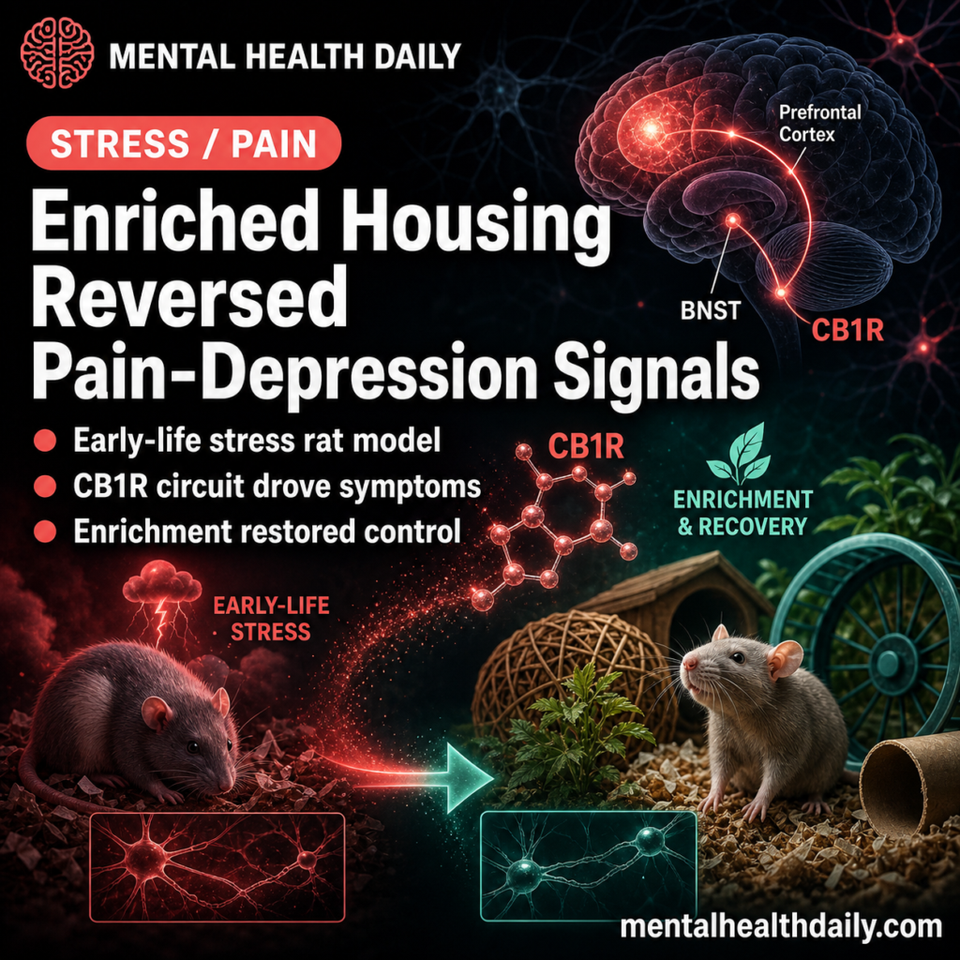
A 2026 Communications Biology rat study found that enriched housing reversed early-life-stress visceral hypersensitivity and depression-like behavior by normalizing a CB1 receptor-linked prefrontal-limbic circuit connecting prelimbic cortex, anteroventral bed nucleus of the stria terminalis, and paraventricular hypothalamus.1 Huang et al. mapped a gut-pain and mood circuit in rats, but the experiment does not prove that environmental enrichment or cannabinoid drugs treat human IBS with depression.
Research Highlights
- Early-life stress produced the phenotype: Neonatal colorectal distension lowered visceral pain threshold, raised abdominal withdrawal scores, increased EMG responses to distension, increased forced-swim immobility, and reduced sucrose preference.1
- Environmental enrichment reversed both domains: Enriched-environment rats showed higher pain thresholds, lower abdominal withdrawal scores, lower EMG responses at 30, 40, and 50 mmHg, less forced-swim immobility, and higher sucrose preference than CRD controls.1
- CB1R expression was circuit-relevant: 88.8% of CaMKII-alpha prelimbic neurons expressed CB1R mRNA, and 95.5% of CB1R mRNA localized to CaMKII-alpha neurons.1
- The pain pathway was partly separable: The PrL-avBNST-PVN pathway regulated visceral hypersensitivity more selectively than depression-like behavior in some manipulation experiments.1
- CB1R agonism reversed the rescue: Activating CB1Rs in enriched rats reinstated visceral hyperalgesia and increased depression-like behavior, supporting a CB1R-dependent mechanism.1
Environmental enrichment in rodent research means housing that adds social interaction, physical activity, sensory novelty, and cognitive stimulation. It is not the same as psychotherapy, exercise alone, or a human lifestyle prescription, but it can model how richer environments change stress-sensitive neural systems.
CB1 receptors are cannabinoid type 1 receptors: presynaptic receptors that regulate neurotransmitter release in the brain. In this study, excess CB1R signaling appeared to suppress a prefrontal-limbic brake on visceral pain and affective stress behavior.
Neonatal Colorectal Distension Created Pain-Depression Comorbidity
Huang et al. used neonatal colorectal distension to model early-life mechanical visceral stress. Adult rats exposed to that early stress showed a cluster of gut-pain and mood-related abnormalities: lower visceral pain thresholds, higher abdominal withdrawal reflex scores, stronger abdominal EMG responses during graded distension, more immobility in the forced-swim test, and lower sucrose preference.1
Abdominal withdrawal reflex is a behavioral pain score during colorectal distension. Sucrose preference is a rodent assay often used as an anhedonia-like measure because lower preference for sweet solution can signal reduced reward responsiveness. Neither assay is a direct human symptom, but the combination maps sensory pain and affective behavior in the same animals.
Enriched Housing Restored a Prefrontal-Limbic Brake
The circuit model was specific. The prelimbic cortex, a medial prefrontal region involved in top-down regulation, sends glutamatergic projections to the anteroventral bed nucleus of the stria terminalis (avBNST). The avBNST then connects into stress-output circuitry, including the paraventricular nucleus (PVN), a hypothalamic hub for stress-hormone regulation.
In CRD rats, prelimbic glutamatergic neurons and avBNST GABAergic neurons became less active, while PVN CRH neurons became more active. Environmental enrichment moved those signals back toward control patterns. Huang et al. described this as normalization along a PrL Glu to avBNST GABA to PVN CRH pathway.1
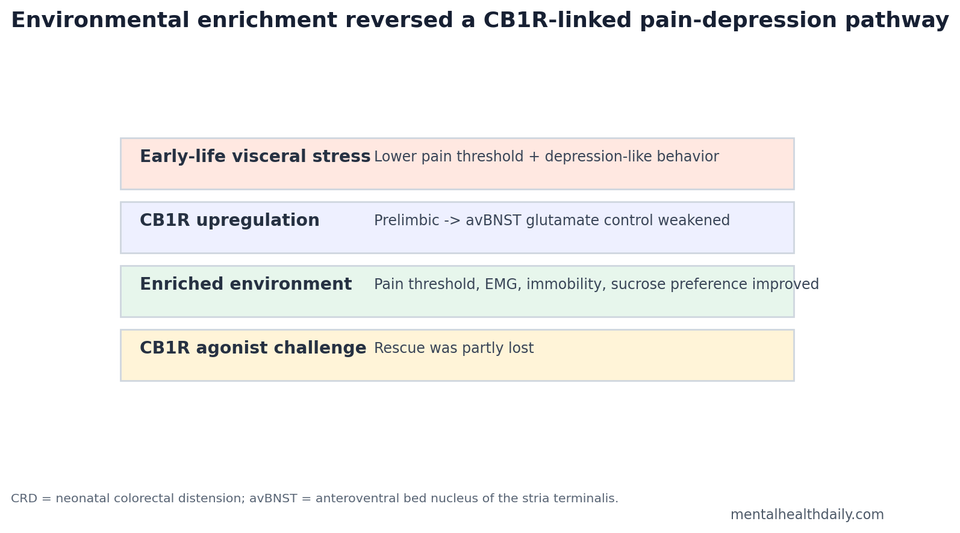
CB1R Signaling Was Not a Simple Cannabinoid Good-News Story
The cannabinoid result is easy to misread. The paper did not show that activating cannabinoid signaling was broadly beneficial. In this pathway, higher CB1R signaling on prelimbic-to-avBNST glutamatergic terminals appeared to contribute to the pain-depression phenotype.
- CB1R knockdown: reducing CB1R expression in prelimbic neurons elevated visceral pain threshold and reduced forced-swim immobility in CRD rats.
- CB1R antagonism: blocking CB1Rs in avBNST increased pain threshold, lowered abdominal withdrawal scores, and reduced forced-swim immobility.
- CB1R agonism: activating CB1Rs in control or enriched animals worsened visceral-pain and depression-like signals.
Calibrated interpretation: CB1R biology is context-dependent. The Huang experiments support a local circuit mechanism in rats, not a broad claim that cannabinoid agonists or antagonists should be used clinically for IBS, pain, or depression.
IBS Depression Context Makes the Circuit Clinically Interesting
The paper’s introduction cited clinical IBS as affecting around 5-10% of the global population, with depression in 29%, anxiety in 39%, and both in 23% of IBS patients.1 Those figures explain why a shared pain-mood pathway is worth testing.
Human gut-brain axis models already treat IBS as more than a bowel motility disorder: pain amplification, stress biology, sleep, mood, attention, and central pain regulation all shape symptom burden.2 The Huang paper adds a mechanistic rodent route by which early visceral stress could alter prefrontal-limbic control of both pain and affective behavior.
Environmental Enrichment Was a Multi-Component Intervention
The enrichment condition bundled several inputs: social housing, novelty, sensory stimulation, and opportunities for physical activity. That design is useful for testing whether a richer environment can rescue a stress phenotype, but it does not isolate which ingredient did the rescuing.
Physical activity: movement can change pain sensitivity, inflammation, stress hormones, and reward behavior in rodents. It could plausibly contribute to the improved pain threshold and sucrose preference.
Novelty and cognitive stimulation: new objects and changing environments can drive prefrontal plasticity. That is relevant because prelimbic glutamatergic excitability was one of the circuit signals restored after enrichment.
Social stimulation: social housing changes stress physiology and affective behavior. In a model where avBNST and PVN activity are central, social environment can alter the same stress systems being measured.
The broad intervention therefore matches the broad phenotype. Visceral pain, depression-like behavior, CB1R signaling, and prefrontal-limbic excitability are not single-lever outcomes. The tradeoff is interpretive: enrichment worked as a package, while component-level causality remains unresolved.
The PVN Result Separated Pain From Mood
The paraventricular nucleus is a hypothalamic stress-output region, especially relevant to corticotropin-releasing hormone and HPA-axis activity. In the Huang experiments, manipulating the PrL-avBNST-PVN pathway changed visceral hypersensitivity more consistently than depression-like behavior. Activation elevated pain threshold but did not clearly alter forced-swim or sucrose-preference measures; inhibition lowered pain threshold but again did not strongly move baseline depression-like behavior.1
That split prevents overclaiming. The larger PrL-avBNST circuit appears relevant to both pain and affective behavior, but the downstream PVN branch may be more directly sensory-pain weighted. Mood-like behavior may require additional avBNST subcircuits, reward pathways, or stress-history interactions.
Why CB1R Direction Cannot Be Generalized From One Circuit
CB1R signaling can reduce neurotransmitter release at presynaptic terminals, but the behavioral consequence depends on which terminal, which transmitter, and which downstream pathway is being regulated. Blocking CB1Rs in one synapse can increase useful glutamatergic drive; blocking them elsewhere could have a different effect.
In this circuit: CB1R upregulation appeared to weaken prelimbic glutamatergic input into avBNST GABAergic control. That can disinhibit downstream stress-pain output and make visceral hypersensitivity worse.
Outside this circuit: cannabinoid signaling can have analgesic, anxiolytic, anxiogenic, rewarding, sedating, or cognition-altering effects depending on dose, timing, receptor distribution, and baseline state. The paper’s pharmacology should therefore be read as pathway evidence, not a general verdict on cannabinoid treatments.
Human implication: the useful next step is phenotyping IBS-pain and mood comorbidity more carefully, not jumping to a CB1R drug claim.
Mechanism-targeted subgroup: patients with stress-reactive visceral pain, prefrontal control deficits, and endocannabinoid abnormalities may be more informative for future trials than broad IBS samples.
Trial-design implication: a human study inspired by this work would need pain thresholds, mood symptoms, stress-reactivity measures, and brain-circuit readouts in the same participants. Studying abdominal pain alone would miss the central claim of the paper: pain and affective behavior can be coupled through a shared stress-control pathway.
What This Rat Study Can and Cannot Support
Supported: in a neonatal colorectal-distension rat model, enriched housing reversed visceral hypersensitivity and depression-like behavior while shifting CB1R expression and prefrontal-BNST-PVN circuit excitability.
Not supported: a claim that human environmental enrichment, exercise, CBT, cannabis products, or CB1R drugs treat IBS depression. The experimental intervention bundled several environmental components, and the animal assays do not map one-to-one onto human pain, major depression, or trauma exposure.
Best next test: translational work should ask whether human IBS subgroups with depression show altered prefrontal-BNST-hypothalamic signaling, stress-reactive pain amplification, or endocannabinoid signatures that predict treatment response.
Human enrichment would also need a careful definition. Exercise, social contact, novelty, sleep regularity, and stress reduction may each matter, but a clinical program has to identify which components drive pain relief, mood benefit, or both.
That distinction matters for patients because an enrichment-style intervention could be behavioral, environmental, social, or pharmacology-adjacent. The rat circuit result does not identify which component should be prescribed first.
Component testing would keep the translation practical instead of turning enrichment into an undefined wellness label.
Questions About CB1R Circuits and IBS Depression
Does this mean cannabis worsens IBS depression?
No. The study used targeted rodent pharmacology and circuit manipulation, not human cannabis exposure. It shows that CB1R activation in one pathway can worsen a rat phenotype.
Is environmental enrichment the same as CBT?
No. Enrichment includes social, sensory, cognitive, and physical stimulation. CBT is a structured psychological treatment. The overlap is that both can alter stress regulation and behavior, but the evidence is not interchangeable.
Why does the BNST matter here?
The bed nucleus of the stria terminalis helps coordinate sustained threat, stress, pain, and affective responses. In this model, avBNST GABAergic neurons formed part of the bridge between prefrontal control and hypothalamic stress output.
References
- Huang ST, Ji NN, Wang Y, et al. Environmental enrichment reverses ELS-induced visceral pain and depression through a prefrontal-limbic circuit involving CB1Rs. Communications Biology. 2026. doi:10.1038/s42003-026-10105-2
- Mayer EA, Labus JS, Tillisch K, Cole SW, Baldi P. Towards a systems view of IBS. PubMed
- Al-Chaer ED, Kawasaki M, Pasricha PJ. A new model of chronic visceral hypersensitivity in adult rats induced by colon irritation during postnatal development. PubMed
- Ford AC, Lacy BE, Harris LA, Quigley EMM, Moayyedi P. Effect of antidepressants and psychological therapies in irritable bowel syndrome. PubMed