A 2026 systematic review of 16 articles found that youth social-media suicide risk clustered around specific mechanisms, not raw screen time: emotional dysregulation appeared in 8 studies, social contagion or imitation in 6, and problematic social-network or gaming use in 4.1
Research Highlights
- Mechanisms beat screen-time panic: Martin-Calvete and Ramirez-Ucles screened 295 records, assessed 55 full texts, and included 16 articles; the strongest synthesis was not “social media causes suicide,” but that several online experiences may amplify risk through identifiable pathways.1
- Emotional dysregulation led the map: 8 of 16 reviewed articles named emotional dysregulation, negative affect, poor mentalization, or related affect-control problems as part of the pathway from digital social-network use to suicidal ideation or behavior.1,6
- Contagion evidence was narrower but sharper: 6 of 16 articles involved imitation, social contagion, or exposure to suicide-related content; youth exposed to suicidal behavior had higher odds of suicide attempt than unexposed youth in one adolescent survey (OR = 1.95).1,7
- Sleep was a plausible bridge: In hospitalized adolescents, negative emotional responses to social media related to sleep disturbance, and sleep disturbance related to suicidal ideation with r = 0.40.4
- Protective use stayed visible: A 62-person ecological momentary assessment study found positive affect during social-media use was associated with lower same-day suicidal ideation risk, which keeps the evidence from collapsing into a one-direction ban narrative.8
Digital social networks are online platforms where users create profiles, interact with peers, view algorithmic feeds, and exchange text, images, or video. The risk question is not whether a teen opened an app for 2 hours; it is whether the app experience delivered self-harm exposure, suicide-group reinforcement, cyberbullying, social rejection, sleep disruption, or short-term emotional collapse.
Suicidal behavior covers more than completed suicide. In this review it included suicidal ideation, non-suicidal self-injury, suicide attempts, and suicide mortality. That broad outcome definition fits prevention work, but it also means the evidence should be read as a mechanism map rather than a single pooled risk estimate.
16 Articles Survived Screening From 295 Imported Records
Martin-Calvete and Ramirez-Ucles followed PRISMA 2020 methods and registered the review in PROSPERO as CRD420261290120. Searches ran from December 2025 to January 2026 across APA PsycINFO, APA PsycArticles, Psychology and Behavioral Sciences Collection, PSICODOC, MEDLINE, and Web of Science.1
Selection flow: the search produced 162 EBSCO-platform records and 133 Web of Science records. After 16 duplicate records were removed, 224 titles or abstracts were excluded, 55 full texts were assessed, and 39 more articles were excluded. The final evidence base contained 13 descriptive empirical studies and 3 review papers.
Risk-of-bias profile: most non-randomized empirical studies scored 13 to 16 out of 16 on MINORS, a tool for judging methodological quality in non-randomized studies. The weakest empirical scores were 11 of 16 for Ali and Gibson 2019 and Hamilton et al. 2024.
Nesi et al. 2021 and Nesi et al. 2022 scored 16 of 16. Two review articles were low risk on ROBIS, while one narrative review was higher or unclear risk.
No meta-analysis was run. Study designs, measurements, samples, and reported effect sizes were too heterogeneous, and several papers did not report compatible statistics. That is the right constraint: a pooled screen-time number would look clean while hiding the mechanisms that prevention actually needs.
Emotional Dysregulation and Social Contagion Were the Most Repeated Pathways
Emotional dysregulation means difficulty modulating distress, shame, anger, loneliness, or anhedonia before those states turn into self-harm urges or suicidal thinking. It appeared in 8 of 16 articles and was usually tied to concrete online experiences: rejection, humiliation, self-comparison, identity stigma, unmet expectations, or distress after viewing suicide-related material.1
Social contagion, often discussed as the Werther effect, refers to imitation or behavioral spread after exposure to suicidal behavior, especially when the exposed person identifies with the story, person, group, or method. The review found contagion or imitation in 6 studies.
Risk depends on content, vulnerability, repetition, and whether the online setting normalizes self-harm or routes the person toward help. A prevention plan should not treat every mention of suicide as equivalent to self-harm reinforcement.
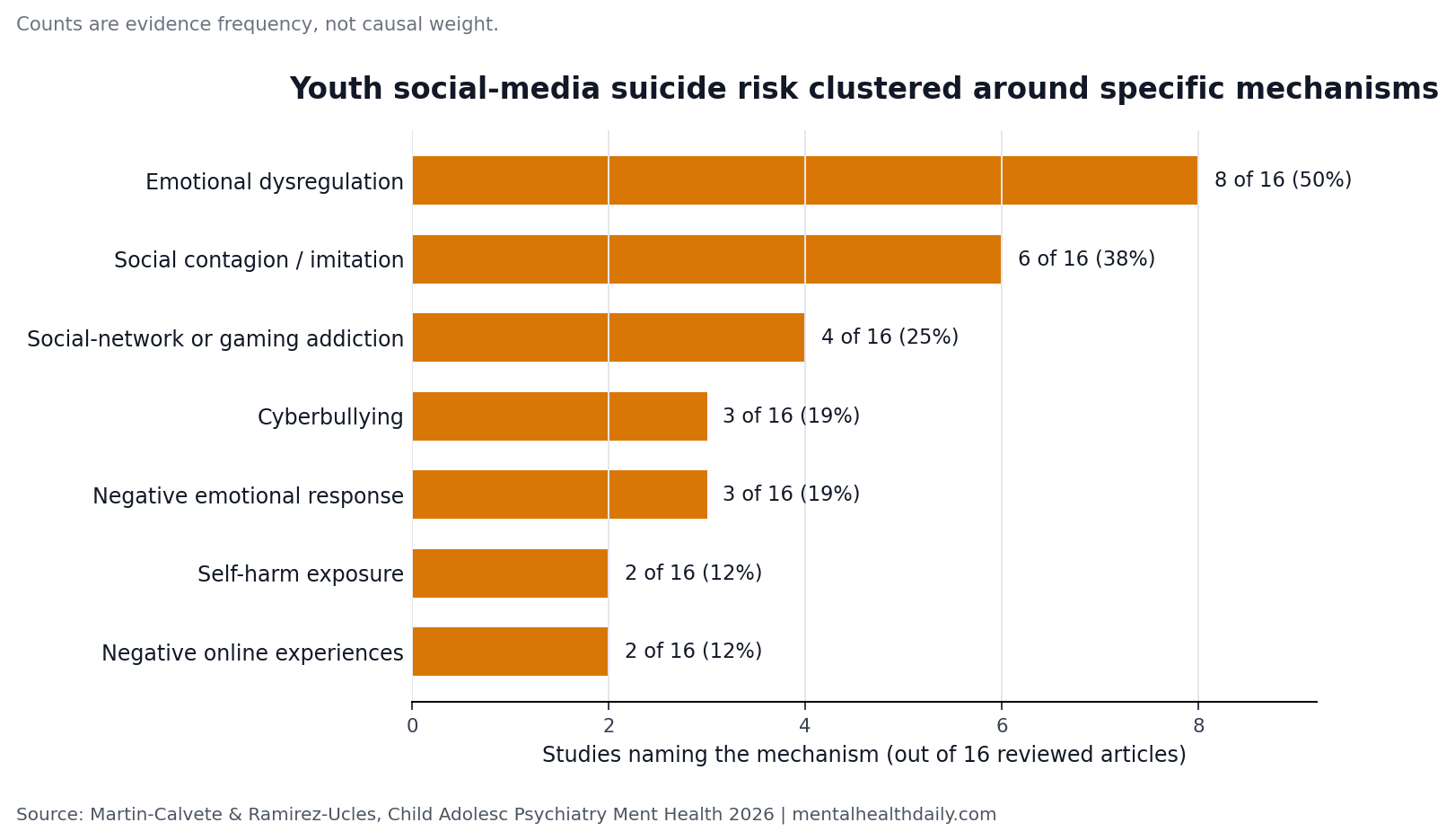
The chart uses counts instead of the printed percentages because the review’s Table 4 appears to mix denominators for several mechanisms. For example, 6 of 16 is 37.5%, while the table prints 42.8% for imitation or social contagion. Counts are safer here and easier for readers to interpret.
Self-Harm Exposure and Suicide-Group Exposure Carried the Clearest Risk Signals
Several adjacent studies sharpen the mechanism claim. Arendt et al. followed 729 young adults in a 2-wave panel and found exposure to self-harm on Instagram predicted later self-harm and suicide-risk indicators. In the review’s extracted association table, self-harm exposure was linked to suicide risk with R2 = 0.43 and to suicidal ideation with R2 = 0.17.1,2
Swedo et al. studied 9,733 students in grades 7 to 12 after a youth suicide cluster in Ohio. In the full sample, 9% reported suicidal ideation and 4.9% reported suicide attempts. Among students with active exposure to suicide-related social-media groups, 22.9% reported suicidal ideation and 15% reported suicide attempts; the review summarized active exposure as linked to both outcomes with OR = 1.7.5
Yildiz et al. surveyed 2,035 adolescents aged 13 to 17 and found 46% had been exposed to suicidal behavior, while 9.83% reported a suicide attempt. Exposure to suicidal behavior was associated with suicide attempt (OR = 1.95), with a larger risk signal in girls (IRR = 1.48, p < .001).7
Prevention target: these findings point toward rapid friction around suicide-related groups, self-harm recommendation loops, unsafe method detail, and high-risk peer-cluster content. They do not support treating ordinary supportive discussion, crisis resources, or carefully moderated help-seeking content as the same exposure.
Sleep Disturbance Turned Negative Online Experiences Into Next-Day Risk
Ecological momentary assessment (EMA) asks participants to report experiences repeatedly in daily life, reducing the memory bias that comes from asking a teen to summarize weeks of phone use after the fact. Hamilton et al. used EMA in 173 adolescents and found that negative social-media experiences and the negative affect that followed were linked to higher same-day suicidal thoughts.9
Nesi et al. studied 243 psychiatrically hospitalized adolescents and found that sleep disturbance helped explain the relationship between negative emotional responses to social media and suicidal ideation. In the review’s extracted table, sleep disturbance was associated with suicidal ideation with r = 0.40, and negative emotional response feeding into sleep disturbance and suicidal ideation had R2 = 0.15.4
That pathway is clinically plausible because late-night distress, rumination, and sleep loss can reduce emotional control the next day. Sleep disturbance here means disrupted sleep timing, poor sleep continuity, or insomnia-like symptoms that weaken mood regulation rather than simply “staying up online.”
- Risk signal: negative online interactions before bedtime may matter more than total daily minutes.
- Screening question: ask whether social media worsens sleep, rumination, or next-day suicidal thoughts.
- Intervention target: move high-conflict app use away from bedtime and add crisis-safe nighttime plans for vulnerable teens.
Problematic Use and Poor Mentalization Added a Different Route
Mentalization is the ability to understand one’s own mental states and infer other people’s intentions without turning every ambiguous interaction into rejection, humiliation, or threat. Bersani et al. studied 623 Italian young adults and found lower mentalization was associated with suicidal ideation, partly through social-media addiction and internet gaming disorder.6
The review’s association table summarized 3 distinct links:1
- Mentalization and suicidal ideation: r = −0.34.
- Social-media addiction and suicidal ideation: r = 0.26.
- Internet gaming disorder and suicidal ideation: r = 0.13.
Those are not interchangeable mechanisms. Poor mentalization describes how a person interprets social information; problematic use describes compulsive online behavior that can crowd out sleep, offline support, and emotion regulation.
Behavioral addiction in this context refers to loss of control, preoccupation, withdrawal-like distress, tolerance, continued use despite harm, and functional impairment around social networks or online games. The review identified this pathway in 4 studies, so it belongs in screening, but it should not be stretched into the whole explanation for youth suicide risk.
Positive Social-Media Use Complicates a Simple Ban Narrative
Dreier et al. followed 62 adolescents with intensive repeated assessments and found a protective pattern: above-average positive affect during social-media use was associated with reduced probability of same-day suicidal ideation. The likely mechanism is behavioral activation, a process where rewarding or socially connecting activity helps pull a person out of anhedonia and withdrawal.8
That finding does not make platforms harmless. It separates supportive engagement from high-risk exposure. A teen who uses a group chat to feel less alone is not in the same risk condition as a teen receiving cyberbullying, viewing self-harm content, joining suicide-related groups, or spiraling through late-night comparison feeds.
Evidence-strength note: the overall literature is still mostly observational, heterogeneous, and vulnerable to self-report bias. Cross-sectional studies cannot prove direction: vulnerable teens may seek certain content, certain content may worsen vulnerability, or both may reinforce each other. The strongest practical claim is therefore targeted prevention around mechanisms, not a universal claim that all social-media exposure causes suicidal behavior.
Questions About Social Media and Teen Suicide Risk
Did the 2026 review prove that social media causes teen suicide?
No. The review found 16 eligible articles and no meta-analysis was possible because designs and measures were too different. It supports mechanism-specific concern, especially around self-harm exposure, suicide-related groups, cyberbullying, negative emotional response, and sleep disturbance.
Which mechanism appeared most often?
Emotional dysregulation appeared most often, in 8 of 16 reviewed articles. Social contagion or imitation appeared in 6, and social-network or gaming addiction appeared in 4.1
Should prevention focus on total screen time?
Total time can be useful as a rough flag, but it is too blunt for suicide prevention. The higher-yield questions are what the teen sees, whether the experience worsens sleep or distress, whether suicide-related content is being reinforced, and whether the teen has offline support.
Can social media ever be protective?
Yes, in some contexts. Positive engagement, supportive peer contact, help-seeking information, and behavioral activation may reduce short-term risk for some adolescents. The practical distinction is supportive connection vs. content or interaction patterns that amplify self-harm risk.
What should clinicians, parents, and schools screen for?
Ask about exposure to self-harm content, suicide-related groups, cyberbullying, late-night distress, sleep loss after online conflict, and whether online interactions leave the teen feeling rejected or trapped. Those questions map better onto the review than generic app-time policing.
References
- Mechanisms underlying the association between the use of digital social networks and suicidal behavior in adolescents and young adults: a systematic review. Martin-Calvete JM & Ramirez-Ucles I. Child and Adolescent Psychiatry and Mental Health. 2026. doi:10.1186/s13034-026-01061-0
- Effects of exposure to self-harm on social media: Evidence from a two-wave panel study among young adults. Arendt F et al. New Media & Society. 2019;21(11-12):2422-2442. doi:10.1177/1461444819850106
- Social media use and deliberate self-harm among youth: A systematized narrative review. Biernesser C et al. Children and Youth Services Review. 2020;116:105054. doi:10.1016/j.childyouth.2020.105054
- Social media use, sleep, and psychopathology in psychiatrically hospitalized adolescents. Nesi J et al. Journal of Psychiatric Research. 2021;144:296-303. doi:10.1016/j.jpsychires.2021.10.014
- Associations between social media and suicidal behaviors during a youth suicide cluster in Ohio. Swedo EA et al. Journal of Adolescent Health. 2021;68(2):308-316. doi:10.1016/j.jadohealth.2020.05.049
- Problematic use of the internet mediates the association between reduced mentalization and suicidal ideation: A cross-sectional study in young adults. Bersani FS et al. Healthcare. 2022;10(5):948. doi:10.3390/healthcare10050948
- Suicide contagion, gender, and suicide attempts among adolescents. Yildiz M et al. Death Studies. 2019;43(6):365-371. doi:10.1080/07481187.2018.1478914
- Social media as a behavioral activation tool, conferring possible protection against suicidal thoughts among adolescents. Dreier MJ et al. Journal of Clinical Child & Adolescent Psychology. 2025;1-15. doi:10.1080/15374416.2025.2509225
- Positive and negative social media experiences and proximal risk for suicidal ideation in adolescents. Hamilton JL et al. Journal of Child Psychology and Psychiatry. 2024;65(12):1580-1589. doi:10.1111/jcpp.13996