hit counter

Weather and Air Pollution Not Linked to Suicide Attempts in Turkish City
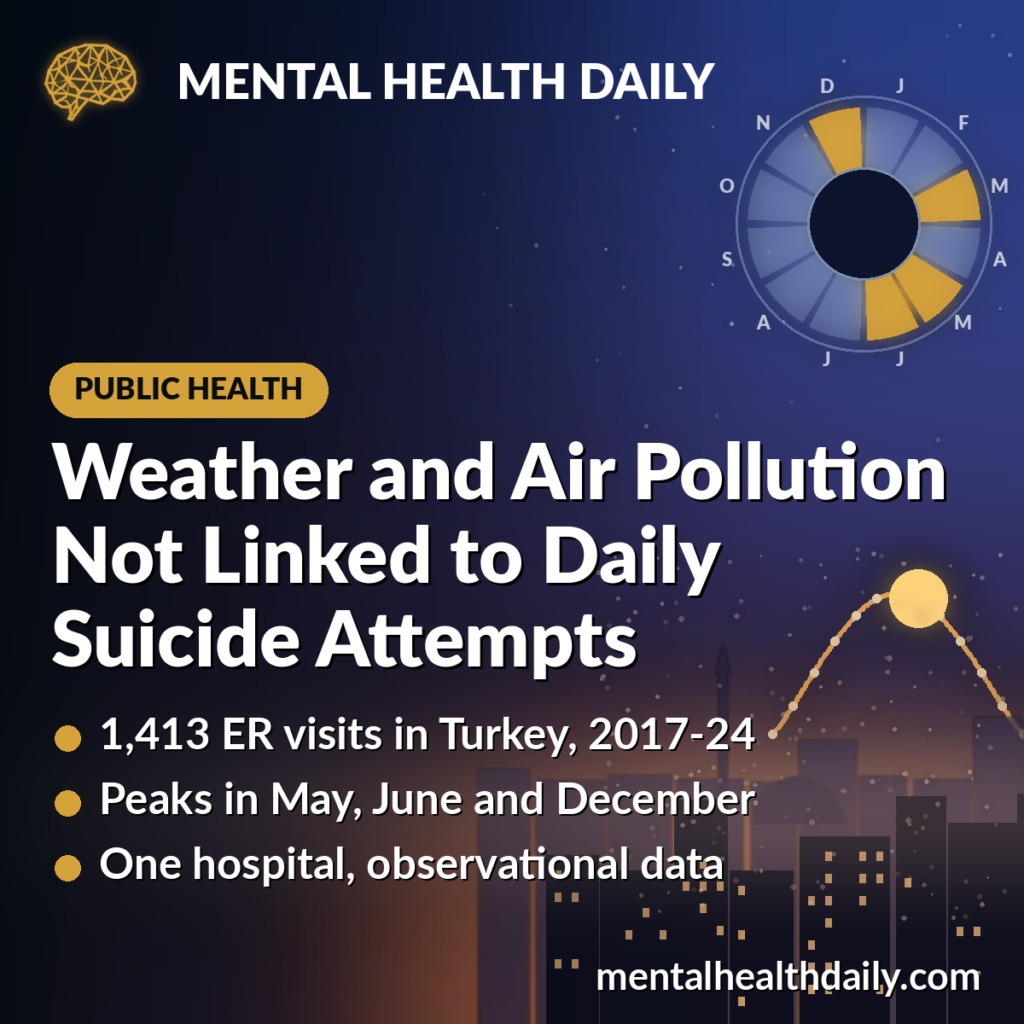
MHD card showing a hazy city skyline at dusk under a sun on a seasonal temperature arc and a 12-month calendar wheel, illustrating a Turkish study in which daily weather and air pollution were not linked to suicide-attempt visits.

Daily weather and air pollution were not linked to suicide-attempt visits at a hospital in Balikesir, Turkey, according to an 8-year study of 1,413 emergency presentations from 2017 to 2024. Visits did follow a seasonal rhythm, peaking in spring, June and December.1 Research Highlights No short-term environmental link: temperature, rainfall, sunlight, fine particles (PM2.5), sulfur …
Read more

After Teen Suicide Attempts, Stress Ran Both Ways With Parents

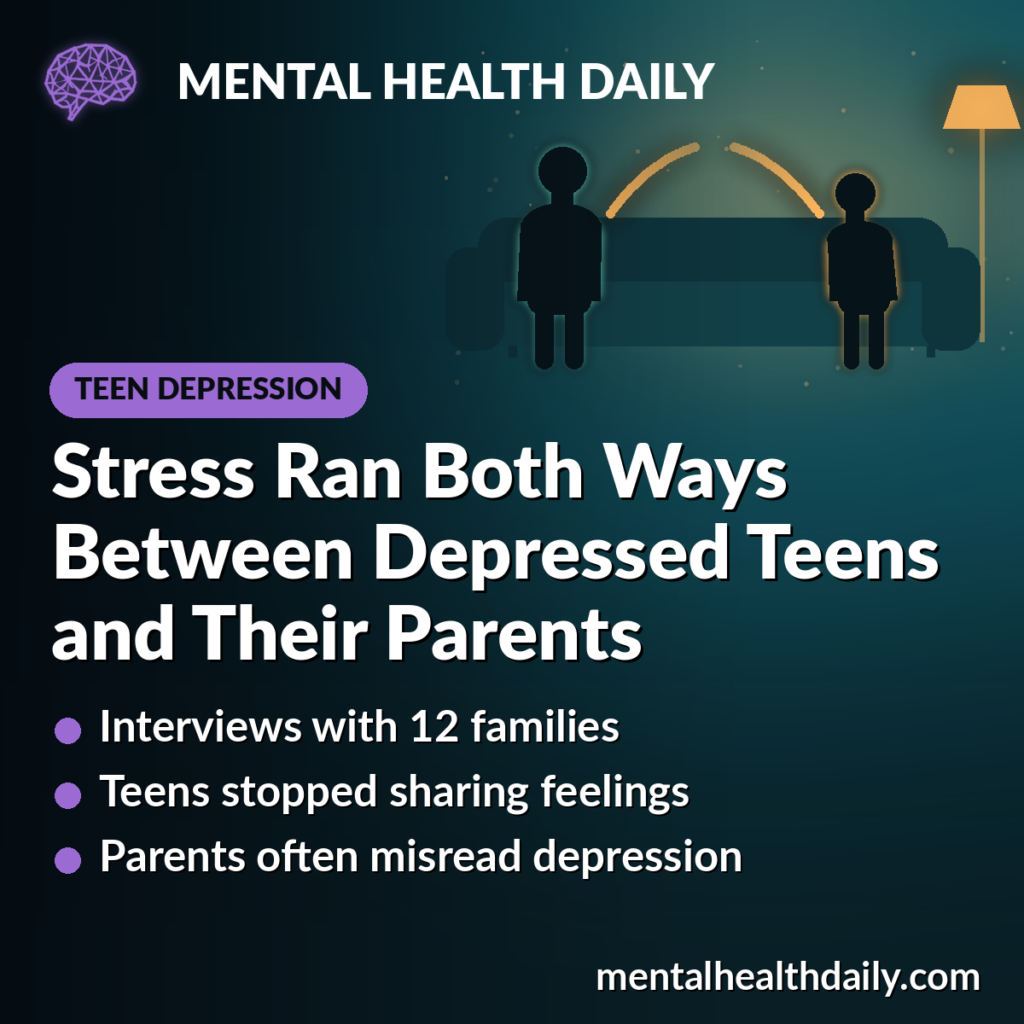
MHD card showing a parent and a teen sitting at opposite ends of a sofa in a dim teal room, with a faint arc of amber light beginning to form between them, illustrating interviews in which stress ran both ways between depressed teens and their parents.

When teens with depression were hospitalized after a suicide attempt, they and their parents described stress moving in both directions, from child to parent and back again. That pattern came from separate interviews with 12 teens and 12 of their parents at a psychiatric hospital in China.1 Research Highlights Parents’ moods reached their teens: all …

Read more

AI Suicide-Risk Agent Detected 91.5% vs. ChatGPT Health

MHD featured image for AI suicide-risk safety-agent research.

A 2026 preprint found that an independent supervisory safety agent detected suicide-risk signals in 205 of 224 synthetic evaluations, compared with 41 of 224 for native ChatGPT Health crisis safeguards.1 The result is a strong benchmark signal for external monitoring, not proof that AI systems can safely manage suicidal patients without human oversight. Research Highlights …

Read more

Suicide in Sculpture: Public Art Makes Risk Socially Visible

MHD featured image for suicide-themed sculpture, public art, psychache, and prevention.

A 2026 qualitative analysis treated suicide-themed sculpture as cultural evidence, showing how public artworks can materialize psychological pain, shame, entrapment, social disconnection, and prevention debates without turning artists or viewers into diagnostic case studies.1 Research Highlights 2026 analysis used cultural methods: the researchers used iconographic, semiotic, and contextual analysis rather than clinical diagnosis or outcome …

Read more