
Autistic children under 6 fell asleep later, woke later and slept a little less than typically developing children of the same age, according to a 2026 study from Guangzhou, China.1
Parents also reported that autistic children were nearly twice as likely to wake up at night more than once a week.
Research Highlights
- Later weekday bedtimes: autistic children fell asleep at about 10:04 pm on weekdays vs. 9:41 pm for typically developing children, and woke at 7:42 am vs. 7:16 am.1
- Less sleep on weekdays and weekends: after adjustment for family and birth factors, autistic children slept about 16 minutes less on weekdays and 17 minutes less on weekends.1
- More night waking: 33% of autistic children woke more than once a week, compared with 18% of their peers (adjusted odds ratio 2.31).1
- No extra weekend shift: both groups moved their sleep later on weekends by a similar amount, so social jetlag did not differ.1
- Parent reports only: sleep was measured through a parent interview, not a wrist tracker or overnight sleep study.1
How the Guangzhou Study Measured Sleep in Children Under 6
Researchers at Guangzhou Women and Children’s Medical Center, led by Xian Liu and Wen-Xiong Chen, compared autistic children with typically developing children of the same age. Results were published in Frontiers in Pediatrics in September 2026.1
- Autistic group: 246 children under 6, recruited at the hospital from 2018 to 2025 and diagnosed by 2 specialists using standard clinical criteria plus 2 structured autism assessments (the ADOS observation and the ADI-R parent interview)
- Comparison group: 246 typically developing children from local kindergartens, matched one-to-one by age
- Ages: average 3.6 years in the autistic group and 3.8 years in the comparison group
- Sleep measure: a face-to-face parent interview built on the Chinese version of the Children’s Sleep Habits Questionnaire (CSHQ), a widely used parent-report survey of children’s bedtimes, wake times and night waking
Sleep was recorded at the time of the autism assessment. The 2 groups differed in some ways: about 86% of autistic children were boys vs. 64% of the comparison group, and their mothers were less likely to hold a university degree (57% vs. 86%).1
Analyses were adjusted for child age, sex, gestational age, delivery method, birth weight, maternal age and maternal education.
Autistic Children Fell Asleep and Woke Up Later on Weekdays
On an average weekday night, autistic children fell asleep 23 minutes later than typically developing children and woke up 26 minutes later. Their total sleep, after subtracting time awake during the night, averaged 9.3 hours vs. 9.6 hours.1
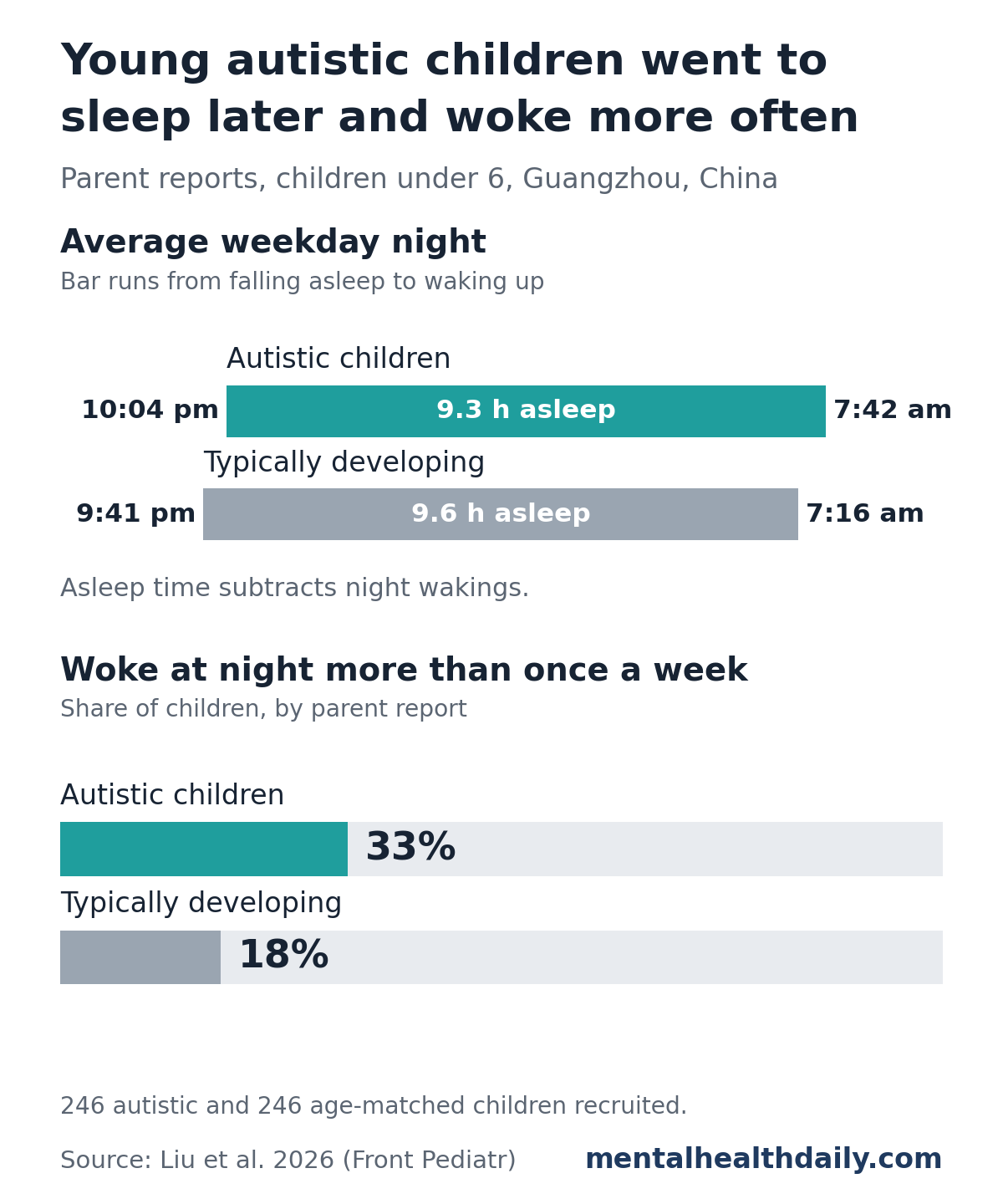
After adjustment, the gaps were similar: about 33 minutes later to sleep (0.55 hours), 25 minutes later to wake, and 16 minutes less sleep on weekdays.1
Weekends: both groups fell asleep around 10 pm, so bedtimes no longer differed. Autistic children still woke later (8:19 am vs. 7:44 am) and slept less (9.4 vs. 9.7 hours, or about 17 minutes less after adjustment).1
Wider spread: weekday bedtimes varied far more among autistic children. The standard deviation was about 2.5 hours, compared with about 40 minutes in the comparison group, which suggests some autistic children had much later or more irregular bedtimes than the average shows.1
A Later Body Clock
The sleep midpoint is the halfway point between falling asleep and waking up. It is a simple marker of chronotype, a person’s natural lean toward early or late sleep.
Autistic children’s sleep midpoint fell about 3:02 am on weekdays vs. 2:28 am in the comparison group, and 3:37 am vs. 2:51 am on weekends. A chronotype score that corrects for weekend catch-up sleep was also later, by about 46 minutes after adjustment.1
Night Waking Was Nearly Twice as Common in Autistic Children
Parents reported how often their child woke during the night. Waking more than once a week was reported for 32.6% of autistic children vs. 18.1% of typically developing children.1
- Woke 5 to 7 times a week: 19.8% of autistic children vs. 7.2% of the comparison group
- Adjusted odds: autistic children had 2.31 times the odds of frequent night waking (95% CI 1.38 to 3.87)
- Length of each waking: about 27 minutes vs. 23 minutes, not a significant difference
In other words, autistic children woke more often, but each waking lasted about as long as in the comparison group.
Weekend Sleep Shifts (Social Jetlag) Did Not Differ
Social jetlag is the gap between a person’s sleep timing on school or work days and on free days. It is measured as the difference in sleep midpoint between weekdays and weekends. It typically becomes more noticeable in school-age children and teenagers.
Both groups in the Guangzhou study had just under half an hour of social jetlag (0.45 hours in autistic children vs. 0.47 hours in typically developing children). The researchers suggested that preschool schedules are loose enough that weekday and weekend sleep look alike at this age.1
A 2025 study of 666 autistic children aged 2 to 7 in Chongqing, China, also found small social jetlag, with medians of 15 to 30 minutes by age group. Among 2- to 3-year-olds in that study, which had no comparison group, more social jetlag went with more severe core autism symptoms.2
Limitations: Parent Reports and a Single Snapshot
This was a cross-sectional case-control study: it compared 2 groups at one point in time. It can show that sleep differed between autistic and typically developing children at diagnosis, but not that autism caused the sleep differences, or that sleep problems came first.
- No objective sleep measure. No actigraphy (a wrist-worn movement tracker) or polysomnography (an overnight lab sleep study) was used. Parents going through an autism assessment may notice or report sleep differently from other parents.
- Different recruitment settings. Autistic children came from a hospital clinic and comparison children from kindergartens.
- Missing factors. Screen time, parents’ own sleep habits, medications and autism severity were not accounted for.
- Pandemic overlap. Recruitment ran through COVID-19, when family routines changed, although both groups were recruited during the same years.
- One center. Children were mostly Han Chinese from one city, so results may differ elsewhere.
- Small inconsistencies. Some group counts in the tables do not add up to the 246 per group described in the text, likely because of missing answers.
Objective tracking points the same way. A 2008 US study at the UC Davis MIND Institute tracked 194 preschoolers for 1 week with actigraphy, sleep diaries and questionnaires. Autistic children got less total sleep over 24 hours than typically developing children or children with developmental delay, though parent reports of sleep problems did not always match objective measures.3
Sleep Is Worth Asking About During an Autism Assessment
On average, the differences were modest: roughly 15 to 35 minutes in timing and length of sleep. The clearer signals were more frequent night waking and the wide spread in bedtimes among autistic children.
The researchers proposed several reasons autistic children may sleep differently, none of which this study tested:
- Biology: genetic differences that may affect melatonin, the hormone that signals night to the body clock
- Routines: rigid habits that make sleep schedules harder to shift
- Senses: heightened sensitivity to light and noise
- Anxiety: difficulty calming down and regulating emotions at night
For parents and clinicians, the practical point is simple: sleep problems were already present around the time of diagnosis, so it makes sense to ask about bedtime, waking time and night waking early. If a young child’s sleep is a struggle for the family, it is worth raising with a pediatrician or the child’s autism care team.
References
- Liu X, Guo C, Gao CL, et al. Sleep characteristics in young children with autism spectrum disorder: a case control study. Frontiers in Pediatrics. 2026;14:1742989. doi:10.3389/fped.2026.1742989
- Chen H, Yang T, Chen J, et al. Social jet lag is associated with core symptoms in 2–3-year-old children with autism spectrum disorders. Frontiers in Psychiatry. 2025;16:1574814. doi:10.3389/fpsyt.2025.1574814
- Goodlin-Jones BL, Tang K, Liu J, Anders TF. Sleep patterns in preschool-age children with autism, developmental delay, and typical development. Journal of the American Academy of Child and Adolescent Psychiatry. 2008;47(8):930–938. doi:10.1097/CHI.0b013e3181799f7c