
Brain scans taken at ages 8 to 13 were linked to depression scores years later, in teens with and without attention deficit hyperactivity disorder (ADHD).
A 2026 study followed 76 children into adolescence and found that the size of one emotion-related wiring bundle in childhood statistically predicted later depression symptoms, regardless of ADHD diagnosis.1
Research Highlights
- One tract stood out: a larger uncinate fasciculus in childhood went with higher depression scores in adolescence, whether parents or teens rated the symptoms.1
- Not just carried over from childhood: the uncinate link held after accounting for each child’s depression symptoms at the time of the scan.1
- Same pattern with or without ADHD: children with ADHD did not differ significantly from other children in these brain regions, and the link looked similar in both groups.1
- Mostly about depression: anxiety was linked for only one side of one tract, on teen self-report, and body-related symptoms were not linked at all.1
- Motor skills entered the picture: weaker childhood coordination went with more parent-rated teen depression, and uncinate size partly accounted for that link.1
How Researchers Measured White Matter in Children
White matter is the brain’s wiring: bundles of long nerve fibers, insulated by a fatty coating called myelin, that carry signals between distant brain regions. Each major bundle, or tract, connects particular areas, so its structure can shape how well those areas work together.
Diffusion MRI maps these tracts without surgery or dye. It tracks how water molecules move in the brain: inside a fiber bundle, water flows more easily along the fibers than across them, which reveals each bundle’s path.
Hyde et al. used a method called fixel-based analysis to measure fiber cross-section, which is roughly the thickness of a bundle at each point along its length. A larger cross-section means a bulkier bundle. It is a size measure, not a test of how well signals travel.1
The team focused on 3 tracts on each side of the brain:
- Uncinate fasciculus: a hook-shaped bundle linking the front of the brain with the temporal lobe and nearby emotion areas such as the amygdala; it is thought to help with emotion regulation
- Inferior longitudinal fasciculus (ILF): runs from the back of the brain to the temporal lobe and supports higher-level thinking and sensory processing
- Superior longitudinal fasciculus (SLF): a long front-to-back bundle involved in higher-level thinking and movement control
Study snapshot:
- Participants: 40 children with ADHD and 36 typically developing children, recruited in Baltimore
- Childhood visit (ages 8 to 13): diffusion MRI, a standard motor skills test (Movement ABC-2) and parent-rated emotional symptoms
- Teen visit (ages 12 to 18): the Behavior Assessment System for Children (BASC), filled out by parents and by the teens, with depression, anxiety and body-symptom (somatization) scales
- Gap between visits: 1.6 to 8.9 years, about 4.5 years on average
Uncinate Fasciculus Size Was Linked to Later Teen Depression
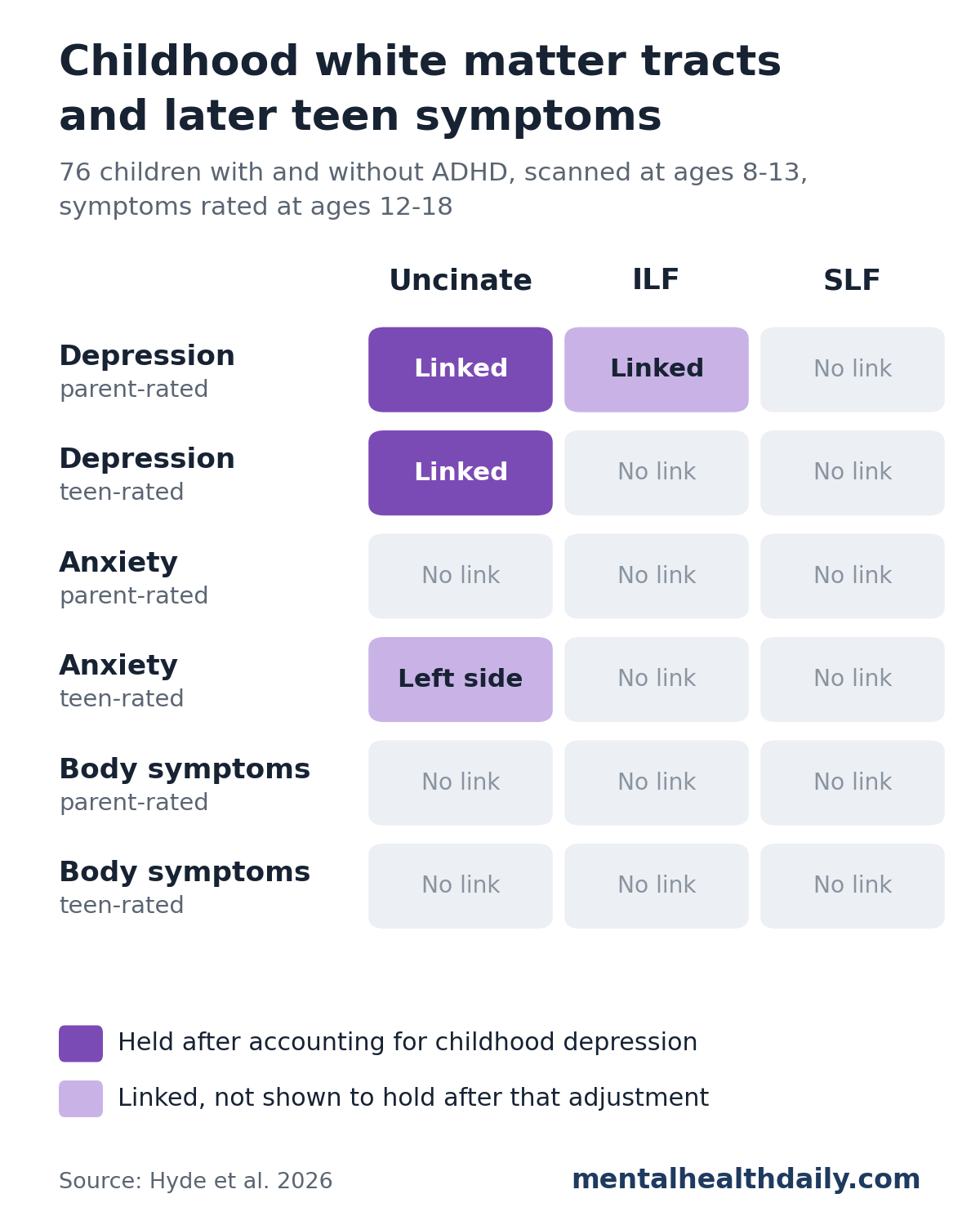
Children with a larger uncinate fasciculus cross-section, on both sides of the brain, had higher depression scores as teens. That held for parent ratings and for the teens’ own ratings. Both links remained after the researchers accounted for depression symptoms at the childhood visit (for teen ratings, the adjusted result was reported for the left uncinate).1
The researchers had expected this direction: a bulkier bundle went with more symptoms, not fewer. The analysis also adjusted for age, sex and overall brain size.
Other tracts showed weaker or no links:
- ILF: a larger cross-section went with higher parent-rated depression, but this faded once childhood depression symptoms were taken into account
- Left uncinate only: linked to teen-rated anxiety; parent-rated anxiety showed no link
- SLF: no links with any symptom scale
- Body symptoms: no links with any tract
“Predicts” here is statistical. In this group of 76 children, childhood tract size and later depression scores moved together. That is different from a clinical test: no cutoff was set, no individual child’s risk was estimated, and the scores were symptom ratings rather than diagnoses.
The finding is consistent with earlier work. In the Bucharest Early Intervention Project, white matter differences measured at ages 8 to 10 in children raised in institutions partly explained their higher anxiety and depression symptoms in later childhood and early adolescence.2
The Link Looked the Same in Children With and Without ADHD
Teens with ADHD had higher parent-rated depression scores than their peers. On the BASC, 50 is the population average, and the ADHD group averaged 53.6 compared with 47.1 in the comparison group.1
That gap appeared only in parent ratings. When teens rated themselves, the 2 groups did not differ on depression (45.8 vs. 44.4), anxiety or body symptoms.1
No group difference in the key tracts. In the uncinate and ILF regions linked to depression, children with ADHD did not have significantly different cross-sections from other children. The relationship between tract size and later depression also looked similar in both groups, although the sample was too small to test that formally.1
On balance, the researchers concluded that the uncinate–depression link held regardless of ADHD status rather than being specific to ADHD.
Weaker Childhood Motor Skills Went With More Teen Depression
About half of children with ADHD have motor difficulties, such as clumsiness or trouble with handwriting and balance.1 In this sample, children with ADHD scored lower on the motor test than the comparison group.
Earlier research points the same way: a population-based study of 244 children found that those with both coordination problems and ADHD had the highest levels of depression and anxiety symptoms.3
Hyde et al. tested 2 possible pathways:
- Brain wiring → motor skills → depression. Motor skills did not explain the link between tract size and later depression.
- Motor skills → brain wiring → depression. Children with weaker motor skills had more parent-rated depression as teens, and right uncinate size statistically accounted for part of that link.
Motor skills and tract size were both measured at the same childhood visit, so the study cannot show which came first. The researchers suggested that coordination problems could serve as an early marker worth checking in children with ADHD and called for trials of motor skills training.1
Limits of This White Matter Study
This is an observational study, so it shows links over time rather than cause and effect. Other limits:
- Small sample: 76 children in one US research cohort, too few to test sex differences or confirm that the pattern is identical in ADHD and non-ADHD groups
- Symptom scores, not diagnoses: group averages sat near the population average, so the results describe shifts in symptom levels rather than who developed clinical depression
- No effect sizes for the brain links: the brain analysis reports which regions reached significance, not how much tract size moved depression scores
- Uneven follow-up: the gap between visits ranged from about 1.6 to 8.9 years
- Scan limits: the diffusion scans used a modest setting, so the team measured bundle size but not fiber density
- Narrow population: children with autism, other neurodevelopmental conditions, head injuries or lower IQ scores were excluded, and 24 of the 40 children with ADHD were taking stimulant medication
What the Findings Mean for Children With ADHD
- No brain scan test for depression. These results come from group statistics in research scans and cannot tell whether a particular child will become depressed.
- Watch mood in the teen years. Parents in this study reported more depression symptoms in teens with ADHD, and up to 40% of children and teens with ADHD have significant problems such as depression, anxiety or social withdrawal.1
- Coordination problems are worth noticing. Weaker motor skills went with more later depression, and the researchers echoed recent advice to check motor skills when a child is assessed for ADHD.
- Larger studies come next. Bigger cohorts with repeated scans could show whether uncinate development helps explain why some children with or without ADHD develop depression.
References
- Hyde C, Fuelscher I, Rosch KS, et al. Childhood white matter organization predicts adolescent internalizing problems among youth with and without ADHD. NeuroImage: Clinical. 2026;51:104053. doi:10.1016/j.nicl.2026.104053
- Bick J, Fox N, Zeanah C, Nelson CA. Early deprivation, atypical brain development, and internalizing symptoms in late childhood. Neuroscience. 2017;342:140–153. doi:10.1016/j.neuroscience.2015.09.026
- Missiuna C, Cairney J, Pollock N, et al. Psychological distress in children with developmental coordination disorder and attention-deficit hyperactivity disorder. Research in Developmental Disabilities. 2014;35(5):1198–1207. doi:10.1016/j.ridd.2014.01.007