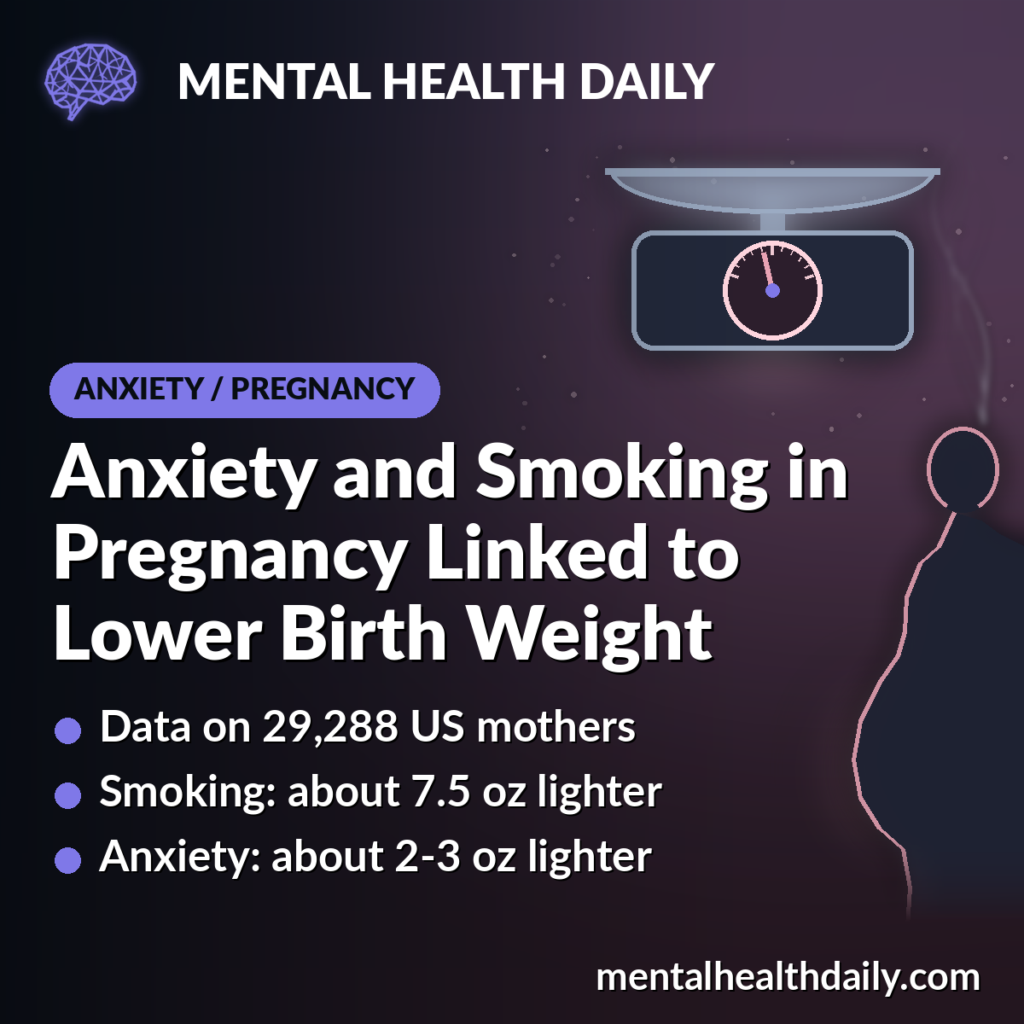
Babies born to mothers with an anxiety diagnosis weighed a little less at birth, and babies exposed to tobacco in the womb weighed much less, in a 2026 analysis of nearly 30,000 US mothers.1
Research Highlights
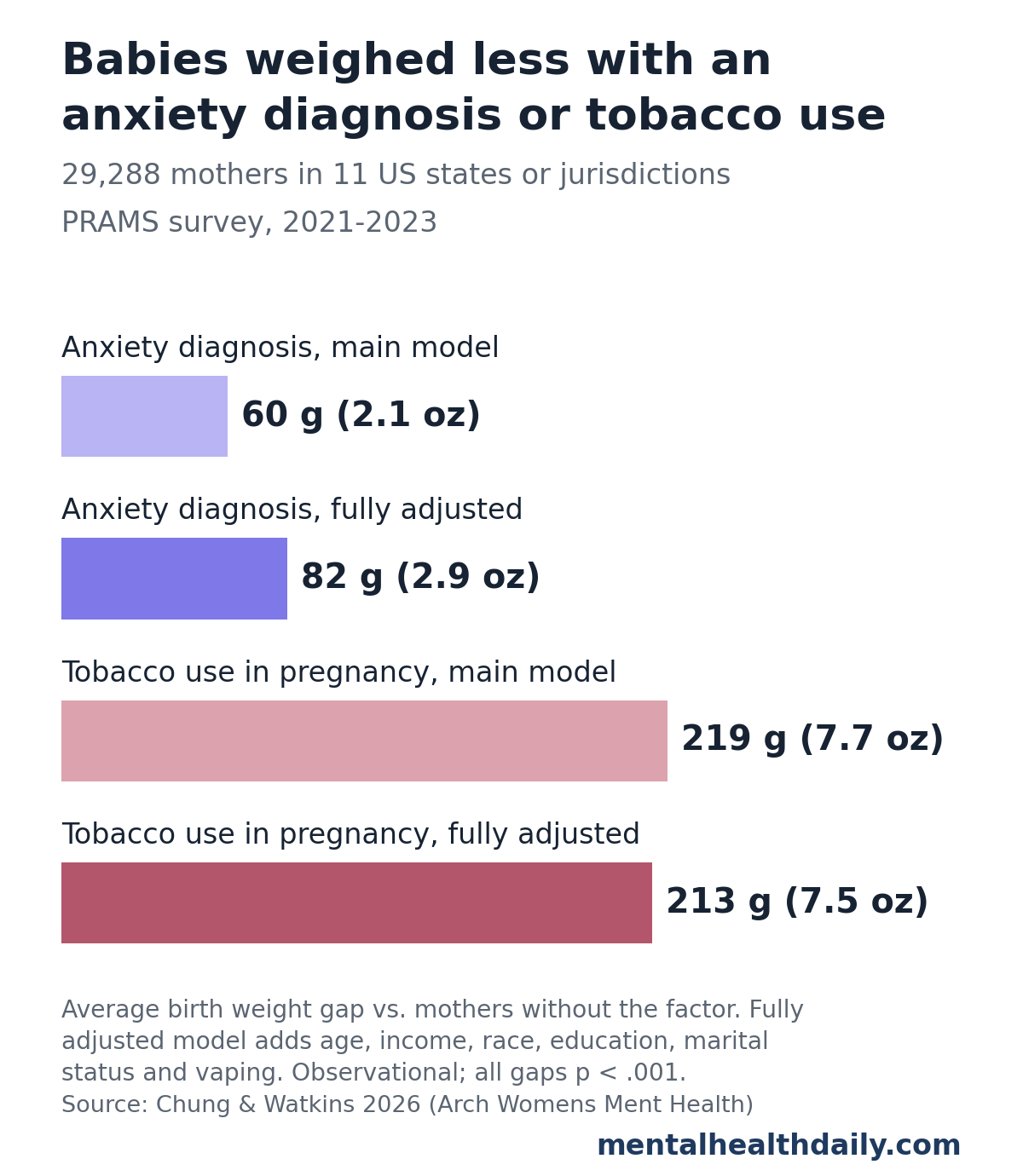
- Anxiety linked to a small drop: mothers who said a health care provider had diagnosed them with anxiety had babies about 60 g (2.1 oz) lighter on average, or about 82 g (2.9 oz) lighter with fuller adjustment for demographics and vaping.1
- Tobacco linked to a larger drop: tobacco use during pregnancy went with babies about 213 to 219 g (7.5 to 7.7 oz) lighter, roughly 3 times the anxiety gap.1
- Each factor counted on its own: both links held with the other factor in the same model, so the anxiety gap was not simply explained by smoking.1
- State rates did not matter, but places differed: a state’s overall rates of anxiety and tobacco use did not predict birth weight, while the size of the anxiety link varied from state to state.1
- Consistent with earlier research: a 2018 meta-analysis found anxiety in pregnancy linked to babies about 56 g lighter, almost the same size as this study.2
How the PRAMS Study Measured Anxiety, Tobacco Use and Birth Weight
Sunghyun Chung and Lawrence Watkins of Texas A&M University analyzed 2021–2023 data from the Pregnancy Risk Assessment Monitoring System (PRAMS). PRAMS is a CDC-run survey of women who recently gave birth, linked to each baby’s birth certificate.1
Of 59,343 initial records, 29,288 mothers had complete answers and came from the 11 places with full data: Delaware, Kansas, Michigan, Missouri, Montana, New Jersey, Pennsylvania, Utah, Washington, Wisconsin and New York City.1
- Anxiety: a yes/no question asking whether a health care provider had told the mother she had anxiety before or during pregnancy. 29% said yes.
- Tobacco use: a yes/no report of using tobacco during pregnancy. 6.4% said yes.
- Birth weight: taken from birth certificates, but recorded in 250 g (8.8 oz) bands, so the researchers used the middle of each band as the baby’s weight. The average was 3,074 g (about 6.8 lb).
The researchers used a multilevel model, a type of regression that separates differences between individual mothers from differences between states. It also let the anxiety link take a different size in each state.1
Anxiety Was Linked to Babies About 2 to 3 Ounces Lighter
In the main model, which included both anxiety and tobacco use plus state-level rates, an anxiety diagnosis was linked to babies 59.9 g (2.1 oz) lighter (SE 12.84, p < 0.001).1
A fuller model also accounted for maternal age, education, race and ethnicity, marital status, household income and e-cigarette use. In that version, the anxiety gap grew to 81.6 g (2.9 oz; SE 11.27, p < 0.001).1
Effect size: 2 to 3 ounces is a small shift for an individual baby. Across a population, though, a downward shift of that size nudges more babies toward low birth weight, defined as under 2,500 g (about 5.5 lb), a level linked to newborn complications and later health problems.1
Tobacco Use in Pregnancy Was Linked to Babies About 7.5 Ounces Lighter
Tobacco use was linked to babies 218.7 g (7.7 oz) lighter in the main model and 213.1 g (7.5 oz) lighter in the fully adjusted model (both p < 0.001).1
In predicted terms, babies of mothers who used tobacco averaged about 2,886 g (6.4 lb), compared with about 3,104 g (6.8 lb) for babies of mothers who did not.1
This is the expected direction. A 2022 meta-analysis of 55 cohort studies found that smoking during pregnancy raised the odds of low birth weight by 89% (odds ratio 1.89), with higher risk for women who smoked more cigarettes a day or for more of the pregnancy.3
Anxiety and Smoking Were Separate Risks, Possibly Connected
Because both factors sat in the same model, the anxiety link was measured over and above tobacco use, and the reverse. Each was linked to lower birth weight on its own.1
The researchers still caution against treating them as unrelated. Some pregnant women smoke to cope with stress and anxiety, so anxiety may also raise risk indirectly, through smoking, on top of its own link.1
Possible pathways from anxiety to fetal growth, as the researchers describe them, include:1
- Behavior: coping through tobacco or other habits that affect the pregnancy
- Stress physiology: changes in the body’s stress response during pregnancy
- Care: differences in how often and how well prenatal care is used
This study did not test any of those pathways directly.
Some States Showed a Stronger Anxiety Link Than Others
About 6.3% of the variation in birth weight lay between states rather than between mothers. Even so, a state’s overall rates of anxiety and tobacco use did not predict its babies’ birth weights (p = 0.364 and p = 0.290).1
What did vary was the strength of the anxiety link. It was strongest in Pennsylvania, Kansas and Utah and weakest in Washington, Wisconsin and New Jersey.1
With only 11 places in the analysis, the researchers present this ranking as descriptive. They suggest that access to prenatal and mental health care, local tobacco policy and social support could shape how much anxiety matters, but none of those factors was measured.1
Earlier Research on Anxiety in Pregnancy and Birth Weight
The result is consistent with a 2018 meta-analysis of 29 studies with data collected prospectively, starting during pregnancy. Grigoriadis et al. found anxiety in pregnancy linked to:2
- Lower average birth weight: about 56 g (2 oz) lower
- Low birth weight: 80% higher odds (odds ratio 1.80)
- Preterm birth: 54% higher odds (odds ratio 1.54)
That review also found a larger birth weight gap when anxiety was clinically diagnosed rather than measured with a rating scale, which fits the diagnosis-based question used in PRAMS. Whether treating anxiety changes these outcomes is still unknown.2
Limitations of This PRAMS Birth Weight Analysis
- Observational design: the study shows links, not cause and effect. Unmeasured factors such as prenatal care, other health conditions or medications could explain part of them.
- Simple anxiety measure: anxiety was a self-reported provider diagnosis, with no information on severity, timing or treatment. Women with undiagnosed anxiety were counted as having none.
- Simple tobacco measure: tobacco use was a yes/no self-report, with no data on amount, quitting or secondhand smoke, and some women may have underreported it.
- Approximate birth weights: weights came in 250 g (8.8 oz) bands, which adds imprecision to gaps of 2 to 3 ounces.
- Timing of birth not modeled: the analysis did not account for how many weeks into pregnancy each baby was born, so some of the gap could reflect earlier delivery rather than slower growth.
- Limited coverage: about half of the initial records were dropped for missing data, no southern states were included, and the data overlap the COVID-19 pandemic. The findings are not nationally representative.
What This Means for Prenatal Care
Quitting tobacco remains the bigger lever. Tobacco use carried about 3 times the birth weight gap of anxiety in this study, matching a large body of evidence linking smoking in pregnancy to low birth weight.1,3
Anxiety deserves attention too. The researchers recommend screening for both together: checking pregnant women who report anxiety for tobacco use and coping habits, and checking those who smoke for anxiety, with referral to mental health or quit-smoking support.1
Anyone who is pregnant and dealing with anxiety, or finding it hard to stop smoking, can raise both with a prenatal care provider.
References
- Chung S, Watkins L. Prenatal anxiety, tobacco use, and infant birth weight: a multilevel analysis of PRAMS data. Archives of Women’s Mental Health. 2026;29:134. doi:10.1007/s00737-026-01773-4
- Grigoriadis S, Graves L, Peer M, et al. Maternal anxiety during pregnancy and the association with adverse perinatal outcomes: systematic review and meta-analysis. Journal of Clinical Psychiatry. 2018;79(5):17r12011. doi:10.4088/JCP.17r12011
- Di HK, Gan Y, Lu K, et al. Maternal smoking status during pregnancy and low birth weight in offspring: systematic review and meta-analysis of 55 cohort studies published from 1986 to 2020. World Journal of Pediatrics. 2022;18(3):176–185. doi:10.1007/s12519-021-00501-5