
A 2025 survey of 686 Dutch university students linked violent pornography use to self-reported sexual aggression risk, especially when pornography was perceived as realistic or when peer rape myth acceptance was higher.
Research Highlights
- 686 students were surveyed: the Dutch online sample was 63.4% female and focused on pornography use, perceived realism, peer rape myth acceptance, and self-reported sexual aggression.1
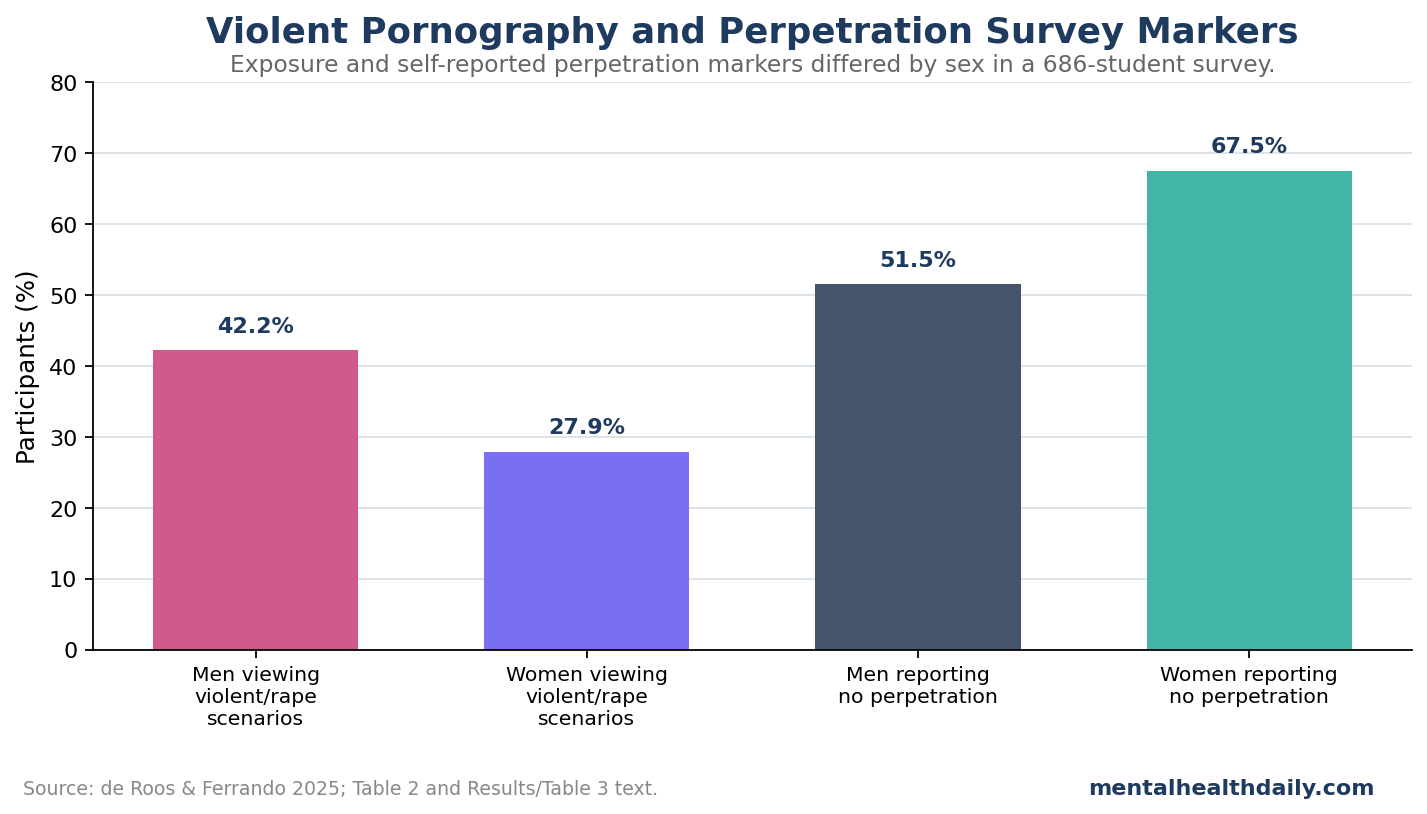
- Violent content exposure differed by sex: 42.2% of men vs. 27.9% of women reported viewing violent sex or rape-scenario pornography, with chi-square = 11.71 and p < 0.001.
- Perpetration reports were common enough to model: 51.5% of men and 67.5% of women reported no perpetration, meaning substantial minorities reported at least 1 behavior category.
- Self-labeling missed behavioral criteria: among participants meeting behavioral criteria for rape, 63.63% of men and 87.10% of women denied rape when asked directly.
- Peer norms amplified risk: violent pornography was more strongly linked to perpetration when peer rape myth acceptance or perceived realism was higher, with a reported high-realism conditional effect of 2.44 (p < 0.001).
Rape myth acceptance means endorsement of false beliefs that excuse perpetrators, blame victims, or minimize sexual violence. Sexual script theory means people learn expectations for sexual situations from experience, peers, media, and social norms.
The study does not show that any single person became sexually aggressive because of pornography. It does show that violent sexual media, perceived realism, and peer norms can cluster in a way that prevention programs should take seriously.
Violent Pornography Was Not the Only Variable
de Roos and Ferrando tested a moderated-risk model. The central question was whether violent pornography had a stronger association with sexual aggression when people viewed pornography as realistic or believed peers accepted rape myths.
The sample showed clear gender-pattern differences:
- Peer rape myth acceptance: men averaged 36.81 vs. 24.13 for women.
- Perceived realism: men averaged 2.53 vs. 1.80 for women.
- Past-6-month use frequency: men averaged 4.05 vs. 2.76 for women.
- Violent sex or rape scenarios: 42.2% of men vs. 27.9% of women reported viewing this content.
Those differences do not make the study a simple men-vs.-women morality story. They identify where the risk pathway was strongest: violent content plus higher realism plus a peer environment perceived as more accepting of rape myths.
Perceived Realism Changed the Meaning of Exposure
Perceived pornography realism means treating pornography as if it reflects ordinary sexual behavior or realistic sexual expectations. In the analysis, perceived realism moderated the link between violent pornography and perpetration, especially for male students.
The practical interpretation is direct. Violent content is more concerning when a viewer treats it as a guide to normal sex rather than as scripted, commercially produced media. Porn literacy work targets that mechanism by separating performance, consent, editing, coercion, and real partner communication.
Meta-analytic evidence is mixed in strength but not empty. Wright et al. reported positive associations between pornography use and acts of sexual aggression, with violent content carrying stronger concern.2 Ferguson and Hartley argued that meta-analytic estimates should be read cautiously and are sensitive to study quality.3 The Dutch study fits between those poles: it supports a moderated risk signal without proving causation.
Peer Rape Myth Acceptance Was a Social Multiplier
Peer norms were not decoration in the model. Peer rape myth acceptance moderated the violent-pornography link, meaning the association was stronger when participants perceived peers as more accepting of rape myths.
That is clinically and socially plausible. People do not interpret sexual media in isolation. Peer comments, jokes, group norms, dating expectations, and perceived consequences shape whether coercive scripts are rejected, tolerated, or normalized.
Prevention implication: risk reduction should not be limited to telling individuals to consume less content. Programs can also target peer correction, consent norms, bystander behavior, and porn literacy. Dawson et al. described porn literacy as a structured way to teach media realism, consent, and critical interpretation rather than relying on shame or silence.4
Self-Report and Cross-Sectional Design Limit the Claim
Evidence-strength note: this was a cross-sectional online survey. It can identify associations and moderators; it cannot prove time order or causation. People already higher in aggression risk may seek violent content, violent content may reinforce risk, peer groups may shape both, or all 3 pathways may interact.
Self-reported perpetration also carries measurement problems. Sensitive behaviors are likely underreported, and the paper's own data showed a gap between behavioral criteria and direct self-labeling. Among those meeting behavioral criteria for rape, 63.63% of men and 87.10% of women denied rape when asked directly.
Porn Literacy Should Target Realism, Consent, and Peer Correction
The moderation pattern points to a more specific prevention target than exposure avoidance alone. If perceived realism and peer rape myth acceptance change the risk association, interventions need to teach people how to interpret violent sexual media and how to correct peer norms that excuse coercion.
A prevention program built around this evidence would emphasize:
- Realism checks: pornography is staged media, not a reliable model for consent, desire, communication, or safety.
- Consent specificity: scripted compliance, silence, intoxication, fear, or pain should not be interpreted as consent.
- Peer correction: jokes, myths, and group approval can make coercive scripts seem normal; correcting peers changes the social environment.
- Bystander behavior: students need concrete scripts for interrupting coercive situations and supporting victims.
- Gender-specific tailoring: the source study found different patterns in men and women, so prevention should not assume 1 pathway for every group.
This is also where mental-health consequences enter the analysis. Sexual violence exposure is linked to depression, PTSD, anxiety, academic disruption, and later vulnerability. Preventing perpetration belongs inside campus mental-health work as well as safety policy.
The Causal Question Needs Longitudinal and Experimental Support
Cross-sectional moderation is useful for identifying risk structure. It cannot determine whether violent pornography exposure came before aggression, whether aggressive students selected different media, or whether peer norms shaped both exposure and behavior.
Future evidence would be stronger if it followed students over time, measured baseline aggression risk, tracked changes in pornography realism beliefs, and tested whether porn-literacy or peer-norm interventions reduce coercive attitudes and behaviors.
Calibrated conclusion: the study supports prevention attention to violent sexual media, perceived realism, and peer rape myths. It does not support simplistic one-cause explanations or individual blame based on media exposure alone.
Measurement should also improve. Direct questions such as "Do you think you may have ever raped someone?" missed many people who met behavioral criteria. Behaviorally specific items can detect coercive acts that participants do not label accurately, which is crucial for both research and prevention.
Campus programs can use that insight without turning prevention into accusation. Clear behavioral examples, consent definitions, and peer-response scripts make the relevant boundary easier to understand than abstract labels. The study's denial gap shows why plain behavioral language is necessary.
Outcome tracking should be just as concrete. A prevention program should not be judged only by whether students say they learned the right consent language after a session. Stronger evaluation would track behaviorally specific coercion items, bystander actions, perceived peer norms, realism beliefs, help-seeking, and confidence interrupting risky situations. Those endpoints match the moderators in the study better than a generic attitude score.
Research translation: the most useful next studies would test whether changing realism beliefs and peer correction actually changes behavior over time. That would move the evidence from risk mapping toward prevention mechanism.
Mental-health angle: preventing coercive behavior reduces trauma exposure, anxiety, depression, PTSD symptoms, academic disruption, and later relationship harm. A prevention model that targets peer norms and perceived realism is therefore a mental-health intervention as well as a sexual-violence intervention.
The study also separates exposure from interpretation. Two students can view similar content and come away with different scripts depending on perceived realism, peer reaction, prior attitudes, and consent education. That is why the moderation results are more actionable than a simple exposure correlation.
For policy, the result argues for precision. Blanket claims about pornography can alienate the people prevention programs need to reach. A more defensible message is that violent sexual scripts become riskier when they are treated as realistic and reinforced by peers who minimize coercion.
That precision also protects scientific credibility. The paper supports targeted prevention around violent content, realism beliefs, and peer myths; it does not support panic messaging about every form of sexual media.
Questions About Violent Pornography and Sexual Aggression
Does this prove violent pornography causes sexual violence?
No. The design was observational and cross-sectional. It supports a risk and prevention signal, not a causal verdict for any individual.
Why did peer rape myth acceptance matter?
Peer norms can make coercive scripts seem more acceptable or less punishable. The study suggests violent content is more concerning when the surrounding peer environment also minimizes sexual violence.
What should prevention focus on?
Prevention should combine porn literacy, consent education, peer-norm correction, and bystander training. The study points to social interpretation of violent content along with exposure count.
References
- Moderating Effects on the Link between Violent Pornography and Sexual Aggression. de Roos MS, Ferrando E. Archives of Sexual Behavior. 2025;54:2671-2684. doi:10.1007/s10508-025-03199-y
- A Meta-Analysis of Pornography Consumption and Actual Acts of Sexual Aggression in General Population Studies. Wright PJ et al. Journal of Communication. 2016;66(1):183-205. doi:10.1111/jcom.12201
- Pornography and Sexual Aggression: Can Meta-Analysis Find a Link? Ferguson CJ, Hartley RD. Trauma, Violence, & Abuse. 2022;23(1):278-287. doi:10.1177/1524838020942754
- Toward a Model of Porn Literacy: Core Concepts, Rationales, and Approaches. Dawson K et al. Journal of Sex Research. 2020;57(1):1-15. doi:10.1080/00224499.2018.1556238