A 1-hour weight-inclusive care training did not significantly change how 10 primary care providers rated their own weight attitudes or practices 2 weeks later. Afterward, though, providers described moving the scale, dropping routine weigh-ins and stocking larger blood pressure cuffs.1
Research Highlights
- No significant change in self-rated practices: between baseline (9 surveys) and 2-week follow-up (10 surveys), providers’ ratings of their weight attitudes and clinical behaviors did not change significantly (p > 0.05).1
- Changes showed up in the clinic: all 4 interviewed providers changed how patients were weighed. Two stopped requiring a weigh-in at every visit and 2 moved the scale to a more private spot.1
- Providers valued the training more afterward: the share rating weight-inclusive training as very or extremely important rose from 50% to 100% (p = 0.025).1
- Old habits persisted in clinical reasoning: the researchers counted 15 moments where providers endorsed weight-inclusive ideas but still steered a sample patient toward weight loss.1
- Why it matters for mental health: a meta-analysis of 105 studies linked weight stigma to worse mental health (r = −0.35), and patients who absorb that stigma report avoiding doctors more often.2,5
Weight Stigma in Health Care Is Linked to Worse Mental Health and Skipped Care
Weight stigma means negative labels, stereotypes and unfair treatment based on body size. In medical settings it can look like a doctor attributing every complaint to weight, a lecture about dieting at an unrelated visit, or exam equipment that does not fit.
Its links to mental health are well documented. A 2020 meta-analysis pooled 105 studies with 59,172 participants and found a medium-to-large association between experiencing weight stigma and poorer mental health (r = −0.35). The link was stronger at higher body weights.2
A 2018 systematic review of 33 studies in adults with higher weight found weight stigma associated with:3
- Mood and anxiety: more depression and anxiety, and lower self-esteem
- Eating and body image: more eating disturbances and body dissatisfaction
- Stress biology: higher cortisol, oxidative stress and C-reactive protein (a marker of inflammation)
These are mostly observational studies, so they show strong, consistent links rather than proof that stigma causes each outcome.
Effects on care: a review of the clinical evidence found that many health care providers hold negative attitudes toward patients with obesity, and that expecting poor treatment causes stress and leads patients to avoid care.4
A survey of 13,996 adults in weight management programs across 6 countries put numbers on this. Of those who had experienced weight stigma (56% to 61% by country), about two-thirds said it had come from doctors.5
Participants who had internalized that stigma — applying negative weight stereotypes to themselves — reported more avoidance of doctors, fewer routine checkups, feeling less listened to and lower-quality care, even after accounting for body mass index (BMI).5
What Weight-Inclusive Care Means in a Primary Care Visit
Most primary care follows what researchers call weight-centric care: BMI screening, weight-loss goals, diet and exercise counseling aimed at losing weight, and referral for weight-loss drugs or surgery when those efforts fall short.1
Weight-inclusive care keeps the focus on health behaviors and health markers rather than the scale. The goal is lasting changes in eating, movement, stress and sleep, with progress tracked through things like blood pressure, cholesterol, blood sugar (HbA1c), fitness, mobility, energy and mood, whether or not weight changes.1
There is some trial evidence behind this approach. In a randomized trial of 80 women with a BMI of 30 or higher, a 6-month weight-neutral program produced larger drops in LDL cholesterol and bigger gains in intuitive eating than a weight-loss program, while the weight-loss program produced more weight loss.6
The open question McEntee et al. took up is practical: how do you get busy clinicians to actually practice this way?
How the 1-Hour Weight-Inclusive Care Training Worked
The training took place during a standing provider meeting at a federally qualified health center (a community clinic serving many low-income and uninsured patients) in Phoenix, Arizona.1
- Format: a 1-hour interactive session led by 2 presenters, mixing short teaching with case discussions
- Content: problems with weight-centric assumptions, personal bias, social factors that shape health, respectful conversations about weight, and setting non-weight goals such as adding fruits and vegetables, enjoyable activity, stress management and better sleep
- Participants: 10 primary care providers; 9 completed the baseline survey, 10 completed the 2-week follow-up and 4 sat for interviews
- Interviews: 30 minutes on Zoom, including talking through care for a standardized sample patient
Behavior first, attitudes second: most weight bias programs try to change how clinicians feel about higher-weight patients. This one targeted what providers say, ask, document and do in the exam room, on the idea that changed behavior does not have to wait for changed beliefs.1
The providers had their own history with weight. Of the 8 who answered those questions, 5 were trying to lose weight and 6 had been teased about their own body size.1
Survey Scores on Weight Attitudes and Practices Did Not Change Significantly
Providers rated 12 attitude statements and how often they used 23 clinical practices, each on a 5-point scale. Apart from how much they valued the training and research, their ratings showed no statistically significant change 2 weeks after training.1
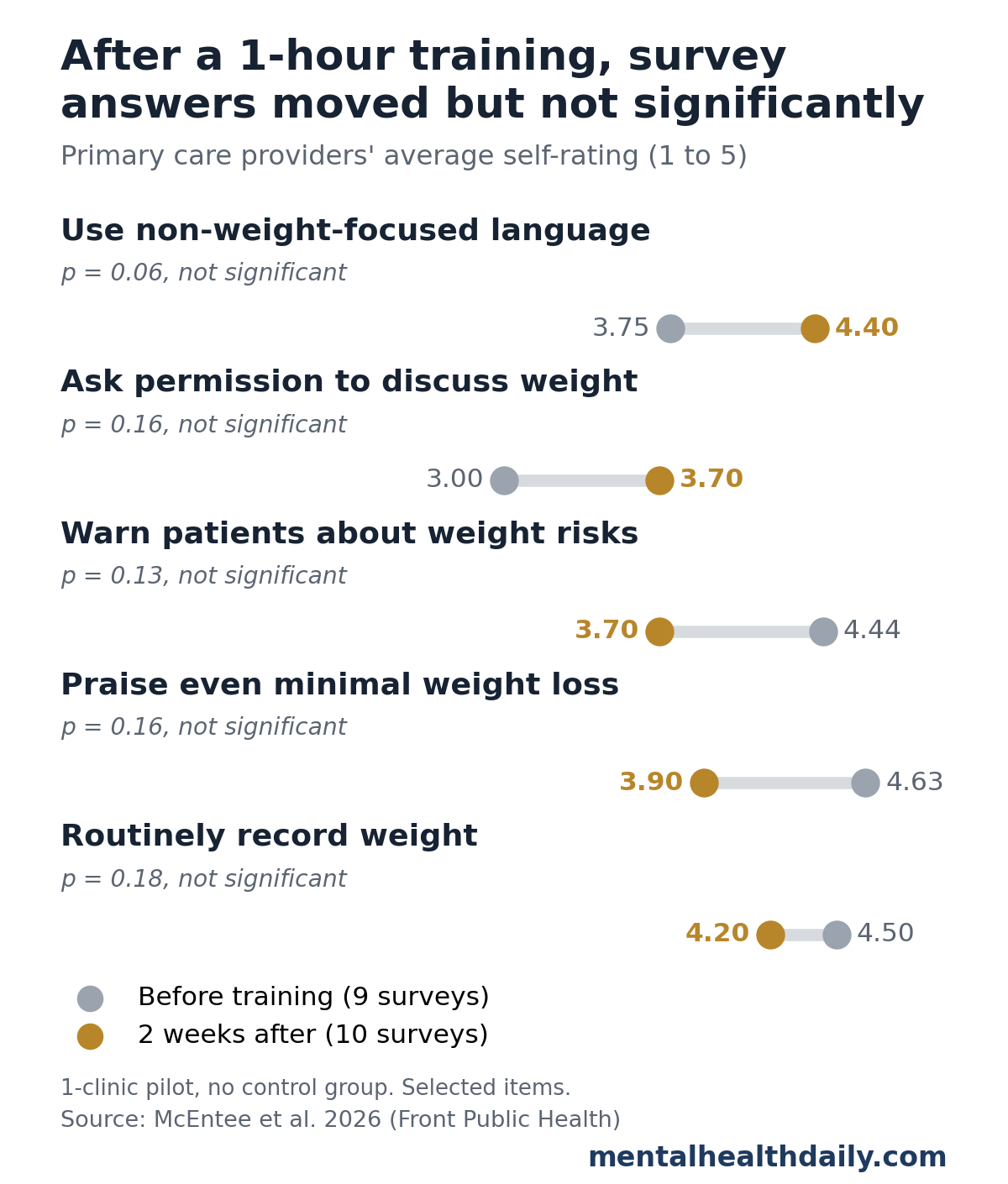
Several items still moved in the direction the training intended:1
- Health-centered language: 3.75 to 4.40 (p = 0.06)
- Asking permission before discussing weight: 3.00 to 3.70 (p = 0.16)
- Believing higher-weight patients must be educated about weight risks: 4.44 to 3.70 (p = 0.13)
- Praising weight loss, even minimal loss: 4.63 to 3.90 (p = 0.16)
Not every item moved the intended way. Making accommodations for larger patients, such as properly sized cuffs, gowns and armless chairs, edged down from 4.13 to 3.90 (p = 0.18), and respecting patients’ own health priorities dipped from 4.75 to 4.40 (p = 0.18). Most other items barely changed.1
What did change significantly was how much providers valued the topic. The share rating weight-inclusive training as very or extremely important went from 50% to 100% (p = 0.025), and the share saying the same about research rose from 63% to 90% (p = 0.046).1
Providers Moved Scales, Stopped Routine Weigh-Ins and Stocked Larger Cuffs
The interviews told a more active story. All 4 interviewed providers reported changing how their clinic weighs patients:1
- 2 providers no longer required a weigh-in at every visit
- 2 providers moved the scale to a more private location
- 2 providers worked to make appropriately sized equipment easier to reach
On the follow-up survey, providers also listed larger blood pressure cuffs, encouraging patients to add healthy foods rather than restrict, giving more priority to behavioral health and new ways of talking with patients.1
One provider described why it matters to patients: “I feel like some of the patients in our population are maybe hesitant to seek care with us because we are not being as inclusive as we should be, and I think that’s where that dread comes from.”1
The researchers suggest that concrete changes like these may show up before they register on broad survey scales, especially after only 2 weeks. None of the reported changes were checked against clinic records or observation.1
Providers Endorsed Weight-Inclusive Care but Still Steered Toward Weight Loss
The sample-patient discussions exposed a gap between knowing and doing. The researchers coded weight-centric reasoning 19 times, weight-inclusive reasoning 21 times and a “disconnect” 15 times.1
The disconnect was a provider stating that the number on the scale does not define health, then later recommending weight loss as the route to health. In one case a provider suggested gym memberships and physical therapy “not in the sense of weight management,” yet framed the end goal as helping the patient address her weight.1
Weight-inclusive reasoning looked different. One provider wanted bloodwork before assuming joint pain came from weight. Another asked about the patient’s kitchen setup, such as whether she could sit while cooking, to understand what shaped her food choices.1
Providers named barriers too:
- Resources: missing equipment in larger sizes, hard-to-rearrange clinic space, short staffing and time pressure
- Materials: no weight-inclusive patient handouts and no list of like-minded providers for referral
- Support: requests for ongoing sessions, monthly check-ins, training for other staff and clear clinic-wide weighing rules
Earlier Weight Bias Trainings Changed Attitudes Only Modestly
The modest survey result fits the wider evidence. A 2014 meta-analysis of 30 weight bias reduction studies found a small average improvement in weight-biased attitudes and beliefs (g = −0.33).7
A 2016 systematic review of 17 studies in health professionals concluded that most interventions did not reduce weight bias and that long-term effects were unknown.8
A 2022 meta-analysis of more recent provider interventions found a small-to-moderate reduction in weight bias (g = −0.38, 95% CI −0.52 to −0.24).9
Those studies mostly measured attitudes. Far fewer checked whether clinicians actually behaved differently with patients, which is the gap this pilot tried to address.1
Limitations of This Weight-Inclusive Care Pilot
- Very small sample: 10 providers at 1 clinic, with only 4 interviews. A study this size can easily miss real changes, and the changes it does report are uncertain.
- No comparison group: without a control clinic, changes cannot be firmly credited to the training.
- Self-report only: practice changes came from providers themselves and were not verified through charts or observation.
- Untested measures: the behavior items were adapted for this study and not validated.
- Short follow-up: 2 weeks says nothing about whether changes lasted.
- No patient outcomes: the study did not measure whether patients felt less stigmatized, kept more appointments or had better mental health.
What This Means for Patients and Clinics
For clinics: a single talk is a reasonable start, but this pilot points to the practical layer as the place where change shows up first: where the scale sits, whether weighing is routine, and whether cuffs, gowns and chairs fit every patient. Providers themselves asked for follow-up sessions and clinic-wide policies.1
For patients: evidence that weight stigma is linked to depression, anxiety and avoiding care is strong.2,5 Weight-inclusive care is a way of practicing that addresses that harm directly, and providers in this pilot reported changing clinic routines within 2 weeks of a brief training. Whether that improves patients’ experience or mental health still needs larger, controlled studies.
References
- McEntee ML, Zach R, Herath B. Implementation of weight-inclusive care in primary care: a mixed-methods pilot study of a brief, behavior-focused provider training. Frontiers in Public Health. 2026;14:1934441. doi:10.3389/fpubh.2026.1934441
- Emmer C, Bosnjak M, Mata J. The association between weight stigma and mental health: a meta-analysis. Obesity Reviews. 2020;21(1):e12935. doi:10.1111/obr.12935
- Wu YK, Berry DC. Impact of weight stigma on physiological and psychological health outcomes for overweight and obese adults: a systematic review. Journal of Advanced Nursing. 2018;74(5):1030–1042. doi:10.1111/jan.13511
- Phelan SM, Burgess DJ, Yeazel MW, Hellerstedt WL, Griffin JM, van Ryn M. Impact of weight bias and stigma on quality of care and outcomes for patients with obesity. Obesity Reviews. 2015;16(4):319–326. doi:10.1111/obr.12266
- Puhl RM, Lessard LM, Himmelstein MS, Foster GD. The roles of experienced and internalized weight stigma in healthcare experiences: perspectives of adults engaged in weight management across six countries. PLoS One. 2021;16(6):e0251566. doi:10.1371/journal.pone.0251566
- Mensinger JL, Calogero RM, Stranges S, Tylka TL. A weight-neutral versus weight-loss approach for health promotion in women with high BMI: a randomized-controlled trial. Appetite. 2016;105:364–374. doi:10.1016/j.appet.2016.06.006
- Lee M, Ata RN, Brannick MT. Malleability of weight-biased attitudes and beliefs: a meta-analysis of weight bias reduction interventions. Body Image. 2014;11(3):251–259. doi:10.1016/j.bodyim.2014.03.003
- Alberga AS, Pickering BJ, Alix Hayden K, et al. Weight bias reduction in health professionals: a systematic review. Clinical Obesity. 2016;6(3):175–188. doi:10.1111/cob.12147
- Moore CH, Oliver TL, Randolph J, Dowdell EB. Interventions for reducing weight bias in healthcare providers: an interprofessional systematic review and meta-analysis. Clinical Obesity. 2022;12(4):e12545. doi:10.1111/cob.12545