A 37-question survey that maps what a family caring for someone with schizophrenia has to work with, from money and emotional support to community services, held together well in its first full test with 304 caregivers in Beijing.1
Research Highlights
- What was tested: the M-FRAT, a caregiver-rated questionnaire on family resources for schizophrenia, given to 304 family caregivers at 7 community health centers in Beijing and published in Frontiers in Psychiatry.1
- Trimmed from 46 to 37 questions: the final version groups items into 7 types of resources, 3 inside the family and 4 outside it, which together explained 70.245% of the variation in answers.1
- Consistent answers: the 37 items hung together well (Cronbach’s alpha 0.927), and 8 experts rated nearly every item as relevant.1
- Outside help scored lowest: caregivers reported the fewest economic and environmental resources, such as subsidies, welfare support and rehabilitation services.1
- Small link to caregiver health: higher scores went with slightly better caregiver quality of life, explaining no more than 5.3% of the differences between caregivers.1
Why Schizophrenia Caregivers Need a Family Resource Questionnaire
In China and much of Asia, most people with schizophrenia live with relatives, who handle daily supervision, medication, emotional support and dealings with health and social services.1
That work takes a toll. A survey across 5 European countries found that 398 schizophrenia caregivers scored lower on the mental health summary of the SF-36 quality-of-life questionnaire than matched non-caregivers (40.3 vs. 45.9) and caregivers of people with other conditions such as dementia, cancer and stroke (40.3 vs. 42.7).3
Family support also helps the patient. A 2022 network meta-analysis of 90 randomized trials with 10,340 participants found that nearly every type of family intervention reduced relapse at 12 months compared with usual care; the exceptions were crisis-oriented approaches and very brief family education of 2 sessions or fewer.4
Clinicians who want to help a family first need to know what it already has and what is missing. Existing questionnaires mostly measure one slice, such as social support or how well the family functions.1
The M-FRAT (multidimensional family resource assessment tool for schizophrenia) was built to cover the whole picture from the caregiver’s point of view.1
What the M-FRAT Asks Caregivers
The questionnaire grew out of a 2024 study in which 21 experts agreed, over 2 rounds of a Delphi survey (a structured process in which experts rate items until they reach consensus), on 46 family resource indicators in 10 domains.2
Caregivers rate each statement from 1 (strongly disagree) to 5 (strongly agree), and higher totals mean more resources. Statements in the final version include:1
- Family money: “The family is able to pay the patient’s medical expenses.”
- Emotional support: “Family members can listen carefully to the patients’ complaints.”
- Treatment help: “Family members can urge patients to take medication.”
- Community care: “There are mental health doctors in community health service institutions.”
- Financial aid: “Patients can obtain financial subsidies through organized rehabilitation labor.”
Religious resources were left out because most of the development experts considered religious activities possibly unsuitable for people with schizophrenia. That was a judgment for this setting, and the researchers suggest studying religious resources in other cultural contexts.1
How the Researchers Tested the Questionnaire
Li et al. ran the evaluation in 2 stages:1
- Expert review: 8 experts (university professors, mental health doctors and general practitioners) rated how relevant each item was.
- Caregiver survey: between November 2021 and February 2022, caregivers who lived with the patient and carried primary responsibility for care completed the M-FRAT and the SF-36, a standard 0-to-100 measure of physical and mental quality of life.
Sample: 304 of 322 invited caregivers (94.4%); most who declined cited stigma or not wanting to share personal information. Caregivers averaged 59 years old, 44.7% were spouses and 31.6% were parents, and 71.0% had been caregiving for more than 10 years.1
37 Questions in 7 Groups Passed the Main Reliability Checks
Several standard checks asked whether the questions work as a measuring tool:1
- Expert relevance: each item’s content validity index, the share of experts rating it relevant, ranged from 0.88 to 1.00, with a scale average of 0.97.
- Telling families apart: every item separated the highest-scoring 27% of families from the lowest-scoring 27%.
- Internal consistency: Cronbach’s alpha measures how closely a set of items agree, on a 0-to-1 scale where 0.70 or higher is usually acceptable. The final 37 items scored 0.927.
To find the scale’s structure, the team used exploratory factor analysis, a statistical method that sorts questions into groups based on which ones caregivers tend to answer alike. Over 3 rounds, 9 items were dropped because they fit weakly, straddled 2 groups or landed in the wrong group.1
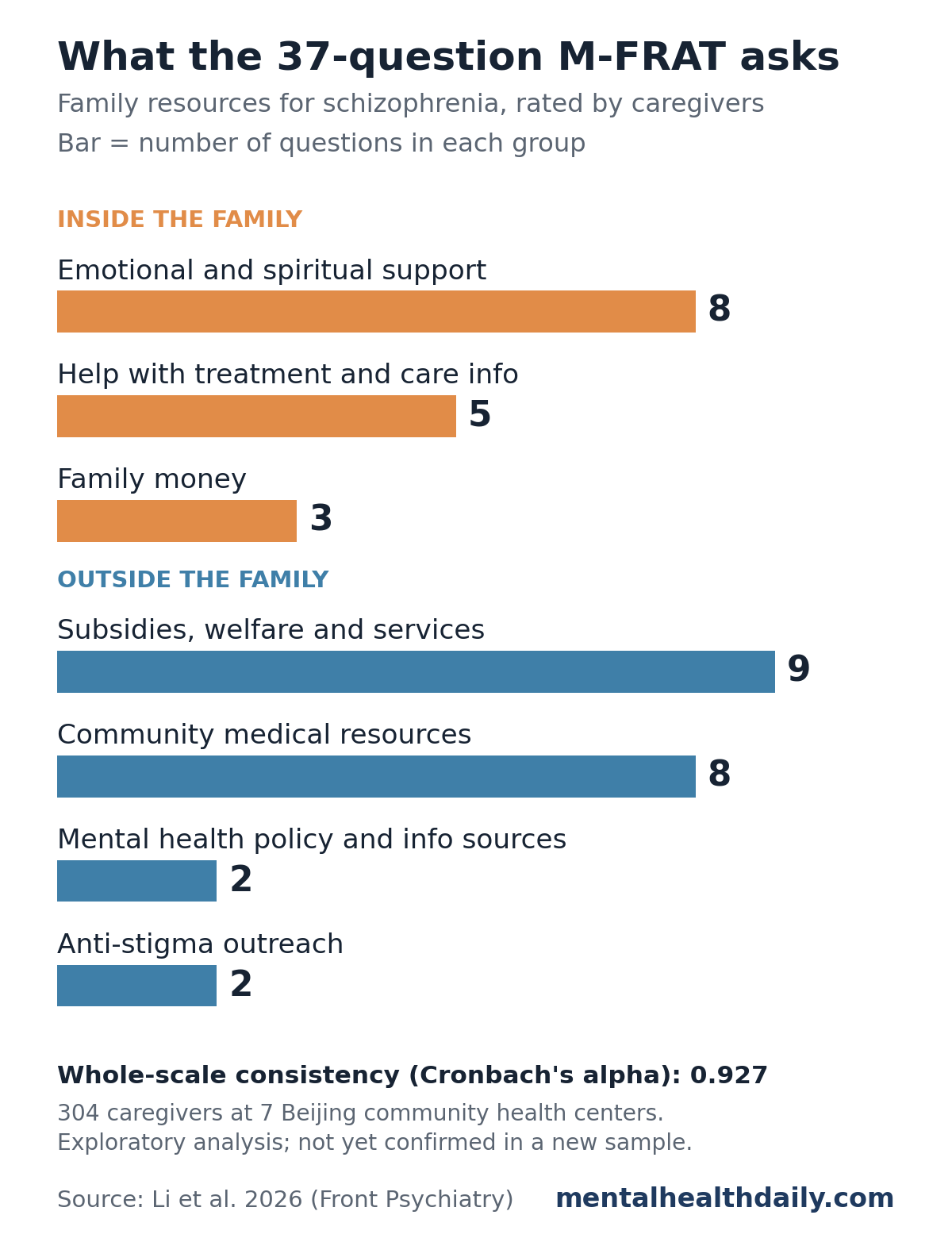
Two pairs of the original domains merged. Economic resources (such as rehabilitation subsidies and employment support) combined with environmental resources (such as welfare and access to nursing or rehabilitation facilities), and information and education support folded into medical treatment support.1
The structural support domain, which covered practical home arrangements such as keeping dangerous items in a safe place, did not hold together (alpha 0.117) and was dropped. Most patients in this sample were in a stable phase of illness, when home adjustments may matter less.1
Subsidies and Community Services Were the Weakest Resources
On the original 46-item version, caregivers gave the lowest per-question scores to economic and environmental resources. The highest-rated single item was a free yearly physical exam in the community, which 60.5% strongly agreed was available.1
This pattern matches an earlier survey of 363 caregivers in 6 urban Beijing districts, in which fewer than 10% knew about rehabilitation programs and related subsidies and fewer than 5% had used them.5 Li et al. point to likely reasons:1
- Low awareness: services are poorly publicized, and application procedures are complicated.
- Poor fit: many employment-linked benefits require work activity that is hard for people with schizophrenia.
- Stigma: families may avoid seeking help or joining community activities.
- Lost income: caregiving makes steady work harder, pushing families to spend on essentials before rehabilitation.
Rural and Urban Families Scored About the Same
The researchers expected resource levels to differ by where families lived. Total scores did not differ significantly: 131.4 for rural families vs. 127.0 for urban families (p = 0.089).1
Only the cultural resources group, made up of 2 items on community anti-stigma outreach, differed: rural families scored 7.16 vs. 6.59 for urban families (p = 0.030). The researchers counted this as partial support for their prediction.1
More Family Resources Were Linked to Slightly Better Caregiver Health
Caregivers’ SF-36 scores for general health, vitality and mental health averaged about 58 out of 100, which the researchers flagged as relatively low.1
Higher M-FRAT totals were linked to better scores on 7 of the 8 SF-36 domains in regression models, as predicted. The links were small: M-FRAT scores explained between 1.7% and 5.3% of the differences in caregiver quality of life. Simple correlations were significant only for the 4 physical-health domains (r = 0.124 to 0.187).1
The researchers read this as expected, since caregiver quality of life also depends on the patient’s illness, the caregiver’s own health, stigma and much else. The data are cross-sectional, so they cannot show that adding resources would improve caregivers’ health.1
How Clinics Could Use the M-FRAT
The intended use is practical: a primary care doctor or community mental health worker could give the questionnaire to a caregiver, see which resources are thin, and connect the family to services they are missing, such as subsidies they have not applied for or community rehabilitation guidance.1
That use is still a proposal. The tool has not been tested in an intervention study, so there is no evidence yet that using it changes caregiver burden, patient recovery or relapse.1
Limitations of This M-FRAT Validation Study
- One city: caregivers were purposively recruited from 7 community health centers in Beijing; the tool needs testing in other regions and health systems.
- Structure not yet confirmed: the 7 groups came from an exploratory analysis in the same sample used to trim the items. A confirmatory factor analysis in an independent sample was not done.
- No retest or change data: the single survey could not show whether scores are stable over time or shift when a family’s resources change.
- All self-report: caregivers filled in both the M-FRAT and the SF-36, which can inflate links between them.
- Mostly stable patients: resources that matter during relapses, such as home safety arrangements, may be undercounted.
- Minor reporting issues: one t value in the SF-36 table (12.291 with p = 0.023) appears to be a typo, and the discussion describes recruitment as urban Beijing although 55.9% of caregivers reported rural residence.
References
- Li T, Wang M, Pan Z, Chen L, Jin G, Lu X. Psychometric evaluation of a multidimensional family resource assessment tool for schizophrenia (M-FRAT) from caregivers’ perspectives in communities of Beijing, China. Frontiers in Psychiatry. 2026;17:1818532. doi:10.3389/fpsyt.2026.1818532
- Wang M, Jin G, Li T, Pan Z, Lu X, Wang X. Development of family resource indicators for people with schizophrenic disorder in community by modified Delphi method in Beijing, China. BMJ Open. 2024;14:e076838. doi:10.1136/bmjopen-2023-076838
- Gupta S, Isherwood G, Jones K, Van Impe K. Assessing health status in informal schizophrenia caregivers compared with health status in non-caregivers and caregivers of other conditions. BMC Psychiatry. 2015;15:162. doi:10.1186/s12888-015-0547-1
- Rodolico A, Bighelli I, Avanzato C, et al. Family interventions for relapse prevention in schizophrenia: a systematic review and network meta-analysis. Lancet Psychiatry. 2022;9(3):211–221. doi:10.1016/S2215-0366(21)00437-5
- Wang MR, Jin GH, Wei Y, et al. Awareness, utilization and influencing factors of social supports for main informal caregivers of schizophrenia patients: a cross-sectional study in primary care settings in Beijing, China. BMC Family Practice. 2020;21:192. doi:10.1186/s12875-020-01257-z