
Sleep apnea often goes unnoticed in people with cancer, and a 2026 review argues that a closer look at the mouth, jaw and nose could help catch it. The researchers propose adding a dental and airway exam to standard sleep testing for adults with cancer.1
Research Highlights
- A proposal, not a trial: 3 dental researchers at the University of Murcia in Spain published a narrative review in Nature and Science of Sleep (September 2026) laying out a 5-step framework. It reports no new patient data.1
- Sleep problems are common in cancer: a meta-analysis of 46,279 patients found sleep disturbance in 60.7%, rising to 70.8% in advanced disease.2
- Sleep apnea can be very common in some cancers: in a study of newly diagnosed lung cancer, 80% of patients tested had obstructive sleep apnea and 50% had moderate-to-severe disease.3
- The new piece is a dental exam: the review lists features such as a narrow upper jaw, high-arched palate, narrow nasal passages, a set-back lower jaw and tongue-tie as clues that the airway may narrow during sleep.1
- Fatigue, focus and mood are at stake: the review names morning fatigue, poor concentration and daytime sleepiness as warning signs, and a large trial outside cancer found that treating sleep apnea eased depressive symptoms.1,4
- Still untested: the framework has not been checked in a prospective study, so its effect on diagnosis or patient outcomes is unknown.1
What Sleep Apnea and Nocturnal Hypoxia Mean
Obstructive sleep apnea is a sleep disorder in which the upper airway, the passage behind the nose, tongue and soft palate, repeatedly narrows or collapses during sleep. Breathing stops (an apnea) or becomes very shallow (a hypopnea) until the brain briefly wakes the person enough to reopen the airway.
Each pause can lower the oxygen level in the blood. When this happens again and again overnight, it is called nocturnal hypoxia: low oxygen during sleep. The repeated wake-ups also break sleep into fragments, even if the person never remembers waking.
Doctors usually grade sleep apnea with the apnea–hypopnea index (AHI), the number of pauses and shallow-breathing episodes per hour of sleep. Mas Bermejo et al. argue that the AHI alone can miss people who have relatively few events but still spend a lot of the night with low oxygen.1
For that reason, the review recommends also looking at hypoxic burden, a measure of how deep and how long the oxygen drops are across the night, and the time spent below normal oxygen levels.1
How Common Sleep Problems and Sleep Apnea Are in Cancer
Sleep trouble is one of the most common complaints in cancer care. A 2022 meta-analysis pooled 160 studies with 46,279 patients and found sleep disturbance in 60.7% of them. In the 20 studies of advanced disease, the figure was 70.8%.2
Sleep apnea itself has been measured directly in lung cancer. In the Sleep Apnea in Lung Cancer study, home sleep testing found obstructive sleep apnea in 80% of newly diagnosed patients and moderate-to-severe apnea in 50%, and low overnight oxygen was common.3
Those numbers come from one cancer type and one small study. The review itself cautions that rates vary by tumor type, stage, treatment and testing method, and should not be generalized across all cancers.1
Why Untreated Sleep Apnea Matters for Fatigue, Focus and Mood
The symptoms the review lists for its first screening step overlap heavily with what people with cancer already report:1
- Unrefreshing sleep and morning fatigue
- Morning headaches
- Trouble concentrating and other thinking problems
- Daytime sleepiness
- Snoring, a blocked nose and broken sleep
That overlap is a problem. Fatigue and “chemo brain” are expected in cancer care, so a treatable breathing disorder behind some of the tiredness can be put down to the cancer or its treatment and never tested.
The review also notes that how bad the symptoms feel does not always match how much oxygen a person loses at night. Someone can feel only mildly tired and still have significant drops.1
Mood is part of the picture too. Outside cancer, a secondary analysis of the SAVE trial followed more than 2,400 people with moderate-to-severe sleep apnea and heart or blood vessel disease.
Those randomly assigned to CPAP (continuous positive airway pressure, a bedside machine that blows air through a mask to hold the airway open) had fewer depressive symptoms than those given usual care alone.4
The same paper pooled 20 randomized trials with 4,255 participants and found a benefit of CPAP for depressive symptoms. It found no clear benefit for anxiety. Those trials were not done in people with cancer.4
The 5-Step Airway Check the Review Proposes
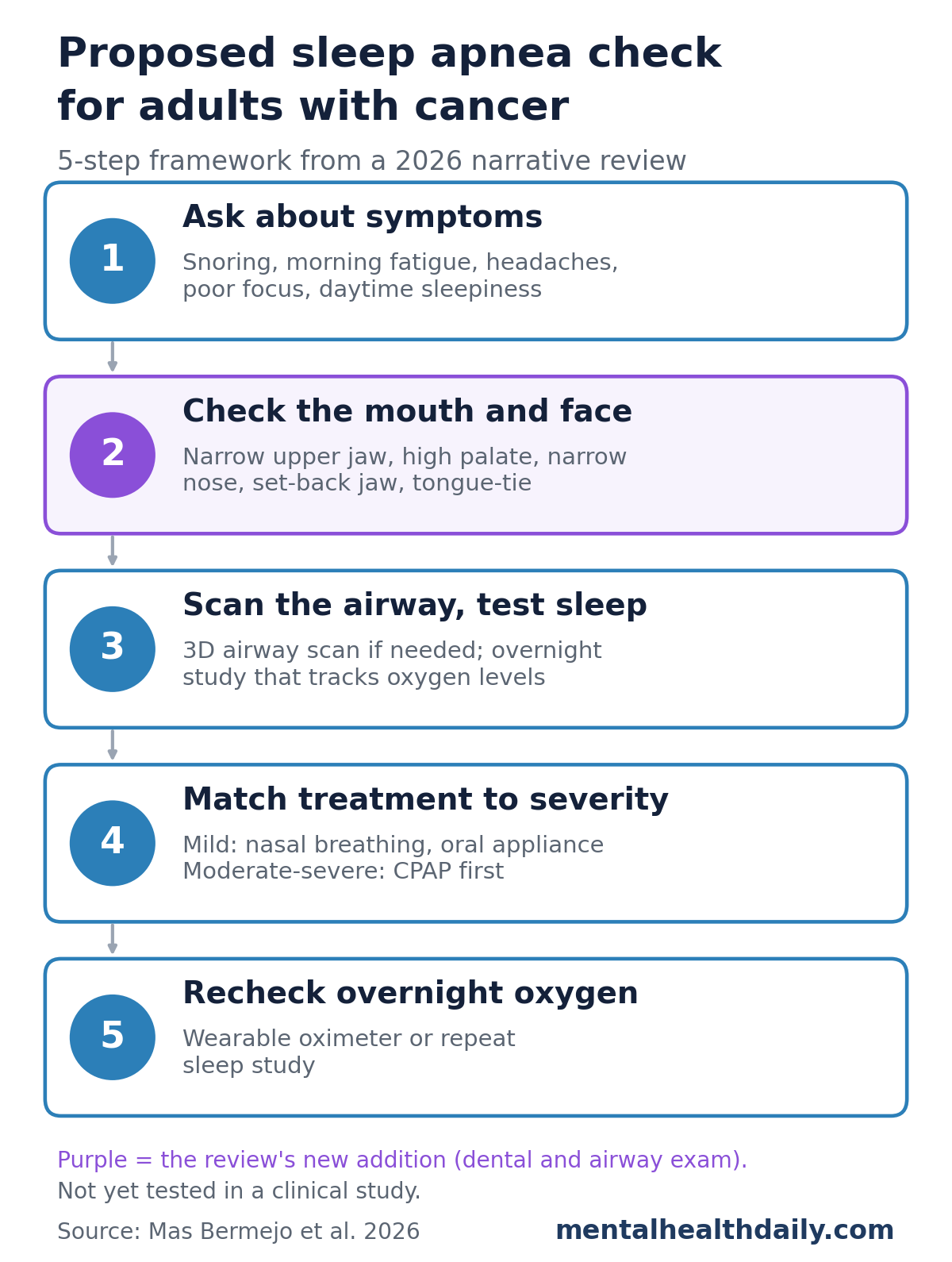
The framework is meant to sit alongside established sleep medicine guidelines and formal sleep testing, not replace them. Its steps are:1
- Screen for symptoms with standard questionnaires such as the Epworth Sleepiness Scale, STOP-BANG (a short sleep apnea risk checklist) and the Pittsburgh Sleep Quality Index.
- Examine the mouth, jaws and face for features linked to a narrow airway.
- Image the airway and test sleep: a 3D dental CT scan (cone-beam CT) when clinically indicated, plus an overnight sleep study that tracks oxygen patterns and hypoxic burden as well as the AHI.
- Match treatment to severity, oxygen loss and the person’s anatomy.
- Recheck overnight oxygen with a wearable oximeter or a repeat sleep study to confirm treatment is working.
What the Dental Exam Looks For
Dentists and orthodontists see the mouth up close, which puts them in a good position to spot anatomy that can crowd the airway. The review asks examiners to check jaw development, palate shape, nasal breathing, jaw position, tongue posture and bite.1
The features it flags as warning signs:
- Narrow upper jaw (maxillary constriction), often with a high-arched palate
- Narrow nasal passages that push a person toward mouth breathing
- Set-back lower jaw (retrognathia), which leaves less room behind the tongue
- Tongue-tie (ankyloglossia), a short band under the tongue that can affect tongue posture
According to the review, these features can raise airway resistance, encourage mouth breathing and fragment sleep. The researchers say they often see such features in adults with cancer across tumor types. They describe this observation as hypothesis-generating; it has not been measured in a study.1
Treatment Options the Review Describes
The review groups treatment by severity and hypoxic burden:1
- Milder disease, less oxygen loss: improving nasal breathing (including nasal dilators), breathing and tongue-posture exercises, sleeping off the back, and a mandibular advancement device, a mouthguard-like appliance that holds the lower jaw forward to widen the airway.
- Moderate-to-severe disease or substantial oxygen loss: CPAP as first-line treatment.
- Clear structural blockage: referral to an ear, nose and throat specialist, and in selected cases orthodontic or jaw surgery options.
The review does not test whether any of them changes fatigue, thinking or mood in people with cancer.
The review also discusses research linking intermittent low oxygen to cancer biology. It states plainly that a causal link between sleep apnea and cancer development or progression has not been established.1
Limitations
- Narrative review: the researchers chose the literature themselves rather than searching it systematically, so selection bias cannot be ruled out.
- Untested framework: no study has yet checked whether the 5 steps find more sleep apnea or improve outcomes.
- Clinical impressions: the claim that airway-crowding anatomy is common in cancer patients comes from the authors’ practice, not measured data.
- No agreed oxygen thresholds: there is still no standard definition of clinically meaningful nocturnal hypoxia or a validated hypoxic-burden cutoff.
- Loose citations: a few treatment statements in the review are followed by references on unrelated topics, such as cancer cell biology papers cited for nasal breathing therapy.
- Dental perspective: the authors are dental clinicians, and one figure shows a branded commercial nasal dilator. They declared no conflicts of interest.
What This Means for People With Cancer
Loud snoring, gasping at night, morning headaches or heavy daytime sleepiness are worth raising with the cancer care team, even when fatigue seems like an expected side effect. The established route to a diagnosis is an overnight sleep study, and sleep apnea has effective treatments.
A dental exam that flags a narrow jaw or nasal airway may add a useful clue, especially for someone who already sees a dentist regularly. Whether building that exam into cancer care finds more sleep apnea, or eases fatigue, focus and mood problems, is the question the next studies need to answer.
References
- Mas Bermejo C, Mas Gómez C, Bravo-González LA. Sleep-disordered breathing and nocturnal hypoxia in cancer patients: a stomatological and airway assessment framework. Nature and Science of Sleep. 2026;18:629732. doi:10.2147/NSS.S629732
- Al Maqbali M, Al Sinani M, Alsayed A, Gleason AM. Prevalence of sleep disturbance in patients with cancer: a systematic review and meta-analysis. Clinical Nursing Research. 2022;31(6):1107–1123. doi:10.1177/10547738221092146
- Cabezas E, Pérez-Warnisher MT, Troncoso MF, et al. Sleep disordered breathing is highly prevalent in patients with lung cancer: results of the Sleep Apnea in Lung Cancer study. Respiration. 2019;97(2):119–124. doi:10.1159/000492273
- Zheng D, Xu Y, You S, et al. Effects of continuous positive airway pressure on depression and anxiety symptoms in patients with obstructive sleep apnea: results from the Sleep Apnea cardioVascular Endpoint randomized trial and meta-analysis. EClinicalMedicine. 2019. doi:10.1016/j.eclinm.2019.05.012