Nearly 1 in 5 people with COPD in Lithuania had a recorded diagnosis of anxiety or depression, according to a nationwide study of 64,246 patients. Anxiety was far more common than depression, and most patients who received medication were prescribed benzodiazepines.1
Research Highlights
- 18.1% had a recorded diagnosis: 11,608 of 64,246 adults with COPD in Lithuanian outpatient records from 2020 to 2024 had an anxiety or depressive disorder on file.1
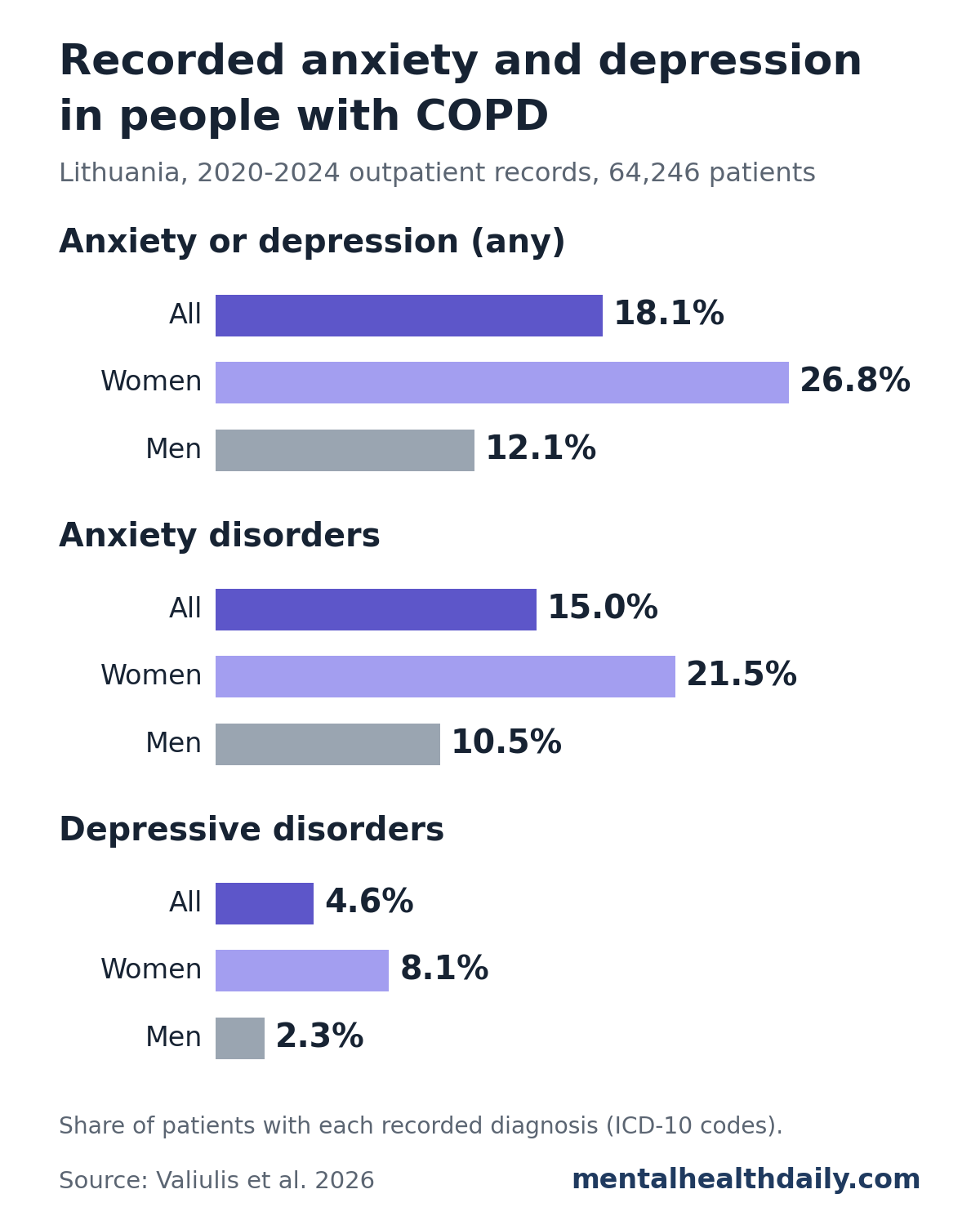
- Anxiety led: anxiety disorders were recorded in 15.0% of patients and depressive disorders in 4.6%.1
- Women were more affected: 26.8% of women vs. 12.1% of men had a recorded diagnosis (adjusted odds ratio 2.40).1
- Benzodiazepines dominated treatment: of 7,190 treated patients, 85.0% received a benzodiazepine, and family physicians wrote most of the prescriptions.1
- Records likely undercount: studies that screen patients with questionnaires find depression in about 27% of people with COPD and anxiety disorders in about 36% of older patients.23
How the Lithuanian COPD Study Worked
Chronic obstructive pulmonary disease (COPD) is a long-term lung disease, usually caused by smoking or other inhaled irritants, that narrows the airways and makes breathing harder. Breathlessness, coughing, and limits on daily activity make it a disease that weighs on mood as well as the lungs.
Tadas Valiulis and colleagues at Vilnius University used anonymized outpatient records from the Lithuanian State Data Agency covering January 2020 through December 2024. They found 64,246 unique adults with a COPD diagnosis: 38,063 men and 26,183 women.1
Mental health conditions were counted from diagnosis codes in the International Classification of Diseases (ICD-10):
- Anxiety disorders: code F41, which includes panic disorder and generalized anxiety disorder
- Depressive disorders: codes F32 (depressive episode) and F33 (recurrent depressive disorder)
The team also looked at psychotropic prescriptions and whether a family physician or a psychiatrist wrote them. The study was published in September 2026 in the International Journal of Chronic Obstructive Pulmonary Disease.1
Anxiety Was Recorded More Than 3 Times as Often as Depression
Of the 64,246 patients, 11,608 (18.1%) had at least one recorded anxiety or depressive diagnosis. Anxiety disorders accounted for most of them:1
- Anxiety disorders: 9,615 patients (15.0%)
- Depressive disorders: 2,983 patients (4.6%)
- Both: 990 patients, or 8.5% of those with any diagnosis
Earlier Lithuanian data from 2012 to 2014 showed the opposite order, with depression more common than anxiety. The authors suggest that social stress during the COVID-19 pandemic and the war in neighboring Ukraine, along with changes in access to care, may have contributed to the shift. The study design cannot test that.1
Recorded diagnoses rose until 2022 and then fell in 2023 and 2024. Neither anxiety (P for trend = 0.284) nor depression (P for trend = 0.238) showed a significant straight-line trend over the 5 years. Older age carried slightly higher odds of a diagnosis (adjusted odds ratio 1.015 per year of age).1
Women With COPD Had More Than Twice the Odds of a Diagnosis
Women made up 41% of the COPD patients but 60% of those with a psychiatric diagnosis. After adjusting for age and calendar year, women had 2.40 times the odds of any recorded anxiety or depressive disorder (95% CI 2.32 to 2.48) and 3.53 times the odds of a depressive disorder (95% CI 3.36 to 3.72).1
- Anxiety: 21.5% of women vs. 10.5% of men
- Depression: 8.1% of women vs. 2.3% of men
The authors point to differences in how symptoms show up, who seeks help, and how doctors diagnose. Women are more likely to report mood symptoms and seek mental health care, while distress in men may go unrecognized unless it comes with physical complaints. Some of the gap may therefore reflect who gets diagnosed rather than who is struggling.1
Why the Real Numbers Are Probably Higher
An 18.1% rate is above the roughly 12.5% the authors cite for the general Lithuanian population, but that comparison draws on a separate national report rather than a matched control group.1 The bigger point is that a diagnosis code only appears when a clinician recognizes the problem and records it.
Studies that screen people with COPD directly find much higher rates:
- Depression: a meta-analysis of 8 controlled studies (5,552 people with COPD and 5,211 controls) found depression on validated screening tools in 27.1% of people with COPD vs. 10.0% of controls, an odds ratio of 3.74.2
- Anxiety: a 2025 meta-analysis of 11 studies covering 136,608 patients aged 60 and older found anxiety disorders in 36% of older people with COPD, with wide variation depending on how anxiety was measured.3
Against those figures, 4.6% recorded depression looks especially low. Breathlessness, fatigue, poor sleep, and low energy belong to both COPD and depression, which makes depression easy to miss in a lung clinic. A racing heart and air hunger can be read as either a COPD flare or a panic attack.
Benzodiazepines Made Up Most of the Treatment
Of the 11,608 patients with a diagnosis, 7,190 (61.9%) received a psychotropic prescription. That share rose from 50.4% in 2020 to 61.4% in 2024. Among the 7,190 treated patients:1
- Anxiolytics (anti-anxiety drugs): 89.9%
- Benzodiazepines (sedatives such as diazepam and alprazolam): 85.0%
- Antidepressants: 37.0%
- Neuroleptics (antipsychotics): 25.6%
Who prescribed. Family physicians prescribed to 82.5% of treated patients and psychiatrists to 32.4%, with some patients seeing both. Family physicians had 10.66 times the odds of prescribing an anxiolytic and 9.85 times the odds of prescribing a benzodiazepine. Psychiatrists were more likely to prescribe antidepressants (2.75 times the odds) and neuroleptics (2.10 times).1
Trends. Among everyone with a diagnosis, benzodiazepine prescribing rose from 40.0% in 2020 to 46.0% in 2024, and antidepressant prescribing rose from 15.3% to 22.7%. Psychiatrist involvement grew slightly each year as well (adjusted odds ratio 1.04 per year).1
Why it matters in COPD. Benzodiazepines can slow breathing, a concern for people whose lungs are already struggling.
In an Ontario study of adults aged 66 and older with COPD, new benzodiazepine users had 45% higher risk of respiratory flare-ups treated as outpatients and 92% higher risk of emergency room visits for COPD or pneumonia than non-users. Their risk of hospitalization was not significantly higher.4
The Lithuanian data cannot say why each benzodiazepine was prescribed. Some prescriptions may have been for sleep or other reasons, and dose and duration were not reported.1
Limitations
- Recorded diagnoses only. The study counts diagnosis codes, not people screened for symptoms, so it likely underestimates true prevalence.
- Outpatient records only. Hospital diagnoses and prescriptions were missing, which could leave out the sickest patients.
- Unknown prescribing reasons. Prescriptions were counted regardless of when they were written relative to the diagnosis or what they were for.
- Missing clinical details. COPD severity, lung function, flare-ups, smoking, oxygen use, and income were not available for adjustment.
- No COPD-free comparison group. The study describes how common these diagnoses were; it cannot show that COPD caused them.
- One country. Lithuanian prescribing habits and its 2021 benzodiazepine rules may not match other health systems.
What This Means for People With COPD
- Anxiety and depression are common in COPD. Records found them in about 1 in 5 Lithuanian patients, and screening studies suggest the true share is higher still.123
- Men may be underdiagnosed. Their recorded rates were less than half those of women.
- Benzodiazepine use deserves a careful look. People with COPD who take a benzodiazepine can ask their doctor whether it is still the right choice. Stopping suddenly can cause withdrawal, so any change should be planned with the prescriber.
References
- Valiulis T, Gauronskaitė R, Zablockis R, Danila E. Depression and anxiety among patients with COPD: a nationwide study from Lithuania. International Journal of Chronic Obstructive Pulmonary Disease. 2026;21:606943. doi:10.2147/COPD.S606943
- Matte DL, Pizzichini MMM, Hoepers ATC, et al. Prevalence of depression in COPD: a systematic review and meta-analysis of controlled studies. Respiratory Medicine. 2016;117:154–161. doi:10.1016/j.rmed.2016.06.006
- Sulaimanova G, Talapbek kyzy S. The prevalence of anxiety disorders among older patients with COPD: systematic review and meta-analysis. Geriatric Nursing. 2025;64:103405. doi:10.1016/j.gerinurse.2025.103405
- Vozoris NT, Fischer HD, Wang X, et al. Benzodiazepine drug use and adverse respiratory outcomes among older adults with COPD. European Respiratory Journal. 2014. doi:10.1183/09031936.00008014