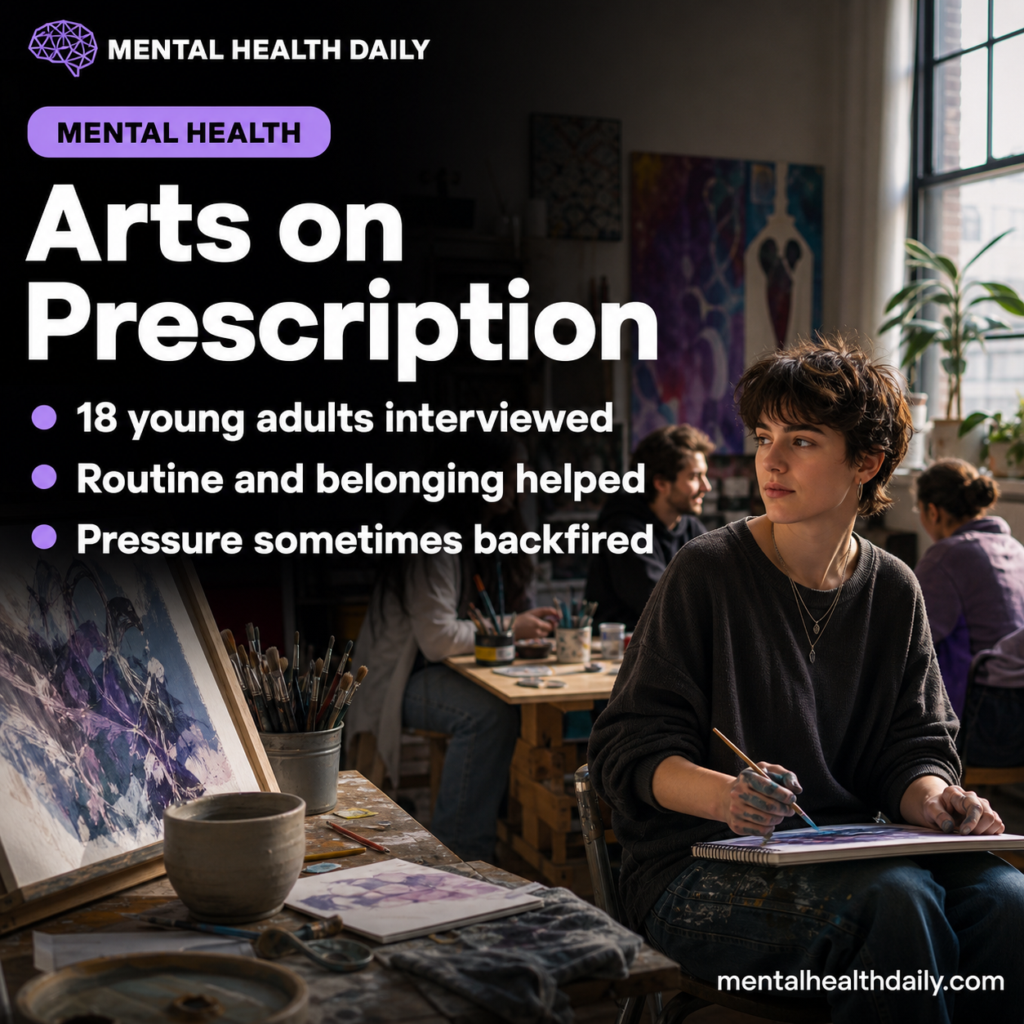
A 2026 qualitative study of a 10-week Danish Arts on Prescription program found that young adults aged 18 to 30 often described more stable daily routine, confidence, and belonging, but some activities also caused stress, fatigue, or discomfort.1 The useful interpretation is structured creative groups may help some disconnected young adults rebuild daily life when the program is flexible enough to avoid overwhelming them.
Research Highlights
- Small qualitative sample: 18 young adults joined 4 focus-group interviews and 4 more completed surveys after a 10-week Arts on Prescription program.1
- Transition support was central: participants were 18 to 30, unemployed or disengaged from education, and often reported anxiety, depression, stress, chronic pain, ADHD, or autism.1
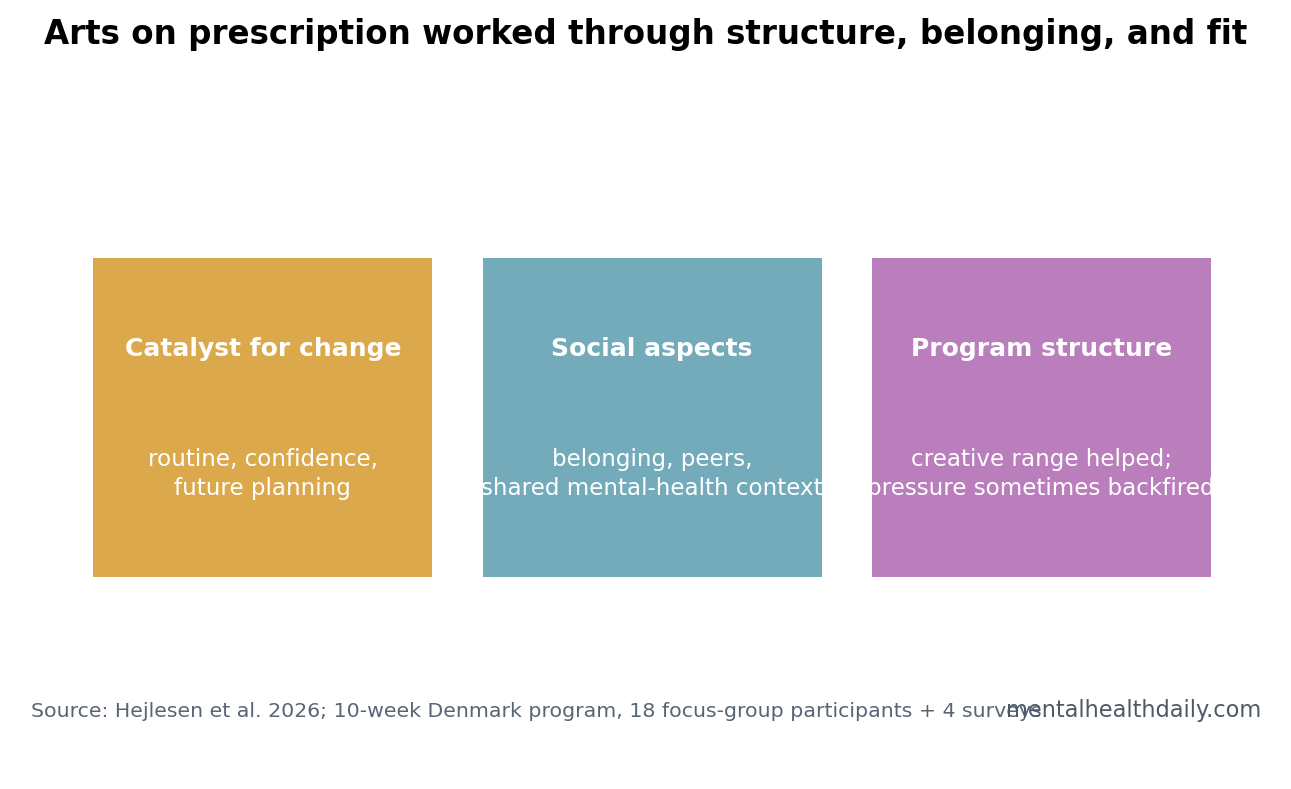
- 3 themes organized the benefits: catalyst for change, social aspects, and program content and structure captured the main participant accounts.1
- Pressure sometimes backfired: theater, performance, and attendance demands could produce stress, fatigue, discomfort, or exclusion for some participants.1
- Evidence is experiential, not efficacy-grade: the study had no randomized comparator and cannot estimate symptom reduction for depression or anxiety.1
Arts on Prescription is a social-prescribing model in which health or social-service professionals refer people to structured creative activities such as visual art, music, literature, drama, or museum-based programs. The clinical logic is indirect: creative participation may rebuild routine, social contact, agency, and identity.
Hejlesen et al. studied “Culture Vitamins for Young Adults,” a Denmark program for young adults who were out of work or education. Groups could include up to 15 participants, and sessions ran across 10 weeks with professional arts facilitators and an Arts on Prescription coordinator.1
The Main Effect Was Routine and Belonging, Not a Symptom Endpoint
The strongest participant accounts were about structure. Young adults described having somewhere to be, someone expecting them, and a reason to leave home. For people whose depression, anxiety, stress, ADHD, autism, chronic pain, or social isolation had disrupted school and work, routine itself was part of the intervention.
That mechanism fits emerging-adulthood risk. Ages 18 to 30 often involve school-to-work transitions, identity formation, housing changes, and unstable support. When mental-health symptoms interrupt those transitions, social withdrawal can become self-reinforcing.
The study’s 3 themes captured that process: catalyst for change, social aspects, and program content and structure. Participants described feeling more confident, making plans for school or work, and experiencing a group where they did not have to explain their mental-health problems from scratch.1
Peer Context Was Therapeutic but Also Fragile
Social connection is the strongest plausible mechanism. The program created repeated contact with peers who had overlapping difficulties. That can reduce shame and make activity feel safer than ordinary education or job programs.
The social-cure literature argues that groups can support health when they create identity, belonging, and practical support.4 Hejlesen et al.’s findings fit that model. Participants valued being around others who understood anxiety, depression, stress, neurodevelopmental conditions, or chronic pain without requiring a long explanation.
Group dynamics can also harm. When attendance dropped or participants felt left out, the group could become another source of exclusion. When activities required performance, quick participation, or exposure in front of others, some participants felt stress rather than relief.
Creative Freedom Helped Only When Demands Stayed Flexible
The program included different creative formats rather than a single therapy manual. That variety helped because participants could discover which activities felt restorative, interesting, or manageable. A person who struggles with direct social conversation may still engage through making, listening, reading, or shared attention.
Flexibility was also the safety mechanism. The paper described “freedom without pressure” as valuable. When activities became too demanding, the same program elements could produce fatigue or discomfort. That is a serious implementation lesson, not a minor preference.
- Helpful structure: predictable sessions, welcoming facilitators, and low-pressure participation.
- Risky structure: performance demands, unclear expectations, weak content warnings, and abrupt endings.
- Needed support: referral pathways, accommodation for ADHD/autism/chronic pain, and follow-up after the 10-week cycle.
Systematic Reviews Support Promise, Not Certainty
Arts-on-prescription evidence is broader than this single Denmark study. Jensen et al. reviewed arts-on-prescription research and found wellbeing benefits, but the literature remains heterogeneous in program design, outcomes, and evaluation quality.2 Creative arts therapy reviews in emerging adults also point to promise with methodological limits.3
That broader context matters because qualitative enthusiasm can be overread. A focus-group quote can identify a mechanism, but it cannot estimate effect size. A participant saying “my depression decreased” is meaningful as lived experience; it is not the same as a blinded PHQ-9 treatment effect.
Evidence-strength note: this was a small qualitative program evaluation. It can show how participants experienced Arts on Prescription, what helped, what strained them, and where implementation failed. It cannot show that the program treats depression, anxiety, ADHD, autism, chronic pain, or unemployment.
Young Adults Need a Soft Landing After the Program
The end of the program was not a detail. Several participants wanted more follow-up and clearer support for what happened after the 10-week cycle. For young adults already disconnected from school or work, a successful group can create a new dependency on structure. Ending it abruptly can reopen the same isolation it helped reduce.
A stronger implementation model would connect Arts on Prescription to next steps: education support, supported employment, peer groups, disability accommodations, mental-health care, or low-pressure community activities. The art program can be a bridge, but a bridge has to land somewhere.
That is where the Denmark study is most useful. It does not prove creative activity as treatment. It shows how a structured social arts program can create momentum, and how easily that momentum can be lost when pressure, access barriers, or follow-up gaps are ignored.
Referral Pathways Decide Who Actually Benefits
Matching problem: social prescribing often sounds simple: refer people to community activity. The hard part is matching the activity to the person’s symptoms, disabilities, energy, social fear, transportation, and current life demands.
- Severe social anxiety: lower-pressure entry and no forced performance.
- Chronic pain: pacing, breaks, and exit options.
- ADHD or autism: clearer structure and sensory predictability.
The Danish program’s open, inclusive design was a strength, but inclusion without accommodation can become accidental pressure. Participants valued freedom, yet some also described discomfort when activities pushed them too fast. The practical lesson is to treat arts-on-prescription referral as a supported transition, not a handoff.
A stronger model would screen for practical barriers before referral, adjust activity demands during the program, and plan the next step before the final session. That turns the creative group from an isolated positive experience into part of a longer recovery pathway.
Measurement problem: a narrow depression score may miss more stable sleep routines, increased confidence, reduced shame, more social contact, or a return to education planning.
Relying only on participant enthusiasm misses deterioration, dropout, exhaustion, and people who never felt safe enough to join. A serious evaluation would track both sides.
For young adults, the most useful endpoint may be functional movement: returning to a course, applying for work, attending a next appointment, joining a peer activity, or maintaining a weekly routine after the art program ends. Those outcomes fit the transition problem better than a simple “did art reduce symptoms?” frame.
Program evaluation should also record who declines referral, who attends 1 session and stops, and who needs extra accommodation to stay. Those missing cases are part of the evidence, because a social-prescribing program can look helpful among completers while quietly excluding the young adults with the most fatigue, fear, pain, or executive-function difficulty.
Comparator problem: the next useful study should compare Arts on Prescription with an active support condition rather than waitlist or satisfaction follow-up alone. A low-pressure peer group, supported volunteering, or ordinary vocational support could produce some of the same routine and belonging effects.
Without that comparison, the evidence cannot tell whether creative activity is the active ingredient, whether structured social contact is enough, or whether the coordinator role is doing most of the work.
Cost, transport, facilitator training, and dropout tracking should be part of that comparison, because implementation burden decides whether the program can scale.
That comparison matters for service design. If the art component is essential, programs should invest in skilled arts facilitators and multiple creative formats. If the active ingredient is predictable social routine, then cheaper non-arts community programs may work for some young adults while arts programs remain valuable for people who need expressive or nonverbal entry points.
Those endpoints also match what participants said they were trying to recover.
Questions About Arts on Prescription for Young Adults
Did the program reduce depression or anxiety scores?
No symptom-scale treatment effect can be inferred from this study. It was qualitative, with 18 focus-group participants and 4 survey respondents.
Why might arts help mental health?
The likely pathway is routine, social belonging, creative agency, and identity rebuilding. The art activity is part of a structured social environment, not a stand-alone biological treatment.
Who might struggle with this kind of program?
Young adults with high social anxiety, fatigue, chronic pain, ADHD, autism, or trauma-related discomfort may need flexible participation rules, content warnings, and nonperformance-based options.
References
- Hejlesen I, Glintborg C, Jacobsen S, Jensen A. The role of arts on prescription in supporting young adults’ mental health and life transitions. iScience. 2026;29:115463. https://doi.org/10.1016/j.isci.2026.115463
- Jensen A, Holt N, Honda S, Bungay H. The impact of arts on prescription on individual health and wellbeing: systematic review with meta-analysis. Frontiers in Public Health. 2024;12:1412306. https://doi.org/10.3389/fpubh.2024.1412306
- Smriti D, Ambulkar S, Meng Q, et al. Creative arts therapies for the mental health of emerging adults: a systematic review. The Arts in Psychotherapy. 2022;77:101861. https://doi.org/10.1016/j.aip.2021.101861
- Haslam SA, McMahon C, Cruwys T, et al. Social cure, what social cure? The propensity to underestimate the importance of social factors for health. Social Science & Medicine. 2018;198:14-21. https://doi.org/10.1016/j.socscimed.2017.12.004