A 2026 pilot trial tested a classroom program for children's climate anxiety: art projects plus guided discussion were supposed to help students express climate emotions and build coping skills. The intervention did not work better than waitlist control, but it also did not make children more anxious.
Research Highlights
- The intervention failed to separate: 46 children received the art-and-discussion program and 41 remained on a waitlist, but group x time interactions were non-significant for every measured outcome.1
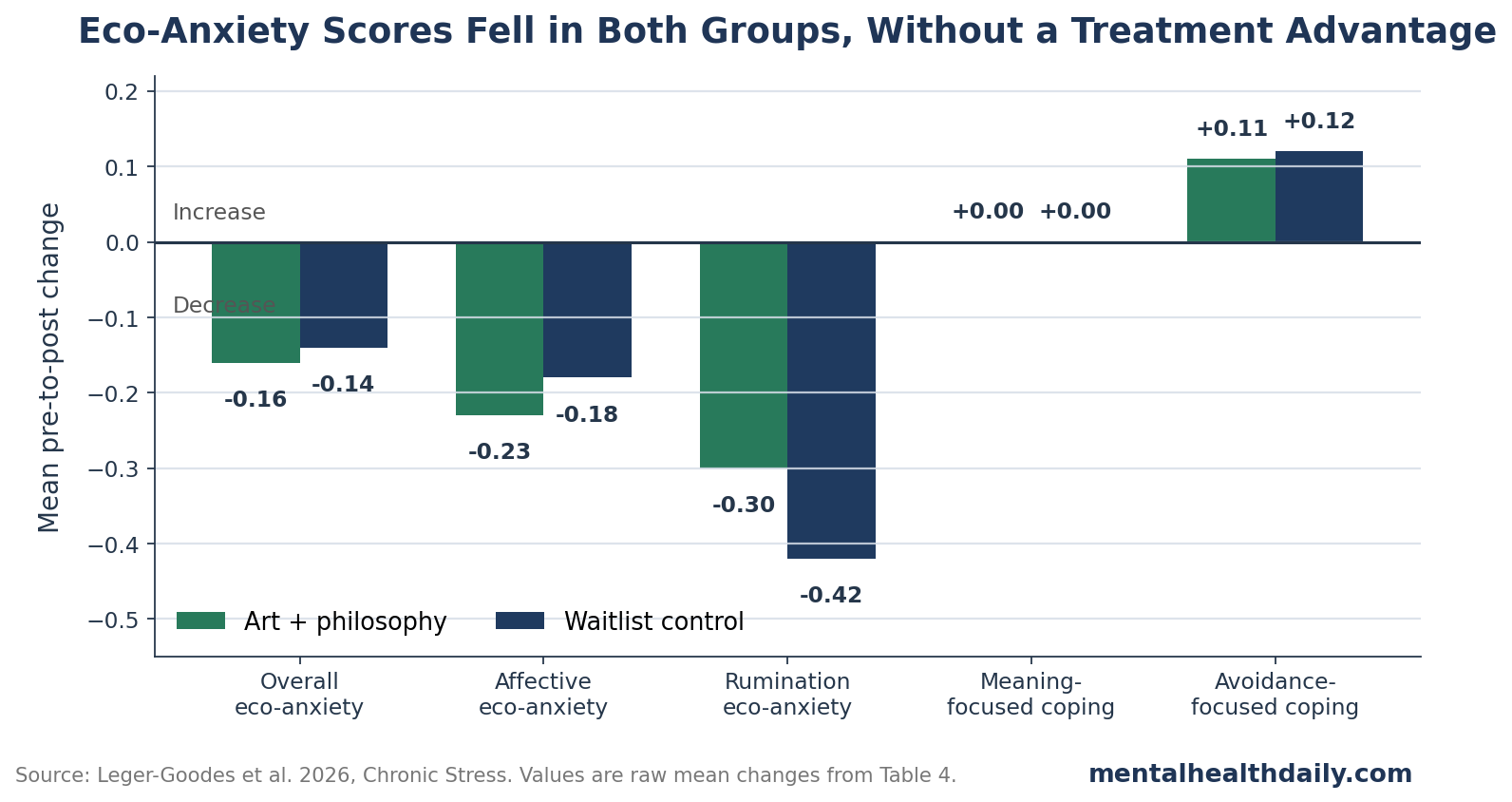
- Eco-anxiety decreased in both groups: overall eco-anxiety fell from 0.73 to 0.57 in the intervention group and from 0.66 to 0.52 in controls, so the decline cannot be attributed to the program.
- Coping did not move: meaning-focused coping stayed at 3.63 in the intervention group and 3.68 in controls, while avoidance coping rose slightly in both groups.
- Safety signal is still useful: 7 weeks of climate discussion through art, nature observation, and classroom conversation did not increase eco-anxiety, affective worry, rumination, or responsibility-related impact scores.
- Evidence strength is limited: this was a small pilot cluster trial with 4 classrooms, low baseline distress, no multilevel model, and several child-adapted scales with weak internal consistency.
Eco-anxiety means worry, distress, grief, anger, or apprehension about climate change and environmental disruption. In children, the clinically relevant question is practical: can adults help children process climate emotions without either minimizing the threat or intensifying the child's distress?
The program theory was simple: children might cope better with climate worry if they could draw, photograph, sculpt, and talk through the issue in a structured classroom setting. The trial tested that idea directly. The intervention was feasible and apparently safe, but it did not outperform waitlist control on eco-anxiety, coping, or self-determination.
87 Children Completed the 7-Week Classroom Trial
Leger-Goodes et al. evaluated a creative arts and philosophical inquiry intervention in 4 elementary school classrooms in Quebec, Canada.1 The researchers randomized classrooms rather than individual students because the intervention was delivered during class.
The analytic sample included 87 children aged 9 to 12 years: 46 in the intervention classrooms and 41 in waitlist-control classrooms.
The program ran weekly from February to April 2024. Each 50-minute session combined around 30 minutes of artistic creation with around 20 minutes of group philosophical discussion. Activities included an emotion wheel drawing, a drawing of the planet in 50 years, photovoice exercises on nature and climate change, a sculpture activity about the strength of nature, a rock-drawing activity about taking care, and a final climate-change slogan poster.
The theoretical model came from self-determination theory, which argues that people function better when 3 basic psychological needs are supported:
- Autonomy: the child has meaningful choice and can act in line with personal values.
- Competence: the child feels able to understand, participate, and have some effect on the surrounding world.
- Affiliation: the child feels connected to other people rather than alone with the problem.
The researchers expected the intervention to increase meaning-focused coping, reduce avoidance coping, reduce eco-anxiety, and improve self-determination. Meaning-focused coping means making sense of a difficult reality by holding negative and positive emotions together, finding purpose, and staying psychologically engaged when the problem cannot be solved by a child alone.
Art and Philosophy Did Not Beat Waitlist Control
The main statistical result was blunt: mixed analysis of variance models found no significant group x time interaction for any outcome. A group x time interaction asks whether the intervention group changed differently from the control group. Without that interaction, a pre-to-post change cannot be credited to the intervention.
The coping measures show the issue clearly:
- Meaning-focused coping: intervention 3.63 to 3.63; control 3.68 to 3.68; group x time F = 0.006, partial η2 = 0.000.
- Avoidance-focused coping: intervention 2.29 to 2.40; control 2.16 to 2.28; group x time F = 0.096, partial η2 = 0.001.
- Problem-focused coping: intervention 3.05 to 2.97; control 2.79 to 2.63; group x time F = 0.342, partial η2 = 0.004.
Partial η2 is an effect-size statistic for analysis of variance; values around 0.01 are usually read as small, around 0.06 as moderate, and around 0.14 as large. The interaction effect sizes here were essentially zero. The program did not measurably shift the coping targets it was built to change.
This is the key calibration for readers attracted to arts-based climate-emotion programs. Art and philosophical discussion are reasonable tools for expression, reflection, and classroom engagement. This pilot trial did not show that they changed children's coping over 7 weeks.
Eco-Anxiety Improved Over Time in Both Groups
The strongest numerical movement was in eco-anxiety, but the pattern appeared in both groups. Overall eco-anxiety fell from 0.73 to 0.57 in the intervention group and from 0.66 to 0.52 in controls.
Affective eco-anxiety, meaning anxiety and worry about climate change, fell from 0.90 to 0.67 in the intervention group and from 0.77 to 0.59 in controls. Rumination eco-anxiety, meaning repetitive climate-related thinking, fell from 1.15 to 0.85 in the intervention group and from 1.20 to 0.78 in controls.
The time effects were statistically significant:
- Overall eco-anxiety: F(1, 85) = 12.106, p < .001, partial η2 = .125.
- Affective eco-anxiety: F(1, 85) = 9.902, p < .002, partial η2 = .104.
- Rumination eco-anxiety: F(1, 84) = 10.613, p = .002, partial η2 = .112.
Those are moderate time effects, but they were not treatment effects. The researchers proposed several explanations: natural fading of concern after a period of unusually warm winter weather in Quebec, media attention shifting to other topics, low baseline eco-anxiety that left little room for improvement, measurement sensitivity problems, and possible contamination because intervention and control classrooms were in the same school.
Discussing Climate Emotions Did Not Increase Distress
The safety result deserves separate attention. Teachers and parents often worry that climate education will make children more anxious.
The intervention group did not show increased overall eco-anxiety, affective eco-anxiety, rumination, impact-related eco-anxiety, general anxiety, or avoidance coping relative to controls.
That safety signal fits earlier qualitative work. A scoping review by Leger-Goodes et al. found that children's climate-change awareness can involve fear, sadness, anger, helplessness, and responsibility, but the literature was thin and heavily qualitative.2 Martin et al. similarly reviewed how climate-change awareness relates to children's mental well-being and negative emotions, emphasizing that the evidence base was still emerging rather than settled.3
The intervention literature is also young. Baudon and Jachens reviewed eco-anxiety interventions and found a field dominated by conceptual proposals, small studies, group approaches, emotional expression, and meaning-making rather than large clinical trials.4 Bingley et al. proposed that climate-anxiety interventions should target multiple psychological needs instead of treating climate worry as ordinary generalized anxiety.5
The 2026 classroom trial is useful because it adds a randomized test to a field with many plausible ideas and few controlled data points. The result supports a cautious implementation message: climate-emotion discussions can be conducted without obvious short-term harm, but adults should not assume that art and discussion alone will produce measurable coping changes.
Low Baseline Scores and Child-Adapted Scales Weaken the Test
This was a pilot trial, and its limitations are central to interpreting the null result. The study recruited 102 children, but only 87 completed both pre-test and post-test questionnaires. The researchers had estimated that 89 participants would be acceptable for a pilot after reducing the full target sample by 30%, and post hoc power fell to 67% after missing data.
The classroom structure created another constraint. With only 4 classrooms, the study could not use a multilevel model that treated classroom as a random factor. Classroom-based trials can look more certain than they are when students in the same class share teacher behavior, peer discussion, schedule, physical layout, and local school culture.
Measurement also remained unsettled. The Hogg Eco-Anxiety Scale was originally validated in adults, then adapted for children because no validated child-specific eco-anxiety scale existed when the trial began.
Several internal-consistency values were weak: rumination eco-anxiety had α = 0.646 at pre-test and α = 0.672 at post-test, while the self-determination measure had α = 0.687 at pre-test. Cronbach's α estimates how consistently items in a scale move together; low values make small changes harder to trust.
An evidence-strength note is necessary here: this pilot can show feasibility, acceptability, short-term safety signals, and rough effect-size estimates. It cannot prove that classroom climate-emotion programs are ineffective in general. A larger trial would need more schools, more clusters, better privacy during questionnaires, child-validated scales, longer follow-up, and monitoring for control-group exposure to intervention material.
Practical Use in Schools: Safe Discussion, Modest Claims
For schools, the practical result is balanced. Climate change can be discussed with children in emotionally explicit ways when the setting is structured, age-appropriate, and supportive. The trial gives no reason to treat classroom climate-emotion discussion as inherently dangerous.
Claims about benefit should stay modest. A 7-week program of drawing, photovoice, sculpture, posters, and philosophical discussion did not measurably increase meaning-focused coping or reduce avoidance compared with waitlist control. If a school uses similar activities, the defensible goals are expression, shared discussion, and teacher comfort with children's questions. Stronger claims about reducing eco-anxiety need larger trials.
Hickman et al.'s global survey of 10,000 young people aged 16 to 25 found climate anxiety and dissatisfaction with government responses across many countries, including 45% reporting that climate-related feelings negatively affected daily life.6 That finding is often cited to justify immediate intervention, but it does not identify which school activities work for younger children. Intervention evidence has to be tested directly.
The most defensible next step is structured climate education that includes emotional validation, avoids loading adult-scale responsibility onto children, and tests specific components carefully: art alone, philosophical inquiry alone, combined programs, teacher-led delivery, outside-facilitator delivery, and longer follow-up.
Questions About Eco-Anxiety in Children
Did the art-and-philosophy intervention reduce eco-anxiety?
Not more than waitlist control. Eco-anxiety scores decreased over time in both groups, but the intervention group did not improve significantly more than the control group.
Did talking about climate change make children more anxious?
No increase appeared in this trial. The intervention did not worsen eco-anxiety, general anxiety, rumination, or avoidance coping relative to controls.
Does this mean schools should avoid climate-emotion programs?
No. The result supports careful, age-appropriate discussion as feasible and apparently safe. It argues against overselling short art-and-discussion programs as proven eco-anxiety treatments.
What would make the evidence stronger?
A larger multi-school cluster trial with validated child measures, more classrooms, longer follow-up, privacy-protected questionnaires, and prespecified checks for contamination between classrooms would be more informative.
References
- Evaluating the Effectiveness of a Creative Arts and Philosophical Inquiry Intervention Rooted in Self-Determination Theory to Promote Adaptive Coping with Eco-Anxiety among Elementary School Children: A Pilot Randomized Cluster Trial. Leger-Goodes T et al. Chronic Stress. 2026;10:1-13. doi:10.1177/24705470261442334
- Eco-anxiety in children: A scoping review of the mental health impacts of the awareness of climate change. Leger-Goodes T et al. Frontiers in Psychology. 2022;13:872544. doi:10.3389/fpsyg.2022.872544
- Review: The impact of climate change awareness on children's mental well-being and negative emotions – a scoping review. Martin G et al. Child and Adolescent Mental Health. 2022;27(1):59-72. doi:10.1111/camh.12525
- A scoping review of interventions for the treatment of eco-anxiety. Baudon P, Jachens L. International Journal of Environmental Research and Public Health. 2021;18(18):9636. doi:10.3390/ijerph18189636
- A multiple needs framework for climate change anxiety interventions. Bingley WJ et al. American Psychologist. 2022;77(7):812-821. doi:10.1037/amp0001012
- Climate anxiety in children and young people and their beliefs about government responses to climate change: a global survey. Hickman C et al. Lancet Planetary Health. 2021;5(12):e863-e873. doi:10.1016/s2542-5196(21)00278-3