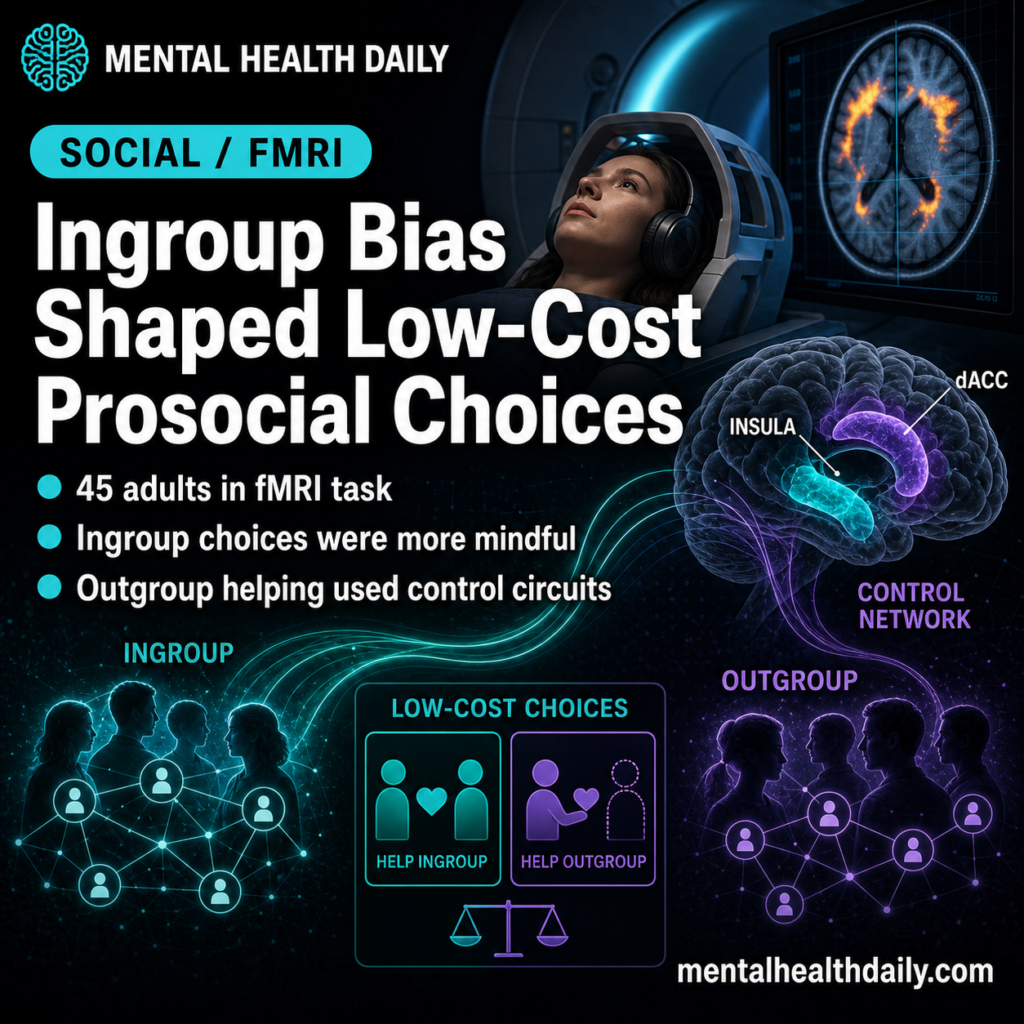
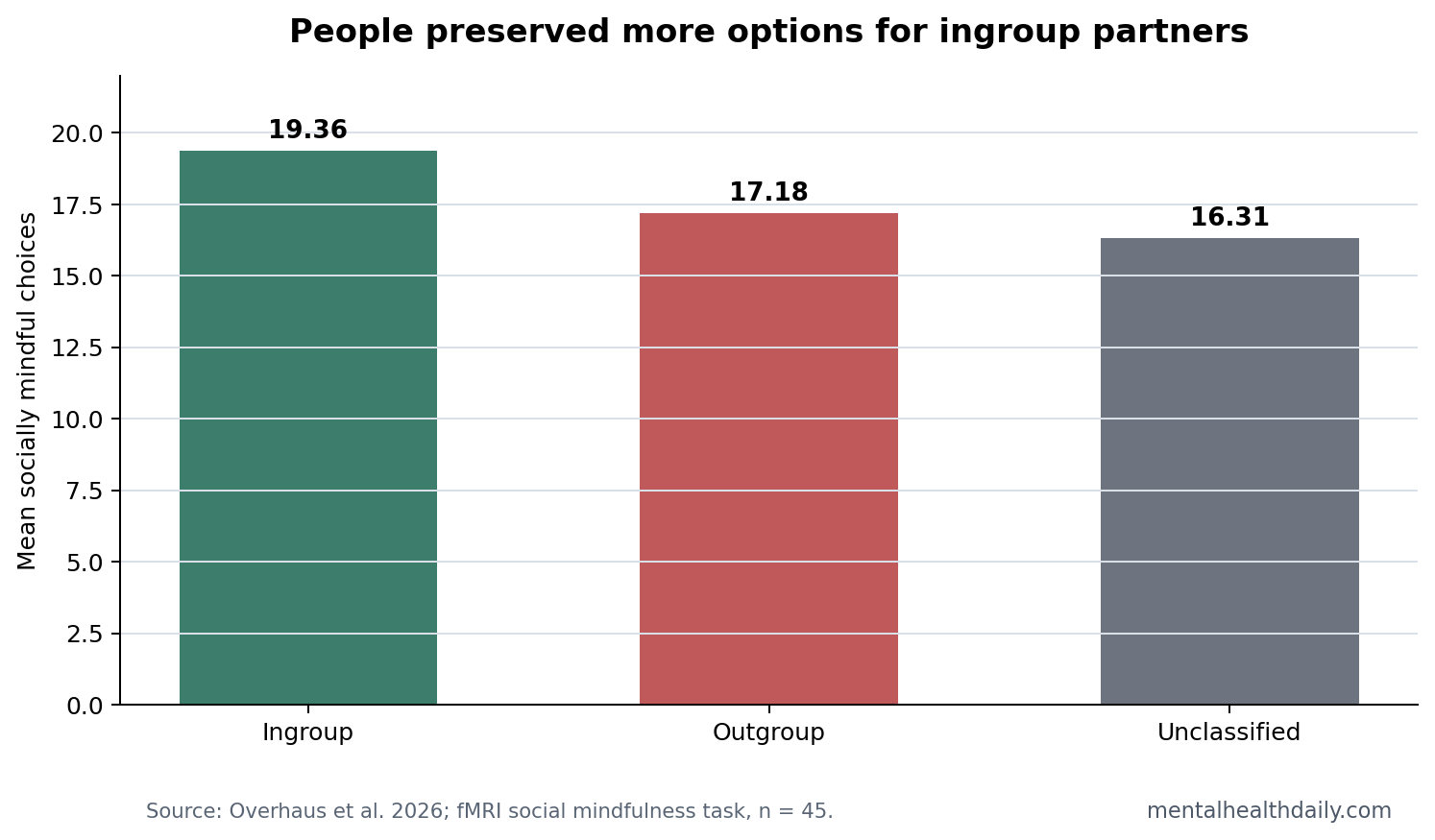
A 2026 fMRI study of 45 adults with strong pro- or anti-refugee stances found that people made more socially mindful choices for ingroup partners than for outgroup or unclassified partners, with mean socially mindful choices of 19.36 for ingroup, 17.18 for outgroup, and 16.31 for unclassified partners.1 Outgroup prosocial choices still occurred, but they recruited right anterior insula and dorsal anterior cingulate cortex signals consistent with social salience and cognitive control.
Research Highlights
- Ingroup partners received more option-preserving choices: Socially mindful choices differed by partner identity, F(2,44) = 7.76, p < .001, partial eta squared = .150.1
- Ingroup beat outgroup: Participants made more socially mindful choices for ingroup partners than outgroup partners, 19.36 vs. 17.18, p = .010, d = 0.36.1
- Ingroup also beat unclassified partners: Ingroup choices exceeded unclassified-partner choices, 19.36 vs. 16.31, p < .001, d = 0.68.1
- Outgroup helping was not absent: Outgroup socially mindful choices recruited right anterior insula vs. ingroup and dorsal anterior cingulate cortex vs. unclassified partners.1
- The ingroup mentalizing hypothesis was not confirmed: The study did not find stronger neural activity for ingroup socially mindful choices than for outgroup or unclassified choices.1
Social mindfulness is a low-cost form of prosocial behavior: choosing in a way that preserves another person’s options. In the classic task, taking one of several identical objects leaves the next person more choice than taking the only unique object.
Group identity in this study meant whether the partner shared the participant’s stance on refugee migration, held the opposing stance, or had no disclosed stance. That made the task more socially charged than an abstract lab-group manipulation.
45 Adults Completed the Social Mindfulness Task During fMRI
Overhaus et al. recruited adults with strong pro- or anti-refugee positions and analyzed data from 45 participants after exclusions for extreme response patterns, stance inconsistency, missing trials, and imaging issues. Participants completed social mindfulness trials with unclassified, ingroup, and outgroup partners while undergoing functional MRI.1
Functional MRI measures blood-oxygen-level-dependent signal, an indirect marker of local neural activity. It can show which regions are more active during a condition, but it cannot prove a single psychological process by itself.
Ingroup Favoritism Appeared in Small Everyday Choices
The behavioral result was clear. Participants made more socially mindful choices for ingroup partners than outgroup partners, p = .010, and more for ingroup partners than unclassified partners, p < .001. Outgroup and unclassified partners did not significantly differ from each other.1
This matters because the task involved low-cost courtesy rather than money, punishment, or explicit political argument. Group identity still changed how often people preserved another person’s options.
Calibrated read: the study supports ingroup favoritism in subtle prosocial behavior. It does not show that outgroup partners were never treated prosocially, and it does not show that political disagreement eliminates cooperative norms.
Outgroup Prosocial Choices Recruited Insula and dACC
Neural results were more specific than the behavioral result. Socially mindful decisions overall engaged regions linked to mentalizing, decision-making, and reward processing, including temporoparietal junction, dorsal medial prefrontal cortex, dorsolateral prefrontal cortex, middle temporal gyrus, and orbitofrontal cortex.1
When group identity was introduced, ingroup socially mindful choices did not show stronger neural activity than outgroup or unclassified choices. Instead, outgroup socially mindful choices elicited more right anterior insula activity than ingroup choices and more dorsal anterior cingulate cortex activity than unclassified choices.
- Anterior insula: often involved in salience, bodily feeling, and emotionally significant social situations.
- Dorsal anterior cingulate cortex: often involved in conflict monitoring and cognitive control when a decision requires more effort.
- Interpretation: preserving an outgroup member’s options may require more salience processing and norm-aligned control than doing the same for an ingroup member.
The Result Extends the Social Mindfulness Literature
Earlier social mindfulness work showed that people preserve more options for teammates than rivals, even when material stakes are minimal.2 Prior neuroimaging work without disclosed group identity linked socially mindful choices to mentalizing, control, and reward networks.3
The Overhaus study connects those lines: real-world ideological identity shaped the behavior, while outgroup prosocial choices appeared to require additional salience and control processing. That is different from saying the brain contains a simple “ingroup kindness” module.
Partner Ratings Confirmed the Identity Manipulation Worked
Participants did not treat all partners as socially equivalent. They liked ingroup partners more than outgroup partners, with a main effect of group identity on liking, F(2,44) = 13.52, p < .001. They also felt more connected to ingroup partners than outgroup partners, F(2,44) = 10.80, p < .001, and more similar to ingroup partners than outgroup partners, F(1.72,44) = 14.05, p < .001.1
Those manipulation checks keep the behavioral result interpretable. The task gave participants socially meaningful partner identities rather than arbitrary A/B labels. Participants reported different liking, connectedness, and similarity depending on whether the partner shared or opposed their refugee-policy stance.
Unclassified partners: the unclassified condition separates outgroup tension from absence of shared identity. Ingroup partners received more socially mindful choices than unclassified partners, while outgroup and unclassified partners did not significantly differ. The ingroup boost may therefore be stronger than active outgroup punishment in this task.
What This fMRI Study Can and Cannot Support
Supported: in this young adult sample, refugee-policy group identity changed low-cost prosocial choices, and outgroup socially mindful choices recruited anterior insula and dACC more than comparison conditions.
Not supported: claims about all political behavior, costly helping, prejudice reduction, charitable giving, or real-world refugee decisions. The task used hypothetical object choices inside a scanner, not actual policy tradeoffs.
Best next test: future studies should compare low-cost option preservation with costly helping, test other political identities, and measure whether interventions that increase cross-group contact reduce the extra control load for outgroup prosocial choices.
The Scanner Task Was Low Stakes by Design
Low stakes are a strength and a limitation. They make the result cleaner because the cost of being socially mindful is small: leave the other person a choice. That simplicity helps isolate subtle prosocial orientation. The same simplicity also limits inference about situations where helping an outgroup member costs money, status, safety, or group approval.
Everyday relevance: many intergroup frictions are low-cost moments: who gets the last option, who is given room to choose, who is treated with default consideration. The study suggests group identity can enter those small decisions even without explicit conflict.
Boundary condition: a person can preserve an outgroup member’s options in a scanner and still oppose that group’s policy goals in the real world. Social mindfulness captures one behavioral layer, not the whole political psychology of immigration attitudes.
Why Ingroup Boost Is Different From Outgroup Hostility
The behavioral pattern is more precise than a simple hostility story. Ingroup partners received the most socially mindful choices. Outgroup partners did not significantly differ from unclassified partners. That means the main behavioral signal may be preferential extra consideration for people who share one’s stance, rather than a large penalty applied to people who oppose it.
Norm-following interpretation: participants still preserved outgroup partners’ options often enough to analyze outgroup socially mindful trials in the scanner. The neural result then suggests those choices may have required more control or felt more socially salient.
Social design implication: interventions aimed at reducing intergroup friction may need 2 goals: reduce active hostility and make basic courtesy less effortful across group boundaries. The fMRI pattern points more directly to the second goal.
That is why low-cost tasks are useful. They reveal small frictions before behavior escalates into explicit punishment, exclusion, or policy conflict. A society can lose a lot of trust through repeated tiny failures to preserve another person’s options.
Measurement implication: future experiments should separate 3 behaviors that often get collapsed: extra help for ingroup partners, ordinary courtesy toward neutral strangers, and active withholding from outgroup partners. Those are different social processes with different intervention targets.
That separation would also make the neural interpretation cleaner. Control-related activation during outgroup courtesy may mean effortful norm-following, but active punishment would likely involve a different motivational profile.
A stronger translational study would pair the scanner task with real choices, such as sharing time, money, information, or access to a preferred option. That would show whether low-cost social mindfulness predicts behavior when the consequence is outside the experiment.
It should also test whether the same person shows ingroup preference across different issues. Refugee-policy identity may behave differently from party identity, religion, sports allegiance, or local community conflict.
Questions About Social Mindfulness and Group Identity
Is social mindfulness the same as generosity?
No. It is narrower. The task measures whether a person preserves someone else’s choice options at little cost, not whether they give money or sacrifice a major resource.
Did outgroup partners get punished?
No. The study found fewer socially mindful choices for outgroup than ingroup partners, but outgroup prosocial choices still happened and carried a distinct neural signature.
Can fMRI prove why people made those choices?
No. fMRI supports a circuit-level interpretation, but the psychological explanation still depends on task design, behavior, and converging evidence from prior studies.
References
- Overhaus MMA, van Buuren M, van Lange PAM, Krabbendam L. Mindful minds: How group identity shapes brain and behavior in social decision-making. Cognitive, Affective, & Behavioral Neuroscience. 2026. doi:10.3758/s13415-026-01425-1
- Van Doesum NJ, Van Lange DAW, Van Lange PAM. Social mindfulness: Skill and will to navigate the social world. PubMed
- Lemmers-Jansen ILJ, et al. Neural correlates of social mindfulness. PubMed
- Rilling JK, et al. A neural basis for social cooperation. PubMed