A 2026 TwinLife analysis found that cognitive ability at age 23 predicted education and occupational status at age 27, and bivariate twin models attributed 69-98% of the shared IQ–SES variance to genetic factors rather than unique environment.1 The calibrated reading is narrow but important: the finding argues against treating cognition, schooling, and occupation as purely environmental variables, while still leaving room for education, policy, and individual life events.
Research Highlights
- Genetic overlap dominated the IQ–SES link: In 4 Cholesky models, genetic factors explained 69% and 81% of the IQ association with education measures and 98% of the IQ association with both occupational measures.1
- The observed correlations were moderate, not all-powerful: IQ at age 23 correlated with education level at r = 0.34, education Casmin at r = 0.43, occupational prestige at r = 0.27, and occupational SES at r = 0.31, all p < .001.1
- Heritability was high inside this sample: AE twin models estimated IQ heritability at 75%, education heritability at 49% and 66%, and occupational heritability at 32% and 71%.1
- Education still carried environmental signal: Unique environment accounted for 31% and 19% of the shared IQ–education variance, while the occupational models left only 2% to unique environment.1
- Policy fatalism would overread the result: A 2018 meta-analysis of 42 education datasets found that another year of schooling raised measured cognitive ability by about 1-5 IQ points, showing that environmental leverage can coexist with heritability.6
Cognitive ability means performance on reasoning, problem-solving, and related mental tests. In this analysis, Kajonius used the CFT-20-R, a 56-item fluid-reasoning test that includes figural reasoning, classification, matrices, and reasoning tasks.1
Socioeconomic status (SES) means social and economic position. The study measured it 4 ways: 2 education scales and 2 occupation scales. The analysis asked how much of the observed link between cognitive ability and later education or occupation looked genetic vs. environmental in a young-adult twin panel.
German TwinLife Data Linked IQ at 23 to SES at 27
The study used the German TwinLife project, a longitudinal twin-family panel designed to study social inequality across the life course. Kajonius analyzed young adults older than 20 and younger than 30 at baseline, with cognitive ability measured at a mean age of 23.1 years and SES outcomes measured at a mean age of 27.2 years.
The full analytic pool included 880 people after pairwise deletion, with 228 monozygotic twin pairs and 212 same-sex dizygotic twin pairs.1
Monozygotic twins share essentially all of their segregating genes. Dizygotic twins share, on average, about half. Twin models use that difference to estimate how much variation in a trait is associated with additive genetics, shared family environment, and unique environment.
The education outcomes were measured with ISCED and Casmin scales, both mapped to a 0-10 range. Occupational prestige used the SIOPS scale from 0-100. Occupational socioeconomic status used the European Socio-Economic Classification, an ordinal 1-9 measure of labor-market position and autonomy.
Zero-order correlations set the baseline. IQ at 23 predicted all 4 SES outcomes at 27: r = 0.34 for education level, r = 0.43 for education Casmin, r = 0.27 for occupational prestige, and r = 0.31 for occupational SES.1 Those are meaningful individual-differences correlations, but they are not destiny. Even the largest correlation leaves most person-to-person variation unexplained.
69-98% of the Shared IQ–SES Variance Was Genetic in the Twin Models
Heritability is the share of observed variation in a trait, inside a particular population and environment, statistically attributed to genetic differences. It is not the percentage of a person’s outcome caused by genes, and it does not say an outcome cannot change.
Kajonius first fit univariate twin models. The more parsimonious AE models estimated 75% heritability for IQ, 49% and 66% for the 2 education measures, and 32% and 71% for the 2 occupation measures.1 Shared family environment looked weaker after model comparison, although one occupational model favored retaining common environment.
The central test was bivariate: IQ at 23 predicting SES at 27. Bivariate Cholesky modeling is a twin-modeling approach that partitions the covariance between 2 traits into genetic and environmental components. In plain English, it asks whether the same genetic or environmental differences that predict IQ also predict later education or occupational status.
The 4 outcome models showed a consistent direction:
- Education level: 69% of the shared IQ–SES variance was genetic; 31% was unique environmental.
- Education Casmin: 81% was genetic; 19% was unique environmental.
- Occupational prestige: 98% was genetic; 2% was unique environmental.
- Occupational SES: 98% was genetic; 2% was unique environmental.
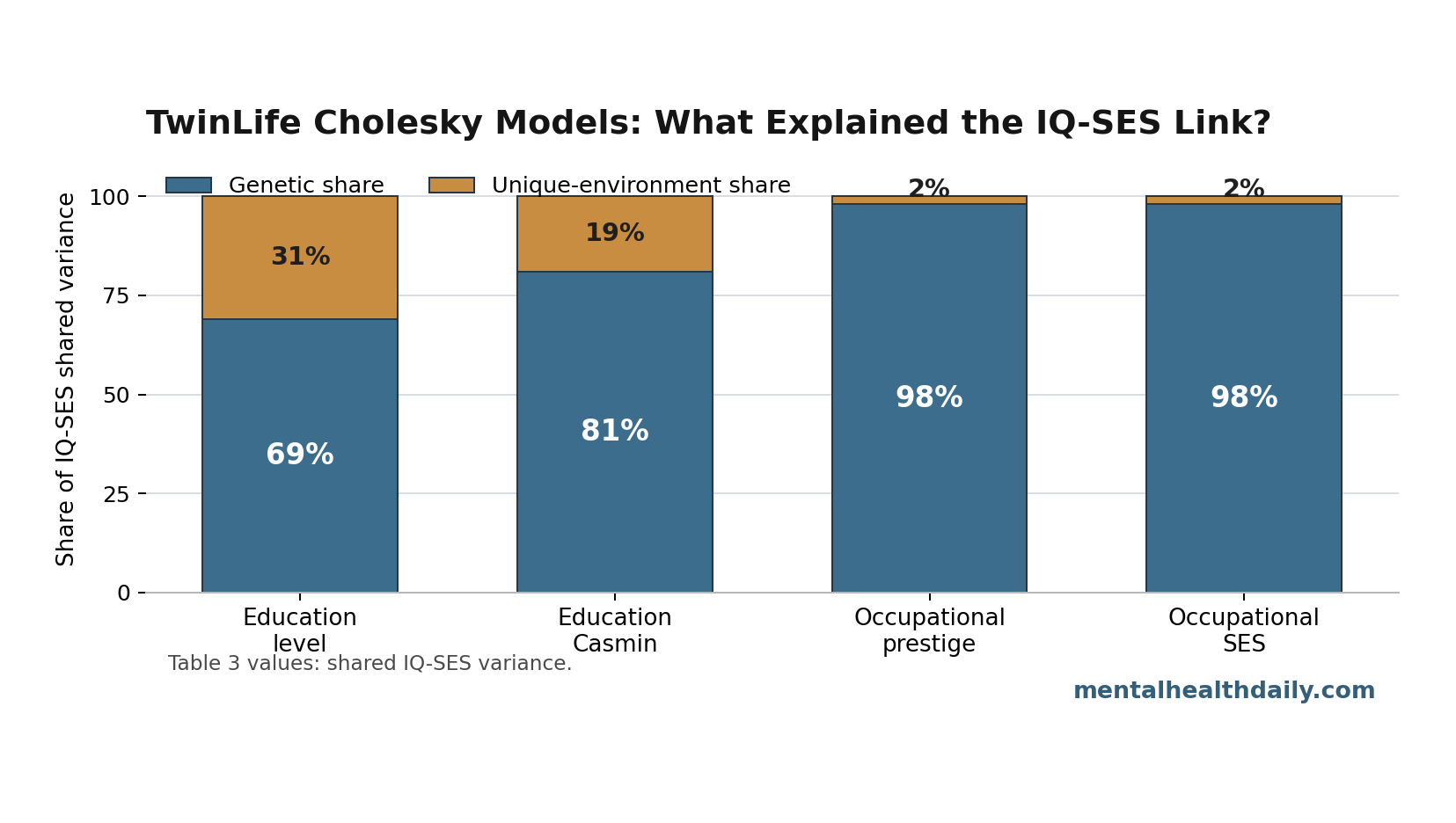
The genetic correlations were also larger than the environmental correlations. Genetic correlations were rG = 0.43 and rG = 0.59 for education, and rG = 0.42 for both occupational outcomes. Environmental correlations were rE = 0.23 and rE = 0.22 for education, then rE = 0.01 and rE = 0.02 for occupation.1
Genetic Overlap Is a Covariance Estimate
A common misread translates “98% genetic explanation of the IQ–occupation association” into “occupation is 98% genetic.” Kajonius was estimating the genetic share of the covariance between 2 measured traits. That is a narrower statement than a total-causation claim.
Covariance means 2 variables move together. If IQ and occupational prestige correlate, a twin model can ask whether the overlap is mostly genetic or mostly environmental. That still leaves the rest of occupational variance outside the IQ pathway: job markets, credential barriers, location, family resources, discrimination, economic timing, health, temperament, motivation, and measurement error can all affect outcomes.
Kajonius made this boundary explicit: the IQ–SES link explained “a quarter of the variance at best” and was nested inside a larger social context where intelligence is economically valued.1 That sentence is the useful guardrail. The genetic overlap is large inside the association, but the association is not the whole person and not the whole society.
Older Longitudinal Studies Already Made IQ Hard to Ignore
Strenze’s 2007 meta-analysis of longitudinal research found that cognitive ability was a strong predictor of later socioeconomic success.2 The TwinLife analysis did not invent the IQ–SES link; it added a genetic-and-environmental decomposition to a link that had already been visible in longitudinal social-science studies.
- Personality and background: Damian et al. tested whether personality traits and intelligence could compensate for background disadvantage in later status attainment.3
- Emerging-adult outcomes: Haider and von Stumm examined how intelligence, personality, and family SES predicted educational and social-emotional outcomes in emerging adulthood.4
- Genetically informed SES work: Trzaskowski et al. reported genetic influence on family socioeconomic status and children’s cognitive ability, while Belsky et al. found that education-linked polygenic scores predicted social-class mobility across 5 longitudinal studies, including within-family comparisons where siblings differed in inherited genetic propensity.57
Those studies keep the discussion from becoming one-variable determinism. Cognitive ability is predictive, but personality, background, educational pathways, social-emotional outcomes, and inherited propensity sit in the same developmental system.
The practical synthesis is simple but uncomfortable: cognitive ability, education, occupation, and social mobility are not cleanly separable into “nature” and “nurture” columns. They are correlated systems where genes influence exposure to environments, environments influence measured ability, and societies reward some abilities more than others.
Education Still Looks Like an Environmental Lever
High heritability does not erase intervention evidence. Ritchie and Tucker-Drob’s 2018 meta-analysis examined 42 datasets and more than 600,000 participants, using quasi-experimental designs such as compulsory-schooling changes and school-entry cutoff designs. They found that another year of education increased measured cognitive ability by about 1-5 IQ points.6
That finding does not contradict Kajonius. It clarifies the boundary. A trait can be heritable and still responsive to environmental changes. Heritability is often high when people share broad access to the same institutions, because remaining person-to-person variation can become more genetically patterned. Changing the institutions can still move the mean, reduce harm, or improve opportunity.
Wolfram and Morris added another caution in a 2023 nuclear-twin-and-family analysis of educational attainment. They argued that conventional twin studies can overestimate between-family environmental differences relevant to education when the model does not separate sibling, parental, twin-specific, and genetic components carefully.8 That does not invalidate the TwinLife result, but it does keep the modeling humility where it belongs: twin decomposition is informative, not omniscient.
The Policy Reading Should Be Individualized, Not Fatalistic
Measurement implication: if cognitive ability and SES share genetic variance, studies that treat family background, schooling, test performance, and occupational status as purely environmental variables can misattribute part of the pathway. Unmodeled genetic selection can make environmental explanations look cleaner than they are.
Clinical and public-health relevance: cognitive ability is also tied to mental-health literacy, treatment navigation, job stability, disability risk, and stress exposure. A young adult with lower measured cognitive ability may need simpler benefits systems, clearer care navigation, more structured job training, or repeated educational support. Genetic contribution does not make those supports pointless; it can explain why one-size-fits-all support fails.
Evidence-strength note: this was a finished longitudinal twin analysis, not a randomized intervention. It can estimate genetic and environmental decomposition under model assumptions. It cannot prove that changing IQ would directly change SES, cannot settle group differences, and cannot tell any individual what occupational status they will reach.
Limitations of This TwinLife IQ–SES Analysis
Several limits keep the result from carrying more weight than the design can support.
- Short follow-up: the analysis covered ages 23 to 27. Occupational status may still be unstable during those years, especially for people in extended education or early career transitions.
- Missing occupation data: occupational prestige and occupational SES had more missingness than education outcomes, which can bias estimates if missingness tracks work, education, health, or family status.
- Twin-model assumptions: estimates depend on assumptions about equal environments, assortative mating, and gene-environment interplay. Violations can shift genetic and environmental shares.
- Within-population inference: the numbers describe variation among German TwinLife participants under existing social conditions. They do not automatically generalize to different countries, policy regimes, labor markets, or historical periods.
Those caveats do not make the headline result disappear. They define the honest use: the IQ–SES association in this young-adult sample was substantially genetically patterned, especially for occupational outcomes, but the result is a variance-decomposition finding rather than a verdict on human potential.
Questions About IQ, SES, and Heritability
Does a 75% IQ heritability estimate mean IQ cannot change?
No. Heritability describes variation inside a particular population. A trait can be highly heritable and still change when nutrition, schooling, health, sleep, toxins, or educational exposure changes.
Did the TwinLife analysis prove that IQ causes socioeconomic status?
No. The study found that IQ measured at 23 predicted SES at 27 and that the shared variance was mostly genetic in twin models. That supports genetic overlap and longitudinal prediction, but it does not isolate a clean causal path from IQ to occupation.
Why did education show more environmental overlap than occupation?
Education may be closer to the measured cognitive pathway in early adulthood, and the 4-year window may capture schooling decisions better than stable occupational sorting. The 31% and 19% environmental shares for education also suggest that school-related experiences remained part of the IQ–education association.
Can policy still reduce socioeconomic inequality if these associations are partly genetic?
Yes. The result argues for better modeling, not surrender. If cognitive and socioeconomic differences are partly genetically patterned, systems may need more individualized educational support, clearer training pathways, and less bureaucratic friction for people who struggle with complex institutions.
Should this result be used for racial or ethnic group comparisons?
No. The analysis estimated within-sample variance among German TwinLife participants. It does not support between-group claims about race, ethnicity, nationality, or fixed social worth.
References
- Kajonius PJ. Longitudinal associations between cognitive ability and socioeconomic status are partially genetic in nature. Scientific Reports. 2026;16:4315. doi:10.1038/s41598-026-37786-3
- Strenze T. Intelligence and socioeconomic success: a meta-analytic review of longitudinal research. Intelligence. 2007;35(5):401–426. doi:10.1016/j.intell.2006.09.004
- Damian RI, Su R, Shanahan M, Trautwein U, Roberts BW. Can personality traits and intelligence compensate for background disadvantage? Predicting status attainment in adulthood. Journal of Personality and Social Psychology. 2015;109(3):473–489. doi:10.1037/pspp0000024
- Haider ZF, von Stumm S. Predicting educational and social-emotional outcomes in emerging adulthood from intelligence, personality, and socioeconomic status. Journal of Personality and Social Psychology. 2022;123(6):1386–1406. doi:10.1037/pspp0000421
- Trzaskowski M, Harlaar N, Arden R, et al. Genetic influence on family socioeconomic status and children’s intelligence. Intelligence. 2014;42:83–88. doi:10.1016/j.intell.2013.11.002
- Ritchie SJ, Tucker-Drob EM. How much does education improve intelligence? A meta-analysis. Psychological Science. 2018;29(8):1358–1369. doi:10.1177/0956797618774253
- Belsky DW, Domingue BW, Wedow R, et al. Genetic analysis of social-class mobility in five longitudinal studies. Proceedings of the National Academy of Sciences. 2018;115(31):E7275–E7284. doi:10.1073/pnas.1801238115
- Wolfram T, Morris D. Conventional twin studies overestimate the environmental differences between families relevant to educational attainment. npj Science of Learning. 2023;8:24. doi:10.1038/s41539-023-00173-y