
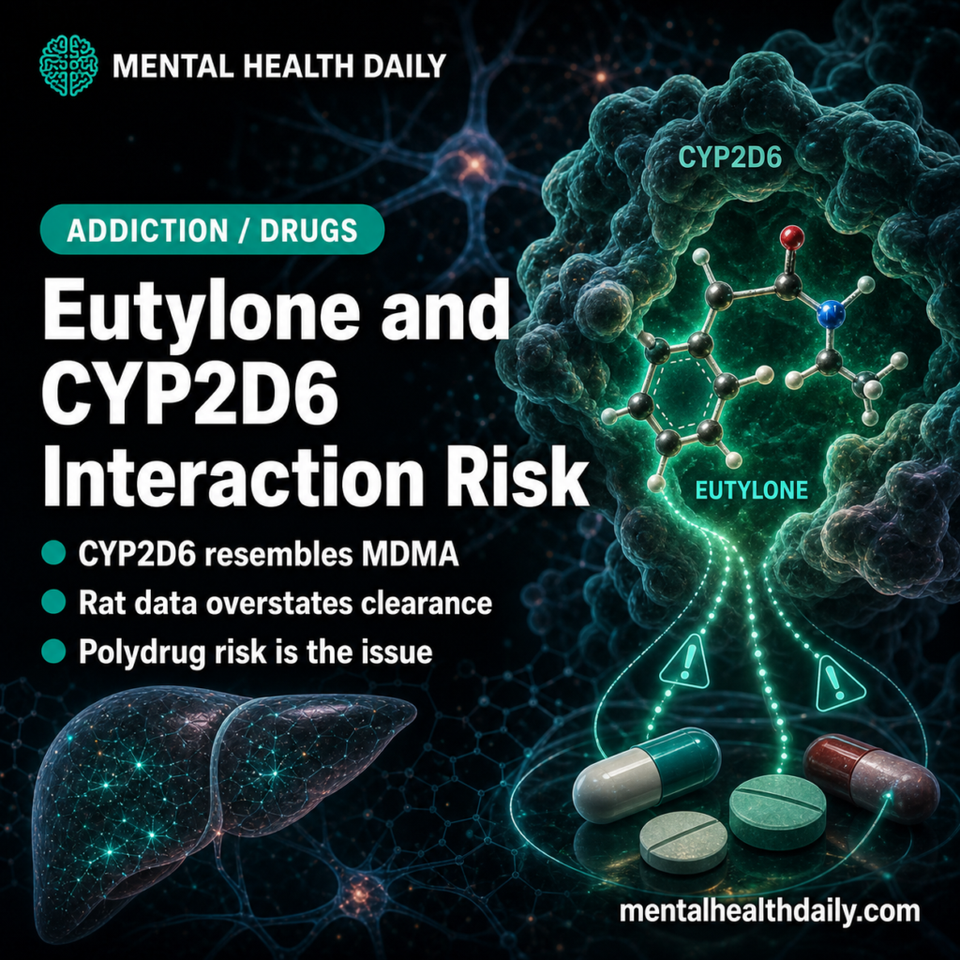
A 2026 cross-species metabolism study found that eutylone, a synthetic cathinone stimulant sometimes sold as a “bath salt” or MDMA-like drug, inactivated CYP2D6 with Ki = 4.2 μM, kinact = 0.069 min-1, and inactivation efficiency = 1.64 x 10⁻² min-1 μM-1 — a range the researchers described as comparable to MDMA.
Research Highlights
- CYP2D6 was the sharpest interaction signal: eutylone inactivated CYP2D6 with Ki = 4.2 μM and kinact = 0.069 min-1, yielding a 1.64 x 10⁻² min-1 μM-1 efficiency.
- CYP2B6 was less efficient than CYP2D6 but still relevant: CYP2B6 inhibition showed Ki = 32.9 μM, kinact = 0.080 min-1, and 2.43 x 10⁻³ min-1 μM-1 efficiency.
- Rodent data did not map cleanly to humans: predicted hepatic extraction was high in rats (0.81) but moderate in humans (0.39), warning against simple rat-to-human extrapolation.
- Metabolite mapping expanded detection targets: the study identified 20 eutylone metabolites, including 4 O-methylated/hydroxylated catechol metabolites seen only in rodents.
- Polydrug use is the clinical frame: a 2020 U.S. report counted 343 eutylone-involved deaths, with fentanyl co-involved in about 77% of cases.
CYP2D6 and CYP2B6 are liver drug-metabolizing enzymes that help clear many psychoactive drugs. When a stimulant inactivates those enzymes, its risk profile can include higher exposure to other drugs taken at the same time.
That is the useful read of Lee et al.’s 2026 eutylone paper. The study does not prove a precise overdose threshold in humans, but it moves eutylone from “another synthetic cathinone” toward a more specific warning: a stimulant with MDMA-like mechanism-based CYP2D6 inhibition in a drug market where co-exposures are normal.
Eutylone Inactivated CYP2D6 With MDMA-Comparable Efficiency
Mechanism-based inhibition means the enzyme loses activity after metabolizing the inhibitor, instead of being blocked only while the drug is temporarily sitting in the active site. This is a harder interaction problem because enzyme activity may recover only as new enzyme is produced.
Lee et al. tested eutylone in human liver microsomes with time- and concentration-dependent assays. The strongest signal was CYP2D6:
- CYP2D6 Ki: 4.2 μM, meaning a relatively low eutylone concentration produced half-maximal inactivation rate in the assay.
- CYP2D6 kinact: 0.069 min-1, the maximal observed inactivation rate.
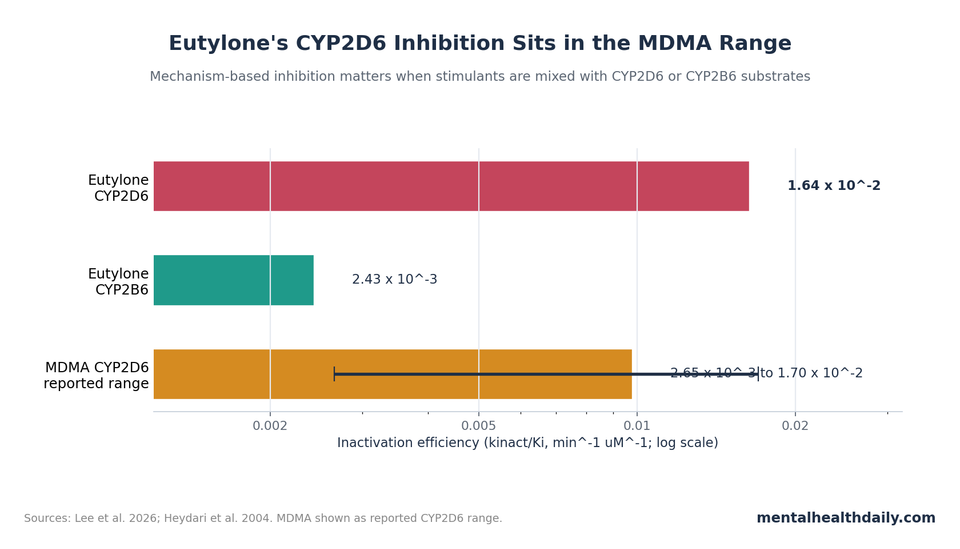
- CYP2D6 efficiency: 1.64 x 10⁻² min-1 μM-1, the kinact/Ki ratio used to compare inactivation liability.
CYP2B6 was also inhibited, but less efficiently: Ki = 32.9 μM, kinact = 0.080 min-1, and inactivation efficiency = 2.43 x 10⁻³ min-1 μM-1.
The MDMA comparison is not a throwaway analogy. Heydari et al. reported CYP2D6 Ki = 8.8-45.3 μM and kinact = 0.12-0.26 min-1 for MDMA, with inactivation efficiency around 2.65 x 10⁻³ to 1.70 x 10⁻² min-1 μM-1. Eutylone’s CYP2D6 efficiency landed at the upper end of that range.
Why CYP2D6 Inhibition Changes the Polydrug Risk
Synthetic cathinones are stimulant drugs related to cathinone, the psychoactive compound in khat. Eutylone belongs to the methylenedioxy-substituted subgroup, which gives it a structural link to MDMA and makes the CYP2D6 finding biologically plausible.
CYP2D6 helps metabolize many centrally acting drugs, including some antidepressants, antipsychotics, opioids, and stimulant-type drugs. CYP2B6 helps clear drugs such as bupropion, methadone, and ketamine. If eutylone inactivates these enzymes during a mixed-drug exposure, 2 things can happen at once:
- Eutylone contributes its own stimulant load: agitation, hyperthermia, cardiovascular strain, anxiety, panic, or psychosis can occur through stimulant pharmacology.
- Co-used drugs may linger or intensify: CYP2D6 or CYP2B6 substrates may show higher exposure than expected for the same dose.
O’Mathuna et al. showed why the enzyme mechanism can matter clinically. In a human MDMA study, MDMA increased dextromethorphan exposure about 10-fold and raised the dextromethorphan-to-dextrorphan ratio by 2 orders of magnitude, consistent with strong CYP2D6 inhibition in people.
Calibrated read: Lee et al. did not administer eutylone to humans with probe drugs, so the article should not treat the in vitro result as a measured clinical interaction. The stronger statement is that eutylone’s enzyme-inactivation kinetics are in the same neighborhood as an MDMA mechanism that has already produced large human probe-substrate effects.
343 U.S. Eutylone Deaths Showed a Co-Exposure Pattern
Forensic context matters because recreational eutylone use rarely occurs as a clean single-drug exposure. Gladden et al. reported 343 eutylone-involved overdose deaths in the United States in 2020. Illicitly manufactured fentanyls were involved in approximately 77% of those deaths, cocaine or methamphetamine in approximately 53%, opioids such as codeine, tramadol, or methadone in approximately 83%, and benzodiazepines in approximately 14%.
That pattern is exactly where CYP2D6 and CYP2B6 inhibition becomes important. Acute stimulant toxicity is one part of the risk; enzyme inactivation can make an already mixed exposure more pharmacologically unstable.
Drug classes to watch:
- CYP2D6 substrates: codeine, tramadol, tricyclic antidepressants, several selective serotonin reuptake inhibitors, and MDMA-type stimulants.
- CYP2B6 substrates: bupropion, methadone, and ketamine.
- Non-enzyme additive risks: fentanyl respiratory depression, stimulant cardiovascular strain, benzodiazepine sedation, and alcohol-related impairment can still dominate the clinical picture.
This is not a clean “avoid one combination” warning. The point is broader: toxicology and emergency assessment should treat eutylone as a possible interaction perpetrator when multiple psychoactive drugs are present.
Rat Clearance Looked Much Faster Than Human Clearance
Lee et al. also showed that animal metabolism can mislead if interpreted too literally. In liver microsomes, human eutylone turnover was minimal over 2 hours, with t1/2 = 972.5 min and CLint = 4.1 mL/min/kg. Rat microsomes cleared it much faster, with t1/2 = 6.8 min and CLint = 921.0 mL/min/kg.
Hepatocyte data showed the same direction, though less extremely. Human hepatocytes had t1/2 = 375.5 min, CLint = 13.2 mL/min/kg, predicted CLhep = 8.1 mL/min/kg, and extraction ratio = 0.39. Rat hepatocytes had t1/2 = 27.1 min, CLint = 239.6 mL/min/kg, predicted CLhep = 44.9 mL/min/kg, and extraction ratio = 0.81.
Plain English: rat systems made eutylone look like a high-extraction compound, while human systems made it look more slowly cleared. If a rat model suggests rapid eutylone elimination or a specific metabolite pattern, the human risk estimate needs a correction step.
This matters for 2 practical tasks:
- Forensic detection: human and dog hepatocytes looked more similar than rat and human hepatocytes, so rodent-only metabolite markers may not be the best human toxicology targets.
- Risk modeling: faster rat clearance can understate human exposure duration if scaled carelessly.
20 Metabolites Connect Detection Targets to Mechanism
Feature-based molecular networking is a mass-spectrometry method that groups related chemical signals by fragmentation similarity, helping researchers see metabolite families without needing a reference standard for every possible metabolite. Lee et al. used it with high-resolution mass spectrometry across human, rat, mouse, and dog hepatocytes.
The study identified 20 eutylone metabolites. Core pathways included O-demethylenation, N-deethylation, beta-ketone reduction, hydroxylation, O-methylation, glucuronidation, and sulfation. Sixteen metabolites appeared across all 4 species, but 4 O-methylated and hydroxylated catechol metabolites appeared only in rodents.
Earlier eutylone work had already described intoxications, urine markers, and targeted metabolism. Krotulski et al. documented eutylone as an emerging forensic stimulant. Yeh and Wang profiled eutylone in vitro and in urine. Godoi et al. studied rat liver microsome metabolism. Pelletier et al. identified consumption markers in a chemsex context.
Lee et al. extended that work by combining cross-species hepatocytes, CYP phenotyping, metabolite networking, and inhibition kinetics in one package. The new contribution is the connection between metabolite formation, species differences, and enzyme-inactivation risk.
What the 2026 Study Can and Cannot Prove
Evidence-strength note: this was a laboratory metabolism and enzyme-inhibition study, not a clinical trial or prospective overdose cohort. It can identify plausible drug-interaction mechanisms, rank enzyme liability, and improve toxicology targets. It cannot estimate the exact probability that a person using eutylone will overdose, develop serotonin toxicity, or experience a specific interaction.
The main limitations are straightforward:
- Exposure uncertainty: recreational eutylone dose, purity, route, and blood concentration vary widely.
- Co-use uncertainty: fentanyl, methamphetamine, cocaine, alcohol, benzodiazepines, antidepressants, bupropion, methadone, and ketamine can enter the same exposure window.
- In vitro translation: microsome and hepatocyte results need human pharmacokinetic confirmation before they become dose-level clinical rules.
- Accepted-manuscript status: the mirrored PDF was an article-in-press version, so final typesetting may clean up wording while preserving the DOI-level result.
Even with those limits, the central message is useful. Eutylone should not be treated as only a parent-drug stimulant problem. It also deserves attention as a CYP2D6/CYP2B6 interaction risk in the exact polydrug settings where eutylone has been showing up.
Questions About Eutylone, CYP2D6, and Drug Interactions
Does this prove eutylone causes dangerous drug interactions in humans?
No. Lee et al. showed mechanism-based CYP2D6 and CYP2B6 inhibition in human liver microsomes, not a measured clinical interaction trial. The reason the signal is concerning is that eutylone’s CYP2D6 efficiency overlapped the MDMA range, and MDMA has already produced large CYP2D6 probe-substrate effects in humans.
Is CYP2D6 more important than CYP2B6 for eutylone?
For the interaction signal in this study, yes. CYP2D6 had the higher inactivation efficiency and played the dominant role in O-demethylenation. CYP2B6 still matters because drugs such as bupropion, methadone, and ketamine can be relevant in real-world polydrug exposure.
Why are rat-human differences important?
Rats cleared eutylone much faster than humans in the study’s liver systems. A rodent model could therefore exaggerate clearance or emphasize metabolites that are less central in humans, which is risky when regulators or toxicologists need human-facing interpretation.
What should toxicology reports look for?
The study supports looking beyond parent eutylone. O-demethylenated, N-deethylated, reduced, hydroxylated, methylated, glucuronidated, and sulfated metabolites all contribute to the detection map, while species-specific markers should be interpreted carefully.
References
- Lee MS, Song I, Jang Y, et al. Cross-species metabolic characterization of eutylone and mechanism-based inhibition of CYP2D6 and CYP2B6 with drug interaction implications. Scientific Reports. 2026. doi:10.1038/s41598-026-48814-7
- Gladden RM, Chavez-Gray V, O’Donnell J, Goldberger BA. Notes from the field: overdose deaths involving eutylone (psychoactive bath salts) — United States, 2020. MMWR Morb Mortal Wkly Rep. 2022;71(32):1032-1034. doi:10.15585/mmwr.mm7132a3
- O’Mathuna B, Farre M, Rostami-Hodjegan A, et al. The consequences of 3,4-methylenedioxymethamphetamine induced CYP2D6 inhibition in humans. J Clin Psychopharmacol. 2008;28(5):523-529. doi:10.1097/JCP.0b013e318184ff6e
- Heydari A, Yeo KR, Lennard MS, Ellis SW, Tucker GT, Rostami-Hodjegan A. Mechanism-based inactivation of CYP2D6 by methylenedioxymethamphetamine. Drug Metab Dispos. 2004;32(11):1213-1217. doi:10.1124/dmd.104.001180
- Krotulski AJ, Papsun DM, Chronister CW, et al. Eutylone intoxications — an emerging synthetic stimulant in forensic investigations. J Anal Toxicol. 2021;45(1):8-20. doi:10.1093/jat/bkaa113
- Yeh YL, Wang SM. Quantitative determination and metabolic profiling of synthetic cathinone eutylone in vitro and in urine samples by liquid chromatography tandem quadrupole time-of-flight mass spectrometry. Drug Test Anal. 2022;14(7):1325-1337. doi:10.1002/dta.3258
- Godoi AB, Antunes NJ, Rodrigues LC, Martins AF, Costa JL. In vitro metabolism and metabolite identification of eutylone using rat liver microsomes. J Pharm Biomed Anal. 2025;260:116827. doi:10.1016/j.jpba.2025.116827
- Pelletier R, Le Dare B, Le Bouedec D, et al. Identification, synthesis and quantification of eutylone consumption markers in a chemsex context. Arch Toxicol. 2024;98(1):151-158. doi:10.1007/s00204-023-03615-z