hit counter

Electroacupuncture for Depression Has Mechanisms, Not Firm Trial Proof

MHD featured image for electroacupuncture depression mechanisms and clinical evidence.

A 2026 review of electroacupuncture for depression found a familiar split: mechanistic evidence is rich, but clinical proof remains uneven because representative trials ranged from 65 to 270 participants, used different sham or drug comparators, and often failed to connect stimulation parameters with biological endpoints.1 Electroacupuncture is plausible as a subtype-matched neuromodulation strategy, but it …

Read more

P2X7 Receptors in Depression: ATP-Inflammation Target

MHD featured image for P2X7 receptors and depression inflammation pathways.

A 2026 review in Purinergic Signalling argues that P2X7 receptors are one of the clearest molecular bridges between stress, ATP danger signaling, microglial inflammation, NLRP3 inflammasome activation, reduced BDNF, and new antidepressant drug targets.1 Research Highlights P2X7 is the lead receptor: Mattova et al. reviewed 7 ATP-gated P2X receptor subunits, with P2X7 carrying the strongest …

Read more

Depression vs. Schizophrenia: Microglial TSPO and KYNA Signals

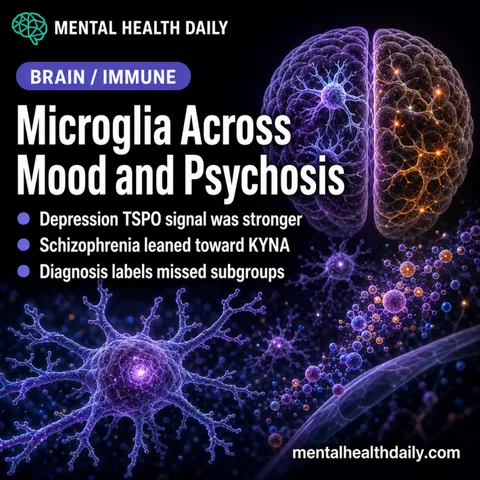
MHD featured image for microglial and kynurenine pathway patterns across depression, bipolar disorder, and schizophrenia.

A 2026 systematic review found that microglia-related immune signals do not line up cleanly with psychiatric diagnosis labels: major depression showed frontolimbic TSPO-PET increases, while schizophrenia showed elevated kynurenic acid in cerebrospinal fluid.1 The strongest interpretation is that immune-brain markers may sort subgroups better than DSM categories do. Research Highlights Depression had the clearest TSPO-PET …

Read more

Inflammatory Depression Had Higher Kynurenine Metabolites

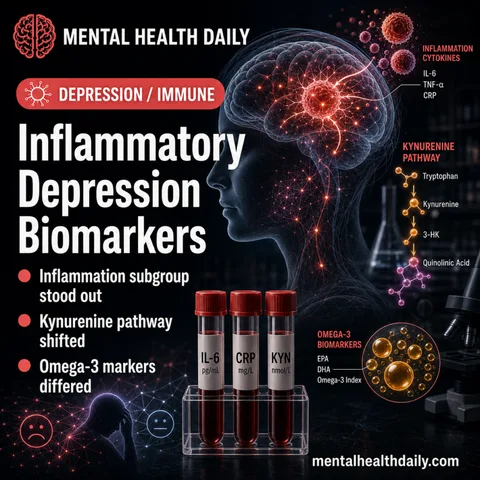
A 2026 biomarker study found kynurenine-pathway activation in inflammatory major depressive disorder (MDD), but not across all depression cases. Compared with non-inflammatory MDD and healthy controls, the inflammatory subgroup had higher pathway metabolites, and omega-3 treatment reduced several of them over 8 weeks.1 Research Highlights Inflammatory depression showed kynurenine activation: people with MDD and high-sensitivity …

Read more

Parkinson’s Sex Differences: Male Flies Show Stronger Rotenone Stress

MHD featured image for Parkinson's sex differences and rotenone immune-gene response in Drosophila.

A 2026 Drosophila Parkinson’s model exposed male and female flies to 500 μM rotenone. By 60 days, male flies had worse survival/climbing than female flies; the paper is a vulnerability screen, not evidence that the same genes are ready human biomarkers.1 Research Highlights 500 μM rotenone split male and female flies: Iyer et al. used …

Read more

Antrodia Silver Nanoparticles Reduced Parkinsonism Markers in 63 Rats

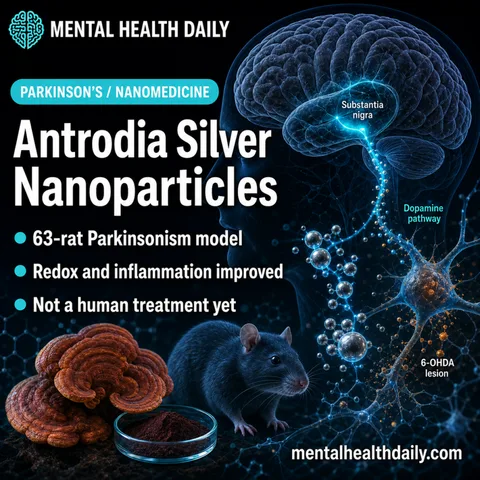
MHD featured image for Antrodia silver nanoparticles and Parkinsonism oxidative-stress markers.

A 2026 Parkinsonism study involving 63 male rats found that Antrodia cinnamomea plus citrate-stabilized silver nanoparticles reduced 6-OHDA motor, oxidative-stress, inflammatory, α-synuclein, and apoptosis markers, while dopamine and acetylcholine recovery remained nonsignificant. The useful claim is a multitarget preclinical signal, not a Parkinson’s disease treatment recommendation. Research Highlights Combination treatment looked strongest: Tekiner et al. …

Read more

Cholestatic Liver Injury Alters Thalamus Fatigue Genes

MHD featured image for cholestatic liver disease, thalamus changes, fatigue, and TNF signaling.

A 2026 mouse study linked cholestatic liver injury to smaller thalamic volume than control injury-free mice, broad thalamus gene-expression changes, and partial pathway rescue after systemic tumor necrosis factor neutralization. Research Highlights Thalamic volume decreased: bile duct ligation (BDL; a mouse model of obstructive cholestatic liver injury) reduced thalamic volume vs. sham surgery by magnetic …

Read more