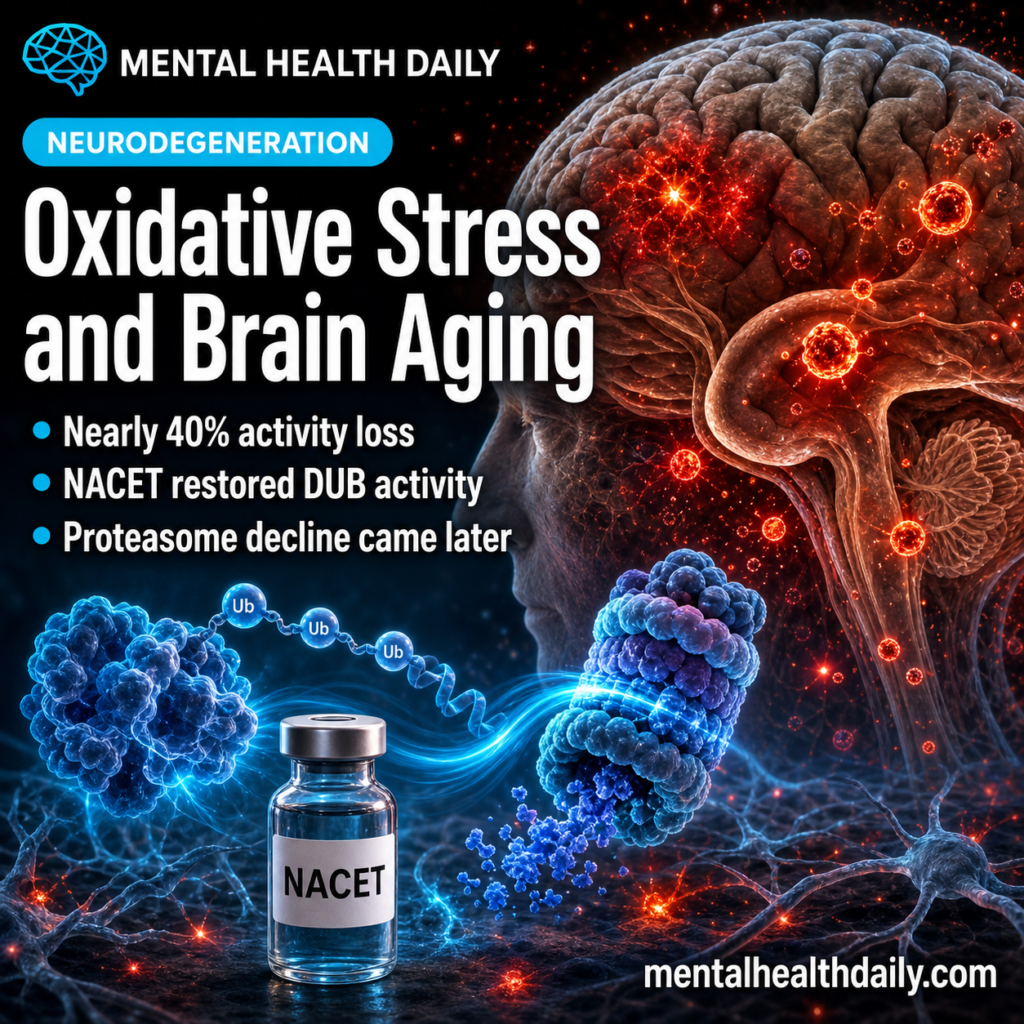
A Nature Communications study found that old vertebrate brains lost almost 40% of cysteine protease deubiquitylase catalytic activity with age, despite relatively stable protein abundance.1 Antioxidant treatment with NACET restored DUB activity in aging brains, making the finding a reversible enzyme-mechanism result rather than a generic “antioxidants reverse brain aging” claim.
Research Highlights
- DUB activity fell with age: old mouse and killifish brains showed almost 40% lower cysteine protease DUB catalytic activity despite stable protein abundance.1
- The mouse screen was enzyme-specific: activity-based probes identified 56 distinct DUBs, with 18 of 56 showing lower activity in old brains.1
- Redox chemistry explained the loss: thiol oxidation impaired DUB function, and N-acetylcysteine ethyl ester restored activity in old brains.1
- DUB decline came early: temporal analysis showed DUB activity dropped after 18 months in mice before broader proteasome impairment.1
- USP7 was only part of the picture: targeted USP7 inhibition in human iPSC-derived neurons partially recapitulated age-related ubiquitylation changes, not the whole aging signature.1
Deubiquitylases (DUBs) are enzymes that remove ubiquitin tags from proteins. Ubiquitin tags help cells decide whether proteins should be degraded, relocated, or used in signaling. In neurons, that tagging system helps maintain proteostasis, the balance of protein folding, repair, trafficking, and degradation.
The study shifts attention upstream of the proteasome. The proteasome is the cell’s protein-disposal machinery, but DUBs help regulate which proteins carry ubiquitin tags before disposal or signaling decisions are made.
Old Mouse Brains Lost Activity in 18 of 56 DUBs
Sahu et al. used activity-based proteomics, meaning chemical probes that bind active enzyme sites rather than merely measuring total protein abundance. In young and old mouse brains, the researchers identified 56 distinct DUBs and found overall activity loss with age.1
Activity vs. abundance: many DUB proteins were still present, but their catalytic cysteine sites were less active. The paper’s core mechanism is functional impairment by oxidative stress rather than wholesale enzyme loss.
Male mouse comparisons included young 3-month-old and old 30-month-old brains, while female mouse comparisons included young 3-month-old and old 22-24-month-old brains. The cross-species work also included killifish, a short-lived vertebrate model useful for aging research.1
Activity-based probes were central to the design. These probes bind active catalytic sites, so the readout is closer to enzyme function than a standard abundance measurement. That is why the study could detect a mismatch between how much DUB protein was present and how much DUB activity remained.
The screen also found that affected enzymes included DUBs previously tied to neurodegenerative biology, including ATXN3, UCHL1, UCHL5, and YOD1. That does not make each enzyme a treatment target, but it links the aging-brain signal to pathways already implicated in protein handling and neuronal vulnerability.
Thiol Oxidation Made DUB Loss Potentially Reversible
Thiol oxidation means chemical modification of sulfur-containing cysteine groups. Many cysteine protease DUBs depend on an active cysteine residue to perform catalysis. Oxidative stress can blunt that active site without permanently removing the protein.
The reversible chemistry matters because it creates a different therapeutic logic than replacing lost cells or clearing aggregates. NACET, short for N-acetylcysteine ethyl ester, is an antioxidant prodrug that can enter cells and supply cysteine. In the study, NACET restored DUB function in aging brains.1
NACET should be read as a mechanistic probe in this paper. The enzyme defect was redox-sensitive and reversible in the tested preclinical systems, while human treatment claims require separate trials.
Why NACET was informative: N-acetylcysteine ethyl ester can enter cells and supply cysteine, which supports antioxidant defenses and glutathione synthesis. If DUB activity improves after that redox intervention, the result supports cysteine oxidation as a functional cause of enzyme impairment rather than a bystander marker of old tissue.
The treatment experiment also keeps the claim more precise than a broad antioxidant narrative. The measured target was DUB catalytic activity and related molecular signatures. Cognitive performance, neurodegenerative disease progression, and human aging outcomes were outside the study’s scope.
DUB Decline Appeared Before Proteasome Decline
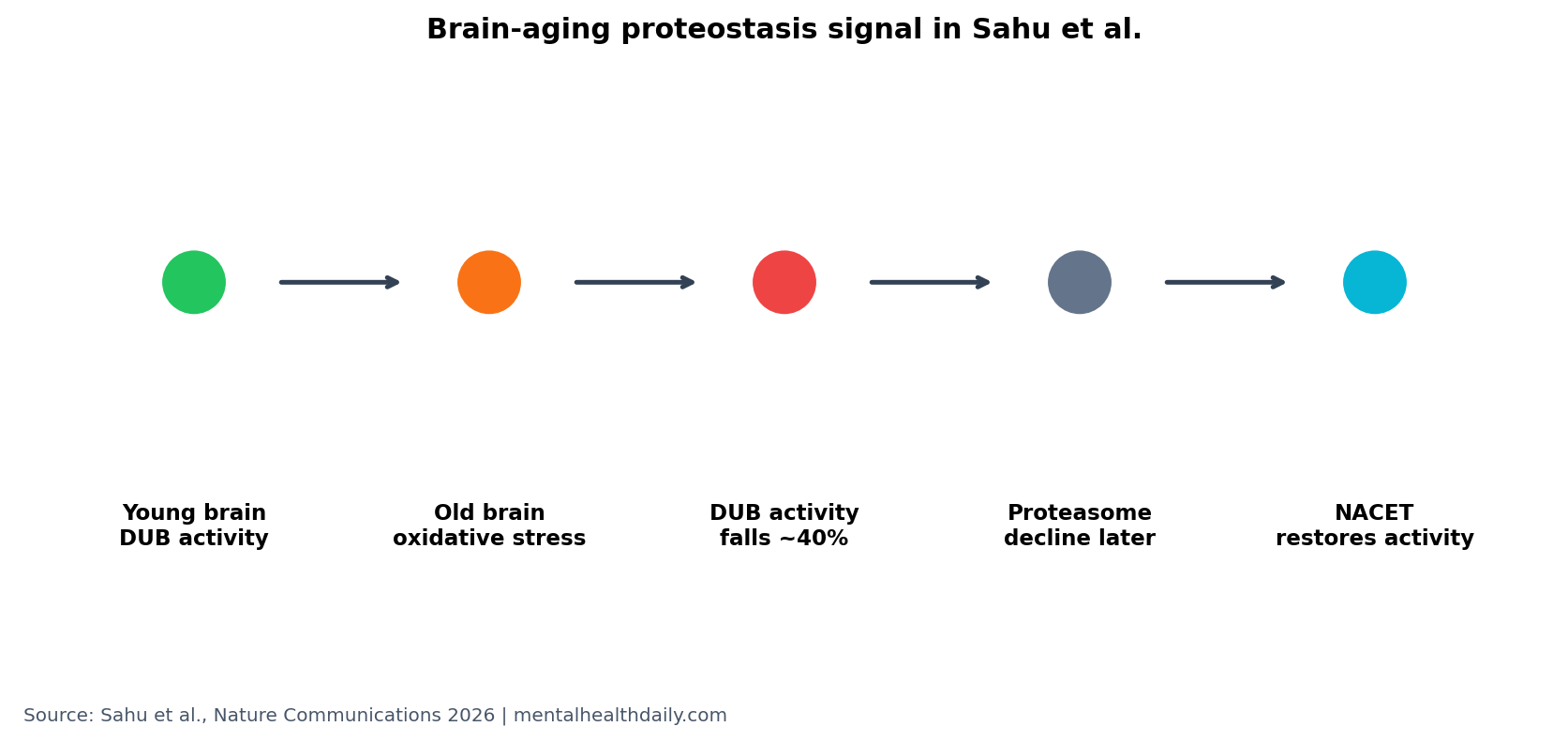
Temporal mouse analysis found thiol concentration stable until 12 months, then decreasing beginning around 18 months. DUB activity declined after 18 months, while broader proteasome impairment and ubiquitylated-protein accumulation appeared later.1
Proteasome impairment means reduced capacity of the protein-degradation machinery to break down tagged proteins. If DUB activity fails first, aging proteostasis may start to drift before the disposal machinery itself is obviously impaired.
Human iPSC-derived neurons strengthened the sequence. Global DUB inhibition and targeted USP7 inhibition altered ubiquitylation patterns, and USP7 inhibition partially reproduced aging-associated protein-tagging changes. iPSC-derived neurons are lab-grown neurons generated from induced pluripotent stem cells, useful for mechanistic experiments but not equivalent to an aging human brain.
USP7 is one DUB that showed strong age-related activity change and was tested directly in human neuron models. Inhibiting USP7 changed ubiquitylation of proteins involved in proteostasis, cytoskeletal dynamics, trafficking, and synaptic transmission. Partial overlap with aging signatures makes USP7 a mechanistic handle, not the sole driver of brain aging.
Prior Proteostasis Work Focused More on the Proteasome
Kelmer Sacramento et al. showed that reduced proteasome activity in aging brain can disrupt ribosome stoichiometry and promote aggregation.2 That work made the proteasome an obvious aging target.
Koyuncu et al. showed that rewiring of the ubiquitinated proteome can shape aging in C. elegans.3 Lee et al. previously showed that reactive oxygen species can reversibly inactivate DUBs through redox-sensitive cysteine chemistry.4
Sahu et al. connects those threads in vertebrate brain aging: the ubiquitin system changes with age, DUBs are redox-sensitive, and the DUB defect may precede later proteasome decline.
That sequence is important for intervention design. If the proteasome is already failing and aggregates have accumulated, late-stage repair may be harder. A reversible DUB activity defect that appears earlier gives researchers a cleaner molecular checkpoint to test in aging and neurodegeneration models.
Why neurons are vulnerable: neurons are long-lived cells with high energy demand, long projections, and heavy dependence on local protein turnover at synapses. Small shifts in protein tagging, trafficking, and degradation can accumulate over time. A partial loss of DUB activity may therefore have larger consequences in brain tissue than in rapidly dividing tissue that can dilute damaged proteins through cell division.
The study also helps explain why oxidative stress and proteostasis often appear together in aging research. Reactive oxygen species can damage proteins directly, but they can also damage the enzymes responsible for managing protein tags. That creates a feedback loop: oxidized DUBs handle ubiquitin tags less effectively, protein handling becomes noisier, and damaged proteins become harder to clear.
Clinical boundary: the findings should not be converted into supplement advice. NACET was useful because it tested whether redox restoration could rescue a defined enzyme activity. Human trials would need to establish dose, brain exposure, safety, target engagement, and meaningful cognitive or neurological endpoints before any treatment recommendation could follow.
Selectivity question: restoring redox balance broadly may help some DUBs, but different DUB family members act on different substrates and pathways. Future work needs to separate beneficial restoration of normal protein handling from unwanted interference with stress responses, immune signaling, or synaptic remodeling.
Age, cell type, and disease context will probably decide whether DUB restoration is protective, neutral, or risky.
For now, the strongest claim is mechanistic: oxidative stress can disable a protein-quality-control regulator before the larger disposal system visibly fails.
Target-engagement standard: a future animal or human translational study would need to show that an intervention actually restores DUB catalytic activity in relevant brain tissue or a credible proxy. General antioxidant exposure, blood redox change, or improved behavior alone would not prove that the same mechanism is being engaged.
Tissue specificity will be central. A compound that shifts redox biology in blood or liver may not reach neurons, glia, synapses, or vulnerable aging brain regions at the right exposure.
That is why target engagement has to be measured close to the biology of interest.
Location is part of the mechanism.
Evidence Strength and Limits
Supported: aging vertebrate brains show reduced cysteine protease DUB activity, oxidative stress can explain part of that loss, NACET can restore activity in tested aging-brain systems, and DUB inhibition can produce aging-like ubiquitylation changes in human neuron models.
Not supported: using NACET as a proven cognitive anti-aging therapy, assuming all antioxidants restore DUB activity, or treating USP7 as the only relevant enzyme. The study is mechanistically strong but still preclinical.
Questions About DUBs and Brain Aging
Are DUBs good or bad in aging?
The useful answer is activity-specific. The study suggests that losing normal DUB catalytic activity can destabilize protein handling in aging brain, but DUBs are a large enzyme family with different functions.
Does NACET reverse brain aging?
No clinical conclusion follows from this paper. NACET restored DUB activity and molecular patterns in preclinical systems. Human cognition, safety, dose, and disease outcomes would need separate trials.
Why does “before proteasome decline” matter?
If DUB activity falls earlier than proteasome function, the first detectable proteostasis failure may be regulatory rather than purely degradative. That changes where researchers might look for early aging-brain interventions.
References
- Sahu AK, Minetti A, Di Fraia D, et al. Oxidative stress causes a reversible decrease of deubiquitylases activity in old vertebrate brains. Nature Communications. 2026. doi:10.1038/s41467-026-71921-y
- Kelmer Sacramento E, et al. Reduced proteasome activity in the aging brain results in ribosome stoichiometry loss and aggregation. Molecular Systems Biology. 2020. doi:10.15252/msb.20209596
- Koyuncu S, et al. Rewiring of the ubiquitinated proteome determines ageing in C. elegans. Nature. 2021. doi:10.1038/s41586-021-03781-z
- Lee JG, Baek K, Soetandyo N, Ye Y. Reversible inactivation of deubiquitinases by reactive oxygen species in vitro and in cells. Nature Communications. 2013. doi:10.1038/ncomms2562