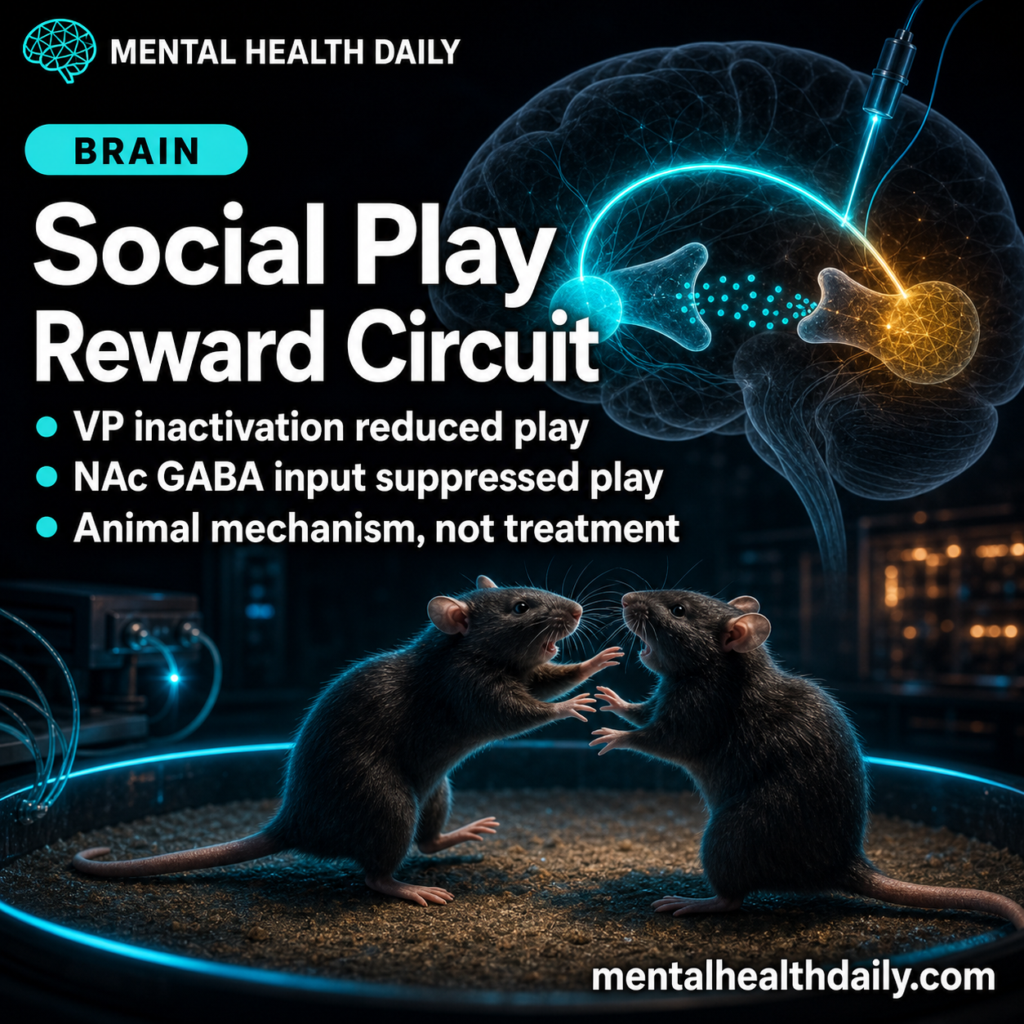
A 2026 juvenile rat study found that inactivating the ventral pallidum or stimulating nucleus accumbens GABA terminals in the ventral pallidum reduced social play behavior in both sexes, pointing to a specific reward-circuit pathway required for normal play expression.1
Research Highlights
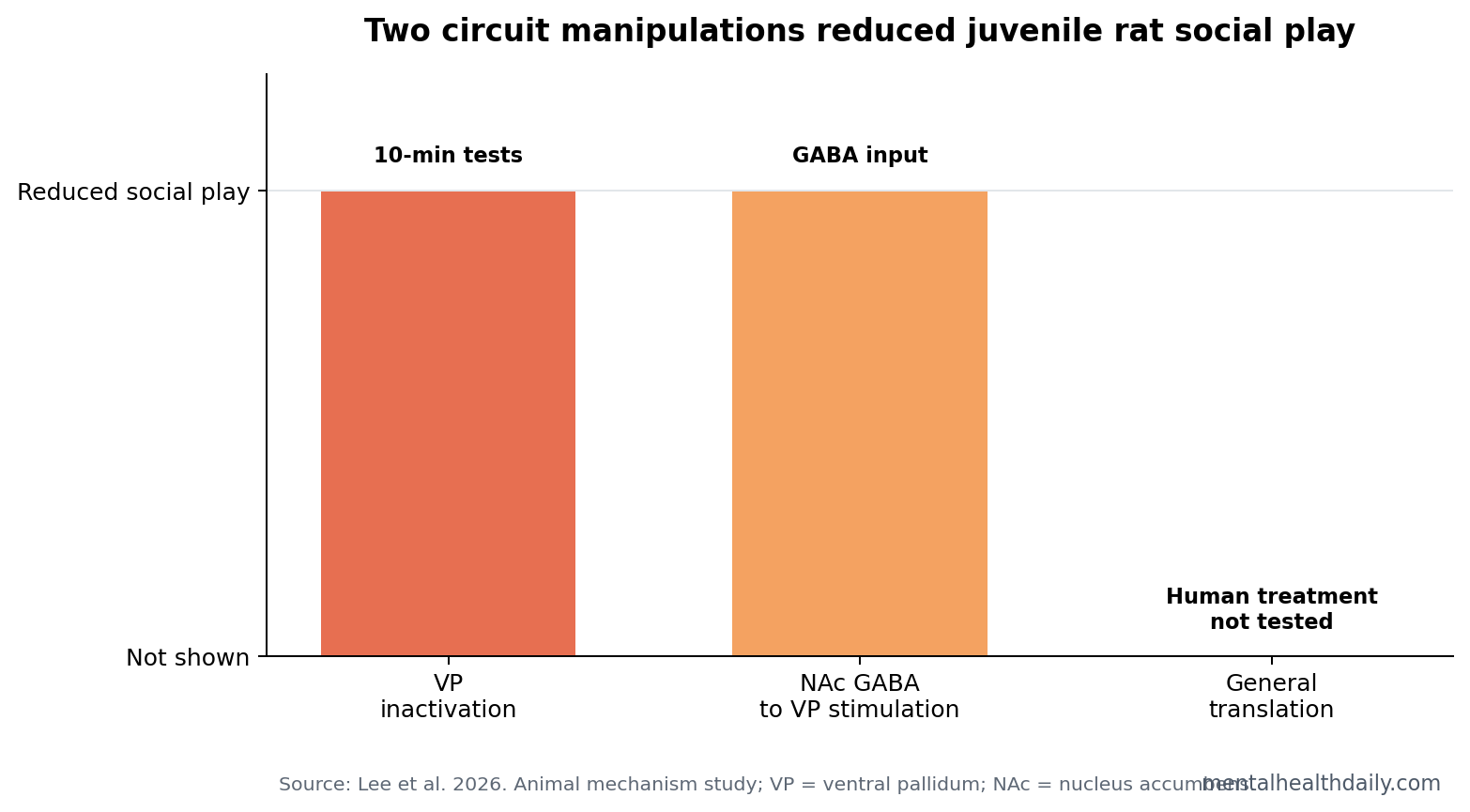
- VP inactivation reduced play: bilateral muscimol infusion into the ventral pallidum reduced juvenile social play during 10-minute tests.1
- NAc-to-VP GABA input also reduced play: chemogenetic stimulation of nucleus accumbens GABA terminals in the ventral pallidum decreased social play and reduced VP neuronal activation.1
- The effect was behavior-specific: reductions were reported for social play behaviors rather than a broad collapse of movement or ordinary social exploration.1
- Sex patterns were examined: male and female juvenile rats showed equal social play expression, with sex-specific accumbens activation patterns shifting after play exposure.1
- Human translation is limited: the study used 3 preclinical experiments in rats, so it supports circuit mechanism rather than autism or social-motivation treatment claims.2
Social play behavior is rough-and-tumble juvenile interaction that is rewarding, developmentally timed, and conserved across several mammals. In rats, it is measurable through behaviors such as pouncing, pinning, chasing, and nape attacks during a standardized social play test.
Mesolimbic reward circuitry is a network linking dopamine-rich and GABA-rich brain regions that regulate motivation, reinforcement, and approach behavior. The nucleus accumbens and ventral pallidum sit in this system, making them plausible control points for social reward.
Ventral Pallidum Activity Was Required for Normal Social Play
Lee et al. first inactivated the ventral pallidum with muscimol, a GABA-A receptor agonist that suppresses local neuronal activity. Rats receiving muscimol showed less social play behavior during 10-minute tests.1
Ventral pallidum is a basal forebrain reward hub that receives nucleus accumbens input and helps translate motivation into action. In adult animals, it is involved in food reward, drug reward, and incentive motivation. The 2026 study extends that logic to juvenile social play.
NAc GABA Terminals in VP Suppressed Play When Stimulated
GABA is the brain’s main inhibitory neurotransmitter. The nucleus accumbens sends GABAergic projections to the ventral pallidum. In this study, chemogenetic stimulation of those NAc GABA terminals decreased ventral pallidum neuronal activation and reduced social play.1
The circuit logic is disinhibition. If accumbens GABA input inhibits ventral pallidum cells too strongly, play expression falls. Normal social play may require the right level of ventral pallidum activity rather than simple “more reward circuit activity” everywhere.
Social Play Was Reduced Without a Global Behavior Collapse
The behavioral specificity matters. A manipulation that simply sedates rats, reduces locomotion, or blocks all social contact would say little about play reward. Lee et al. report that the reductions were specific to social play behaviors rather than explained by broad nonsocial deficits.1
- Play duration: the core behavior reduced by ventral pallidum manipulation.
- Nape attacks and pins: rat play components that mark rough-and-tumble interaction.
- Locomotion and exploration: necessary controls for distinguishing play suppression from nonspecific impairment.
Sex Differences Were Circuit-Level, Not Behavior-Level
Male and female juvenile rats expressed similar levels of social play. The interesting sex result was neural: social play exposure altered Fos-positive cell patterns in the nucleus accumbens shell and removed a baseline sex difference in activation.1
Fos is an immediate-early gene marker often used as a proxy for recent neuronal activation. Fos data do not show moment-by-moment firing, but they can identify which regions were recruited after a behavior or manipulation.
Autism Relevance Should Stay Preclinical
Reduced social motivation is discussed in autism research, and animal social-play models can help map basic reward mechanisms. Trezza et al. described social play as a reward-linked behavior with corticostriatal and limbic control.2 Berridge and Kringelbach mapped reward into interacting wanting and liking systems rather than one pleasure center.4
The 2026 rat study belongs in that mechanism literature. It does not show that the same pathway causes human autistic social differences, and it does not suggest that manipulating ventral pallidum activity would be a treatment.
Evidence Strength and Limits
Evidence-strength note: this was an animal-only mechanism study. It can support a causal role for the nucleus accumbens-to-ventral pallidum pathway in juvenile rat social play. It cannot support clinical claims about autism, social anxiety, depression, or human social functioning.
Translation would require converging evidence from human imaging, developmental behavior, pharmacology, and clinical phenotyping. Rat play is useful because it is quantifiable and reward-linked. It is not a one-to-one model of human friendship, empathy, loneliness, or autistic social communication.
Reward Circuitry Is More Specific Than Dopamine Alone
The study is useful because it makes social reward more specific than a dopamine-only story. The nucleus accumbens-to-ventral pallidum projection is a specific GABAergic pathway, and stimulating that pathway reduced play. That means social play depends on circuit balance, with more precision than a one-direction “more reward signal” story.
Mechanistic implication: ventral pallidum output may need to stay available for juvenile play to occur. Too much inhibitory input from accumbens GABA terminals can suppress that output and reduce play behaviors. The result fits a disinhibition model in which reward expression depends on releasing downstream action systems rather than activating every reward-related region.
Human Social Behavior Needs Separate Evidence
Translation boundary: animal social play models are valuable because they allow causal circuit manipulation. Human social behavior is broader: friendship, conversation, eye contact, social anxiety, loneliness, autistic communication, trauma, depression, and motivation all involve additional cognitive and environmental layers. A rat pathway can be conserved and still explain only a small part of the human phenotype.
The safest translation is therefore mechanistic. The study tells researchers where to look when studying social reward and juvenile play. Clinical questions about social withdrawal or autism require separate human evidence.
GABA Input Can Reduce Reward Expression Rather Than Increase It
Pathway direction: the nucleus accumbens is often described as a reward center, but its outputs are mostly inhibitory. That means activating an accumbens projection can suppress a downstream target. In the 2026 study, stimulating accumbens GABA terminals in the ventral pallidum reduced play, consistent with pathway-specific inhibition rather than a simple reward boost.
This is why circuit direction matters. Saying “the nucleus accumbens was involved” is too vague. The important finding is that a particular accumbens output to the ventral pallidum could reduce the expression of a juvenile social reward behavior.
Social Play Models Developmental Motivation, Not Adult Social Skill
Juvenile rat social play is developmentally concentrated and highly rewarding. It is not the same as adult social bonding, pair bonding, parental care, or human conversation. Its value is that it gives researchers a controlled window into how young animals seek and maintain rewarding peer interaction.
That makes the model relevant to developmental neuroscience, but translation needs restraint. Human social problems can come from anxiety, sensory overload, trauma, depression, psychosis, language pragmatics, motor differences, cognitive load, or social exclusion. A social-play circuit can illuminate one motivational layer without explaining the whole clinical picture.
Future Work Should Test Naturalistic Circuit Timing
Chemogenetic and pharmacological tools are powerful because they test causality, but they are relatively coarse in time. Social play unfolds in seconds: approach, chase, nape attack, pin, release, and re-engagement. Future studies that record or manipulate circuit activity during those moments could show when the ventral pallidum is needed.
That timing question is clinically relevant in a broad sense. Social behavior often fails at transitions: initiating contact, sustaining interaction, recovering from unexpected feedback, or re-entering after withdrawal. A circuit that regulates moment-to-moment play expression may help animal researchers model those transitions more precisely.
Similar Play Behavior Can Use Different Circuit States
The male and female rats showed similar social play expression, but the activation findings suggest that similar behavior can be supported by partly different circuit states. That is a useful reminder for developmental neuroscience: equal behavior at the surface does not guarantee identical neural implementation.
Future work should test whether stress, puberty timing, social isolation, or prior play experience changes the accumbens-to-pallidum pathway differently by sex. Those moderators could explain why the same circuit supports similar play in a controlled test while remaining sensitive to developmental context.
A stronger bridge to human questions would pair animal circuit timing with measurable social-reward markers in people, such as approach vigor, peer-feedback learning, or effort spent to maintain interaction. That keeps translation behavioral rather than slogan-level.
Developmental timing is central too. A circuit that shapes juvenile play may have different implications before puberty, during adolescence, and in adult social behavior, even if the anatomical pathway remains present.
Questions About Social Play Reward Circuits
What did the 2026 study prove?
It showed that ventral pallidum activity and nucleus accumbens GABA input to ventral pallidum help regulate juvenile rat social play.
Does this explain autism?
No. It maps a preclinical social-reward pathway. Autism is a heterogeneous human neurodevelopmental condition involving sensory, communication, cognitive, genetic, and environmental factors.
Why does the circuit matter?
It gives researchers a more precise mechanism for studying social reward. Instead of saying “reward circuitry,” the study identifies a specific projection: nucleus accumbens GABA terminals in the ventral pallidum.
References
- Lee J, et al. The nucleus accumbens to ventral pallidum pathway regulates social play behavior in male and female juvenile rats. Brain Structure and Function. 2026. https://doi.org/10.1007/s00429-026-03100-0
- Trezza V, Baarendse PJJ, Vanderschuren LJMJ. The pleasures of play: pharmacological insights into social reward mechanisms. Neuroscience & Biobehavioral Reviews. 2011. https://doi.org/10.1016/j.neubiorev.2010.12.006
- Smith KS, Tindell AJ, Aldridge JW, Berridge KC. Ventral pallidum roles in reward and motivation. Neuropsychopharmacology. 2009. https://doi.org/10.1038/npp.2008.231
- Berridge KC, Kringelbach ML. Pleasure Systems in the Brain. Neuron. 2015. https://doi.org/10.1016/j.neuron.2015.02.018