The “men have shallower friendships” story is too blunt. In a 2026 Sex Roles analysis of 1,899 young adults, the familiar gender friendship gap was largely driven by one group: white men reported the lowest closeness to best friends, while Black men, Latino men, and women across ethnoracial groups looked much more similar after adjustment.1
Research Highlights
- The gender friendship gap was real in the pooled model. Women reported closer best friendships than men, with an adjusted coefficient of b = 0.54 on an 11-point closeness scale.1
- The pooled gap hid an intersectional pattern. Once gender was crossed with ethnoracial identity, white men stood out as the lowest-closeness group; Black men, Latino men, and women of all groups were closer to one another.1
- The finding narrows the male-friendship claim. Prior meta-analytic work finds sex differences in friendship expectations, but the Fox study suggests those averages should be read as socially patterned rather than universal male psychology.1,2
- White respondents had some unique predictors. Socioeconomic class and having a same-gender friend predicted closeness for white respondents but not across all groups, which argues against a one-mechanism explanation.1
- The mental-health implication is practical. In this 1,899-person analysis, male loneliness work should not assume all men have the same friendship problem. The specific cultural rules around white male friendship may matter more than sex alone.
Friendship is part of the informal care system: close friends notice distress, buffer stress, give practical help, and create a place where emotion can be named before it becomes crisis. If a subgroup has weaker friendship closeness, that gap is a social-support vulnerability.
The trap is turning that vulnerability into a universal story about men. The older literature often found that men’s friendships were less intimate, self-disclosing, supportive, or emotionally expressive than women’s friendships. The new study does not erase that pattern. It asks whether the average was being over-read because many classic samples were heavily white and college-centered.
1,899 Young Adults, Best-Friend Closeness, and NLSY97
The study by Fox used the National Longitudinal Survey of Youth 1997 cohort, focusing on the 2002 survey year. Respondents were 18–21 years old at the time, old enough for friendship patterns to matter outside childhood but young enough that adult networks were still forming.1
The sample is easier to understand as a study snapshot:
- Initial friendship module: 3,253 respondents named a best friend.
- Analytic sample: 1,899 respondents whose best friend was not a parent, spouse, romantic/sexual partner, cohabiting partner, or co-parent.
- Age range: 18–21 years in 2002, with mean age around 19.5 years.
- Groups compared: Black, Latino/a, and white men and women.
- Main outcome: self-reported closeness to a best friend on an 11-point scale, with controls for friendship characteristics, communication, age, region, and demographics.1
Design logic: the model asks whether gender does the same work inside different social positions. If masculinity, race, class, and social expectations interact, then a pooled “men versus women” coefficient can be technically correct and still miss the mechanism.
Pooled Gender Gap: Women Were 0.54 Points Higher
When Fox modeled gender, ethnoracial identity, socioeconomic class, friendship characteristics, age, and region as independent predictors, the expected gender friendship gap appeared. Women reported feeling closer to their best friends than men did, with b = 0.54 (P < 0.001).1
That is the familiar result. It fits older work showing that women often report higher friendship expectations around intimacy, self-disclosure, emotional support, and reciprocal communication. Hall’s meta-analysis of 36 samples and 8,825 participants found a small overall difference favoring women in friendship expectations (d = 0.17), with a larger difference for communion-oriented expectations such as self-disclosure and intimacy (d = 0.39).2
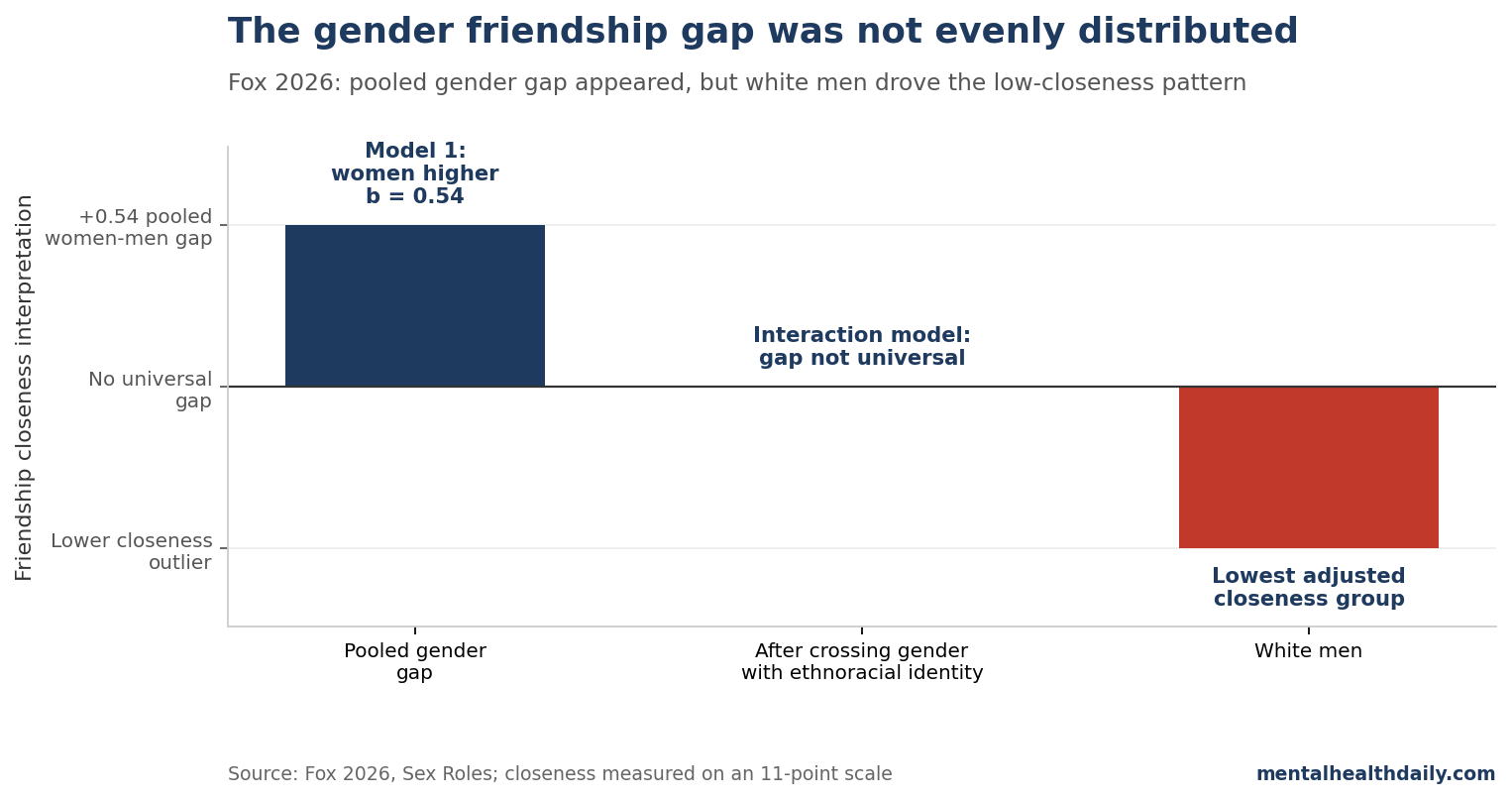
But pooled results are averages across unlike subgroups. They can tell us whether a gender contrast appears after adjustment. They cannot tell us whether the contrast is a universal feature of male friendship or a pattern concentrated in a particular ethnoracial group.
White Men Were the Low-Closeness Outlier
The interaction model changed the interpretation. Fox found that the gender gap in closeness was not universal across ethnoracial groups. Black men, Latino men, and women from all ethnoracial groups reported levels of best-friend closeness that were similar to one another after adjustment. White men reported the lowest closeness.1
White men can and do have close friendships. The key point is that the average gender gap documented in much prior work may disproportionately reflect a white male pattern. The intervention target changes accordingly: broad “men need friendship” programming is weaker than asking what social norms, class expectations, homophobia, emotional restriction, competition, and same-gender friendship rules are doing in that subgroup.
Bowman’s work on same-sex male friendships is useful here because it pushes against a simple “men do not self-disclose” stereotype. In that study, self-disclosure was consistently tied to greater closeness in men’s same-sex friendships.5 The issue is not that closeness mechanisms are alien to men. It is that some male friendship cultures may make those mechanisms harder to use.
Friendship Expectations Are Gendered, But Not Destiny
Older work still matters. Hall’s meta-analysis found sex differences in what people expect from friends, especially around communion. Felmlee and Muraco found that older women placed greater emphasis on intimacy in friendship norms than older men did.2,3 Demir and Orthel found that friendship real-ideal discrepancies related to well-being, meaning the gap between wanted friendship and actual friendship is psychologically relevant.4
Gendered friendship expectations are documented, but they are not a sufficient explanation for every group. If Black men and Latino men do not show the same low-closeness pattern as white men in this dataset, then “male friendship” is too broad a category for the mental-health question.
That is a useful correction because public discussion often turns male loneliness into a single moral story. Sometimes the villain is masculinity; sometimes feminism; sometimes technology; sometimes dating apps; sometimes work culture. The data here point to a narrower claim: some men may face friendship-closeness constraints, but those constraints are socially patterned rather than biologically uniform.
White Respondents Had Different Predictors of Closeness
The predictor pattern is just as important as the group mean. Fox found that socioeconomic class and having a same-gender friend predicted closeness for white respondents, but not as general predictors across all ethnoracial groups.1
That finding is easy to under-read. It suggests that friendship closeness is not built from the same ingredients in every group. For one group, class position and gender matching may shape closeness. For another, longer shared history, communication frequency, cultural expectations, family context, or support under marginalization may matter more.
Clinical implication: when a young man reports few emotionally close friendships, ask what social rules are shaping this person’s friendships. The answer may involve gender norms, race, class, geography, sexuality, disability, family stress, religion, peer culture, or lack of practice in one-to-one emotional disclosure.
How to Interpret Male Friendship and Mental Health
For loneliness prevention: do not treat men as one group. Programs built around “men need to open up” may help some people, but they can miss the cultural specificity of the problem.
For therapy and coaching: friendship closeness is a legitimate mental-health target. A useful intake question moves beyond “do you have friends?” to “who knows when you are not okay?” Quantity and closeness are separate constructs.
For public writing: avoid the lazy line that women have intimacy and men have activity buddies. The evidence is more complicated. Men can and do form close friendships, but certain groups may face stronger social penalties or weaker scripts for maintaining them.
For research: the next step is not another all-men average. It is measuring which friendship mechanisms predict distress, depression, suicidality, and help-seeking inside specific groups, then testing whether interventions need different social entry points.
The Fox study changes the unit of explanation. The next question is why one subgroup of men may be less close to friends, and what kinds of social scaffolding make closeness easier rather than embarrassing.
Questions About Male Friendship and Closeness
Does this prove white men are lonelier than everyone else?
No. The study measured closeness to a best friend, not total loneliness, network size, depression, or suicide risk. It suggests a lower best-friend closeness pattern among young white men in this dataset.1
Does the gender friendship gap disappear?
No. The pooled gender gap appeared. The better interpretation is that the pooled gap was not universal across ethnoracial groups and was strongly shaped by white men’s lower closeness.
Do men want less emotional friendship?
Not as a universal rule. Prior work finds some gender differences in friendship expectations, but men still benefit from self-disclosure and close friendship. The problem is better framed as cultural constraint, not lack of capacity.2,5
Why is friendship closeness clinically relevant?
Friendship closeness is part of informal mental-health protection. People with emotionally thin networks may have fewer chances for early support, reality testing, practical help, and crisis interruption.
References
- Are White Men Missing Out?: Differences in Friendship Closeness by Gender and Ethnoracial Identity. Fox EC. Sex Roles. 2026;92:12. doi:10.1007/s11199-025-01638-7
- Sex Differences in Friendship Expectations: A Meta-Analysis. Hall JA. Journal of Social and Personal Relationships. 2011;28(6):723–747. doi:10.1177/0265407510386192
- Gender and Friendship Norms Among Older Adults. Felmlee D, Muraco A. Research on Aging. 2009;31(3):318–344. doi:10.1177/0164027508330719
- Friendship, Real-Ideal Discrepancies, and Well-Being: Gender Differences in College Students. Demir M, Orthel H. The Journal of Psychology. 2011;145(3):173–193. doi:10.1080/00223980.2010.548413
- Gender Role Orientation and Relational Closeness: Self-Disclosive Behavior in Same-Sex Male Friendships. Bowman JM. The Journal of Men’s Studies. 2009;16(3):316–330. doi:10.3149/jms.1603.316