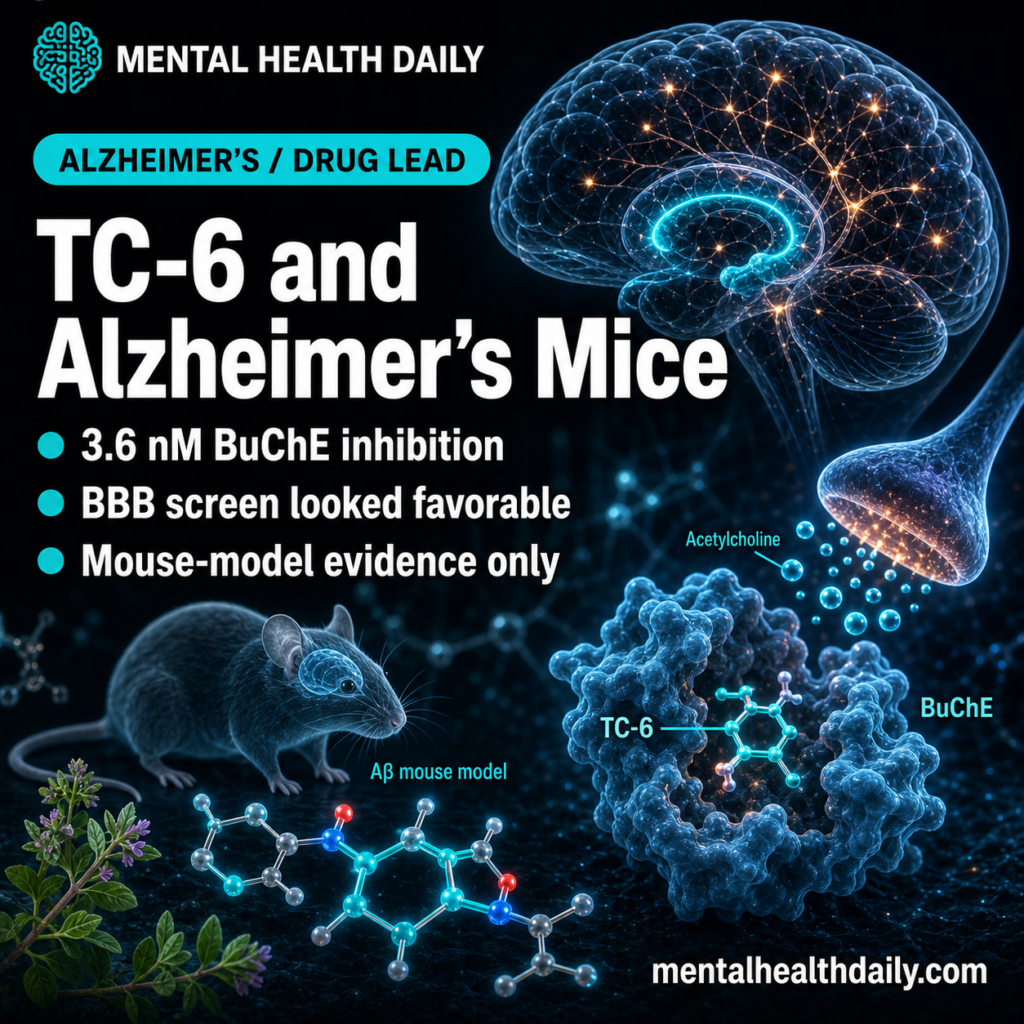
A 2026 medicinal-chemistry study found that thymol carbamate TC-6 inhibited human butyrylcholinesterase at 3.6 nM, showed more than 2,500-fold selectivity over human acetylcholinesterase, crossed a blood-brain-barrier screening assay, and improved spatial-memory behavior in amyloid-β-injected mice.
Research Highlights
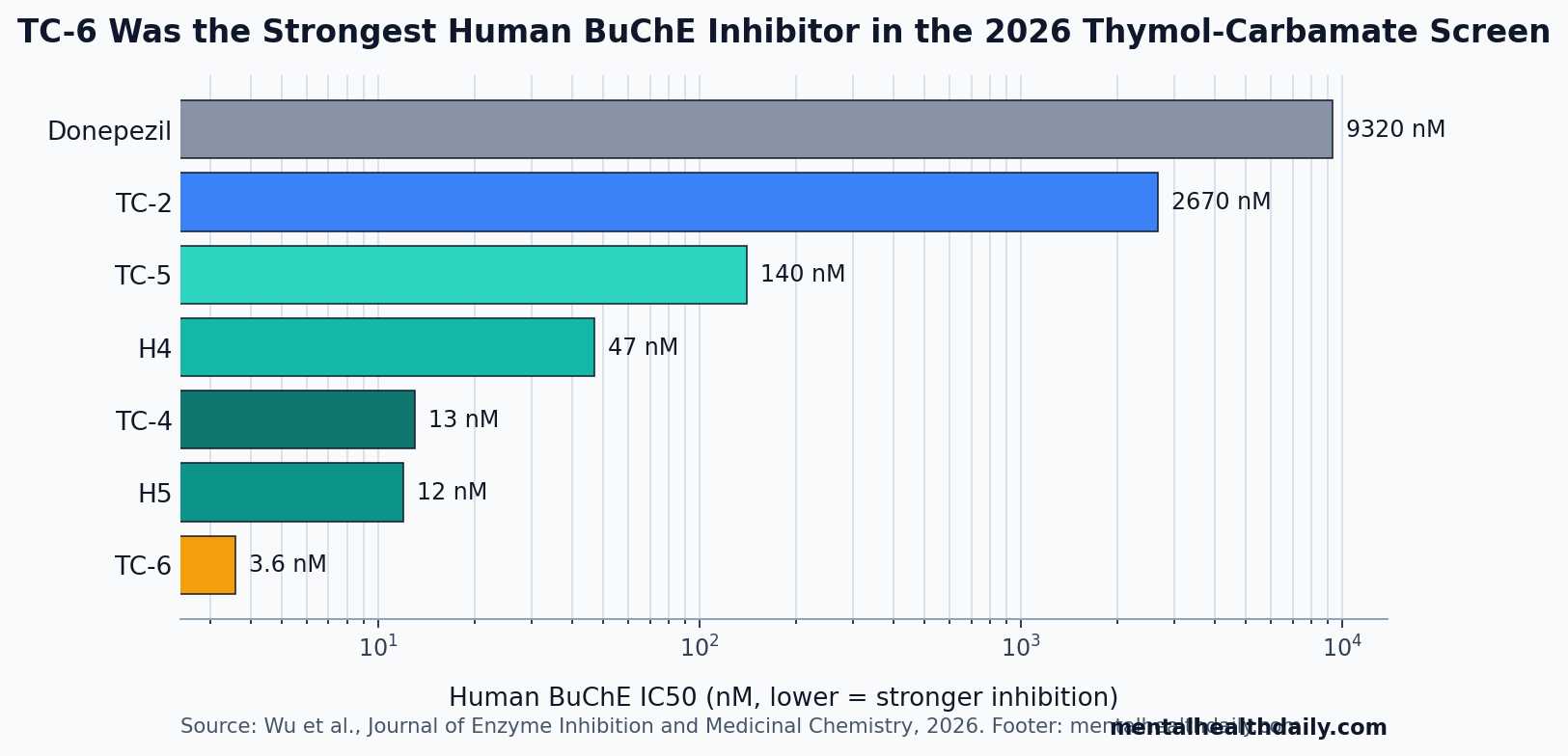
- TC-6 hit BuChE hard: Wu et al. reported human butyrylcholinesterase (BuChE) inhibition at 3.6 nM, compared with 9,320 nM for donepezil in the same human BuChE assay.1
- Selectivity favored BuChE: TC-6 showed no measurable human acetylcholinesterase (AChE) activity in the tested range, producing more than 2,500-fold BuChE-over-AChE selectivity.1
- Kinetics looked drug-like but not irreversible: TC-6 had a carbamylation rate constant of 0.98 min^-1 and a decarbamoylation rate of 0.48 min^-1, consistent with pseudo-irreversible inhibition that can wear off as the enzyme recovers.1
- Brain access remained a screen, not proof: TC-6 reached 1.82 x 10^-5 cm/s in a PAMPA-BBB assay, above the 4.0 x 10^-6 cm/s threshold the researchers used for central-nervous-system permeability.1
- Mouse efficacy stayed preclinical: 10 mg/kg TC-6 improved Morris water maze performance in amyloid-β1-42-injected mice and reduced ventricular amyloid-β peptide levels by 14.2% vs. the model group.1
Butyrylcholinesterase is an enzyme that breaks down acetylcholine, a neurotransmitter involved in attention and memory. Most familiar Alzheimer’s drugs, including donepezil, mainly target acetylcholinesterase; BuChE becomes more interesting because AChE activity tends to fall as Alzheimer’s pathology advances, while BuChE activity can remain stable or rise.2
The result is narrow but real: TC-6 remains a preclinical Alzheimer’s drug lead, and the mouse model was an amyloid injection model rather than a slowly progressive disease model. The study still gives a coherent preclinical package: enzyme potency, target selectivity, pseudo-irreversible kinetics, permeability screening, cell protection, and behavioral rescue all pointed in the same direction.
TC-6 Inhibited Human BuChE at 3.6 nM
TC-6 is a thymol carbamate: a compound built from thymol, a phenolic molecule found in thyme oil, connected through a carbamate group to a piperidine ring. The carbamate group is the pharmacology-relevant piece because carbamate drugs can temporarily modify cholinesterase enzymes, producing longer inhibition than a purely reversible blocker.
Wu et al. synthesized 12 thymol carbamates and compared them with earlier carvacrol-linked analogs. The standout result was enzyme selectivity. TC-6 inhibited human BuChE at 0.0036 μM, or 3.6 nM, while human AChE showed no measurable activity in the assay. H5, a carvacrol comparator with a similar piperidine ring, reached 12 nM against human BuChE. TC-4 reached 13 nM, H4 reached 47 nM, and TC-5 reached 140 nM.
Donepezil had the opposite profile in the same human enzyme table: 15 nM against human AChE and 9,320 nM against human BuChE. That makes TC-6 an enzyme-selective BuChE lead, not another donepezil-like AChE inhibitor.
Why BuChE selectivity is relevant: the cholinergic hypothesis of Alzheimer’s disease argues that part of the cognitive syndrome comes from loss of acetylcholine signaling. Selective BuChE inhibition has older animal support: Greig et al. reported that BuChE inhibition elevated brain acetylcholine, improved learning, and lowered amyloid-β peptide in rodents.2 That does not prove TC-6 will work in humans, but it keeps the target biologically plausible.
The Kinetic Profile Looked Pseudo-Irreversible
Pseudo-irreversible inhibition means the inhibitor forms a temporary covalent modification of the enzyme. It is not permanent enzyme destruction; activity can recover when the modified enzyme slowly decarbamoylates.
TC-6 showed a dissociation constant of 0.25 μM, a carbamylation rate constant of 0.98 min^-1, and a decarbamoylation rate constant of 0.48 min^-1. Rivastigmine, the clinically used carbamate cholinesterase inhibitor, had a weaker binding constant in the same table at 1.74 μM, a carbamylation rate of 0.38 min^-1, and a faster decarbamoylation rate of 5.93 min^-1.
The comparison does not make TC-6 clinically superior to rivastigmine. It says the scaffold behaved like a serious carbamate inhibitor in the enzyme system: quick enough to carbamylate BuChE and slow enough to keep the enzyme inhibited for a measurable interval.
- Binding step: TC-6 first forms a reversible complex with BuChE.
- Carbamylation step: the carbamate group modifies the enzyme, reducing activity.
- Recovery step: the enzyme gradually regains activity as the carbamyl group is removed.
BBB Screening and Cell Protection Supported, But Did Not Prove, Brain Exposure
PAMPA-BBB is an artificial membrane assay used to estimate whether a compound is likely to passively cross the blood-brain barrier. Animal pharmacokinetics, brain tissue concentrations, transporter studies, and human exposure data remain the higher evidentiary layers.
Wu et al. used 4.0 x 10^-6 cm/s as the cutoff for likely central-nervous-system permeability. TC-6 reached 1.82 x 10^-5 cm/s, while TC-4 reached 1.60 x 10^-5 cm/s, TC-5 reached 1.56 x 10^-5 cm/s, H4 reached 1.73 x 10^-5 cm/s, and H5 reached 2.56 x 10^-5 cm/s. All 5 carbamates cleared the screen.
Cell protection: in PC12 cells, a rat adrenal-cell line often used for neurobiology screens, 100 μM hydrogen peroxide reduced viability to 44.7%. TC-6 at 25 μM raised viability to 73.0%, close to the donepezil-treated comparator. The result supports antioxidant or cytoprotective activity in a stress model; it does not show that TC-6 protects human neurons in Alzheimer’s disease.
Low cytotoxicity screen: after 24 hours at 50 μM, GES-1 gastric epithelial cell viability was 94.4% with TC-6, 97.0% with TC-5, 90.3% with H5, and 86.4% with donepezil. That is a favorable early safety screen, not a tolerability profile.
Amyloid-Injected Mice Improved on Memory Behavior
The in vivo test used intracerebroventricular amyloid-β1-42 injection, a model that creates acute Alzheimer’s-like toxicity rather than the gradual pathology of human Alzheimer’s disease. Behavioral testing involved 8 mice per planned group, with 40 mice included before 2 animals died during surgery.
Morris water maze testing measures spatial learning and memory by asking mice to learn the location of a hidden platform in a pool. Wu et al. injected amyloid-β1-42 on day 1, treated animals from days 3 to 14, trained them from days 10 to 14, and ran the probe trial on day 15.
Both donepezil and TC-6 improved performance relative to amyloid-injected model mice. The paper reported that TC-6 produced shorter escape latencies, more platform crossings, and longer time in the target quadrant than donepezil, although the most publication-ready numerical details were presented graphically rather than as a full text table.
Ventricular amyloid-β levels also moved in the expected direction. TC-6 at 10 mg/kg reduced peptide levels by 14.2% compared with the model group, while donepezil at 15 mg/kg reduced peptide levels by 16.8%. Hippocampal histology favored TC-6 as well, especially in the CA1 region, where neuronal density increased relative to amyloid-injected model mice.
TC-6 Fits a BuChE Drug-Lead Pattern, Not a Treatment Claim
Several adjacent medicinal-chemistry papers make the TC-6 result easier to calibrate. Jiang et al. reported cannabidiol-carbamate hybrids as selective BuChE inhibitors, Li et al. described another potent selective BuChE inhibitor with biological evaluation, and Du et al. pushed benzamide-derived BuChE inhibition into the sub-nanomolar range.345 TC-6 is not the strongest BuChE inhibitor ever reported.
Its value is the package. TC-6 combined low-nanomolar human BuChE inhibition, strong AChE sparing, pseudo-irreversible kinetics, a favorable permeability screen, cell protection, and mouse behavioral effects in one natural-product-linked carbamate scaffold.
Evidence-strength note: this is preclinical evidence from enzyme assays, cell models, artificial permeability testing, and an amyloid-injection mouse model. It can support continued drug-development work. It cannot support human dosing, human efficacy, disease-modification claims, or clinical substitution for approved Alzheimer’s drugs.
The translational bottleneck extends beyond potency. A next lead has to show oral exposure, brain concentrations, cholinergic side-effect margins, chronic dosing tolerance, and benefit in progressive models.
That sequence matters because many Alzheimer’s drug leads look strong in enzyme or injection models and then fail when chronic exposure, metabolism, and behavior are tested together.
Questions About TC-6 and BuChE Inhibition
Is TC-6 related to thyme or thymol supplements?
Only chemically. TC-6 is a synthesized thymol carbamate, not thyme oil, dietary thymol, or an over-the-counter supplement. The carbamate modification and piperidine ring are central to the enzyme activity reported in the 2026 study.
Does stronger BuChE inhibition mean better Alzheimer’s treatment?
No. Stronger enzyme inhibition is only one early drug-discovery signal. A useful Alzheimer’s drug also needs appropriate brain exposure, dose-response data, chronic safety, toxicity testing, metabolism data, and clinical evidence that cognition or function improves in people.
Why target BuChE instead of AChE?
AChE is the classic cholinesterase target, but BuChE may carry more acetylcholine-breakdown burden as Alzheimer’s pathology progresses. That makes selective BuChE inhibition a plausible late-stage or adjunctive strategy, though the clinical case remains unsettled.
What would make TC-6 more convincing?
The next evidence layer would include pharmacokinetic data showing actual brain levels after dosing, repeated-dose toxicity studies, comparison against stronger BuChE leads, testing in progressive transgenic Alzheimer’s models, and eventually human safety data. The current study is enough to justify those steps, not enough to skip them.
References
- Wu C, Ding Y, Liu X, Gao S, Wang X, Tang W. Thymol carbamates bearing cyclic amines as potent and selective BuChE inhibitors alleviate memory impairments for Alzheimer’s disease therapy. Journal of Enzyme Inhibition and Medicinal Chemistry. 2026. https://doi.org/10.1080/14756366.2026.2623314
- Greig NH, Utsuki T, Ingram DK, et al. Selective butyrylcholinesterase inhibition elevates brain acetylcholine, augments learning, and lowers Alzheimer beta-amyloid peptide in rodents. Proceedings of the National Academy of Sciences. 2005;102(47):17213-17218. https://doi.org/10.1073/pnas.0508575102
- Jiang X, Zhang Z, Zuo J, et al. Novel cannabidiol-carbamate hybrids as selective BuChE inhibitors: docking-based fragment reassembly for the development of potential therapeutic agents against Alzheimer’s disease. European Journal of Medicinal Chemistry. 2021;223:113735. https://doi.org/10.1016/j.ejmech.2021.113735
- Li Q, Xing S, Chen Y, et al. Discovery and biological evaluation of a novel highly potent selective butyrylcholinesterase inhibitor. Journal of Medicinal Chemistry. 2020;63(17):10030-10044. https://doi.org/10.1021/acs.jmedchem.0c01026
- Du C, Wang L, Guan Q, et al. N-benzyl benzamide derivatives as selective sub-nanomolar butyrylcholinesterase inhibitors for possible treatment of advanced Alzheimer’s disease. Journal of Medicinal Chemistry. 2022;65(16):11365-11387. https://doi.org/10.1021/acs.jmedchem.2c00654
- Marucci G, Buccioni M, Ben DD, Lambertucci C, Volpini R, Amenta F. Efficacy of acetylcholinesterase inhibitors in Alzheimer’s disease. Neuropharmacology. 2021;190:108352. https://doi.org/10.1016/j.neuropharm.2020.108352